Aimed at senior undergraduate and post-graduate students following courses in International Business and Industrial Relations this book examines the labour market effects of multinational business. In reflecting the complexity and dynamism of developments in this area, the book makes clear the need to underpin analysis of the labour market effects of multinational business with conceptual understanding of the theory of multinational enterprise.

- 4 pages
- English
- ePUB (mobile friendly)
- Available on iOS & Android
eBook - ePub
Multinational Business and Labour (RLE International Business)
1 |
Introduction |
The author of a recent book on US labour and international trade and investment (Mitchell, 1976, p. 100) concludes
The treatment of multinational firms in this chapter will leave many readers unsatisfied. Because of the need to confine the analysis to the labor impact, many of the most interesting aspects of MNCs have been neglected. These aspects revolve around issues of national sovereignty, political influence, the impact on foreign policy, and the general area of the ‘goodness’ or ‘badness’ of bigness in business enterprises.
The theme of this book is that the labour aspects of multinational operations are just as important and interesting as the other aspects identified. Perhaps what distinguishes labour aspects from the other issues generated by multinational enterprises1 (MNEs) is their comparative neglect in the literature. Where they are explicitly considered, analysis is often shallow and dogmatic. This book attempts to redress the situation.
There are several considerations which prompt analysis of the relationships between labour and multinational business. Firstly, there is considerable debate over the emergence of a ‘new international division of labour’ (NIDL) (Frobel et al., 1980) within which multinational enterprises play a central role (Michalet, 1976). What distinguishes the NIDL from its predecessor, the classical international division of labour, is the part played by the developing nations. Their traditional role of providing agricultural and mineral resources and, on occasion, slave labour, has given way to the possibility of manufacturing facilities, serving the world market, being located in such countries (Castles, 1979). Such a trend has obvious implications for the growth prospects of developing nations and the adjustment process in the advanced nations.
Secondly, the impact of the changing global division of labour is compounded by its concentration by both nation (Saunders, 1981) and industry (Plant, 1981). The fact that only a handful of nations have successfully assumed an export orientation focusing on a narrow range of commodities raises issues of the differential impact of readjustment in the Western nations and the long-term prospects for development by this route in underdeveloped nations (Caporaso, 1981).
Thirdly, the impact of multinational enterprises in this process has attracted criticism. There is some evidence that the longer-term effect of direct foreign investment (DFI)2 may be to impede development (Bornschier, 1978; Mahler, 1981). Similar criticism surrounds the alleged transfer of inappropriate technologies to developing countries (Watanabe, 1980) contributing to factor underutilisation and income inequalities.
Fourthly, in the advanced nations the spectre of the export of jobs and of ‘runaway’ plants has generated concern about the relative stability of employment created in multinational subsidiaries. This concern is voiced in both source nations (AFL-CIO, 1971) and advanced host countries, particularly within Western Europe (Enderwick, 1982; Hood and Young, 1982). A number of forms of foreign involvement in Third World countries, particularly subcontracting, have also been identified as potentially highly unstable (Berthomieu and Hanaut, 1980).
Fifthly, a multinational organisational structure is widely equated with a relative bargaining disadvantage for labour in its collective bargaining function (Kujawa, 1979; Szakats, 1980). The sources of labour’s disadvantage include the enterprises’ ability to service strikebound plants from overseas, the fact that total revenue is not halted in the face of a dispute, the threat of production switching, inaccessibility to decision-makers and the unreliability and paucity of information disclosed by multinational firms. Many of these assertations have been absorbed into the literature without serious scrutiny of their validity.
Sixthly, one of the apparent benefits of multinational production is the introduction and dissemination in the host nation of innovative and possibly superior production and management methods (Constas and Vichas, 1981; Enderwick, 1983; Globerman, 1979). Considerable public policy interest has focused on this aspect of foreign firms’ operations in an attempt to develop beneficial lessons for indigenous firms (Takamiya, 1981).
Finally, the emergence of multinational production has generally been perceived as a threat by organised labour (Edwards, 1977; Gennard, 1972). This concern has prompted a variety of labour-initiated responses (Enderwick, 1979). There is a widely held view that the only effective labour response lies in the development of multinational collective bargaining (Gennard, 1972; Heise, 1973). Despite assertions of the occurrence of such bargaining, the evidence does little to support such claims (Northrup and Rowan, 1979). The prospects for the widespread development of multinational bargaining also seem unfavourable (see Chapter 6). Analysis of the driving forces behind the spread of international production may throw some light on the reasons for the lack of success of this response and the viability and effectiveness of alternative strategies.
These considerations generate a number of questions which this study seeks to address. In attempting to evaluate competing claims and positions our analysis is guided by one central conviction. That conviction is the view that understanding of the implications of multinational business can only follow from an explicit evaluation of the determinants of this form of production (Enderwick, 1982). More specifically, analysis should be firmly grounded in the theory of the multinational enterprise. Whilst a variety of such theories are available (Hymer, 1976; Vernon, 1966 and 1979) recent years have seen an attempted synthesis of several important elements of theory (Dunning, 1981). The emergent ‘eclectic’ model provides a basis for the evaluation of contending claims and conflicting evidence.
Chapter 2 provides an outline of the magnitude and pattern of multinational production. The industrial distribution of such investment is examined in the light of contending theories of the multinational. The source and host labour market effects of international production are the subject of Chapter 3. The labour utilisation practices and industrial relations impact of multinationals are examined in Chapters 4 and 5, respectively. Labour-initiated responses to the multinational are scrutinised in Chapter 6. Chapter 7 provides policy implications and conclusions.
Notes
1. This study adopts a simple ‘threshold’ definition of the multinational enterprise. Such an enterprise is one which owns or controls income-earning assets in more than one nation. A variety of alternative definitions, of varying degrees of complexity, have been proposed (Aharoni, 1971).
2. Direct foreign investment is distinguished from other forms of international investment by the fact that the investing company, (typically an MNE), retains control over the investment.
2 | The Growth and Pattern of Multinational Business |
Introduction
Widespread internationalisation of production is primarily a post-World War II phenomenon. Whilst the origins of the MNE may be traced back to the monopoly charter trading companies of seventeenth-century Europe, the significance of modern MNE growth presents unique problems. By comparison with its historical forerunners the modern MNE is a much larger entity whose source of power is likely to be technological advantage; an advantage which bestows far greater mobility than that possessed by firms whose monopoly was based on exclusive control of agricultural or mineral resources.
This chapter profiles the phenomenon of multinational production. The following section outlines the magnitude and growth of the MNE. The major source and host nations of DFI are then discussed. The highly uneven distribution of DFI by industry is the subject of the following section. Recent trends highlighting alternative and newer forms of market servicing are then examined. Finally, theoretical explanations of these patterns are appraised. Particular emphasis is placed on the eclectic model.
The Magnitude and Growth of Multinational Production
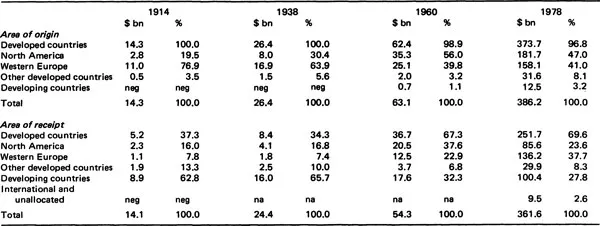
DFI is a significant economic phenomenon both in absolute terms and relative to economic magnitudes such as visible trade, gross national product or domestic output. Estimtes of the cumulative stock of DFI for selected dates between 1914 and 1978 by aggregate area of origin and receipt are contained in Table 2.1. Whilst considerable caution must be attached to prewar estimates, the later estimates are acceptably robust.
Table 2.1: Estimated Stock of Accumulated Direct Foreign Investment by Area of Origin and Receipt, 1914–78
Note: neg = negligible values; na = not available.
Source: Dunning (1983).
Table 2.1 indicates that the accumulated book value of DFI in 1978 was some $380 bn. The rise in the value of DFI over the period 1914–78 is apparent. Particularly significant is the rapid expansion between 1960 and 1978. The table highlights the fact that the MNE is predominantly a developed country phenomenon in terms of both source and destination. The share of industrialised countries as a source of DFI has only declined from 100.0 per cent in 1914 to 96.8 per cent in 1978. Similarly, in 1978 nearly 70 per cent of DFI was located in developed countries. This percentage share has risen particularly since the interwar period. Thus while DFI to the less developed countries (LDCs) has increased in absolute terms ($8.9 bn in 1914 to $27.8 bn in 1978) it has fallen in relative terms (62.8 to 27.8 per cent). The relative decline, since 1960, in the importance of US investment is also apparent.
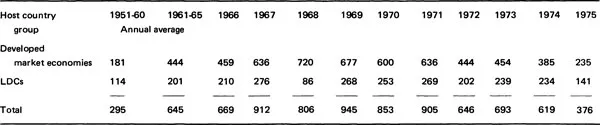
The rapid growth rate of DFI achieved during the 1960s was not sustained in the 1970s. This is highlighted in Table 2.2 which shows the number of affiliates established by the largest US MNEs for selected periods and years. Since US DFI still comprises nearly 50 per cent of the global total (Table 2.1), trends observed for US MNEs are likely to be a reasonable indicator for that of all firms.
Table 2.2: New Foreign Affiliates Established or Acquired by the 180 Largest US MNEs, 1951–75 (number of affiliates)
Source: UN (1978), Table III-19, p. 233.
The acceleration in US investment which occurred through the 1950s and 1960s peaked at the end of the latter decade. The increasing difficulties of the world economy during the 1970s is reflected in a fall in the rate of affiliate establishment. This is particularly marked for the 1974/5 recession.
A distinctive feature of DFI is the importance of large MNEs in the internationalisation process. Several MNEs have value added which exceeds the gross national product of certain industrialised market economies (Buckley and Casson, 1976, p. 12). On average, larger firms tend to be more multinational in orientation. Supportive evidence for this contention is provided in Tables 2.3 and Ta...
Table of contents
- Cover
- Half Title
- Title Page
- Copyright
- Contents
- List of Tables
- Preface and Acknowledgements
- 1. Introduction
- 2. The Growth and Pattern of Multinational Business
- 3. The Labour Market Effects of MNEs
- 4. The Labour Utilisation Practices of MNEs
- 5. The Labour Relations Practices of MNEs
- 6. Labour Responses to the MNE
- 7. Policy Implications and Conclusions
- Appendix 1
- Appendix 2
- Bibliography
- Index
Trusted by 375,005 students
Access to over 1.5 million titles for a fair monthly price.
Study more efficiently using our study tools.
Frequently asked questions
Yes, you can cancel anytime from the Subscription tab in your account settings on the Perlego website. Your subscription will stay active until the end of your current billing period. Learn how to cancel your subscription
No, books cannot be downloaded as external files, such as PDFs, for use outside of Perlego. However, you can download books within the Perlego app for offline reading on mobile or tablet. Learn how to download books offline
Perlego offers two plans: Essential and Complete
- Essential is ideal for learners and professionals who enjoy exploring a wide range of subjects. Access the Essential Library with 800,000+ trusted titles and best-sellers across business, personal growth, and the humanities. Includes unlimited reading time and Standard Read Aloud voice.
- Complete: Perfect for advanced learners and researchers needing full, unrestricted access. Unlock 1.5M+ books across hundreds of subjects, including academic and specialized titles. The Complete Plan also includes advanced features like Premium Read Aloud and Research Assistant.
We are an online textbook subscription service, where you can get access to an entire online library for less than the price of a single book per month. With over 1.5 million books across 990+ topics, we’ve got you covered! Learn about our mission
Look out for the read-aloud symbol on your next book to see if you can listen to it. The read-aloud tool reads text aloud for you, highlighting the text as it is being read. You can pause it, speed it up and slow it down. Learn more about Read Aloud
Yes! You can use the Perlego app on both iOS and Android devices to read anytime, anywhere — even offline. Perfect for commutes or when you’re on the go.
Please note we cannot support devices running on iOS 13 and Android 7 or earlier. Learn more about using the app
Please note we cannot support devices running on iOS 13 and Android 7 or earlier. Learn more about using the app
Yes, you can access Multinational Business and Labour (RLE International Business) by Peter Enderwick in PDF and/or ePUB format, as well as other popular books in Business & Business General. We have over 1.5 million books available in our catalogue for you to explore.