- 252 pages
- English
- ePUB (mobile friendly)
- Available on iOS & Android
eBook - ePub
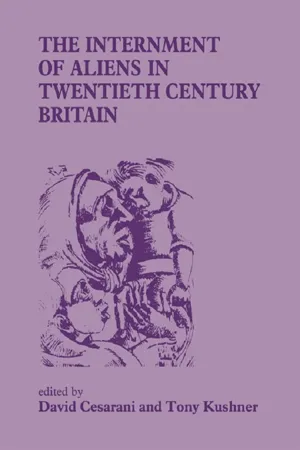
The Internment of Aliens in Twentieth Century Britain
About this book
These essays reveal the role of British intelligence in the roundups of European refugees and expose the subversion of democratic safeguards. They examine the oppression of internment in general and its specific effect on women, as well as the artistic and cultural achievements of internees.
Information
II. THE BRITISH STATE AND INTERNMENT
Clubland, Cricket Tests and Alien Internment, 1939–40
TONY KUSHNER
Alien internment in the Second World War has received only passing attention from general historians and is usually viewed as no more than a panic measure due to the military crisis in spring! summer 1940. This article argues that ideological factors have not received sufficient attention, specifically the debate about ‘Englishness’ which was a constant issue in twentieth century Britain. In the crisis period, when most of the internments were carried out, forces whose ideology was shaped by the world-view of clubland dictated government policy over ‘enemy aliens’.‘How much antisemitism was there [in Britain during
the 1930s and 1940]? The refugees seldom complained
of it. Of course, they had seen the real thing and
knew how to differentiate between that and
golf-club snobbery.’1‘There are worse forms of discrimination than not
being allowed to play ball with the pompous nobs of
Edinburgh [Honourable Company of Golfers]’.2‘If one looks at the treatment by the United States of
its citizens of Japanese descent, with no substantial
threat of invasion, the British decision about
internment becomes easier to understand. The
immigrants were interned not because they were Jews
(that is, not as a result of antisemitism) but because
they were Germans. And the reaction of the refugees
themselves proved considerably more understanding
than that of the historians who were not even born at
that time, or who were infants then.’3‘[C]ompared with the vile conduct of the Vichy
Government, which delivered every refugee to the
Germans, our own Government’s actions constitute a
monument of generosity’.4
‘Many continentals think life is a game; the English
think cricket is a game … It is important that you
should learn to enjoy simple joys, because that is
extremely English. All serious Englishman play darts
and cricket and many other games’.5‘The Committee may terminate the membership of a
member without giving any reason’.6
In 1954 the English Golf Union defended the rights of clubs ‘to exclude Jewish members’. The Council of Christians and Jews countered that such discrimination was ‘inconsistent with the spirit and the best interests of British sportsmanship’. The Union replied that this attack missed the point. Selection of members was important, they argued, because ‘the game of golf in many cases is merely incidental to the Club life’. In 1990, the senior Conservative party statesman and ex-Chairman Norman Tebbit posed ‘an interesting test’ — how many Asians in Britain cheered the ‘wrong side’ in cricket matches against England. Tebbit added that ‘When people move to a new country, they should be prepared to immerse themselves utterly and totally in that new country’.7
Golf clubs and cricket tests seem on the surface a long way removed from the explicit military crisis facing Britain in the spring and summer of 1940 which as a result led to the internment and deportation of 27,000 ‘enemy aliens’. To explain the direction and scope of internment in this period, however, it is necessary, I will argue, to examine the ideology behind those responsible for policies which led to the removal of freedom for thousands of refugees from Nazism and members of Britain’s Italian community. Although the military and political situation provided the specific context of the scale of internment in May–July 1940, most specifically in the balance of power within government circles, more fundamental was an ongoing and ever-developing battle over ‘Englishness’. The crisis of spring 1940 brought into sharp focus in a most dramatic manner the question of who did, and did not, ‘belong’ in British society. The key to understanding this issue can be found in the world of British clubland.
I. The Phoney War
To the journal Truth and its readership based across the elite institutions of the country (in 1941 it was reported that it was ‘still to be found in every club of standing and in most of the messes of well-known regiments’), it was clear who was not a proper member of British or more importantly, English society. In a poem published in October 1939 the ‘Refu-Spy’ is unveiled:
To Germany I bid farewell
The country has become a hell
For anyone who won’t conform
To the dull, regimented norm
I’d rather be a refugee
Than live where I’m not even free
To perpetrate from time to time
What prejudice describes as crime.
how can a fellow work in peace,
When he is wanted by the police
In several towns for fraud alone?
My finger-prints are too well known.
The only sensible solution
For victims of such persecution
Is a forged passport to acquire,
Accomplices on board to hire,
And as a stowaway set sail
Concocting some heart-rending tale
Wherewith asylum to implore
On England’s hospitable shore.
OPromised Land of milk and honey,
Where people love subscribing money
To help the foreigner who robs
Their fellow-citizens of jobs!
Some heartless magistrate in court
May make an order to deport;
But I don’t care. I know of course,
It never will be put in force,
And that I safely can betray
My hosts by off ring to purvey
Secret and vital information
To agents of the very nation
Which, if my tale were accurate,
I ought most bitterly to hate.
A little quiet espionage
Helps to eke out my modest wage,
And no one will suspect that I
Am acting as a German spy.
How can the Englishmen whom sees
This teeming crowd of refugees
Distinguished in it sheep from goats,
Or the chaff winnow from the oats?
So I intend no more to roam;
Here I can make myself at home.
Particularly when I find
So many others of my mind
That — ere they know what we’re about—
The English will be crowded out,
Regarded as intruders, while
We occupy their native isle8
For Truth there was no legitimate place in Britain for the refugee. Shortly afterwards the weekly journal published an attack on leading British Jews which made it clear that in its mind a Jew could not be a good patriotic Englishman.9 There was much worse anti-Semitism in Britain than Truth in the form of the semi-pornographic British Fascist or pro-Nazi press at this stage of the phoney war. Truth, however, was run by Sir Joseph Ball who was also in charge of the Conservative Research Department on behalf of Neville Chamberlain. It was, according to an intelligence report of August 1940, ‘run since the beginning of the war … as a secret corridor where the ghost of appeasement could walk and try itself out, while it clanked its muffled chains’. Moreover, it was described by the Conservative party chairman in the middle of the war as ‘being nearest to a dependable organ’ in the British press.10 In autumn 1939, however, Ball, despite his close links with Chamberlain, had limited influence on government policy towards aliens. Truth managed to play a major role in the destruction of the political career of Leslie Hore-Belisha, the Minister for War, in January 1940. Hore-Belisha was reported to have explained his dismissal in two words: ‘Jew boy’. A vicious attack on him by Truth in the weeks following ensured that Hore-Belisha would remain an outsider for the rest of the war. Yet its constant attack on the refugees in the first six months of the war had less of an impact.11
It is true that some very peculiar individual decisions were taken with regard to ‘enemy aliens’ at the start of the conflict. Eugen Spier, a friend of Churchill and bitter opponent of appeasement found himself interned with several hundred aliens at Olympia in October 1939. Looking around and seeing that half the internees were fellow German Jews or known anti-Nazis, Spier wondered if the internment lists had not been drawn up by the Gestapo. In fact Spier was at Olympia courtesy of the British security world, but why he and other anti-Nazis had been admitted to this exclusive club remains a mystery.
In a snippet of information released accidentally as part of the Mosley papers in the 1980s, a hint of the membership rules qualifying aliens for a stay at Olympia is given. Ewald Stern, a Jewish refugee, was apparently interned on the advice of MI5 because they were worried that the Gestapo had expelled him from Germany. Spier, therefore, if only indirectly, may have been right — to MI5 its enemy’s enemy was not necessarily a friend, and certainly not one to be allowed the privilege of freedom in Britain. Elsewhere in this volume Lucio Sponza indicates how Italian anti-Fascists in Britain during the summer of 1940 believed that they were pursued by MI5 according to whether they were on lists of subversives provided by the Italian secret service.12
Fortunately for the refugees, during the phoney war period club rules in Britain were not being drawn up by Ball or his friends in the security forces. Policy towards enemy aliens at the start of the war was dominated by the Home Office and the Home Secretary, John Anderson. Anderson, later rather unfairly maligned by contemporaries for his role in the internment episode, stated in September 1939 that as the enemy aliens were guests in Britain and as a large proportion were refugees, there would be, he was sure ‘a general desire to avoid treating as enemies those who are friendly to the country which has offered them asylum.’ Anderson was appalled by the later mass internment of aliens and fondly reflected on the ‘liberal policy [which he had outlined at the outbreak of war] … which gave me personally the greatest satisfaction’.13
Tribunals were set up to categorize the aliens. They were generally informal affairs which gave the enemy aliens a chance to put their own case and even bring a British friend to emphasize their suitability for freedom and their loyalty to the British cause. Here was a classic manifestation of a liberal aliens policy. It was local, individual and gentlemanly. The refugee children of Harris House in Southport recorded their experiences in their collective diary as such:
When the country went to war with Germany, we were considered automatically as enemy aliens. The fairness of the English [is shown as it] set up Tribunals in every town, to give the Refugees the opportunity to prove themselves as loyal friends of Great Britain. We were very glad to get this chance not only because it would exempt us from certain restrictions, but also we hated to be considered as enemy aliens. Everything before the tribunal went very well. The chairman showed great understanding and sympathy and Mr Middleton and Mr Harrison [from the hostel] did their best to help us … So we all got exemption all[]right.14
Such policy was self-consciously liberal and the government had a great eagerness to show the world that this was indeed the case. In particular, there was a desire to prove to the United States how humanitarian British treatment of the refugees was. The key was to show the differences between Nazi treatment of ‘aliens’ and those of a liberal democracy. The early detentions at Olympia were an embarrassment to the liberal image, but it was stressed that ‘internment en masse has not been our policy and we can state principles which will fully correspond with American ideas.’ Furthermore the tri...
Table of contents
- Cover
- Half Title
- Full Title
- Copyright
- Dedication
- Contents
- Editors' Note
- Alien Internment in Britain During the Twentieth Century: An Introduction
- I: PRECEDENTS
- II: THE BRITISH STATE AND INTERNMENT
- III: THE EXPERIENCE OF INTERNMENT
- APPENDIX: Internment Testimonies:
- Notes on Contributors
- Index
Trusted by 375,005 students
Access to over 1.5 million titles for a fair monthly price.
Study more efficiently using our study tools.
Frequently asked questions
Yes, you can cancel anytime from the Subscription tab in your account settings on the Perlego website. Your subscription will stay active until the end of your current billing period. Learn how to cancel your subscription
No, books cannot be downloaded as external files, such as PDFs, for use outside of Perlego. However, you can download books within the Perlego app for offline reading on mobile or tablet. Learn how to download books offline
We are an online textbook subscription service, where you can get access to an entire online library for less than the price of a single book per month. With over 1.5 million books across 990+ topics, we’ve got you covered! Learn about our mission
Look out for the read-aloud symbol on your next book to see if you can listen to it. The read-aloud tool reads text aloud for you, highlighting the text as it is being read. You can pause it, speed it up and slow it down. Learn more about Read Aloud
Yes! You can use the Perlego app on both iOS and Android devices to read anytime, anywhere — even offline. Perfect for commutes or when you’re on the go.
Please note we cannot support devices running on iOS 13 and Android 7 or earlier. Learn more about using the app
Please note we cannot support devices running on iOS 13 and Android 7 or earlier. Learn more about using the app
Yes, you can access The Internment of Aliens in Twentieth Century Britain by David Cesarani,Tony Kushner in PDF and/or ePUB format, as well as other popular books in Historia & Historia del mundo. We have over 1.5 million books available in our catalogue for you to explore.