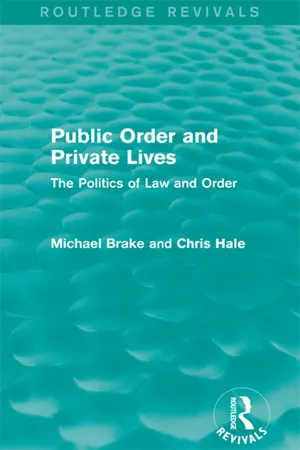
First published in 1992, Public Order and Private Lives is a radical examination of the political forces which shaped the law and order debate in Britain at that time. The authors offer a significant and provoking analysis of Conservative policies on crime, showing that, ironically, they created the very social conditions in which crime flourished. The book argues that the Conservative government undermined basic civil liberties by its increased use of legislation as a means of control and coercion, and as a result of this, crime increased under their governance.
eBook - ePub
Public Order and Private Lives (Routledge Revivals)
The Politics of Law and Order
- 190 pages
- English
- ePUB (mobile friendly)
- Available on iOS & Android
eBook - ePub
Public Order and Private Lives (Routledge Revivals)
The Politics of Law and Order
About this book
Information
1 Introduction
The most disturbing threat to our freedom and security is the growing disrespect for the rule of law. In government as in opposition, Labour have undermined it.… The number of crimes in England and Wales is nearly half as much again as it was in 1973. The next Conservative government will spend more on fighting crime even while we economise elsewhere.… Britain needs strong, efficient police forces with high morale.
(Conservative Party Election Manifesto 1979)
The origins of crime lie deep in society: in families where parents do not support or control their children; in schools where discipline is poor; and in the wider world where violence is glamorised and traditional values are under attack.
Government alone cannot tackle such deep-rooted problems easily or quickly.
(Conservative Party Election Manifesto 1987)
In one sense, law and order can be seen as the Conservative confidence trick of the 1980s, yet, in another, it was an integral part of their success. The emphasis on strong policing and the need to deter by the use of incarceration were key planks in their 1979 election propaganda. They certainly did not fail to meet the pledges made during that campaign to increase expenditure on the institutions of the criminal justice system. While other spending departments came under the razor-edged scrutiny of the Treasury and the ideologues of the market, the Home Office managed to expand the resources at its proposal. The cost of policing England and Wales increased by 60 per cent in real terms between 1974–75 and 1989–90 from £2.58 billion to £4.12 billion (Graef 1990). A major prison building programme was planned and its implementation begun. However, the implicit promise to reduce crime has palpably failed, if the official figures used by the Tories themselves are to be believed. Between 1979 and 1988 there was a 45 per cent increase in the numbers of notifiable offences reported to the police (Criminal Statistics 1988). This figure includes a reduction in recorded offences of 5 per cent in 1988, a turndown greeted with much self-congratulation by Home Office ministers. Figures for 1989 (Guardian 30.3.1990), which showed an annual increase of 4.2 per cent, and the highest ever rise in recorded crime of 17 per cent in the second quarter of 1990 compared with the same period of 1989 (Independent 27.9.90), suggest that this fall was simply a transitory blip in the otherwise steady increase in recorded crime. The average annual change in serious crimes known to the police was 4.3 per cent between 1979 and 1988 compared to 4.2 per cent between 1974 and 1979. Furthermore, the national clear-up rate was 41 per cent in 1979 but had fallen to 35 per cent by 1988 and 34 per cent in 1989, a drop of 17 per cent. Clearly the idea that the Conservative Party has the answers to rising crime rates has become difficult to sustain. However, equally there can be no doubt, that it has successfully portrayed itself as the only political party which takes the issues of law and order seriously.
In this book we will explore the notion that the Conservative Government, first elected in 1979 developed, as part of its determined campaign to replace socialism with a market economy, a distinct project: to reduce State involvement in the field of welfare provision and to break the power of the trade unions. To succeed with either aim it felt it had to develop a strong State in the arena of law and order, a task in which it could rely upon traditional conservatism for support. This first emerged in Margaret Thatcher's 1979 notorious ‘barrier of steel’ speech, in which she set her agenda by referring disparagingly to the support given by Labour cabinet ministers to the pickets at the free enterprise inspired, non-unionised Grunwick plant, commenting that:
Labour ministers do not seem to understand their own responsibilities in the unending task of upholding the law in a free society.… Do they not understand that when ministers go on the picket line and when Labour backbenchers attack the police for trying to do their difficult job, that gives the green light for lawless methods right throughout the industry?
(Televised campaign meeting 19 May 1979. Quoted in Taylor 1987)
Clarke and Taylor (1980) neatly make the point that this occurred the night before the appearance of Police Federation-financed advertisements in the national press challenging the prospective parties for the 1979 election to tackle what they saw as the problem of law and order. The Conservatives’ commitment to the strong State and the rule of law meant they became engaged in the most openly partisan defence of law and order in post-war politics. The Conservative Government was setting its agenda around the issues of law and order, welfare, shiftlessness and immorality. It intended to move societal responsibility back to the individual and morality back to the family.
In order to understand this Conservative agenda, and in particular the area of law and order, which is the focus of this book, it is necessary to consider the post-war history of the economy in Britain, since the crisis of hegemony in the 1970s occurred precisely because of the failure of earlier attempts to achieve the restructuring required by capital within a Keynesian welfare-oriented framework. The identification of the Labour Party and the trade unions with the failure of this corporatist approach was used by the radical right, which had gained influence within the Tory Party in the 1970s, to launch an attack on the consensus approach to economic and social problems which had developed since 1945.
THE BRITISH ECONOMY SINCE 1945
Here we can only sketch the post-war economic developments in Britain. The brief discussion which follows has benefited from the work to be found in the journal of the Conference of Socialist Economists, Capital and Class and in particular from reading Atkins (1986), Gamble (1983), Grahl (1983), Hymans (1987) and McDonnell (1978). Another useful, if more sympathetic, source of information on the economic performance under Mrs Thatcher may be found in Maynard (1988).
The major economic crises of the 1920s and 1930s resulted in greatly increased intervention by the State in the economy and the adoption of Keynesianism in an attempt to reconcile the interests of capital and labour. Through taxation and Government borrowing the State actively intervened in the economy to encourage economic growth by keeping consumption high. The Labour Government of 1945–51 was committed to full employment and improved living conditions for the working class. There was an increase in State involvement in social policy, an expansion of welfare benefits and the establishment of the National Health Service. The Tory Governments of the 1950s accepted this ‘welfarism’ and it became part of the consensus of British political life. The parties might argue over the details of policy but the commitment to the Welfare State itself was not in question. The trade unions had co-operated closely with the Labour Government and the Tories avoided any confrontation with them. Indeed McDonnell argues that:
Working class demands were allowed to become the motor of capitalist development. Wage rises were permitted with productivity increases and rises beyond them were covered with mild inflation.
(McDonnell 1978)
During this period, under the Tories, economic policy followed cycles of contractions followed by expansion. Because of the strength of the working class the Government attempted to control wages by a succession of incomes policies, each of which met with only limited success. Economic policy at this time consisted, according to McDonnell:
of reactions to the consequences of the underlying problems of the economy (balance of payments deficits, currency crises) without any real attempt to tackle these problems (low investment, low productivity).
(McDonnell 1978)
The end of the 1950s saw a faltering in the post-war expansion of the British economy. This was due in part to the independence, and subsequent actions to defend their interests, of many Third World countries and also to the rapid expansion of the Japanese and German economies. However, the main reason was the strength of the trade unions, and in particular that of the shop stewards’ movement, which was able to keep wage bargaining and other negotiations at the plant level, and so prevent employers from keeping down wage costs. It became clear that the economic boom had been maintained by an expansion of credit which had protected inefficient firms. What was required was a radical restructuring of the economy. However, the commitment to full employment and the strong working-class organisations made this difficult if not impossible. Instead the trend towards corporatism was intensified and the solution to the problem sought through the institutionalisation of class conflict and a massive increase in State apparatuses. The Labour Government elected in 1964 oversaw a proliferation of new State structures and the inclusion of the trade unions in the process of economic and State planning. Following the balance of payments crisis of 1965–66 the full-employment policy was abandoned and replaced by an incomes policy, sterling devaluation and industrial rationalisations. Employers attempted to force increases in productivity, wage cuts and rising unemployment on the workers. The end of the 1960s saw a major upsurge of mainly unofficial strikes and the incomes policy was finally broken in 1969. This resistance to forced cuts in living standards led to poor industrial relations being perceived as the root of the British problem.
The Tory Government elected in 1970 was committed to a radical programme of economic reform which foreshadowed what was to come in 1979. Committed at the start to the desirability of free market forces it abandoned the interventionist strategy and began to dismantle the State bureaucracy. Economic crises were to be allowed to force ‘lame duck’ firms into bankruptcy. Incomes policy was renounced as unemployment and strict control of public sector expenditure were to ensure wage restraint. The Industrial Relations Act was passed to place legal restraints on the power of the unions in an attempt to alter the balance of class forces. However, a number of bankruptcies of major companies such as Rolls Royce and the Upper Clyde Shipbuilders forced the Tories to abandon their non-interventionist stance, and strong working-class resistance to the Industrial Relations Act meant it was rarely applied. The abandonment of this radical approach led to the crises of profitability between 1972 and 1974 again being tackled by statutory incomes policies and familiar Keynesian measures to raise total demand by increasing State expenditure or to hold down costs by cutting taxation. These measures failed and led to a growing State budget deficit and the fiscal crisis of the mid-1970s. There were increasing tensions in industrial relations with numerous strikes culminating in the miners’ strike of 1974 which contributed to the Tories’ defeat in the general election of the same year.
Initially the new Labour Government reasserted its interventionist strategy. It repealed the Industrial Relations Act and, since the experience of the previous administration had shown that a statutory incomes policy was unlikely to be successful against the wishes of the trade unions, it negotiated a voluntary agreement, the Social Contract, with them. To create a suitable climate for this the 1974 Budget contained several measures advocated by the Trades Union Congress including subsidies on housing and food and increased welfare and pension payments. By the end of the year, however, the Government was announcing limits on planned increases in public expenditure and, as it became clear that the Social Contract was failing, in 1975 they launched a major campaign, aided by the press, to set a definite limit on wage increases. Meanwhile in his Budget speech in March 1975, Denis Healey argued that high unemployment was part of the price to be paid for high levels of inflation. As the incomes policy creaked, the Government began to rely on restricting the money supply and cutting public expenditure in the hope that tight monetary policy linked to increasing unemployment would produce wage restraint.
By 1976 following yet another series of sterling crises and the visit of officials from the International Monetary Fund, major cuts in public expenditure were announced in February, July and December. At the same time a major ideological campaign against State expenditure was launched by the Labour Government. While they were at this time abandoning commitments to welfarism supposedly under the pressure of the IMF, the Tory Party and nearly all the national press were ahead of them. If for the Labour Party monetarism was presented as a pragmatic necessity, for the Tories it became part of an ideology. They had adopted a thorough-going monetarist position in which the huge Government borrowing requirement and the subsequent increases in the money supply were the major problems. To quote from their 1979 manifesto:
To master inflation, proper monetary discipline is essential with publicly stated targets for the rate of growth of the money supply. At the same time a gradual reduction in the size of the Government's borrowing requirement is also vital.… The State takes too much of the Nation's income; its share must be steadily reduced. When it spends and borrows too much, taxes, interest rates, prices and unemployment rise so that in the long run there is less wealth with which to improve our standard of living.
(Conservative Manifesto 1979, p.8)
Massive cuts in State expenditure were, they argued, the only answer to the crisis. In addition State welfare expenditure was seen as stifling individual initiative, individual enterprise, and as holding back industrial investment and exports. Whether or not in practice the Tories ever had strict monetary policy or indeed the previous Labour administration had been anything other than competent in its policy is at least debatable. At the level of policy or ideology, however, it is crucial since, in the words of Gamble:
monetarism represents an attempt to legitimate the abandonment of responsibility for levels of unemployment and rates of economic growth and to protect the essentials of market order.
(Gamble 1984, p. 15)
In its first years in power the Tories were faced with a massive deepening of the world recession. By 1981 industrial production was 12 per cent below the 1979 level, itself a marginal recovery from the 1975 slump. The doubling of the oil price and sterling's role as a petro-currency had led to a massive rise in the exchange rate between 1979 and 1980 resulting in a 30 per cent decline in international competitiveness. Unemployment in England and Wales leapt from a daily average of 1.4 million in 1979 to 2.3 million in 1981. Ironically, of course, this led to an immediate increase in welfare payments and an increase in Government expenditure and borrowing. With hindsight the depth of the recession was a bonus for the Tories since the shakeout of labour led to a weakening of the unions and a sharp reduction in strikes and pay claims.
So the years 1974–76 marked a watershed in the post-war Keynesian welfarist consensus in the United Kingdom. The Labour Government embraced monetarism and implicitly by so doing abandoned any commitment to maintaining full employment. It pursued reductions in public expenditure which were to make it difficult for the following Tory administration to find easy targets for cuts. More importantly it laid the ideological foundation for the so-called Thatcherite revolution. By involving the unions in the Decision-making procedure they contributed to the weakening of their strength within the working class. The Unions and Labour became identified with the existence of an overbearing State bureaucracy which stifled individual initiative and encouraged moral decline through the welfare system. For the Tory Party a central feature of this monetarist approach was an attack on the Welfare State. Gough argues that this is for two reasons. First:
it allegedly generates even higher tax levels, budget deficits, disincentives to work and save, and a bloated class of unproductive workers. Second because it encourages ‘soft’ attitudes to crime, immigrants, the idle, the feckless, strikers, the sexually aberrant and so forth.
(Gough 1983)
Again by undermining the welfare system the power of trade unions is attacked: one of the Conservatives’ first measures in the 1980 Budget was to cut the amount of welfare benefits to which families of strikers were entitled. And in addition it reaffirmed the virtues of self-reliance, individualism, family and personal responsibility. Individuals must be encouraged to take responsibility for their own destiny and those who are unable to cope, or who are morally deficient should not expect sympathy. In this populist ideology generous welfare provisions and soft criminal justice policies are entwined in their detrimental effect upon morality and responsibility for the increasing crime problem.
In many ways the key to the subsequent Tory economic success was their industrial relations strategy which had the simple aim of breaking the power of the unions. The Employment Acts of 1980 and 1982 and the Trade Union Act of 1984 substantially restricted the legal possibilities for collective action by trade unions. The 1980 Act introduced the use of secret ballots prior to strike action, and restricted immunity for secondary industrial action, such as the blacking of goods and sympathy strikes. A Code of Practice introduced at the same time recommended that picketing be restricted to the workplace and that a maximum of six people was consistent with peaceful picketing. The 1982 Act placed union funds at risk by allowing unions as well as their officials to be sued for damages where they were responsible for ‘unlawful action’. Since it also restricted the definition of a lawful trade dispute to those between workers and their own employers it meant that any supportive action was likely to place union funds in jeopardy. Finally, the 1984 Act laid down that legal immunities for strike action could only be maintained if supported by a majority of the union members in a secret ballot held not more than 4 weeks prior to its commencement.
These policies for radical reform of the economy had to be supported in the ideological sphere. For the Conservative government elected in 1979, law and order meant new forms of social discipline, leading, they hoped, to self-discipline. The ideological aspect of what we see as Conservative criminology during this period emerges because it has resonance with their economic policies. Under Conservatism, law and order is a metaphor for certain forms of morality, emphasising individual effort and endeavour. Ironically Conservative policies created the very social conditions in which crime has flourished. They have undermined many structural features, such as full employment, job security and the belief that the State would make provision for housing, health care and income maintenance. In order to shift responsibility from these effects they have been obliged to conceptualise public disorder and rising crime as moral issues, the acts of bad people. Crime has been dislocated from any structural context. Young offenders may be seen as passing through a phase, but responsible adult law breakers are seen as wicked individuals, needing punishment not mollycoddling.
CONSERVATIVE CRIMINOLOGY
For us there are several distinctive fe...
Table of contents
- Cover
- Title Information
- Title Page
- Copyright Page
- Title Page
- Original Copyright Page
- Table of Contents
- List of Tables
- Preface
- 1 Introduction
- 2 Economic Liberalism and Conservative Criminology
- 3 Private Attitudes and Public Policy: Control Culture or the Law and Order Society
- 4 The Police as Social Workers: Community and Multi-agency Policing
- 5 The Failure of Conservative Criminology under Thatcher
- 6 Fraud: White Collars and Grey Areas
- 7 Inside the Crisis and the Crisis Inside: Prisons, Punishment and Conservative Criminology
- 8 Is Conservative Criminology Here to Stay?
- Bibliography
- Name Index
- Subject Index
Trusted by 375,005 students
Access to over 1.5 million titles for a fair monthly price.
Study more efficiently using our study tools.
Frequently asked questions
Yes, you can cancel anytime from the Subscription tab in your account settings on the Perlego website. Your subscription will stay active until the end of your current billing period. Learn how to cancel your subscription
No, books cannot be downloaded as external files, such as PDFs, for use outside of Perlego. However, you can download books within the Perlego app for offline reading on mobile or tablet. Learn how to download books offline
Perlego offers two plans: Essential and Complete
- Essential is ideal for learners and professionals who enjoy exploring a wide range of subjects. Access the Essential Library with 800,000+ trusted titles and best-sellers across business, personal growth, and the humanities. Includes unlimited reading time and Standard Read Aloud voice.
- Complete: Perfect for advanced learners and researchers needing full, unrestricted access. Unlock 1.5M+ books across hundreds of subjects, including academic and specialized titles. The Complete Plan also includes advanced features like Premium Read Aloud and Research Assistant.
We are an online textbook subscription service, where you can get access to an entire online library for less than the price of a single book per month. With over 1.5 million books across 990+ topics, we’ve got you covered! Learn about our mission
Look out for the read-aloud symbol on your next book to see if you can listen to it. The read-aloud tool reads text aloud for you, highlighting the text as it is being read. You can pause it, speed it up and slow it down. Learn more about Read Aloud
Yes! You can use the Perlego app on both iOS and Android devices to read anytime, anywhere — even offline. Perfect for commutes or when you’re on the go.
Please note we cannot support devices running on iOS 13 and Android 7 or earlier. Learn more about using the app
Please note we cannot support devices running on iOS 13 and Android 7 or earlier. Learn more about using the app
Yes, you can access Public Order and Private Lives (Routledge Revivals) by Michael Brake,Chris Hale in PDF and/or ePUB format, as well as other popular books in Social Sciences & American Government. We have over 1.5 million books available in our catalogue for you to explore.