- 410 pages
- English
- ePUB (mobile friendly)
- Available on iOS & Android
eBook - ePub
About this book
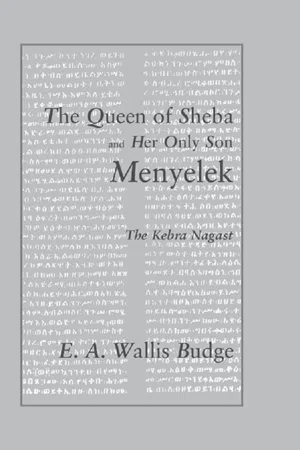
This is a complete English translation of the famous Ethiopian work The Kebra Nagast - The Glory of the Kings of Ethiopia. Complied by a Coptic priest in the 6th century AD from much older material, The Kebra Nagast is a remarkable mixture of legends and traditions, some historical and some of a mythic quality, derived from the Old Testament and the later Rabbinic writings and from Egyptian (both pagan and Christian), Arabian and Ethiopian sources. The principle theme is the descent of the Kings of Ethiopia from the union of Solomon, King of Israel, and the Queen of Sheba. Woven through the story are many important narratives, including prophecies in the Old Testament that concern the Messiah as applied to Jesus Christ, the history of the rebel angels, and legends of Solomon and the Queen of Sheba in the Koran.
Information
1. Concerning the Glory of Kings
THE interpretation and explanation of the Three Hundred and Eighteen Orthodox [Fathers] concerning splendour, and greatness, and dignity, and how God gave them to the children of ADAM, and especially concerning the greatness and splendour of ZION, the Tabernacle (tâbôt) of the Law of God, of which He Himself is the Maker and Fashioner, in the fortress of His holiness before all created things, [both] angels and men. For the Father, and the Son, and the Holy Spirit with good fellowship and right good will and cordial agreement together made the Heavenly ZION to be the place of habitation of their Glory. And then the Father, and the Son, and the Holy Spirit said, “Let Us make man in Our similitude and likeness,”1 and with ready agreement and good will They were all of this opinion. And the Son said, “I will put on the body of ADAM,” and the Holy Spirit said, “I will dwell in the heart[s] of the Prophets and the Righteous”; and this common agreement and covenant was [fulfilled] in ZION, the City of their Glory. And DAVID said, “Remember Thine agreement which Thou didst make of old for salvation, the rod of Thine inheritance, in Mount ZION wherein Thou dost dwell.”2
And He made ADAM in His own image and likeness, so that He might remove SATAN because of his pride, together with his host, and might establish ADAM —His own plant—together with the righteous, His children, for His praises. For the plan of God was decided upon and decreed in that He said, “I will become man, and I will be in everything which I have created, I will abide in flesh.” And in the days that came after, by His good pleasure there was born in the flesh of the Second ZION the second ADAM, Who was our Saviour CHRIST. This is our glory and our faith, our hope and our life, the Second ZION. 3
2. Concerning the Greatness of Kings
Come then, let us go back, and let us consider, and let us begin [to state] which of the kings of the earth, from the first even unto the last, in respect of the Law and the Ordinances and honour and greatness, we should magnify or decry.
GREGORY, the worker of wonders and miracles, 4 who was cast into a cave because of [his] love for the martyrdom of CHRIST and suffered tribulation for fifteen years, said, “When I was in the pit I pondered over this matter, and over the folly of the Kings of ARMENIA, and I said, In so far as I can conceive it, [in] what doth the greatness of kings [consist]? Is it in the multitude of soldiers, or in the splendour of worldly possessions, or in extent of rule over cities and towns? This was my thought each time of my prayer, and my thought stirred me again and again to meditate upon the greatness of kings. And now I will begin.”
3. Concerning the Kingdom of ADAM
And I go up from ADAM and I say, God is King in truth, for Him praise is meet, and He appointed under Him ADAM to be king over all that He had created. And He drove him out of the Garden, because of his apostasy through the sin of the Serpent and the plotting of the Devil. And at that sorrowful moment CAIN was born, and when ADAM saw that the face of CAIN was ill-tempered (or, sullen) and his appearance evil he was sad. And then ABEL was born, and when ADAM saw that his appearance was good and his face good-tempered he said, “This is my son, the heir of my kingdom.”
4. Concerning Envy
And when they had grown up together, SATAN had envy of him, and he cast this envy into the heart of CAIN, who was envious [of ABEL] first, because of the words of his father ADAM, who said, “He who hath the good-tempered face shall be the heir of my kingdom”; and secondly, because of his sister with the beautiful face, who was born with him and who had been given unto Abel, even as God commanded them to multiply and fill the earth—now the face of the sister who had been born with ABEL resembled that of CAIN, and their father had transferred them (i.e., the two sisters) when giving them [in marriage];—and thirdly, because when the two [brothers] offered up sacrifice, God accepted the offering of ABEL and rejected the offering of CAIN. And because of this envy CAIN killed ABEL. Thus fratricide was first created through SATAN’S envy of the children of ADAM. And having killed his brother, CAIN fell into a state of trembling and horrible fright, and he was repulsed by his father and his Lord. And [then] SETH was born, and ADAM looked upon him and said, “Now hath God shown compassion upon me, and He hath given unto me the light of my face. In sorrowful remembrance I will console myself (?) with him. The name of him that shall slay my heir shall be blotted out, even to his ninth generation.”
5. Concerning the Kingdom of SETH
And ADAM died, and SETH reigned in righteousness. And SETH died, and HÊNÔS (ENOS) reigned. And HÊNÔS (EONS) died, and ḲÂYNÂN (CAINAN) reigned. And ḲÂYNÂN (CAINAN) died, and MALÂL’ÊL (MAHALALEEL) reigned. And MALÂL’ÊL (MAHALALEEL) died, and YÂRÔD (JARED) reigned. And YÂRÔD died, and HÊNÔKH (ENOCH) reigned in righteousness, and he feared God, and [God] hid him so that he might not see death. And he became a king in his flesh in the Land of the Living. And after ENOCH disappeared MÂTÛSÂLÂ (METHUSELAH) reigned. And MÂTÛSÂLÂ died, and LÂMÊKH (LAMECH) reigned. And LÂMÊKH died, and NÔḤ (NOAH) reigned in righteousness, and he pleased God in all his works.
6. Concerning the Sin of CAIN
And that accursed man CAIN, the murderer of his brother, multiplied evil, and his seed did likewise, and they provoked God to wrath with their wickedness. They had not the fear of God before their eyes, and they never kept in mind that He had created them, and they never prayed to Him, and they never worshipped Him, and they never called upon Him, and they never rendered service to Him in fear; nay, they ate, and they drank, and they danced, and they played upon stringed instruments, and sang lewd songs there-to, and they worked uncleanness without law, without measure, and without rule. And the wickedness of the children of CAIN multiplied, until at length in the greatness of their filthiness they introduced the seed of the ass into the mare, and the mule came into being, which God had not commanded—even like those who give their children who are believers unto those who deny God, and their offspring become the seed of the filthy GOMORRAITES, one half of them being of good and one half of them of evil seed. And as for those who do [this] wickedness, their judgement is ready, and their error is lasting.
7. Concerning NOAH
Now NOAH was a righteous man. He feared God, and kept the righteousness and the Law which his fathers had declared unto him—now NOAH was the terith generation from ADAM —and he kept in remembrance and did what was good, and he preserved his body from fornication, and he admonished his children, bidding them not to mingle with the children of CAIN, the arrogant tyrant, the divider of the kingdom, [who] walked in the counsel of the Devil, who maketh evil to flourish. And he taught them everything that God hated—pride, boastfulness of speech, self-adulation, calumniation, false accusation, and the swearing of false oaths. And besides these things, in the wickedness of their uncleanness, which was unlawful and against rule, man wrought pollution with man, and woman worked with woman the abominable thing.
8. Concerning the Flood
And this thing was evil before God, and He destroyed them with the water of the Flood, which was colder than ice. He opened the doors of heaven, and the cataracts of the Flood poured down; and He opened the fountains that were under the earth, and the fountains of the Flood appeared on the earth. And the sinners were blotted out, for they reaped the fruit of their punishment. And with them perished all beasts and creeping things, for they were all created for the gratification of ADAM, and for his glory, some to provide him with food, and some for his pleasure, and some for the names to the glorification of his Creator so that he might know them, even as DAVID saith, “And Thou hast set everything under his feet”;5 for his sake they were created, and for his sake they were destroyed, with the exception of Eight Souls, and seven of every kind of clean beasts and creeping things, and two of every kind of unclean beast and creeping thing.
9. Concerning the Covenant of Noah
And then NOAH the righteous man died, and SHEM reigned in wisdom and righteousness, for he was blessed by NOAH, saying, “Be God to thy brother.” And to HAM he said, “Be servant to thy brother.” And he said unto JAPHET, “Be thou servant to SHEM my heir, and be thou subject unto him.”6 And again, after the Flood, the Devil, our Enemy, did not cease from his hostility against the children of NOAH, but stirred up CANAAN, the son of HAM, and he became the violent tyrant ...
Table of contents
- Cover
- Half Title
- Title Page
- Copyright
- Preface to the Present Edition
- Preface to the First Edition
- Contents
- List of Plates
- Introduction
- 1. The Glory of Kings
- 2. The Greatness of Kings
- 3. The Kingdom of ADAM
- 4. Concerning Envy
- 5. The Kingdom of SETH
- 6. The Sin of CAIN
- 7. NOAH
- 8. The Flood
- 9. The Covenant of NOAH
- 10. Concerning ZION
- 11. Declaration of the Three Hundred and Eighteen Orthodox Fathers
- 12. CANAAN
- 13. ABARAHAM
- 14. The Covenant of ABRAHAM
- 15. ISAAC and JACOB
- 16. REUBEN
- 17. The Glory of ZION
- 18. The Agreement of the Orthodox Fathers and Bishops
- 19. The Discovery of the Book KEBRA NAGAST
- 20. The Division of the Earth
- 21. The Queen of the South
- 22. TÂMRÎN, the Merchant
- 23. The Return of TÂMRÎN to ETHIOPIA
- 24. The Queen of ETHIOPIA prepares for her Journey to JERUSALEM
- 25. The Queen of ETHIOPIA comes to SOLOMON the King
- 26. The Conversation of SOLOMON with the Queen of ETHIOPIA
- 27. SOLOMON and the Workman
- 28. SOLOMON’S Instructions to the Queen
- 29. The Three Hundred and Eighteen Patriarchs—Narrative of SOLOMON and the Queen—continued
- 30. SOLOMON’S Oath to the Queen of ETHIOPIA
- 31. SOLOMON’S Sign to the Queen of ETHIOPIA
- 32. The Queen brings forth her son BAYNA-LEHKEM
- 33. BAYNA-LEHKEM Sets out for JERUSALEM
- 34. BAYNA-LEHKEM arrives in GÂZÂ
- 35. SOLOMON makes BAYNA-LEHKEM Captain of his Host
- 36. SOLOMON’S Conversation with BAYNA-LEHKEM
- 37. SOLOMON questions his son BAYNA-LEHKEM
- 38. SOLOMON decides to send BAYNA-LEHKEM away with the eldest sons of his nobles
- 39. BAYNA-LEHKEM (i.e. MENYELEK) is anointed King of ETHIOPIA, and is called DAVID (II)
- 40. ZADOK’S Commands to DAVID (II)
- 41. The Blessing of Kings
- 42. The Ten Commandments
- 43. The Priests and Officials of the Court of DAVID (II) in ETHIOPIA
- 44. The King must not be reviled
- 45. The Sons of the Nobles who are to go to ETHIOPIA make a plot.
- 46. The Plot to steal the Tabernacle of ZION from the Temple in JERUSALEM
- 47. The Offering of AZARIAH and the King
- 48. How they stole the Tabernacle of ZION
- 49. How SOLOMON blessed his son DAVID (II)
- 50. The Farewell of DAVID (II) to his father, and the grief of the people.
- 51. SOLOMON bids ZADOK fetch the covering of the Tabernacle of ZION
- 52. ZADOK gives DAVID (II) the covering of the Tabernacle of ZION
- 53. The Gift of the Wagon of ZION to ETHIOPIA
- 54. How DAVID (II) prophesied and saluted ZION
- 55. How the People of ETHIOPIA rejoiced
- 56. ZADOK the Priest discovers that the Tabernacle of ZION has been stolen
- 57. The Swooning of ZADOK the Priest
- 58. How SOLOMON rose up to slay them
- 59. SOLOMON arrives in EGYPT and questions the EGYPTIANS
- 60. SOLOMON’S Lament for the Tabernacle of ZION
- 61. SOLOMON’S Return to JERUSALEM
- 62. SOLOMON’S Resignation to the Will of God
- 63. The Elders accept SOLOMON’S View and decide to keep the theft of ZION a secret
- 64. SOLOMON Marries an Egyptian Princess
- 65. The Sin of SOLOMON
- 66. SOLOMON a prototype of CHRIST
- 67. The Death Lament of SOLOMON
- 68. The Virgin Mary, Our Lady of Salvation
- 69. The Conversation of SOLOMON with the Angel concerning CHRIST
- 70. The Reign of REHOBOAM
- 71. The Virgin Mary, the daughter of DAVID
- 72. The King of RÔMÊ (CONSTANTINOPLE)
- 73. ‘ADRÂMÎ, the son of SOLOMON, becomes King of RÔMÊ
- 74. The King of MEDYÂM, a descendant of SHEM
- 75. The King of BABYLON, a descendant of SHEM
- 76. NEBUCHADNEZZAR, the son of KARMÎN, a descendant of SHEM
- 77. The King of PERSIA, a descendant of TAMAR
- 78. The King of MOAB, a descendant of LOT
- 79. The King of AMALEK, a descendant of LOT
- 80. The King of PHILISTIA, a descendant of SAMSON
- 81. How AKAMHÊL, the son of SAMSON, slew TEBRÊLÊS, the son of the King of the PHILISTINES
- 82. ABRAHAM’S journey into EGYPT
- 83. The King of the ISHMAELITES
- 84. How BAYNA-LEHKEM (DAVID II) returned to ETHIOPIA
- 85. How Queen MÂKEDÂ rejoiced at his coming
- 86. How Queen MÂKEDÂ made her son King of ETHIOPIA
- 87. How the Ethiopian Nobles swore fidelity to him.
- 88. BAYNA-LEHKEM describes to his Mother his anointing as King
- 89. Queen MÂKEDÂ’S Address to the ISRAELITES in ETHIOPIA
- 90. How AZARIAH praised the Queen and her Royal City
- 91. Regulations about Meats, clean and unclean
- 92. How the Kingdom of BAYNA-LEHKEM (DAVID II) was established in ETHIOPIA
- 93. How the Men of RÔMÊ (BYZANTIUM) destroyed the Faith
- 94. The First War of BAYNA-LEHKEM (DAVID II)
- 95. How the Authority of BAYNA-LEHKEM was universally accepted
- 96. The Prophecies concerning CHRIST
- 97. The Murmuring of the ISRAELITES against MOSES and AARON
- 98. The Rod of MOSES and the Rod of AARON
- 99. Parable of the Two Slaves, i.e. the Devil and ADAM
- 100. How the Angels rebelled against God when He created ADAM
- 101. Concerning Him that existeth in everything
- 102. The Beginning
- 103. The Horns of the Altar and their Significance.
- 104. The Ark of NOAH and the Talk of the Wicked
- 105. The Belief of ABRAHAM
- 106. A prophecy concerning the Coming of CHRIST
- 107. CHRIST’S Glorious Entrance into JERUSALEM
- 108. The Wickedness of the Jews
- 109. The Crucifixion
- 110. The Resurrection
- 111. The Ascension of CHRIST and His Second Coming
- 112. The Prophets as prototypes of CHRIST
- 113. The Chariot and the Vanquisher of the Enemy.
- 114. The Return of ZION
- 115. The Judgement of ISRAEL
- 116. The Chariot of ETHIOPIA
- 117. The King of RÔMÊ and the King of ETHIOPIA
- Colophon
- Index
- List of Passages quoted from the Old and New Testaments.
Trusted by 375,005 students
Access to over 1.5 million titles for a fair monthly price.
Study more efficiently using our study tools.
Frequently asked questions
Yes, you can cancel anytime from the Subscription tab in your account settings on the Perlego website. Your subscription will stay active until the end of your current billing period. Learn how to cancel your subscription
No, books cannot be downloaded as external files, such as PDFs, for use outside of Perlego. However, you can download books within the Perlego app for offline reading on mobile or tablet. Learn how to download books offline
We are an online textbook subscription service, where you can get access to an entire online library for less than the price of a single book per month. With over 1.5 million books across 990+ topics, we’ve got you covered! Learn about our mission
Look out for the read-aloud symbol on your next book to see if you can listen to it. The read-aloud tool reads text aloud for you, highlighting the text as it is being read. You can pause it, speed it up and slow it down. Learn more about Read Aloud
Yes! You can use the Perlego app on both iOS and Android devices to read anytime, anywhere — even offline. Perfect for commutes or when you’re on the go.
Please note we cannot support devices running on iOS 13 and Android 7 or earlier. Learn more about using the app
Please note we cannot support devices running on iOS 13 and Android 7 or earlier. Learn more about using the app
Yes, you can access The Queen of Sheba and her only Son Menyelek by Budge,E.A. Wallis Budge in PDF and/or ePUB format, as well as other popular books in Social Sciences & Anthropology. We have over 1.5 million books available in our catalogue for you to explore.