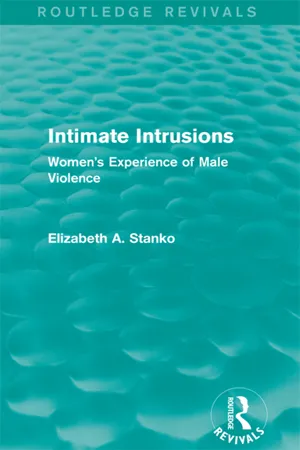
First published in 1985, this book looks at the victimisation of women, focusing on the four main areas of incest, rape, physical violence, and sexual harassment. Elizabeth Stanko's work is based on original research and interviews with police forces, victims and others involved. It examines women's experiences of male violence and looks at the reactions of those to whom women complain, including police officers, judges and union officials. The book analyses the decision making process of the criminal justice system and of administrative personnel at the time of publication, and Stanko shows how such institutions can be carriers of a male point of view.
eBook - ePub
Intimate Intrusions (Routledge Revivals)
Women's Experience of Male Violence
- 212 pages
- English
- ePUB (mobile friendly)
- Available on iOS & Android
eBook - ePub
About this book
Information
Chapter 1
Introduction
This book is about women’s lives in contemporary Britain and the United States. It focuses on the commonness of their lives through an understanding of their experiences of men’s behaviour – behaviour women themselves perceive and/or experience as intimidating, threatening, coercive or violent. The brutal rape, the sexually harassing comments, the slap on the face, the grab on the street – all forms of men’s threatening, intimidating and violent behaviour – are reminders to women of their vulnerability to men. Try as they might, women are unable to predict when a threatening or intimidating form of male behaviour will escalate to violence. As a result, women are continually on guard to the possibility of men’s violence.
Women, in fact, are specialists in devising ways to minimise their exposure to the possibility of male violence. Some hesitate going out on the street alone after dark (even in their own neighbourhoods). Some buy cars so that they can feel freer, and safer, as they travel about. Some quit jobs. Some leave violent husbands. Some alter their lifestyles or their appearance to avoid drawing attention to themselves.
Specialists in survival through avoidance strategies, women know, consciously or unconsciously, what it means to be vulnerable to sexual and/or physical male intimidation or violence. Old and young, rich and poor, white and black, no woman is immune from men’s intimidating, threatening or violent behaviour. If one is young, poor or from a minority, though, chances of being affected by different forms of male violence are increased; resources for avoidance strategies – owning a car, living in a ‘nice’ neighbourhood, being employed in daytime employment – are much more limited. (While the focus of this book is on the effects of being female, feelings of vulnerability are significantly compounded when women are poor or minority or poor and minority.)
Linked with women’s subordinate position vis-à-vis men, women’s survival strategies include observing men’s behaviour because it affects what women have to do to avoid male violence. (In contrast, states William Goode, men do not often observe women’s lives because their behaviour is not affected by them.)1 Women, for example, monitor footsteps behind them or sexualised comments or glances directed from men because they must devise strategies in case the encounter moves in a direction not of their own choice. Certainly, in many instances, but unpredictably so, the footsteps or the glances could be characterised by women to be men’s perfectly ‘innocent’ behaviour. This characterisation, however, only arises after there has been ‘no trouble’. As long as women do not feel coerced by men’s behaviour, then women feel safe, or feel that at least this time they are not immediately threatened.
Being on guard for women, though, is not paranoia; it is reasonable caution. Many women have encountered men’s threatening, intimidating or violent behaviour at first hand. As children, many women have had experiences of sexual abuse, either from male relatives or from male strangers. Quite likely, female children are even taught to be on guard for male strangers who wish to offer them candy or money to do something unspeakable (unspeakable, because, of course, few of us were ever told why male strangers might wish to offer us goodies). Female adolescence too is a time of learning what it means to be on guard. As soon as women begin pubescent development, they actually begin to see men’s behaviour toward them change. Adolescent women are met with comments, glances, whistles, admiration for the visible development of their sexuality. At the same time within their peer group, sexual experimentation starts. Fending off male sexuality, much of which is initially welcomed, the young woman learns that she cannot always control sexual encounters she engages in. She also learns that if anything ‘happens’, she is to blame. As adults, then, women have acquired, as part of their maturation, an idea of how men respond to them as sexual beings. They are also aware that they are less physically powerful than men, that much of their surrounding world rewards them for their feminine appearance, and that men – young and old – make sexual advances toward them. It is not uncommon that, by the time women are adults, they have experienced some form of coercive, threatening, intimidating or violent behaviour from men. It is no wonder that, as adults, women are on guard.
Awareness of the commonness of physical and sexual exploitation of women by men is not new. It was a major focus of nineteenth-century feminists.2 Despite the contradictions and middle-class bias of the ‘sexual purity’ campaigns in both the US and Britain, nineteenth-century feminists were aware that behaviour that men considered ‘typical’ was in fact exploiting many women, particularly poor and working women. One major contradiction centred on the belief that somehow ‘respectable’ women could avoid men’s sexual and physical exploitation. Newspaper coverage of the Jack the Ripper murders in London in 1888, for example ‘blamed “women of evil life” for bringing the murders on themselves, but elsewhere warned that “no woman is safe while this ghoul’s abroad”.’3 Even more interesting, nineteenth-century English men’s reactions to the Ripper murders took different forms, ‘from conscious intimidation and impersonation of the Ripper to a more latent identification with the criminal and subtle exploitation of female terror’.4 Judith Walkowitz includes the following story in her 1982 article.
James Henderson, a tailor, was brought before the Dalston Magistrates for threatening Rosa Goldstein, an ‘unfortunate’, with ‘ripping’ her up if she did not go with him and for striking her several hard blows with his cane. Henderson was let off with a fine of forty shillings, on the grounds that he had been drunk – despite the fact that the severely injured Goldstein appeared in court ‘with surgical bandages about her head’ and ‘weak from the loss of blood’.5
Regardless of the hope of nineteenth-century feminists that female respectability would grant women immunity from male violence (respectability which stemmed from being middle-class and white as well), the Ripper murders exposed deep-seated antagonisms of men toward women.
Across the waters in the United States, nineteenth-century American feminists too recognised the importance of female respectability. They also recognised women’s obstacle in complaining about men’s sexual and physical exploitation: the male-dominated criminal justice system. In 1885, for example, the Chicago Women’s Club was established to offer legal aid to women who experienced sexual molestation, rape, wife beating, incest, and so forth. Staffed by women, agency members also appeared in court on behalf of raped women because ‘they believed that the presence of respectable women helped create a moral atmosphere and in order to encourage the victim to testify in a courtroom dominated by men.’6 The Chicago Women’s Club was an exceptional agency; few other such agencies existed. Around this same time, feminists in various cities both in the US and Britain also sought to have women hired in the police departments.7 This move too was a recognition that women’s complaints of male violence were not being heard by the male police forces. None the less, most women were unassisted by this wave of feminist intervention into male violence. As respectable women turned their efforts to gaining the right to vote, they virtually abandoned their efforts to stem the tide of male violence.
The double bind of nineteenth-century women is still with us: to maximise women’s safety from male violence, women are to remain ‘pure’; this purity, however, is no guarantee that any woman will not encounter male violence. Yet it was the nineteenth-century feminists who provided us with valuable information: typical men’s behaviour, particularly their sexual behaviour, can be violent, intimidating, coercive, indeed damaging to women. Women, however, still bear the blame for men’s ‘indiscretions’, which are the result, many believe, of women’s ‘unrespectable’ behaviour.
Understanding what it means to be female within contemporary British and American societies is understanding the meaning of male violence in women’s lives. Many women’s lives, in fact, revolve around strategies to avoid men’s threatening, intimidating, coercive or violent behaviour. Contemporary feminists, not unlike their nineteenth-century sisters, have uncovered widespread experiences of male violence among women. Efforts to assist women affected by rape, incest, wife battering, or sexual harassment have led these feminists to see the endemic nature of men’s threatening or violent behaviour in many of women’s everyday interactions with men. Yet there is a stony silence surrounding incidents of male violence. It is because women who encounter men’s threatening, intimidating, coercive or violent behaviour are suspected of being ‘unrespectable’.
The purpose of this book is to explore how male violence against women remains a problem of women’s respectability, not men’s behaviour. Part I examines women’s experiences of men’s threatening, intimidating, coercive or violent behaviour and their typical reaction, silence. Women’s silence demonstrates a recognition of their untenable position: blamed for men’s behaviour, women seek an explanation for male violence in their own ‘unrespectability’. So too do those to whom women complain about men’s potentially threatening or violent behaviour (if, indeed, they complain at all). Part II explores the inquiry process where individuals in official capacities – police, judges, prosecutors, or personnel managers – handle women’s complaints of men’s ‘indiscretions’. Not surprisingly, they do so with an eye to women’s ‘respectability’.
Part 1
Ordinary experiences
Elli is raped when she accepts a lift from a truck driver, her own fault, a woman can’t hitch on her own. A girl comes crying into the woman’s house. Raped by an Angolan with whom she had been talking in the pub about the liberation movement in the Third World and when he asked would you like to come home for coffee because we are having such a good talk she thought don’t be paranoid there are some nice men. Own fault, she shouldn’t have gone with him. Francine was attacked in a lift, threatened with a knife, abducted and raped, afterwards allowed to go. Own fault, you know that you mustn’t stand in a lift at night alone with a man. Her woman friend, who thought rape only happened after twelve o’clock, had the same thing happen to her a week later during the day. I don’t even dare talk about it, says Francine, it was a black man and there are all the disgusting things said about blacks that I always challenge when I hear them. I understand they don’t have an easy time here and that they are discriminated against and that they must then take out their aggression somewhere, but why should it be taken out on women? What must you do, start a discussion about us both being oppressed?
While he has his hands in your pants.
While we talk we continually find more stories to tell. The usual stuff, pinching our tits as we walk past, hands on our cunt on the tram, being pulled off our bicycle, pushed against a wall by a gang of drunken adolescents. Normal experiences. And then, naturally, the remarks. Don’t look so grim, otherwise I’ll stuff a broomstick up your cunt. Now, girl, if your cunt is as sloppy as your tits you’re in bad shape. Shall we get her, men? I remember the opinions I held before. Women who don’t want it aren’t raped because he has only two hands. And: perhaps the woman to whom it happened asked for it a little. At least I haven’t been raped really, I say in the group, and then immediately I realise it isn’t true. Toni, I remember, wasn’t that rape, he only stopped when I scratched his skin to draw blood. And afterwards the forced fucking to buy my freedom. Why didn’t I see that, I say. You were married, says Francine, that doesn’t count as rape, that’s called normal. And then we investigate what that means for us, for all women, not only those to whom it happens. We don’t walk alone along the street at night, if we do we look straight in front of us, big steps, hands balled into fists, and our buttocks tight. No strolling, no looking in shop windows, walking round groups of men, getting into a panic if you hear steps behind you, making a detour not to go through a dark street, being careful not to look anyone directly in his face because eye contact, by accident, is already an invitation.
Ordinary, daily fear. We don’t even notice it any more, so ordinary. It’s not about if it happens to you – it’s about our living in a society where it can happen, we are all outlawed.
Anja Meulenbelt1
Chapter 2
Ordinary experiences
To be a woman – in most societies, in most eras – is to experience physical and/or sexual terrorism at the hands of men. Our everyday behaviour reflects our precautions, the measures we take to protect ourselves. We are wary of going out at night, even in our own neighbourhoods. We are warned by men and other women not to trust strangers. But somehow they forget to warn us about men we know: our fathers, our acquaintances, our co-workers, our lovers, our teachers. Many men familiar to us also terrorise our everyday lives in our homes, our schools, our workplaces.
Women’s experiences of incest, battering, rape and sexual harassment become the sources for documenting all women’s actual and potential experiences. Physically and/or sexually assaulted women speak in similar voices; much of what they say describes what it means to be female: the child who finds she is treated as sexually available at 9, the battered woman who is embarrassed by her black eyes, shamed by her failed marriage; the raped woman who is grateful to survive, only to live with nightmares; the sexually harassed woman who is humiliated by the pornographic pictures she finds every day on her desk. In each case, a woman endures an invasion of self, the intrusion of inner space, a violation of her sexual and physical autonomy.
Cast in a mould constructed within male-dominated society, women’s experiences of sexual and physical violation take on an illusion of normality, ordinariness. Through an assumption of normality, many characterise male physical and/or sexual aggression as linked to biological make-up, sparked by an innate, at times uncontrollable, sexual drive. After all, boys will be boys, we sigh. While we acknowledge that not all men publicly display this uncontrollable biological predisposition, we further believe its display is generally aroused by deserving, provoking women. We consequently ignore what is assumed to be typical male behaviour directed toward provoking women. At the same time, though, we recognise that some male aggression is not sparked by provocative women. These, we reassure ourselves, are the rarest of situations. Above all, we retain traditional assumptions about women who experience sexual and/or physical assault; some women are alluring, masochistic and provoke the uncontrollable responses of some men, and some...
Table of contents
- Cover Page
- Half Title page
- Title Page
- Copyright Page
- Original Title Page
- Original Copyright Page
- Dedication
- Contents
- Preface
- Acknowledgements
- 1 Introduction
- Part I Ordinary experiences
- Part II The second assailant
- Notes
- Bibliography
- Index
Trusted by 375,005 students
Access to over 1.5 million titles for a fair monthly price.
Study more efficiently using our study tools.
Frequently asked questions
Yes, you can cancel anytime from the Subscription tab in your account settings on the Perlego website. Your subscription will stay active until the end of your current billing period. Learn how to cancel your subscription
No, books cannot be downloaded as external files, such as PDFs, for use outside of Perlego. However, you can download books within the Perlego app for offline reading on mobile or tablet. Learn how to download books offline
We are an online textbook subscription service, where you can get access to an entire online library for less than the price of a single book per month. With over 1.5 million books across 990+ topics, we’ve got you covered! Learn about our mission
Look out for the read-aloud symbol on your next book to see if you can listen to it. The read-aloud tool reads text aloud for you, highlighting the text as it is being read. You can pause it, speed it up and slow it down. Learn more about Read Aloud
Yes! You can use the Perlego app on both iOS and Android devices to read anytime, anywhere — even offline. Perfect for commutes or when you’re on the go.
Please note we cannot support devices running on iOS 13 and Android 7 or earlier. Learn more about using the app
Please note we cannot support devices running on iOS 13 and Android 7 or earlier. Learn more about using the app
Yes, you can access Intimate Intrusions (Routledge Revivals) by Elizabeth Stanko in PDF and/or ePUB format, as well as other popular books in Social Sciences & Criminology. We have over 1.5 million books available in our catalogue for you to explore.