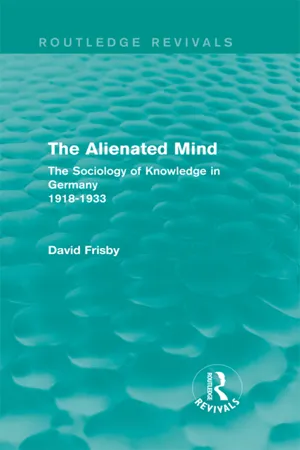
This book, first published in 1983, with a second edition in 1992, investigates the emergence of the sociology of knowledge in Germany in the critical period from 1918 to 1933. These years witnessed the development of distinctive paradigms centred on the works of Max Scheler, Georg Lukács and Karl Mannheim. Each theorist sought to confront the base-superstructure models of the relationship between knowledge and society, which originated in Orthodox Marxism. David Frisbsy illustrates how these and other themes in the sociology of knowledge were contested through a detailed account of the central sociological debates in Weimar Germany. This reissue of The Alienated Mind will be of particular interest to students and academics concerned with the development of an important tradition in the sociology of knowledge and culture, social theory and German history.
eBook - ePub
The Alienated Mind (Routledge Revivals)
The Sociology of Knowledge in Germany 1918-1933
- 282 pages
- English
- ePUB (mobile friendly)
- Available on iOS & Android
eBook - ePub
About this book
Information
1 The Sociology of Knowledge in Weimar Germany: Its Background and Context
I
Any serious attempt to understand the distinctive nature of the German tradition of the sociology of knowledge in the Weimar Republic, must take into account not merely the immediate theoretical and practical context of its emergence but also its antecedents.1 Our particular concern will be with those philosophical and sociological traditions that inform the sociology of knowledge as it developed in Weimar Germany: the Marxism of the Second International, Dilthey’s philosophy of the human sciences, Nietzsche’s critique of ideology, Simmel’s theory of alienation, Weber’s theory of values, and Troeltsch’s historicism. Some of these traditions also permeate the theoretical crises in Weimar Germany — such as ‘the crisis of historicism’ (Troeltsch) or the Wissenschaftsstreit.2 Indeed, the whole atmosphere of crisis informs much of the writing on the sociology of knowledge in Weimar Germany. Mannheim, for instance, saw his Ideologie und Utopie as itself ‘conscious of an intellectual crisis situation’.
Whereas Mannheim, however, often viewed this crisis as an intellectual one, there is little doubt that it was itself a part of a wider social and political crisis in Weimar Germany of the kind that surfaces in various forms in the sociology of knowledge. Often, the sociology of knowledge itself can be seen to emanate from these practical crises. For instance, one cannot fully comprehend Mannheim’s theory of political ideologies without being aware that Ideologie und Utopie was written in the context of a crumbling political structure in the latter stages of the Weimar Republic.
Taking a simplified model of the socio-political and economic constellation in Weimar Germany, we can pick out three basic periods. The first is the aftermath of the First World War ‘defeat’, the Revolution of 1918/19, and the political and economic upheaval down to 1923, including the uprising of March 1921. This is the period in which the essays that make up Lukács’ History and Class Consciousness were written. For Lukács, of course, his role in the Hungarian Revolution, participation in Bela Kun’s short-lived revolutionary government, and subsequent exile are also of central importance. This was the period of Lukács’ adherence to what he later termed messianic Marxism. The second period, characterised as that of ‘relative stabilization’, extends from 1924 and the Dawes Plan down to the financial collapse of 1929. Lukács, in a later account of German philosophy and social theory, located Scheler’s sociology of knowledge within this period.3 One might add that most of Mannheim’s work on the sociology of knowledge also falls within this period. The third period, from 1929 to 1933, is characterised by the collapse of the German economy and the increasing disintegration of the political structure. The fragmentation that characterized the parliamentary political scene gave way to an increasing polarisation and, what was crucial for Mannheim, to the collapse of parties occupying the middle ground of the political spectrum. Though, strictly speaking, this final period cannot be said to inform Mannheim’s Ideologie und Utopie, which was completed in 1928, Mannheim nonetheless incorporated the fragmentation of the political structure into his sociology of knowledge, both in his paper on competition and in Ideologie und Utopie. Furthermore, the publication of the work in 1929 ensured that Mannheim’s contemporaries would recognize that the ‘intellectual crisis’ of which he spoke was itself part of a much deeper crisis permeating the Weimar Republic.
What this suggests is that the sociology of knowledge was not merely viewed as an academic discipline concerned with broad theoretical issues but that it contained practical and sometimes overtly political aims. Scheler and Mannheim both saw a significant pedagogic role either for a Weltanschauungslehre or for the sociology of knowledge. Much of Mannheim’s later work seeks to relate the insights gained from his sociology of knowledge to the contemporary situation. This is most explicit in Ideologie und Utopie, where one of the work’s immediate aims — and that of the sociology of knowledge — is ‘a diagnosis of the times’. In Lukács’ case, the practical, political intentions of the critique of ideology contained in History and Class Consciousness are presented openly. But in Mannheim’s Ideologie und Utopie, too, the problem of ideology is also located within the context of a discussion of theory and practice. Thus, wherever possible, it is important to investigate these contexts initially in the light of the interests of the sociology of knowledge itself. In this way, they are no longer ‘external’ contexts, but a constituent element of our textual understanding. Conversely, the works themselves must be seen as interventions in the crises — controversies of both the theoretical and practical domains — and not merely writings about these crises.
II
Within the various philosophical and sociological traditions adopted by the sociology of knowledge there can be seen important modes of reflection upon issues that were taken up by the sociology of knowledge at a later date. A sociology of culture, a theory of ideology, hermeneutic and historicist reflection upon the problem of interpretation, a sociological-biological critique of reason, a base-superstructure model of society, a theory of cultural alienation, Weltanschauungsanalyse, and the relativist problematic — are some of the central themes in the sociology of knowledge in Weimar Germany. All of them were developed within the various philosophical and sociological traditions that the sociology of knowledge was to take up in Weimar Germany. At the end of one of his essays Mannheim very briefly reviews the development of the sociology of knowledge and highlights the most important of its forerunners: Marx, Nietzsche, Dilthey and, more recently, Lukács and Scheler.4 Lukács and Scheler, and their association with this tradition, are examined in detail in chapters 2 and 3. It would thus seem reasonable to consider how important were the others listed in the development of the sociology of knowledge in Germany. But this, in itself, would not give us a sufficiently clear focus upon the specific problems raised by the sociology of knowledge and its distinctive mode of dealing with them. Rather, we need to know in advance what the common features of the sociology of knowledge were.
There is little doubt that one of its central features was either a confrontation with the theory of ideology or an attempt to develop it further or, finally, an attempt to transform it into a sociology of knowledge. It might be thought, at first, that the source of this theory of ideology, and its extension in the sociology of knowledge, lay in Marx’s critique of ideology. But even in the case of Lukács, whose History and Class Consciousness appears to be a Hegelian-Marxist reinterpretation of Marx’s critique of ideology, we find that his theory of ideology and reification is deeply embedded in the German sociological tradition, however critical of it he might be. In the case of Mannheim it has often been assumed that the roots of his sociology of knowledge lay in Marx. Grünwald, for instance, suggests that Mannheim’s philosophical position ‘…is that of a historicism derived from Marx and Dilthey interspersed with phenomenological elements’.5 In the course of the discussion surrounding Mannheim’s paper on competition, he himself agreed that ‘Marx has influenced me but … in association with Dilthey’s spirit’.6 In Scheler’s case — and he was less obviously concerned with the development of a theory of ideology — one is confronted with a bewildering array of influences. For instance, Coser suggests,
As one proceeds to read his work, one is struck even more forcibly by the variety of his intellectual forebearers. Besides Husserl, influences of Dilthey, Bergson, of German neo-vitalism, and above all of Nietzsche (italics added: D.F.), are unmistakable. But Scheler’s thought is also deeply marked by Saint Augustine and Pascal, by Cardinal Newman and Saint Francis.7
Of course, not all of these are responsible for Scheler’s quasi-biological base-superstructure theory of knowledge and ideology; it is probably Nietzsche who is central to this aspect of his work.
Thus, whereas at first sight it seems as if the theory of ideology in the sociology of knowledge is derived from Marx’s work, the situation is indeed more complex. The specific constellation of intellectual currents is well expressed by Barth with reference to the theory of ideology in Weimar Germany:
The problems that emerge with the concept of ideology in the present period, their scope and comprehensiveness, become intelligible primarily through the intellectual-historical background which had been formed with the amalgamation of motifs of recent historicism and philosophy of life, together with Nietzsche’s socio-biological critique of reason and Marx’s base-superstructure doctrine.8
Barth highlights four central strands that are important for an understanding of the German tradition in the sociology of knowledge: Marx, Dilthey (Lebensphilosophie), historicism and Nietzsche. In order to give some indication of the specific form which the theory of ideology (Ideologienlehre) took in Weimar Germany, we may point to Barth’s account of its four basic presuppositions. He highlights them as follows:
1 In the anthropological conception, the irrational will and drives take over the leading functions. Intellect and reason appear as epiphenomena that owe their emergence to human beings’ need for orientation to the world and are created and prove successful as instruments in the service of the life-struggle. Human intellectual capacity is a form of adaptation to the general struggle for the maintenance and development of existence.
2 By means of the primacy of the will over reason, the main body of human activity is situated in this practical behaviour that is to be characterised, in the broadest sense of the word, as the economy. The recognition of the predominance of the will over the mind and reason, confirms the view that the will, directed toward life’s welfare and the institutional forms in which it operates, relates to human intellectual functions and their creations in the same way as the material base relates to the ideological superstructure. This viewpoint is dangerous in so far as it supports the tendency to believe that cognitive and concrete-practical behaviour can be separated from one another and in so far as it encourages the impression that the economic welfare of life takes place without the co-operation of intellectual functions. Yet, as Marx correctly remarked, the economy is always composed of both intellectual and mental labour …
3 Since intellectual activity develops originally in the closest contact with the provision of life and orientation to the world, since therefore it is assumed that it is linked with concrete-practical interests, there emerges the belief that, in its apparently ‘pure’ development, its primary function — to operate in the service of life — is not sacrificed.
4 There exists a relationship of dependency between the world of objective and subjective mind, on the one hand, and the socio-economic basis, on the other. This dependency is embodied in an insidious and dubious metaphor: it is maintained that the contents and forms of the mind are the ‘expression’ of these material existential foundations and their organisation.9
Even from this brief outline, it is clear that it would be erroneous to assume that the theory of ideology embodied in the sociology of knowledge is simply taken from Marx. Therefore, one of the tasks of illuminating the context within which this theory of ideology is developed in the sociology of knowledge will be to examine this understanding in the light of its mediation through the Marxism of the Second International and through German sociology itself.
In his study of the reception of Marx’s work in the sociology of knowledge in Weimar Germany, Lenk demonstrates how far this tradition relied for its understanding of Marx’s critique of ideology upon interpretations of Marx that had already gone some way towards ‘destroying’ Marx’s critique of ideology.10 Lenk argues that the sociology of knowledge in Weimar Germany derived its interpretation of Marx either from the Marxism of the Second International or from German sociology itself through the writings of Simmel, Max Weber and Troeltsch. Despite the fact that Lenk seeks to draw a sharp demarcation line between Marx’s and Engels’ notions of ideology and those base-superstructure notions that have proved difficult to maintain in the light of recent analyses by Wellmer,11 Böhler12 and others, his account of the Marxism of the Second International and of Engels’ own later work suggests that the development of vulgar Marxism was already well underway before the substantive development of sociology in Germany. The base-superstructure model of society, Lenk argues, which itself presupposes two realms of existence, was already present in Marxism itself.
In comparison with Marx, Engels exhibits a preference for concepts that signify a causal or interactional relation between base and ideology, expressions such as ‘mirror-image’, ‘reflection’, ‘economic reflection’, … etc, that in part are also already applied by Marx but which do not yet possess this dominating character as in Engels.13
The simple reduction of the superstructure to a material base, and the absence of reflection upon the nature of the truth of this ‘consciousness’ in the superstructure, are thus to be found in Marxism itself. Similarly, the naturalization of society in the scientific and positivistic interpretation of Marxism also reduces any dialectical notion of the subject-object relationship to that of ‘interaction’. Socialism as a scientific world view sought to understand Marxism as a world view
that encompassed nature, history and society. In it, science and politics, theory and practice are identical in the sense that politics is merely the application of scientific knowledge.14.
A second tendency towards the ‘scientisation’ of Marxism lay in a contrary orientation towards separating empirical propositions and normative implications within Marxism itself. The implications for the sociology of knowledge of this ‘scientific’ Marxism, especially in its first variant, are probably already evident. Le...
Table of contents
- Cover
- Half Title
- Title Page
- Copyright Page
- Original Copyright Page
- Contents
- Acknowledgements
- Preface
- 1 The Sociology of Knowledge in Weimar Germany: Its Background and Context
- 2 Max Scheler: From the Sociology of Culture to the Sociology of Knowledge
- 3 Georg Lukács: From Reification to the Critique of Ideology
- 4 Karl Mannheim: From the Critique of Ideology to the Sociology of Knowledge
- 5 The Contemporary Controversy Surrounding the Sociology of Knowledge: 1918–33
- Conclusion
- Afterword to the Second Edition
- References and Notes
- Bibliography
- Index of Names
Trusted by 375,005 students
Access to over 1.5 million titles for a fair monthly price.
Study more efficiently using our study tools.
Frequently asked questions
Yes, you can cancel anytime from the Subscription tab in your account settings on the Perlego website. Your subscription will stay active until the end of your current billing period. Learn how to cancel your subscription
No, books cannot be downloaded as external files, such as PDFs, for use outside of Perlego. However, you can download books within the Perlego app for offline reading on mobile or tablet. Learn how to download books offline
Perlego offers two plans: Essential and Complete
- Essential is ideal for learners and professionals who enjoy exploring a wide range of subjects. Access the Essential Library with 800,000+ trusted titles and best-sellers across business, personal growth, and the humanities. Includes unlimited reading time and Standard Read Aloud voice.
- Complete: Perfect for advanced learners and researchers needing full, unrestricted access. Unlock 1.5M+ books across hundreds of subjects, including academic and specialized titles. The Complete Plan also includes advanced features like Premium Read Aloud and Research Assistant.
We are an online textbook subscription service, where you can get access to an entire online library for less than the price of a single book per month. With over 1.5 million books across 990+ topics, we’ve got you covered! Learn about our mission
Look out for the read-aloud symbol on your next book to see if you can listen to it. The read-aloud tool reads text aloud for you, highlighting the text as it is being read. You can pause it, speed it up and slow it down. Learn more about Read Aloud
Yes! You can use the Perlego app on both iOS and Android devices to read anytime, anywhere — even offline. Perfect for commutes or when you’re on the go.
Please note we cannot support devices running on iOS 13 and Android 7 or earlier. Learn more about using the app
Please note we cannot support devices running on iOS 13 and Android 7 or earlier. Learn more about using the app
Yes, you can access The Alienated Mind (Routledge Revivals) by David Frisby in PDF and/or ePUB format, as well as other popular books in Social Sciences & Sociology. We have over 1.5 million books available in our catalogue for you to explore.