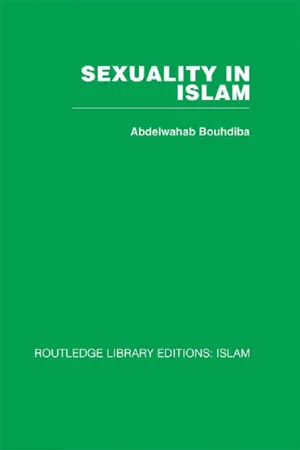
Originally published in 1985. Beginning with the Qur'an, Abdelwahab Bouhdiba confronts the question of male supremacy in Islam, and the strict separation of the masculine and the feminine. He gives an account of purification practices, of Islamic attitudes towards homosexuality, concubinage, legal marriage and of the sexual taboos laid down by the Qur'an. He assesses present-day sexual practice, including eroticism, misogyny and mysticism and concludes that the sexual alienation – and even oppression – of modern Muslim women is the result not of the Islamic vision of sexuality, but of social and economic pressures.
- 304 pages
- English
- ePUB (mobile friendly)
- Available on iOS & Android
eBook - ePub
Sexuality in Islam
About this book
Information
PART I
The Islamic view of sexuality
Tradition is a permanent element in the basic Arabo-Muslim personality. Quran, hadiths and fiqh are pre-eminently the invariants. Their value lies not so much in their historical import as in their revealed character. They are Revelation, that is to say, uncreated, eternal discourse. Even if Revelation is situated here and now, the content is perceived as an eternal and extra-temporal message. It lays down the model that God has chosen for his community; and this divine choice cannot undergo change. That is the basic intuition on the basis of which tradition proposes series of stereotyped forms of behaviour that at any given moment must be restored – at least as far as possible - in their entirety and in their original purity. The Quran is the divine Word, kalāmu Allah, the universal logos, pure idea. The Sunna of the Prophet is the practical model, the ideal behaviour that conforms to the sacred Word; behaviour embodied in a living being, of course, but which, though historical, is nevertheless the privileged echo of transcendence. In Islam, tradition is an ideal cultural set of rules. To conform to them strictly ensures that we are in the ways of God. Departure from them is tantamount to straying into error. Islam is essentially an orthodoxy. Hence the continual, ‘regressive’ temptation of ‘fundamentalism’.
Of course one will find in the Sacred Texts innumerable passages marked by an indubitably historical and existential will. Nevertheless the dominant tendency bears the mark of the eternal. The great debate between the ancient and the modern, the qadīm and the jadīd, is at the very heart of Islam: ‘Among the Arabs the qadīm, so vilified by the advocates of jadīd, might be another name for the “organic”. The traditionalists like to oppose living tradition to rotten tradition. Let us define qadīm as the rotten side of something that might be called archetypal.’1 There is a fundamentalism inherent in Arabo-Muslim culture. Hence the nostalgia for an absolute order that the Quran, the uncreated Word, reveals in à permanent way, which Muslim ideology will never be able to explain adequately and to the realization of which Muslim consciousness has never ceased to strive.
Let us be attentive, as generation after generation of Muslims have been, to these Quranic positions: ‘And We sent Messengers before thee, and We assigned to them wives and seed; and it was not for any Messengers to bring a sign, but by God’s leave. Every term has a Book, God blots out, and He establishes whatsoever He will; and with Him is the Essence of the Book.’2 While possessing its own value historical existence is strictly dependent on the scriptural archetype. The very nature of Prophecy embodied in a living community symbolized here by wife and seed inscribes the meaning of the divine in the very hollow of historicity. The sign of Prophecy may be produced only on the order of God who, alone and sovereignly possessing the archetypal absolute, Umm al-Kitāb, may efface and confirm what He wishes. The phrase ‘every term has a book’ (li kulli ajalin kitāb), so controversial in both traditional and modern theology, certainly allows a historicizing understanding of the Word of God. This Word is embodied in different formulations, suited to different centuries. But the trans-historical meaning remains the same: the word pronounced here and now always refers back to the ineffable Word. And outside the archetype there are merely shadows or, rather, renewal is a plunging back into the absolute.
The Sunna of the Prophet and, later, the fiqh are ultimately merely a continuous commentary upon the absolute. The effort of understanding, of exegesis, of penetration of the divine Word are so many successive points of view of a meaning that remains profoundly identical to itself. Although the viewpoint is historical, the meaning envisaged is eternal.
So we must not be afraid of the non-historicity of Tradition. On the contrary, a rigorous analysis of Islamic culture requires that we situate ourselves at the very heart of that tradition and grasp it as a whole. For the overall corpus of the Quran, of hadith, of exegesis, of fiqh defines a total science (’ilm) whose purpose is to apprehend a non-temporal command defined by the ḥudūd Allah. It is also intended to be understood as such.
It would, of course, have been highly interesting to carry out a historical and comparative study of the development of this corpus. One might even have been able to uncover a veritable ‘archeology’ of Islamic views of the world, although neither could nor ought to have been my main concern. Firstly, too many of the stages in such a development are missing: there is too much ignorance and too little knowledge of the matter. Secondly, and more importantly, to project historical preoccupations on to Tradition really would have been to sin by anachronism. For Tradition specifically rejects historicity. And what matters in my undertaking is to grasp Tradition as a whole, made up certainly of contributions from different ages, but forming an ethics that claims to be non-temporal. The fact is that, not so long ago, whole generations did not see Tradition in any other way.
But there is more to it than that. For the traditional image of Tradition operated a veritable inversion of history.
The historical Model embodied by the Prophet and described by the Sunna is an ‘ancient’ model. This means that, the more history moves forward, the more Muslims move away from that Model, the more the collective image that they have of it becomes degraded. The Companions of the Prophet were truly privileged men: they lived in constant and close contact with the ideal Model, concerning which, through their questions, they could at any moment bring down Revelation, waḥy. The Companions of the Companions, the Tābi ūn, are necessarily less privileged. But at least they were able to consult the men of the heroic generation who lived in contact with the prophetic Model. This ability declined as the years passed, so that the image that the group has of the Model is thus in a state of decline. Far from being a bearer of progress, history is a retreat, a gradual moving away from the original Model, which will necessarily be more and more enveloped in a halo, enlarged, mythified. In the end, history, prophecy, legend and myth merge together.
As a result the entire Arabo-Muslim cultural system is centred on the need to identify, analyse and understand Tradition. Education, philosophy, politics, the arts, even science are no more than so many ways of learning to conform to this revealed ideal Model. It may be, of course, that there are objective explanations to account for this arrested history. But what really matters to us is to observe the extent to which the basic Arabo-Muslim personality was to be indelibly marked by this prior condition: to seek in all things conformity with the past. Exemplary behaviour will always be a restriction and a restoration. All original creation occurring after the Prophecy will be seen as innovation and perhaps even as culpable innovation (bid‘a). Authentic effort, on the other hand, will always be directed towards identifying oneself with the perfect example. It will be a matter of re-creation.
In these circumstances one can see the extent to which the problem of sexuality was in a sense to be simplified by the Arabo-Muslim tradition. The understanding of sexuality would begin therefore not with the internal demands felt by the individual and by the community. It would start from the will of God as revealed in the Sacred Book. And in order to understand it better one must refer to the model realized by God’s Messenger. To begin with, then, I shall try to grasp the sacred representation of sexuality. From the traditional corpus conceived as a whole there emerges a Weltanschauung the permanence of which, right up to our own day, defines a set of ‘invariants’ in the Arabo-Muslim personality. The first part of this book will be an attempt to grasp those ‘invariants’. It will be devoted almost exclusively to the traditional corpus, which has formed a veritable super-ego presiding over all Islamic cultural development. I shall try to grasp the totality of impressions left by these collective ideals. I shall then try to analyse the different ways in which this sacred representation was understood by the Arabo-Muslim communities.
Then only, indeed, will the dialectic of the erotic and sacral in Islamic social practice appear in all its majesty and all its clarity, and will enable us, I am convinced, to understand the nature and profound meaning of the present crisis in love and faith within the Arabo-Muslim societies.
CHAPTER 1
The Quran and the question of sexuality
Everything is double and that is the sign of the divine miracle. Bivalence is the will of God, and sexuality, which is the relating of male and female, is merely a particular case of an absolutely universal divine wish. Many verses sing of it in triumphal fashion. The Sura known as ‘the Greeks’ especially so.1
A view of the world based on bivalence and dual relations emerges from the Quran: opposition of contraries, alternation of the various, the coming into being of all things, love, causality, surrection and resurrection, order and call and, in the last analysis, prayer (qunūt). One cannot but be struck by the central place given to human love. Sexual relations, which are correlative to it, are mediators in this universal process that begins with opposition, continues through alternation and becoming, and culminates in prayer.2 It is no accident that the quranic text is placed under the sign of the Sign and that the word āya should recur in it so frequently. This is because all signs (āya) taken together sing the praise of the Lord by describing the miracle of opposition and relation, order and call. It may even be said that sexuality, by virtue of the central, universal position that it occupies in this process of the renewal of creation, is a sign of signs, an ‘āyāt al-ayāt’
Everything is centred on the notion of zawj, which assumes considerable importance. The Lisān al‘Arab3 emphasizes the fact that the duality included in the concept refers both to the parity and the opposition of the sexes. Azwāj is the unity of that which has a qarīn. Azwāj is two. Diversification and its corollary, copulation, are at the centre of the analysis here and Ibn Mandhūr himself refers us to the Quran. ‘Allah created the two zawj, the male and the female’;4 ‘of every thing we have created a zawj, a couple’.5 The letter and the spirit thus agree in saying that copulation is a universal law in the world. The sexual relationship of the couple takes up and amplifies a cosmic order that spills over on all sides: procreation repeats creation. Love is a mimicry of the creative act of God. The Quran, therefore, abounds in verses describing the genesis of life based on copulation and physical love.
This is because sexual relations are relations both of complementarity and pleasure. ‘Your Lord’, says the Quran, ‘created you of a single soul, and from it created its mate, and from the pair of them scattered abroad many men and women.’6 Elsewhere the Quran declares: ‘They are a vestment for you, and you a vestment for them. ... So now lie with them, and seek what God has prescribed for you.’7
Not only is the working of the flesh lawful, in accordance with the will of God, and with the order of the world, but it is the very sign of divine power. It is miracle, ever-renewed and permanent. It is also both a source of life and a sum of contradictions. Being is formed out of dust, ejaculation, abject water. But this emergence into existence is the very sign of human greatness and of divine majesty. The breath of life that runs through the Quran links biological dynamism with the movement of matter. The sense of this becoming sustained by the divine will is what creates in man repose, relaxation and pleasure. The original unity evolves towards duality by bipartition. But bipartition is not an end in itself. It is the springboard towards the continuous, ever-renewed search for an ultimate unity. Sexuality, then, is merely a variation on the one and the many. ‘He created you a single soul, then from it He appointed its mate. ... He creates you in your mothers’ wombs, creation after creation is threefold shadows.’8 It is in the threefold secret of the abdominal wall, the womb and the placenta that stage by stage life develops and man undergoes his mutation. The Sura, ‘the believers’, provides a more specific description of the process:
We created man of an extraction of clay,
then We set him, a drop, in a receptacle secure,
then We created of the drop a clot
then We created of the clot a tissue
then We created of the tissue bones
then We garmented the bones in flesh;
thereafter we produced him as another creature.
So blessed be God, the fairest of creators!
Then after that you shall surely die,
then on the Day of Resurrection you shall surely be raise...
Table of contents
- Front Cover
- Half Title
- Title Page
- Copyright
- Contents
- Preface
- Part I: The Islamic view of sexuality
- Part II: Sexual practice in Islam
- Conclusion
- Notes
- Bibliography
Trusted by 375,005 students
Access to over 1.5 million titles for a fair monthly price.
Study more efficiently using our study tools.
Frequently asked questions
Yes, you can cancel anytime from the Subscription tab in your account settings on the Perlego website. Your subscription will stay active until the end of your current billing period. Learn how to cancel your subscription
No, books cannot be downloaded as external files, such as PDFs, for use outside of Perlego. However, you can download books within the Perlego app for offline reading on mobile or tablet. Learn how to download books offline
Perlego offers two plans: Essential and Complete
- Essential is ideal for learners and professionals who enjoy exploring a wide range of subjects. Access the Essential Library with 800,000+ trusted titles and best-sellers across business, personal growth, and the humanities. Includes unlimited reading time and Standard Read Aloud voice.
- Complete: Perfect for advanced learners and researchers needing full, unrestricted access. Unlock 1.5M+ books across hundreds of subjects, including academic and specialized titles. The Complete Plan also includes advanced features like Premium Read Aloud and Research Assistant.
We are an online textbook subscription service, where you can get access to an entire online library for less than the price of a single book per month. With over 1.5 million books across 990+ topics, we’ve got you covered! Learn about our mission
Look out for the read-aloud symbol on your next book to see if you can listen to it. The read-aloud tool reads text aloud for you, highlighting the text as it is being read. You can pause it, speed it up and slow it down. Learn more about Read Aloud
Yes! You can use the Perlego app on both iOS and Android devices to read anytime, anywhere — even offline. Perfect for commutes or when you’re on the go.
Please note we cannot support devices running on iOS 13 and Android 7 or earlier. Learn more about using the app
Please note we cannot support devices running on iOS 13 and Android 7 or earlier. Learn more about using the app
Yes, you can access Sexuality in Islam by Abdelwahab Bouhdiba in PDF and/or ePUB format, as well as other popular books in Theology & Religion & Islamic Theology. We have over 1.5 million books available in our catalogue for you to explore.