- 408 pages
- English
- ePUB (mobile friendly)
- Available on iOS & Android
eBook - ePub
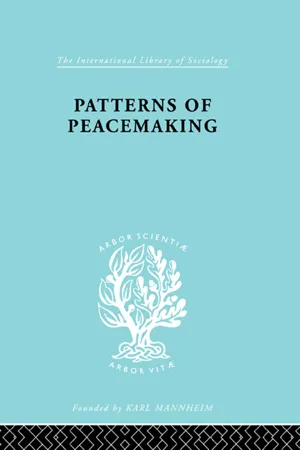
Patterns of Peacemaking
About this book
This is Volume XIII of eighteen in a series on Political Sociology. Originally published in 1945, this books makes a systematic survey and analysis, as objective as possible, of the tendencies most likely to govern peace-making. The authors intended to avoid making any specific recommendations of their own as to how the labours of peace-making should be undertaken, and to confine themselves to a study of how they were likely to be undertaken in the light of past experience, contemporary proposals, and the present alignment of political powers in the world. In the process of study, discussion and writing, all three authors arrived at certain more definite conclusions. At the same time, the course of events and the increasingly clear trend of official policies seemed to justify more positive assertions and more constructive suggestions than had at first been thought possible. The book, therefore, takes its present hybrid form: of systematic analysis carried forward to certain statements and even recommendations.
Information
PART I
THE TECHNIQUE OF PEACEMAKING
CHAPTER I
THE CLIMATE OF PEACEMAKING
§ 1. How different from last time?—nationalism in 1919 and now: an “international civil war”?: public interest in problems of peacemaking: interest of the services: secret agreements of 1918 absent now?: Lend-Lease.
§ 2. How similar to last time?—the widening scope and increasing intensity of “total war”: the growing share of public opinion in peacemaking: armistice hysteria and war-hatreds: economic and social dislocation: the maintenance of war-time controls: the more “positive State” growing from “total war”.
§ 3. Some lessons learnt: international co-operation to liquidate the results of war: national planning: demobilization last time and now: prisoners of war and deported workers: precautions against economic depression: deferred purchasing power: political dangers and “Khaki elections: the rôle of Russia.
§ 4. Summary and conclusions: psychological conditions: social conditions: economic conditions: political conditions.
§ 1. HOW DIFFERENT FROM LAST TIME?
The general environment in which peacemaking will take place after this war will be in many ways different from last time. There was little attempt last time to secure that nationalism should be transcended or superseded by larger loyalties: little belief, except among a few outstanding individuals and small groups, that “patriotism is not enough”. It is true that pacifists were persecuted and gagged in many countries. But they believed that patriotism was too much. International Socialism—the Second International—broke down at the very start of war: and the murder of Jaurès in August, 1914, was symbolic of the breakdown of internationalism as both a movement and an ideal.1 The war became more nationalistic as it went on, until the very basis of the peace settlement itself was that principle which had been proclaimed by President Wilson as “an imperative principle of action which statesmen will henceforth ignore at their peril”: national self-determination. The President’s “Fourteen Points”, contrary to popular belief, were concerned little with lofty ideals of humanitarianism but rather with quite specific undertakings that States should be made more perfect nation-States. And the League of Nations was based on acceptance of the sovereign, territorial nation-State as the unit of all modern diplomacy, politics and social life. The peace-settlement and the League were the apotheosis of the secular, sovereign national community as the basis of all international action.1
This war began less as a war of nationalism than as a war of defence against fascism. During the decade of the 1930’s, men had become accustomed to the idea of an “international civil war”, involving a battle between the forces of liberalism, democracy, socialism on one side, and the reactionary forces of fascism and totalitarian dictatorship on the other. Experience of the Stavisky Riots and the Cagoulard Plot in France, of the Spanish Civil War in which Axis intervention and the International Brigade played so great a part, of general strikes and fascist agitation in almost every country, all seemed to indicate the breaking up of the nation-State as the highest focus of men’s loyalties. Writers had written as if the wars of nationalism were past, and all future wars would be civil wars between conflicting ideologies.2 The notion that war and revolution are inseparable in modern times became widely accepted as a dogma.3 And when Nazi “fifth column” activities (a term significantly coined during the Spanish Civil War) spread throughout all Germany’s neighbours and even across the Atlantic, these notions seemed to be abundantly borne out. The fall of France in 1940 was readily interpreted as due to fifth column and to the conviction, among the bulk of France’s ruling classes, that they would be “better with Hitler than Blum”. The Communists alone—and they somewhat hesitatingly and only until Soviet Russia was attacked—proclaimed this to be an “imperialist war” of the familiar kind.
The importance attached to propaganda as a weapon of war still further encouraged these beliefs Political warfare means appealing above the heads of national governments to the people of the enemy State—appealing for revolution to end the war. It was not startling for “Scipio” to write, in 1940, a book about propaganda and the fifth column called 100,000,000 Allies—if we choose. The exaggerated importance which all belligerents attached in the early years of the war to propaganda as a weapon was not justified in practice.1 It under-estimated the cohesive force of national sentiment, the difference between propaganda carried on within a national community by its own government and propaganda which could be dubbed, from the first, the “voice of the enemy”. The most powerful propaganda of the whole war proved to be the steady supply of reliable news and information provided by the B.B.C. for peoples of the German-occupied territories—that is, for people already fired with a spirit of national resistance to German oppression. Revolutions, when they came, were revolutions against the national oppressor: though in so far as they are also revolts against the classes and conditions which had helped to make national defeat possible, their truly revolutionary character may appear only during the period of peacemaking. The writers of the 1930’s have not yet been proved wrong in identifying war with revolution: they may only have antedated the effects which they described.
The short-term effect of this war, however, has been to breed not revolution but a more fervent nationalism. In none of the defeated enemy States has it precipitated more than a political revolution by gradual stages, as in Italy:2 or a simple change of government, as in Bulgaria, Roumania and Finland. In Germany and Japan, the effect has been ever more strenuous—but largely successful—efforts to preserve and intensify national solidarity. In the occupied countries, national feelings have been stirred and canalized by resistance to German domination, just as the empire of Napoleon aroused a tide of nationalism which surged throughout* Europe for the next generation. In the other allied countries, the total nature of war, the greater intimacy of the effects of war for every citizen, the experience of bombing and blockade have likewise brought closer and more self-conscious national unity.
Yet the nationalism so aroused is different in character from the nationalism of 1914–18. There is little belief that “patriotism is enough”. The twenty years’ crisis and the twenty years’ truce have together implanted the general belief that nationalism cannot be an end in itself: that peace cannot be found in isolation or in neutrality; and that war springs not from imperfections in national unity as men believed true in a territorial sense in 1919,1 or in an ideological sense in 1939. It is widely believed, as will be shown below,2 that international co-operation on the purely political and diplomatic level is not enough, either: but that internationalism must be concerned with social conditions, economic policies and cultural co-operation, and must transcend national loyalties and national organization, even while comprising and satisfying nationalist aspirations, for security and prosperity. In this way, the climate of opinion will be very different from the climate of opinion in 1919. Last time, the settlement was the culmination of nineteenth-century enthusiasm for “national unification”. This time, it will be the culmination of twentieth-century enthusiasm for “national liberation”—liberation not only from fear but from want. That will be the most fundamental difference.
Other elements in the present situation will help to intensify this difference. People in all the United Nations have been made to think more—and to start thinking earlier and more systematically—about problems of peacemaking. The profound heart-searchings prompted by the tragedy of two world wars in one generation: the background experience of prolonged political and economic crisis in the years between these two wars: the early direction of men’s thoughts towards social and economic reconstruction by declarations such as the Atlantic Charter and the great speeches of President Roosevelt and other American leaders:3 the need to undertake extensive reforms even during war itself:4 all have paved the way for a more interested and well-informed public opinion about peacemaking than existed in 1919.5 The existence of radio, whereby the voices of ally and enemy, no less than of national leaders, are brought into the home of the ordinary citizen (and whereby he can, through firsthand war reports, share by proxy in the very atmosphere of battle), constantly focuses public attention on the day-to-day events and the permanent issues of the war and of the peace. In Britain the fighting services themselves afforded new forms of political education, and new opportunities for political discussion through such organizations as the Army Bureau of Current Affairs and the Army Education Corps have been encouraged to give attention and thought to political, social and economic problems. Despite all shortcomings, the armies of Soviet Russia, the United States and the British Commonwealth are more completely citizen armies to-day than ever before: armies with the interests of civilians in full employment, social security and economic prosperity after the war.1 This cannot but have a powerful influence on the making of peace.
In so far as these widespread popular interests and this new popular education open the door to individual thought, it makes for more rationality in peacemaking. But in so far as it merely gives facilities for propaganda, it perhaps makes nationalist doctrines and emotions easier to impart. One striking feature of the fourth and fifth years of war in Britain, at least, was popular concentration on “the German problem”—and the dissemination of semi-racial conceptions of Germany as the eternal “butcherbird” of history. A little education is a dangerous thing, winning credulity for pseudo-scientific notions and plausible historical “interpretations”. The very intensity of popular interest in—and demand for—greater social security and economic prosperity is a temptation to politicians to divert popular attention away from the complex and difficult problems of domestic reconstruction, towards other much simpler and more easily attainable objectives, such as the punishment of war criminals, the disabling of the enemy, reparations and retribution.
The actual effects of the above considerations on the character of the next settlement are thus difficult to predict. Last-moment developments have the power to twist national sentiment and popular demand in one direction or another: and the situation remains malleable until the very last stages of peacemaking. This is further reason for the most thorough and careful investigation of the forces at work, if they are to be in any way consciously controlled for good, instead of being allowed to drift haphazard into evil.
Conscious control and direction of events is made easier by one further important difference between this time and last. There are no secret agreements or treaties this time amongst the allies, no hidden engagements to neutrals or former enemies.1 Mr. Eden has given British assurance of this in the House of Commons. This is due not merely to respect for the principle which President Wilson placed first among his Fourteen Points—the desirability of “open covenants openly arrived at”. There has been little or no need in this war to bribe countries to enter the war by secret promises and concessions. No great countries, except Britain, her Dominions and France, have entered the war until they themselves were directly attacked or (like Brazil) felt themselves directly threatened. Where a smaller country—such as Turkey—has had pressure put on her to sever relations with the enemy, such pressure has normally taken the form of diplomatic protests or economic assistance, not of territorial promises. Last time, the Treaties of London with Italy in 1915, and of Bucarest with Roumania, proved an entanglement and handicap to the peacemakers of Paris. They led to immediate disputes between Italy and Yugoslavia about Fiume and the Dalmatian coast, and to prolonged dispute between Russia and Roumania about Bessarabia, settled only in 1944 by the Soviet defeat of Roumania. Secret British and French promises of Constantinople to Russia (in return for which Russia promised to support French claims to the Rhineland) were prevented from causing further trouble only by the collapse of Russia in 1917.2 This time the only comparable promises or offers of territorial concession have not been secret, and have been made at a late stage when they were certain of fulfilment and could be agreed among the United Nations as parts of the eventual settlement.3 T...
Table of contents
- Cover
- Title Page
- Copyright Page
- CONTENTS
- PREFACE
- INTRODUCTION GETTING WHAT WE WANT
- PART I THE TECHNIQUE OF PEACEMAKING
- PART II THE FRAMEWORK OF PEACEMAKING
- PART III THE SUBSTANCE OF PEACEMAKING
- POSTSCRIPT : UNRESOLVED CONFLICTS
- APPENDICES : I. UNITED NATIONS AGREEMENTS
- APPENDICES II THE INTERNATIONAL LABOUR ORGANIZATION
- APPENDICES III NEW ORGANIZATIONS
- SELECT BIBLIOGRAPHY
- INDEX
Trusted by 375,005 students
Access to over 1.5 million titles for a fair monthly price.
Study more efficiently using our study tools.
Frequently asked questions
Yes, you can cancel anytime from the Subscription tab in your account settings on the Perlego website. Your subscription will stay active until the end of your current billing period. Learn how to cancel your subscription
No, books cannot be downloaded as external files, such as PDFs, for use outside of Perlego. However, you can download books within the Perlego app for offline reading on mobile or tablet. Learn how to download books offline
Perlego offers two plans: Essential and Complete
- Essential is ideal for learners and professionals who enjoy exploring a wide range of subjects. Access the Essential Library with 800,000+ trusted titles and best-sellers across business, personal growth, and the humanities. Includes unlimited reading time and Standard Read Aloud voice.
- Complete: Perfect for advanced learners and researchers needing full, unrestricted access. Unlock 1.5M+ books across hundreds of subjects, including academic and specialized titles. The Complete Plan also includes advanced features like Premium Read Aloud and Research Assistant.
We are an online textbook subscription service, where you can get access to an entire online library for less than the price of a single book per month. With over 1.5 million books across 990+ topics, we’ve got you covered! Learn about our mission
Look out for the read-aloud symbol on your next book to see if you can listen to it. The read-aloud tool reads text aloud for you, highlighting the text as it is being read. You can pause it, speed it up and slow it down. Learn more about Read Aloud
Yes! You can use the Perlego app on both iOS and Android devices to read anytime, anywhere — even offline. Perfect for commutes or when you’re on the go.
Please note we cannot support devices running on iOS 13 and Android 7 or earlier. Learn more about using the app
Please note we cannot support devices running on iOS 13 and Android 7 or earlier. Learn more about using the app
Yes, you can access Patterns of Peacemaking by A. Briggs,E. Meyer,David Thomson in PDF and/or ePUB format, as well as other popular books in Social Sciences & Sociology. We have over 1.5 million books available in our catalogue for you to explore.