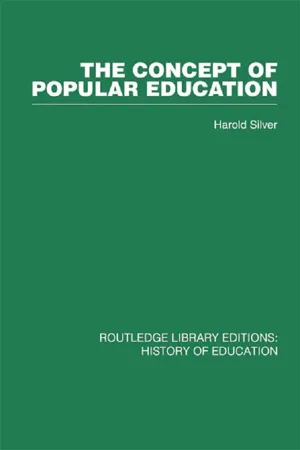
Originally published 1965. This reprints the 1977 edition which included a new introduction. From the starting point of "popular" charity education, the book traces the dynamic of ideological and social change from the 1790s to the 1830s in terms of attitudes to education and analyzes the range of contemporary opinions on popular education. It also examines some of the channels through which ideas about education were disseminated and became common currency in popular movements.
- 304 pages
- English
- ePUB (mobile friendly)
- Available on iOS & Android
eBook - ePub
The Concept of Popular Education
About this book
Information
CHAPTER II
Principles into Practice
(i) Perennial fountain of science
MODERN concepts of popular education, as of political democracy, leap into historical prominence in Britain in the 1790’s. It is our concern here to see how, against the backcloth of the French Revolution, in the situation of growing industrialism, and through the activities of people and of movements concerned with the radical regeneration of British politics and society, some of the rationalist assumptions we have examined came to be disseminated, as a challenge to the established order of ‘mental darkness’ or ‘mental glimmer’.
On October 4, 1793, Robert Owen attended his first meeting of the Manchester Literary and Philosophical Society,1 and on one occasion, called on to give his comments in a discussion on cotton spinning, ‘blushed, and stammered out some few incoherent sentences, and felt quite annoyed at my ignorance and awkwardness being thus exposed’.2 In December 1793 the house of the Manchester radical, Thomas Walker, was attacked by a King-and-country mob; Tom Paine had been tried (in his absence) the previous year, and 1793–4 was the period of treason trials against booksellers and radicals (including Walker himself). Paine's Rights of Man had appeared in 1791–2, Mary Wollstonecraft's A Vindication of the Rights of Men in 1790 and her A Vindication of the Rights of Woman in 1792. Godwin's Political Justice appeared in 1793.
When Owen, therefore, at the age of twenty-two began to attend the meetings of the Manchester Literary and Philosophical Society, it was against a background not only of the expansion of Britain's, and particularly Manchester's, industry and population, but of social and intellectual conflict. Information about how, through the Society and elsewhere, he came to a greater self-confidence than he displayed in the discussion on cotton spinning, his contact with the world of ideas, and the growth of his conviction that some of the ideas of the Enlightenment we have discussed were not only true but practicable, is unfortunately fragmentary; in trying to piece the story together, however, we will be looking at a case study in the emergence of a whole new social outlook in Britain, in a recasting of the terms in which popular education was discussed.
Owen had arrived in Manchester in the late 1780’s,1 having previously worked as a draper's assistant, in Stamford and London, and highly conscious, as he was to be for many years, of his lack of any advanced education. In his Life he describes how, when he first became manager in a large mill in Manchester he had been ‘a thoughtful, retiring character, extremely sensitive, and could seldom speak to a stranger without blushing, especially to one of the other sex…and I was diffident of my own powers, knowing what a very imperfect and deficient education I had received’.2
Such schooling as Owen did have was in the small Newtown, in Wales, under, as Owen tells us, ‘a Mr Thickness, or some such name’. He started school at the age of four or five, and learned to ‘read fluently, write a legible hand, and understand the four first rules of arithmetic’, which was considered ‘a good education’ in schools in these small towns, and in any case ‘I have reason to believe…the extent of Mr Thickness'a qualification for a schoolmaster—because when I had acquired these small rudiments of learning, at the age of seven, he applied to my father for permission that I should become his assistant and usher, as from that time I was called while I remained at school…about two years longer’.3 At the age of ten he set off for his first job, in Stamford.
The only record we have of Owen's early reading is in his autobiography. The books he read, he tells us, included ‘Robinson Crusoe, Philip Quark, Pilgrim's Progress, Paradise Lost, Harvey's Meditations among the Tombs, Young's Night Thoughts, Richardson's and all other standard novels’.1 He also read navigators’ voyages, some history ‘and all the lives I could meet with of the philosophers and great men’. His employer in Stamford, a draper called McGuffog, in whose house he lived, had a ‘well-selected library’ and he read ‘upon the average about five hours a day’, though the only author he specifies is Seneca.2 After three years in Stamford he moved to London, to a firm where the work was so hard that he had time to read only ‘in the less busy season’.3 Deductions about the ideological equipment with which Owen arrived in Manchester are therefore extremely difficult to make. Colonel M. Jullien, ‘the philanthropic friend and historian of Peslatozzi’,4 is said to have claimed that with Owen:
‘…what first pleaded the cause of nature and of sense was reading the adventures of Robinson Crusoe, contemplating what might be called the manual and practical education of necessity, remote from the institutions of men, which are often maleficent…’5
Jullien may have heard Owen himself comment on the impact on him of this story of ‘economic man’; Owen merely confirms that he had read the novel. We can only speculate, therefore, as to whether Defoe's novel, with its total situation of the absence of any dominant social institutions (or unmanageable natural handicaps), contributed to Owen's receptivity to the rationalist position. We can do nothing but speculate, similarly, despite the attention the reference has subsequently attracted, as to the importance of the mention of Seneca;6 the only useful clue in the reference is to the fact that Owen was no doubt familiar at this early stage with habits of abstract thought, and above all with simple humanitarian philosophy.
He was familiar, similarly, with religious controversy. He tells us that when he was probably eight or nine, some friends of the family, gave him Methodist books to read, being ‘desirous to convert me to their peculiar faith’. He read these and other religious works ‘of all parties’ and was surprised, ‘first at the opposition between the different sects of Christians, afterwards at the deadly hatred between the Jews, Christians, Mahomedans, Hindoos, Chinese, etc. etc., and between these and what they called Pagans and Infidels’.1 And so, he tells, at the age of ten he became convinced that there must be something fundamentally wrong in all religions, as they had been taught up to that period’.2 He went on to abandon the Christian religion and ‘all others’.3
His first job in Manchester was again with a draper, but before long, on borrowed capital, he was in partnership on a small scale making machinery for spinning cotton and in 1792 he became manager over some five hundred workpeople at the new mill of Peter Drinkwater.4 Relatively inexperienced and awkward in his social relations, he assiduously devoted himself to learning the complexities of his new and responsible task. He remained at Drinkwater's, acquiring a growing reputation as a spinner of fine cotton, probably until 1794, when, feeling that Drinkwater was not keeping faith with him over an agreement that he should become a partner, he left and entered into a partnership which was to build cotton mills, and then into another partnership—the Chorlton Twist Company, of which he was manager in Manchester from 1796 to 1800.5 Owen's reputation as a cotton spinner had won him a leading position in the world of industry.
Peter Drinkwater held relatively advanced views on some aspects of factory organisation. In a letter on the subject of sanitary arrangements, for example, he indicated that ‘the object of keeping the factory sweet and wholesome at this point is a matter which I cannot help considering of the utmost importance, whether as regards decency, convenience or humanity’.1 The fact that Drinkwater's mill was in any sense at all well-run, or humanely run, in a period such as this, is of considerable importance to the examination of Owen's future development. Owen himself claimed that by the time he became Drinkwater's manager he had ‘perceived the constant influence of circumstances over my own proceedings and those of others’. He had come to the conclusion that ‘man could not make his own organization, or any one of its qualities, and that these qualities were according to their nature, more or less influenced by the circumstances which occurred in the life of each…I therefore viewed human nature in my fellow-creatures…with far more charity’. This, in his view, enabled him to exert ‘complete influence’ over the workpeople within six months, and ‘their order and discipline exceeded that of any other in or near Manchester’.2
This does not mean, of course, that Drinkwater's was a model mill, or that Owen was undertaking a community experiment there. The point is that Drinkwater's ideas and the conditions in the mill were progressive fr...
Table of contents
- Front Cover
- Half Title
- Title Page
- Copyright
- Title Page
- Copyright
- CONTENTS
- ACKNOWLEDGMENTS
- ABBREVIATIONS
- PREFACE
- INTRODUCTION
- I SOME EIGHTEENTH CENTURY ATTITUDES
- II PRINCIPLES INTO PRACTICE
- III THE FATE OF AN IDEA
- IV ARCHITECTS AND BUILDERS
- V ON HIGHER GROUND
- APPENDIX A
- APPENDIX B
- APPENDIX C
- APPENDIX D
- INDEX
Trusted by 375,005 students
Access to over 1.5 million titles for a fair monthly price.
Study more efficiently using our study tools.
Frequently asked questions
Yes, you can cancel anytime from the Subscription tab in your account settings on the Perlego website. Your subscription will stay active until the end of your current billing period. Learn how to cancel your subscription
No, books cannot be downloaded as external files, such as PDFs, for use outside of Perlego. However, you can download books within the Perlego app for offline reading on mobile or tablet. Learn how to download books offline
We are an online textbook subscription service, where you can get access to an entire online library for less than the price of a single book per month. With over 1.5 million books across 990+ topics, we’ve got you covered! Learn about our mission
Look out for the read-aloud symbol on your next book to see if you can listen to it. The read-aloud tool reads text aloud for you, highlighting the text as it is being read. You can pause it, speed it up and slow it down. Learn more about Read Aloud
Yes! You can use the Perlego app on both iOS and Android devices to read anytime, anywhere — even offline. Perfect for commutes or when you’re on the go.
Please note we cannot support devices running on iOS 13 and Android 7 or earlier. Learn more about using the app
Please note we cannot support devices running on iOS 13 and Android 7 or earlier. Learn more about using the app
Yes, you can access The Concept of Popular Education by Harold Silver in PDF and/or ePUB format, as well as other popular books in Education & Education General. We have over 1.5 million books available in our catalogue for you to explore.