eBook - ePub
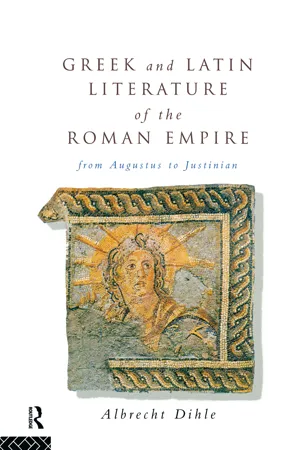
Greek and Latin Literature of the Roman Empire
From Augustus to Justinian
- 656 pages
- English
- ePUB (mobile friendly)
- Available on iOS & Android
eBook - ePub
Greek and Latin Literature of the Roman Empire
From Augustus to Justinian
About this book
Professor Dihle sees the Greek and Latin literature between the 1st century B.C. and the 6th century A.D. as an organic progression. He builds on Schlegel's observation that art, customs and political life in classical antiquity are inextricably entwined and therefore should not be examined separately. Dihle does not simply consider narrowly defined `literature', but all works of cultural socio-historical significance, including Jewish and Christian literature, philosophy and science. Despite this, major authors like Seneca, Tacitus and Plotinus are considered individually. This work is an authoritative yet personal presentation of seven hundred years of literature.
1
INTRODUCTION
1 GENERAL REMARKS
After his decisive victory in the last of those civil wars which had gone on for about a century, Augustus brought peace and a new order to all the countries surrounding the Mediterranean Sea. But for those who lived in the part of the world where Greek culture dominated, for the citizens of Athens, Ephesus, Antioch, or Alexandria, this new order did not have the same features as it presented to people of the Romano-Italic tradition. It is true that on both sides of the linguistic divide, this man's astounding political success was seen as a superhuman achievement; and the apostrophising of the Emperor as a divine being, which was fairly common to the Augustan writers of Rome, could not simply be dismissed as the flattery of courtier-poets.
On the other hand Augustus tried very hard to make the new order which he gave to his world empire – an order we would not see as anything else than monarchic – appear to the Italians and to the Latin world as a restoration of the Roman Republic. He was reluctant to permit the worship of the living Emperor in the West; he was anxious to construe his manner of wielding almost absolute political power as the exercising of limited Republican control; he insisted on a show of equality with the other Roman Senators, among whom his claim to leadership was to be based solely on personal ‘authority’; and finally, he encouraged the revival of countless institutions and customs which had degenerated or had been completely forgotten. These facts are evidence enough to prove that Augustus with good reason avoided presenting himself as a monarch in the public and religious life of the Roman milieu. In his day the political tradition of Rome was staunchly Republican, as his adoptive father Caesar had found out to his own detriment. It was no less an authority than Theodor Mommsen who described the political order of the Empire in its early and its high period as a dyarchy, that is a system where government is divided between Senate and Emperor. Untrue as this is with regard to the real distribution of power in state and society, it is certainly an accurate definition in terms of the political constitution.
Things looked entirely different from an eastern, Greek point of view. Here the Roman Emperor was always perceived as the successor to the Hellenistic Kings; this is to say as a monarch who like them was entitled on religious grounds to a position above the law which bound other humans. However, there was a difference between Augustus and the rulers of all those states which had emerged between Greece, Egypt, and India after the dissolution of Alexander's empire. There, power was legitimised by an ideology which saw the King as an earthly counterpart of the highest God and ruler of the world. But none of the monarchs of the Hellenistic world after Alexander had ever attained the fullness of power that could have supported the claim to world rule which has always been at least potentially linked to the cult and the ideology of the royal sovereign. With his victory at Actium Augustus had truly attained the position of world ruler. And more: he had succeeded in putting a definite end to the unrest, uncertainty, and exploitation which for several generations had accompanied the dissolution of the system of Hellenistic states under Roman pressure, and which had reached their peak during the final phase of the Roman civil wars. Thus he had proved to be the Soter, the Saviour, the good world ruler who was to restore the bliss of the golden age which had preceded all human sin and transgression at the dawn of time.
Consequently there is no need to be surprised by the enthusiasm with which the Greek East celebrated Augustus as world redeemer and world ruler, or by its readiness to recognise his divine status by acts of worship, the construction of temples, celebrations in his honour, or naming months after him. This shows how quickly and how smoothly, in the eyes of the Greek East, Augustus had assumed the part of King and world ruler without the slightest need to present his rule as the product of the authority bestowed by a Republican office.
The age of Alexander had already seen the clarification of the relationship between the monarch and the Greek city in its nature as an independent, free community with elected officials, its own calendar, its own dating system, its own legislation and jurisdiction, and above all, its own forms of worship. The god-like position of the ruler was the very reason why his messages or directions did not have to affect the formal independence of an urban community any more than the sayings of a divine oracle. In military terms and with regard to foreign relations such a city was, of course, in a dependent position. But as for all other aspects of its status, it must be noted that the Graeco-Macedonian rulers, not to mention the Oriental rulers of eastern territorial states, made it their particular concern to encourage the municipal independence of Greek cities as economic and cultural centres. In this manner, those monarchs were promoting the civilisation and the economic viability of their countries.
Greek civilisation, superior to oriental cultures, thrived in the cities, and it was an obvious way of social climbing for a native rural Phrygian or Syrian to become an inhabitant or even a citizen of such a city, and finally to become a Greek. The cities fostered intense social activity, expressed in the form of worship and festivals, schools and other places of education, sports and clubs, health care and poor relief, but above all public building, often financed by private benefactors. There could hardly have been a single one among those hundreds of communities between Sicily, Afghanistan, and Egypt which did not have theatres and grammar schools, baths and libraries, market halls and water installations, not to mention the temples. Here was the reason for the attraction which a city held for the rural people, underprivileged throughout the Romano-Hellenistic world. To the Greek population, the self-assurance and the far-reaching autonomy of the cities were a continuation of the tradition of city-states in the Classic period, the only difference being an arrangement – not too insulting to municipal pride – with the superior power of territorial rulers, which only very few cities (for example, Rhodes) could escape for any length of time.
The accession to power of a Roman monarch who established a modern administration with officials whom he trusted did not signify a rupture; on the contrary, Augustus could build on existing circumstances. In contrast, the Roman Republic had put the countries conquered and ruled by Rome under the command of members of the Senatorial aristocracy, changing yearly, and uncontrolled by any other authority; all of them people who saw this step in their political career as a welcome means of accumulating personal wealth for themselves and for their friends and their clientele, from whom they recruited their staff for their year of office, and on whom they relied for their further political campaigns.
Augustus introduced a varied administration to the Empire. The older provinces, being under no military threat from outside, remained in the domain of the Senate, and were governed by the respective former holders of higher offices in the Republican tradition, even if those offices were losing their importance, and finally came to be mere titles. The other provinces, where a large part of the army was stationed, were brought under the personal authority of the Emperor on the basis of the position he had attained as the supreme military commander. These provinces were administered by civil servants who came from the second order of Roman society, the knighthood, and who were directly answerable to the Emperor; although in the highest ranks there were also some members of the Senatorial class. Unlike the Republican governors and their entourage, these professional officers and civil servants, who had not attained their positions by making a mark in the hurly-burly of politics but by proving their competence and efficiency in a career in public service, guaranteed a regular, controlled, and legal administration after the model of Hellenistic kingdoms. Naturally the superior quality of the Imperial bureaucracy also provided a new yardstick for the Senatorial provinces.
In addition to the two types of provincial government, the Emperor kept a sizeable administration in his domains, most of which he acquired by taking over the property of the crown from previous dynasties to which the Roman Emperor monarch considered himself the legitimate successor. This category included all of Egypt, the richest country and the most vital one for the supply of grain to the capital. Here Augustus ruled as successor to the Ptolemies and the Pharaohs, almost a law unto himself. No Senator, that is to say no member of a class which in the fixed social order of Rome included the Emperor himself, was allowed to enter Egypt without his permission, being a potential rival for the highest position in the state.
Egypt, where a Greek state had managed to survive in the face of Roman power until 31 BC, was a special case in the Hellenistic world. On the one hand it contained Alexandria, the biggest and proudest city of the Orient; but in the rest of the country the Greek part of the population, which was culturally and economically dominant, did not live in autonomous municipal communities. Those Greeks, living according to their own civil law, were commonly called ‘the people of the gymnasium’ because they could not be immediately recognised as Greeks, as was the case elsewhere, through their attachment to a city.
The label shows that in Egypt, and not only there, the Greeks were regarded as what the nineteenth-century Germans came to call eine Kul-turnation: a truly civilised nation, defined by its culture. All over the world the most characteristic expression of the Greek way of life was the practice of sports, and serious cultivation of the literary tradition in the Greek language. And because the Romans, especially the upper classes, knew that their own civilisation was largely founded on the Greek model, the cultural self-confidence which united the Greeks around the eastern Mediterranean was at the same time a decisive factor in that consciousness which was slowly growing in East and West alike: the consciousness of being part of a huge community containing the entire civilised world. This community, however, could be entered by all who embraced Graeco-Roman civilisation.
The Imperial order of Rome, which foresaw such a development, had created yet another type of government for dependent territories. This concerned native monarchies on the periphery of the Empire – for example, Mauritania in western north Africa, Cappadocia in eastern Anatolia, or Judaea. The Romans trusted in the ability of their respective rulers to civilise those countries by measures such as the foundation of cities to an extent which would enable them one day, after the end of a dynasty, to enter into provincial status.
Of course the members of such dynasties themselves had to undergo a more or less thorough process of Hellenisation or, in the West, of Romanisation, spreading and strengthening the status of their newly acquired civilisation by the foundation of cities. This corresponded exactly to Roman policy in territories with an uncivilised population such as Gaul which had to be taken into firm provincial administration immediately for security reasons. But here also, the cultural and linguistic adaptation of the upper classes (i.e. of the chieftains and local dignitaries) was encouraged and eventually rewarded by the award of citizenship, or even elevation to knighthood. There was a constant flow, mainly via a long period of military service, of Gauls and Syrians, people from Asia Minor and Mauritania, Germans and Libyans, who came to be Greek- and Latin-speaking holders of Roman citizenship.
Naturally social structures varied a lot within the vast area of the Empire. Beside the urbanised regions of Italy, Greece, western Anatolia or southern Spain, central Anatolia, for instance, had huge temple estates with peasants living in bondage; Egypt had a social order which was based entirely on the village as the fundamental unit of an agricultural economy; central and northern Gaul still had an intact system of rural tribes, with a nobility, freemen, and slaves. As trade and administrative activity increased, the religious centres and places of assembly in the tribal areas slowly assumed the character of cities and were granted the status of coloniae or municipia, with independent municipal administrations.
This had been the avowed aim of Imperial Roman policy for centuries: the penetration of urban culture into the dependent territories, regardless of their different native traditions. For this purpose, colonies were most frequently founded on the military frontiers of the Empire, along the Rhine, the Danube, and the Euphrates. The existence of civic communities established by former soldiers with twenty or twenty-five years of service and their families strengthened the structure of the Empire and accelerated its Romanisation in the West and its Hellenisation in the East.
The strengthening and the promulgation of municipal culture within the framework of a secure legal order gave meaning as well as substance to the policy of this global state. Its long stability as well as its civilising influence, which outlasted the Empire's existence by many centuries, prove the success of this endeavour.
In the East as well as in the West, the prime upholders and the prime beneficiaries of this urban culture were the upper-class burghers. The socio-historical research of the famous historian Michael Rostovzev has shed ample light on the ‘bourgeois’ character of Imperial culture. That this social class may be so exactly defined is a consequence of the tendency -with its roots in the reforms of Augustus and steadily growing stronger during the Imperial age – towards a legal fixing of the borderlines between the social classes. This had been unknown to the Roman Republic and, despite its extreme social contrasts, also to the Hellenistic East. In the Empire, for example, there were explicit instructions for a different application of the penal code to honestiores and humiliores and, towards the end of the Classical age, all professions which were of any importance in fiscal terms had been made hereditary by law.
The upper-class burghers, whose economic power could be based on the possession of agricultural land, trading or banking, the production or the transport of goods, usually sent their representatives to the municipal council, which in turn elected the holders of administrative, juridical, and religious offices from its midst. Even though a hierarchy of stages of appeal for difficult cases existed, leading via the provincial governor to the central Imperial administration in Rome, and in spite of the fact that occasionally the state sent commissaries whose main task was to investigate faults in the financial administration of a city, the legal powers of an independent municipal administration were far reaching. Thus the members of the upper classes found ample opportunity to use their talents in public life and to satisfy their social ambitions.
It was not only the holders of municipal office who could gain social prestige: this was also possible through, above all, donations for public enterprises such as building, organising festivals, or improving education. Institutions founded on private generosity found ample recognition for which countless inscriptions in honour of benefactors stand as evidence. At the same time such institutions also increased the municipal pride of the mass of free citizens, small-scale craftsmen, tradesmen, workers, and farmers, who did not have a share in the administration. For as in Rome, so in the Empire: Augustus had initiated a development which in due course replaced the democratic elements of the Republican constitution by oligarchic-aristocratic ones, such as the election of the one-year officials by the Senate instead of the popular assembly in the so-called Comitia; and, similarly, the last remains of a democratic order vanished in the dependent territories.
Still, the responsibility of the upper classes for the welfare of their cities was even more far reaching. The Roman Republic, lacking until its end an administrative apparatus able to provide an orderly government for the mass of dependent territories it had acquired, had met the problem of taxation by resorting to a means called tax lease. This meant that bankers or investment companies could, by paying the sum expected as tax return into the public treasury, lease the right to collect the predominantly indirect taxes and duties within a certain area. This procedure opened the door to all kinds of abuse, blackmail, and money-grabbing, especially if the tax collector lent an insolvent debtor the money he owed, at an extortionate interest rate.
It is hardly surprising that the long-suffering inhabitants of the Greek cities of Asia Minor massacred thousands of the hated Romano-Italic tax collectors, money-lenders, and profiteers during the temporary expulsion of the Romans by King Mithridates of Pontus at the beginning of the first century BC. On the whole, the reforms of Augustus had improved the situation here, even if the lease of certain taxes, most notably road and bridge tolls as well as customs duties, was retained. ‘Publicans and sinners’ are well known from the New Testament which portrays the situation in Palestine during the early days of the Empire. But in the cities it was common for an official to take over the liability for taxes owed to the treasury so that the collection of taxes could then be arranged internally by an independent administration. This procedure had a long tradition, especially in the Greek world where in Classic times wealthy citizens had been taxed directly only in exceptional cases. Generally they were asked, individually or in groups, to finance precisely defined public projects by a so-called liturgy; this could be for a festival, or for the equipment of a warship.
During the Empire a complicated system of such contributions or munera to the state or the local community took shape in East and West alike, the lower classes invariably being asked for physical labour, while the requirement from the upper classes, particularly the elected holders of offices, was for financial dues. This mechanism of financing public projects worked well while the Empire enjoyed a certain wealth. But in the economic crisis of the third century AD, the Emperors introduced the collective liability of entire municipal councils, and forced payments of tax debts so ruthlessly that the members of this group kept trying to abandon their legal status, and to move into the ranks of the lesser bourgeois, who were under less pressure. As a privilege the complete exemption from such demands could be expressly granted. Such immunity was given, for example, to professors, physicians, or priests; but occasionally also as a reward for excellence in political or administrative service.
In spite of the fixed borders between social classes, there were plenty of possibilities for upward mobility, at least in the Early and the High Empire, and always within a municipal framework. One approach was through service in the army and the Imperial administration, whose posts were mostly filled by officers and non-commissioned officers on temporary leave. The legions were recruited among holders of citizenship. Whoever had made it to the rank of a senior NCO or a junior officer after twenty years of service, was entitled to the status of a Decurion when returning to civilian life, either to his home city or to a colony of veterans. Such a man was considered to be qualified because of his knowledge of the world and his insight into administrative matters, as well as his command of two languages; his offspring had no harder task to perform than to maintain their social status. In the so-called auxiliary troops non-citizens served twenty-five years and were given Roman citizenship on discharge. Thus their sons were able to enter service in the legions, and consequently start the path of social climbing described above.
The other way was by winning one's freedom. The status of the unfree population was fairly varied: there were hereditary leaseholders who were not legally slaves but were still not allowed to leave their places on the land; their freedom was curbed legally to the same extent that other leaseholders or farmers were restrained by economic necessity. Then there were slaves who lived in barracks, working in mines and on large agricultural estates; those hardly had any chance of rising above their status. But the mass of slaves in the cities belonged to the household – called famili...
Table of contents
- Front Cover
- GREEK AND LATIN LITERATURE
- Title Page
- Copyright
- CONTENTS
- Preface
- 1 INTRODUCTION
- 2 THE JULIO-CLAUDIAN ERA
- 3 THE FLAVIAN ERA
- 4 THE SECOND CENTURY
- 5 THE SEVERAN ERA
- 6 THE CRISES OF THE THIRD CENTURY AD
- 7 THE ERA OF DIOCLETIAN AND CONSTANTINE
- 8 THE CHRISTIAN EMPIRE
- Postscript
- Bibliography
- Index
Trusted by 375,005 students
Access to over 1.5 million titles for a fair monthly price.
Study more efficiently using our study tools.
Frequently asked questions
Yes, you can cancel anytime from the Subscription tab in your account settings on the Perlego website. Your subscription will stay active until the end of your current billing period. Learn how to cancel your subscription
No, books cannot be downloaded as external files, such as PDFs, for use outside of Perlego. However, you can download books within the Perlego app for offline reading on mobile or tablet. Learn how to download books offline
Perlego offers two plans: Essential and Complete
- Essential is ideal for learners and professionals who enjoy exploring a wide range of subjects. Access the Essential Library with 800,000+ trusted titles and best-sellers across business, personal growth, and the humanities. Includes unlimited reading time and Standard Read Aloud voice.
- Complete: Perfect for advanced learners and researchers needing full, unrestricted access. Unlock 1.5M+ books across hundreds of subjects, including academic and specialized titles. The Complete Plan also includes advanced features like Premium Read Aloud and Research Assistant.
We are an online textbook subscription service, where you can get access to an entire online library for less than the price of a single book per month. With over 1.5 million books across 990+ topics, we’ve got you covered! Learn about our mission
Look out for the read-aloud symbol on your next book to see if you can listen to it. The read-aloud tool reads text aloud for you, highlighting the text as it is being read. You can pause it, speed it up and slow it down. Learn more about Read Aloud
Yes! You can use the Perlego app on both iOS and Android devices to read anytime, anywhere — even offline. Perfect for commutes or when you’re on the go.
Please note we cannot support devices running on iOS 13 and Android 7 or earlier. Learn more about using the app
Please note we cannot support devices running on iOS 13 and Android 7 or earlier. Learn more about using the app
Yes, you can access Greek and Latin Literature of the Roman Empire by Albrecht Dihle, Manfred Malzahn in PDF and/or ePUB format, as well as other popular books in History & Ancient History. We have over 1.5 million books available in our catalogue for you to explore.