- 148 pages
- English
- ePUB (mobile friendly)
- Available on iOS & Android
eBook - ePub
About this book
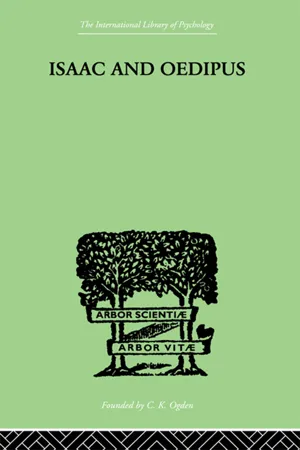
This is Volume V of six in the Psychology and Religion series. First published in 1954, this is a religious-psychological study of the father-son relationship. It represents a re-evaluation of the Oedipus Complex and is based on the exposition of the twenty-second chapter of Genesis, the Sacrifice of Isaac. The thesis of the study is that phenomena described in the Bible provide a unique contribution to psychological truth.
Information
I

Infanticide
‘In Upsal's town the cruel King
Slaughtered his sons at Odin's shrine
Slaughtered his sons with cruel knife
To get from Odin length of life.’
YNGLINGA SAGA
Translated from the Icelandic of Snorro Sturleson by Samuel Laing
Infanticide
THE PRIMAL DEED
‘IN the beginning was the deed.’ These are the closing words of Sigmund Freud's fundamental book Totem and Taboo. In this book he refers to Charles Darwin's hypothesis that in prehistoric times man lived in ‘primordial hordes’ which were led by a ‘primordial father’. Freud assumes that the primordial father was an all-powerful tyrant who owned all women and suppressed and drove away the developing sons. But ‘one day the exiled brothers united, killed and ate the father and made an end of his horde’.
Although no evidence exists for Darwin's hypothesis of a primordial horde, Freud's idea of primordial patricide is nevertheless valuable because it suggests that early society passed through a stage of intense conflict between parents and children and especially between fathers and sons.
It is a feature of Freud's psychology that he usually emphasizes the importance of the experiences of the child. This he has also done when he described the hypothetical patricide of the sons. It was, according to his opinion, ‘the original sin’ of mankind.
Freud did not go into a detailed description of the brutality of the primordial father. But the father's attitude, with that of the mother's, is the first and most formative experience of the children. If one follows up Freud's idea of the primordial father one can, therefore, assume that he not only Violently and jealously drove away’ some of his sons but that he also killed a number of them. This means that before primordial patricide there probably was primordial infanticide. Freud himself noted that the original crime or ‘original sin’ of mankind is sometimes described in myths as an act of infanticide and not of patricide. The murder and cutting into pieces of the young Dionysos-Zagreus by the first human beings, who were the descendants of the Titans, is an example.
Primitive man expressed his thoughts by deeds. If one considers the possibility of the sons having killed the primordial father one can infer that this was due to the father's behaviour. One can assume that in the beginning was infanticide.
In the beginning of the world, according to Greek cosmogony and theogony, was hatred by the parent of the child and infanticide.
The world of the gods began with Uranus who was created by Gaea, the Earth. Gaea not only was his mother but also his wife. They founded a family of Titans. It was a tragic feature of Greek mythology that Uranus, the primordial father of all Gods, violently hated and cruelly persecuted his children. He did not, however, commit infanticide. This occurred in the second generation.
Cronos, the youngest son of Uranus, with the help of his mother Gaea, rose against the persecution suffered through his father, castrated and dethroned him. His behaviour towards his children was worse than his father's towards him. He initiated infanticide by swallowing his children as soon as they were born and became thus the prototype of the devouring parent. The intensification of the hatred of his children in Cronos as compared with the hatred of Uranus had a particular reason. Cronos was warned by an Oracle that he himself would be supplanted by one of his sons and he knew from his own experience how real this danger was.
In spite of all the precautions of Cronos the Oracle was fulfilled. Zeus, his youngest son, again plotting with his mother, Rhea, overpowered Cronos and became King. The drama of infanticide continued. Zeus was informed that the son which his wife Metis would give him, would banish him from his throne. In order to forestall this he even surpassed his father's actions. He devoured his wife with the embryo in her womb.
These early stories are remarkable, as in their description of filio-parental relationships they foreshadow one of the most mature and moving of all Greek myths: the myth of Oedipus.
THE ANTHROPOLOGY OF INFANTICIDE
Infanticide was practised in historic times all over the world by all races and nations. As will be shown later its character differed greatly according to the societies where it occurred. The following chapter does not claim to be a comprehensive treatment of the subject but will give examples of the relevant material.
Julius Caesar, Suetonius and other ancient writers were appalled by the savagery of human sacrifices and infanticide committed by the French Celts, the Gauls. Children were frequently put to death before battle in order to ensure victory from the gods.1
Irish Celts sacrificed children to their God Cromm Cruach,2 the terrible ‘crooked one of the mound’. This was a huge idol which stood on the plain of Magh Sleact, the ‘plain of prostrations’ in the County of Cavan. It was surrounded by a circle of twelve other idols. The sacrifice took place at Samhain, that means at the summer's decline. By pouring their children's blood round the image the parents hoped to obtain an abundance of milk and corn. Firstborn children were sacrificed at the Fair of Taillte in the time of St. Patrick who preached against this.
The Ynglinga Saga, which is the opening part of The Heimskringla, the stories of the Kings of Norway, as told by Snorro Sturleson, an Icelandic chief in the twelfth century, contains many accounts of child murder in ancient Scandinavia.1 One of them relates how On, King of Sweden, slaughtered nine of his sons in order that Odin might prolong his own life. The moving verses describing this are quoted at the beginning of this chapter.
On's tenth son was Egil. He was rescued from his father's threat by the Swedes and became King. But the wish of his father that he should sacrifice his life for his sake had made a lasting effect on Egil. He only half-heartedly fought against it whilst he was partly willing to obey the father's command. This can be inferred from the story that Egil once hunted a fierce bull and struck him with a spear. The bull probably appeared to Egil as a father figure. The skilful hunter felt unable to complete the kill and so was gored to death by the bull. In this way Egil eventually succumbed to On's father image.
The readiness of the child to be sacrificed at his parent's command plays a great role in the development of filio-parental relationships. It is a tendency which is found in many myths and legends but reached its noblest fulfilment in the attitude of Isaac towards Abraham.
The Spartans in ancient Greece killed their deformed children Tor the good of the state’ on the mountain range of Taygetus. The ancient Romans too, forbade by law the rearing of deformed children.
Infanticide was widely practised amongst the peoples of the Eastern Mediterranean. The Carthaginians slew children ‘as if they were lambs or chickens. .. . They placed them one by one, on the sloping hands of the brazen image, from which they rolled into the pit of fire. . . . The mothers had to stand by and see it done without a tear or groan. But all the place in front of the image was filled with a tumultuous music of fifes and drums to drown the shrieks of the victims.’1 The God to whom the children were sacrificed was variously called Moloch, Melech, Mellsarth or Milcom.
Plutarch2 stated that Egyptian mothers sacrificed their children to the holy crocodiles and were ‘proud’ when the children were devoured by the reptiles.
The Pheonicians, according to Porphyry3 , sacrificed their children to Baal.
The Moabites, like all Semetic tribes, followed the custom that in times of great danger their leader should sacrifice his firstborn son as a ransom to the gods. This was described in the Second Book of the Kings.4 ‘And when the King of Moab saw that the battle was too sore for him ... he took his eldest son that should have reigned in his stead, and offered him for a burnt offering upon the walls.’
The Canaa...
Table of contents
- Cover
- Half Title
- Title Page
- Copyright Page
- Dedication
- Preface
- Table of Contents
- Illustrations
- Introduction
- Chapter I. Infanticide
- Chapter II. The Oedipus Complex
- Chapter III. The Akedah
- Conclusions
- Bibliography
- Author Index
- General Index
Trusted by 375,005 students
Access to over 1.5 million titles for a fair monthly price.
Study more efficiently using our study tools.
Frequently asked questions
Yes, you can cancel anytime from the Subscription tab in your account settings on the Perlego website. Your subscription will stay active until the end of your current billing period. Learn how to cancel your subscription
No, books cannot be downloaded as external files, such as PDFs, for use outside of Perlego. However, you can download books within the Perlego app for offline reading on mobile or tablet. Learn how to download books offline
Perlego offers two plans: Essential and Complete
- Essential is ideal for learners and professionals who enjoy exploring a wide range of subjects. Access the Essential Library with 800,000+ trusted titles and best-sellers across business, personal growth, and the humanities. Includes unlimited reading time and Standard Read Aloud voice.
- Complete: Perfect for advanced learners and researchers needing full, unrestricted access. Unlock 1.5M+ books across hundreds of subjects, including academic and specialized titles. The Complete Plan also includes advanced features like Premium Read Aloud and Research Assistant.
We are an online textbook subscription service, where you can get access to an entire online library for less than the price of a single book per month. With over 1.5 million books across 990+ topics, we’ve got you covered! Learn about our mission
Look out for the read-aloud symbol on your next book to see if you can listen to it. The read-aloud tool reads text aloud for you, highlighting the text as it is being read. You can pause it, speed it up and slow it down. Learn more about Read Aloud
Yes! You can use the Perlego app on both iOS and Android devices to read anytime, anywhere — even offline. Perfect for commutes or when you’re on the go.
Please note we cannot support devices running on iOS 13 and Android 7 or earlier. Learn more about using the app
Please note we cannot support devices running on iOS 13 and Android 7 or earlier. Learn more about using the app
Yes, you can access Isaac And Oedipus by E. Wellisch in PDF and/or ePUB format, as well as other popular books in Medicine & Health Care Delivery. We have over 1.5 million books available in our catalogue for you to explore.