Tens of thousands of Western 'teachers', many of whom would not be considered teachers elsewhere, are employed to teach English in public and private education in China. Little has previously been known, except anecdotally, about their experiences, about the effect they have on education in the context, or on students' perceptions of 'the West' that result from this contact. This book is an ethnographic study of Westerners' lived experiences teaching English in Shanghai, China. It is based on three years of groundbreaking research into the pre-service training, classroom practices, personal identities and motives, and local socially constructed roles of a group of 'backpacker teachers' from the UK, the USA and Canada. It is a study that goes beyond the classroom, addressing broader questions about the sociology, and politics, of transnational education and China's evolving relationship with the outside world.
eBook - ePub
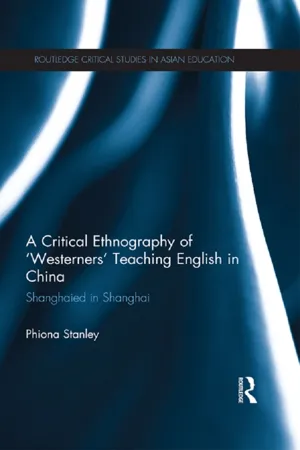
A Critical Ethnography of 'Westerners' Teaching English in China
Shanghaied in Shanghai
- 288 pages
- English
- ePUB (mobile friendly)
- Available on iOS & Android
eBook - ePub
A Critical Ethnography of 'Westerners' Teaching English in China
Shanghaied in Shanghai
About this book
Information
1 Introduction
shanghai (v, tr).
To trick or force a person into doing something against his or her will.
To trick or force a person into doing something against his or her will.
Australian Concise Oxford Dictionary (Moore 2004: 1306)
In the mid nineteenth century, world trade relied on clipper sailing ships which, in turn, relied on huge human crews. There was no problem getting workers to join a ship for a passage to California; the gold rush drew exactly the poor, marginal, hopeful men who would normally crew the clipper ships. But finding crews for ships out of California, to Shanghai and beyond, was much harder. And so began the practice of ‘shanghaiing’: tricking or forcing men into sailing to distant ports. Some were drugged or otherwise rendered unconscious and woke up at sea. Others were kidnapped in bars or boarding houses and brought out through the ‘shanghai tunnels’ that ran under West-Coast American cities. ‘Shanghaied’ sailors were not necessarily sailors and although some benefitted from the months of enforced sobriety and physical labour of the clipper ships, all were pushed into something they did not fully understand, that they had not chosen, and that worked in interests other than their own (Alborn 1992; Tamony 1966).
In some ways the ‘teachers’ that are the subject of this study are nothing like the ‘sailors’ on the clipper ship crews of yesteryear: no burly dockworker forces them to go and teach in China and most are treated very well once they arrive. Certainly, few experience enforced sobriety. And, rather than wishing they could stay for an American gold rush, many are glad to leave behind their sometimes limited employment options in depressed Western economies. And yet in this ethnography I contend that they are nevertheless ‘shanghaied in Shanghai’. This is not to say that their experiences are necessarily bad; most of the participants that I focus on in this book can be said to have benefitted from their time in China. But through their experiences I show that, like the shanghaied sailors, all are pushed into something they do not fully understand, that they have not chosen, and that works in interests other than their own.
As for the nature of that ‘something’: although all are hired by a Chinese university as oral English teachers, their primary role does not seem to be to teach English. Instead, an Occidentalist Chinese discourse of foreign ‘Otherness’ frames the ‘authenticity’ they are expected to perform. This means they are under pressure to be fun, bubbly, ever-smiling, and entertaining. Their de facto purpose is to represent and provide contact with ‘the West’ and to validate Chineseness, defined against the foil of an Other. As this may not match their own perceived purposes, they are shanghaied into this role.
This is, then, a study of a nether world of the education profession, of native English speaking teachers, or perhaps ‘teachers’, far from home. It explores teacher identity, teacher preparation, and what it means to teach ‘effectively’ in this context. It is also a study of Chinese nationalism, the nature of ‘multi-culturalism’ as this plays out in mainland China’s worldliest city, and the effects of both of these on middle-tier transnational ‘Westerners’ living in Shanghai. Like the non-sailor ‘sailors’, these are ‘teachers’ who would not necessarily be considered teachers elsewhere. Some teach while ‘stoned’ as smoking marijuana allows them to be relaxed enough not to care. Others engage in sexual relationships with their students in the ‘playboy mansion’ of their teaching context. And there are some whose only qualification for the job is a degree of enthusiasm.
But this is not a polemic that argues that such people should be driven out of the teaching profession. Instead, I seek to understand the complexity and contradictions of this teaching situation. Although academics working in English language teaching (ELT) may wish it were otherwise, this soft underbelly of our profession exists. Further, it will continue to exist as long as there is a demand for English, a shortage of communicatively competent local teachers willing to remain in classroom teaching for less money than they can make in other jobs, and the dangerous fallacy that proficiency in a language is sufficient qualification to teach it. So instead of arguing that these teachers should not exist, I seek to understand the reality of this situation and to provide some suggestions as to how it might be improved within the parameters of what is practical, rather than what is desirable in an ideal world.
Contextualizing the study
Annually, more than 10,000 people undertake the University of Cambridge pre-service ELT teacher preparation course called CELTA (Certificate of English Language Teaching to Adults). Many thousands more do other, similar, practically focused short courses. Not all plan to teach and travel but many do, and many such courses are marketed as a way to see the world. And ‘seeing the world’ is no longer the preserve of the super rich and the ‘dropouts’ that created the ‘hippy trail’ across Asia in the 1960s. Instead, an extended overseas sojourn, often as a working holiday, has become an accepted, even expected, practice among British, Australian, and other ‘gap year’ travellers, who are often young people straight out of university.
Meanwhile, China is the single largest English language teaching market in the world: English is compulsory throughout much of schooling and tertiary education, private English language teaching provision is a multi-billion dollar industry, and there is a shortage of local teachers of English. There are also people, in China and elsewhere, who believe a native speaker of English to be the best teacher type. As I will discuss, this is an unfounded belief. But as much of Chinese ELT is directly or indirectly market driven, people’s beliefs translate into important realities. And the reality is that there is an enormous demand for sojourning ‘Western’ teachers in China. To obtain a work visa, such teachers need only a university degree in any subject and some kind of certificate in ELT; this might be an online or weekend course.
This creates a nexus in which minimally trained ‘Westerners’ are employed as teachers of English in China, in both the public and private sector. For Chinese students, this may be the first non-Chinese person they have met; for the teachers, this may be their first experience of living and working in another culture. Teachers and students alike come to the encounter with pre-conceived beliefs about the foreign Other, and they may base their subsequent beliefs in part on their experiences of this first-contact encounter. So this is much more than English teaching; it is a site of intercultural contact.
There are political and historical dimensions to the context. Until 30 years ago, contact with foreign nationals was all but unheard of in China, which was largely sealed off from the world. Before that, China was exploited and insulted by various foreign powers. This followed centuries of China’s own empire building. As a result, China has a highly complex relationship with outsiders and its contemporary rise as a superpower is coloured by its political history. The positioning and role of ‘foreign experts’, as work-permit holders are termed in China, must be contextually located in this history; as recently as the mid 1980s, the ruling Chinese Communist Party, the party-state, condemned the ‘spiritual pollution’ brought by foreign influences.
This affects education. The notion of ‘curriculum’ defines everything that is taught and learned in an educational encounter, and this may well go beyond what is intended by curriculum planners and teachers themselves. In learning English from minimally trained foreign ‘teachers’, Chinese students may be learning other, unintended lessons, perhaps lessons about foreign Others. This may be a warm, positive experience in which both sides’ meanings are compared and shared, and everyone leaves the encounter with a greater understanding and appreciation of each other’s culture. But it may not be. As I will show, the university context in which this research was conducted is far from being a site of intercultural bridge building. Instead, the employment of foreign teachers there appears to reinforce existing stereotypes, prejudices, and barriers to understanding, among teachers and students alike.
Perhaps, though, this is simply the price that has to be paid for learning English at this stage of China’s development. As the Qing dynasty scholar Zhang Zhidong advocated in the 1890s, perhaps China should aim to extract expertise and not values from foreigners. (Zhang’s epigram, zhongxue wei ti, xixue wei yong translates as ‘Chinese learning for fundamentals, Western learning for practicalities’).
So perhaps English alone is enough. But the rush and the push for English learning in China must surely be for something, presumably communication with the non-Chinese outside world. And so the notion of isolating English language competence from intercultural competence is problematic; language users need to be able to use English to communicate with people who do not necessarily share their own cultures. In addition, the Chinese College English curriculum itself identifies intercultural competence as one of the goals of English language teaching (Chinese Ministry of Education 2007: 32). So the curriculum as it plays out in the research context, in which pre-existing notions about foreign Others go unchallenged and may actually be reinforced, is highly problematic.
There is also uncertainty as to whether the employment of foreign teachers is even effective in teaching English. English language teaching at the research site and in other Chinese universities is divided into separate courses in, for example, grammar, ‘intensive reading’, and writing. These courses lead to the CET examination (College English Test), without which students cannot graduate, but which does not contain a compulsory speaking component. Students at the research site then undertake a subsequent, capstone course called ‘oral English’, whose purpose is to develop students’ oral fluency. At the university in which this study was conducted, as in many other Chinese universities, foreign teachers teach only oral English and oral English is taught only by foreign teachers. So the construct of foreign teachers’ effectiveness is inseparable from the question of the effectiveness of this separated model of English teaching and the ‘orphan’ oral English course that lacks credible CET examination backwash. Does it work? This is central to my discussion.
The context I am introducing, therefore, is one in which the teachers are minimally trained and ‘oral English’ may seem somewhat intangible. Students often arrive in class never having met a real, live foreigner but bringing some baggage of historico-political assumptive paradigms about foreign Others. In addition, teachers on CELTA courses practise teaching with small groups of motivated adult students. This is different from teaching in the research context, in which classes comprise up to 35 students for whom English is compulsory. Also, the teachers themselves may simply be passing through, ‘seeing the world’ before going onto further study or a non-ELT career in their home countries or elsewhere. Most are native English speakers, many have never lived outside their home countries, and all bring themselves and their own cultural and individual paradigms with them. What happens to them? How do they perceive and process the experience? This is what this study is about.
Locating the study
If the following disciplines were mapped, and the various maps were laid out, my study would fall at the very edges of most of the sheets. The disciplines are: education, sociology, politics, history, tourism, anthropology, gender studies, applied linguistics, psychology, and cultural studies. The marginal, liminal areas are not well covered by any of the established disciplines’ maps, but between their edges a space becomes clear; this is my study’s location. Morgan (2004: 82) stresses the importance of expanding knowledge within language teaching and also increasing the discipline’s interdisciplinary scope in a way that is intra-disciplinary. This means utilizing ideas from myriad sources to support research in the ‘home’ discipline. Accordingly, my study draws upon, and contextually grounds, literature from various disciplines so as to build a theory about the teachers studied. So this is a study in education; it is about teachers in a university. But it also relates to other disciplines, considering people’s lived realities as transnational Westerners in China, positioned as teachers, and struggling to make sense of their experiences.
My study is different from some other critical studies in ELT. This is not to say I am uncritical; indeed, I am highly critical of the power relations, hegemonies, and other dynamics at work in the context, and in Chapter 3 these are explored in more detail. However, this study is different in that I problematize the assumption, widely espoused, that minimally qualified, White, Western native speaker ‘teachers’ in ‘periphery’ classrooms are (always) the (only) ‘baddies’. As this study shows, power relations in China are far from straightforward. So I critically examine such teachers’ lived experiences as they are lived, which is different from demonizing them for what they represent.
So instead of hoping, as some scholars seem to, that the demand for native speaker teachers will wither away or that they might be replaced by the lofty goal of highly trained, communicatively competent, interculturally competent local teachers, I seek to engage with the reasons Chinese institutions might be hiring ‘foreign teachers’ and what is happening as a result (mainly to the teachers themselves but also to the students and their learning). And my finding is that this is far from a Western neo-colonial endeavour. Indeed, it is as much the teachers who are on the receiving end of some quite powerful essentialism constructed primarily by the Chinese party-state to wrap its own legitimacy in the flag of nationalism, defined against a constructed, Western ‘Other’.
This study is also unique in its subject matter. While the post-training working lives of CELTA-qualified teachers has been studied in an Australian context (Senior 2006), and some attempt is under way to understand such teachers’ post-training lives elsewhere (Green 2005), research has yet to be done on the all too common phenomenon of short-course-trained English language outside their home countries. Anecdotal evidence abounds, of course, and many ELT scholars researching in China pass judgement on ‘Western teachers’ (e.g. Boyle 2000; Cortazzi and Jin 1999; Degen and Absalom 1998; Dooley 2001; J. Jin 2005; M. Li 1999; Melby, Dodgson, and Tennant 2008; F. Yu 2008; Zhao and Grimshaw 2004). But there is little appreciation in the literature of such teachers’ lived realities, experiences, and identities. This study fills that gap. By doing so, it provides a substantial contribution to knowledge in the areas of teachers’ lives, identities, and practices. It also adds topographical detail to the maps of the various disciplines listed above.
Defining the research focus
ELT qualifications are confusing. Different types as well as different levels exist and are accredited by hundreds of institutions of varying degrees of legitimacy. Some qualifications are practice based with little theoretical underpinning; others have no practical component and are mainly theoretical. Course duration varies from a weekend to several years. It is therefore difficult to draw a line between ‘qualified’ and ‘unqualified’ English language teachers.
In this study I consider a common qualification type for sojourning teachers, the ‘short’ ELT course, the best example of which is Cambridge CELTA. This qualification is considered sufficient for beginning English language teachers in many contexts (British Council 2007; NEAS 2005). It has been described as a ‘one-size-fits-all’ training that provides beginning teachers with a ‘toolkit’ of classroom skills and activities. CELTA-type courses do not provide much theoretical underpinning, focusing instead on the development of hands-on skills and a knowledge of how English works (Ferguson and Donno 2003; Horne 2003; Kanowski 2004; Macpherson 2003). This type of course was developed in London in the 1960s in response to the needs of untrained native speaker ‘teachers’ in International House language schools, primarily in Europe (Haycr...
Table of contents
- Cover
- Halftitle
- Title
- Copyright
- Contents
- Illustrations
- Acknowledgements
- 1 Introduction
- 2 English teaching in China
- 3 Theorizing transnationals in China
- 4 Showing the workings
- 5 Teachers, training, and teaching
- 6 Understanding oral English
- 7 The pressure to be ‘fun’
- 8 It’s not about English teaching
- 9 Gendered identities
- 10 Training outcomes and teacher needs
- 11 Constructing and maintaining identities
- 12 Recommendations and reflections
- References
- Index
Trusted by 375,005 students
Access to over 1.5 million titles for a fair monthly price.
Study more efficiently using our study tools.
Frequently asked questions
Yes, you can cancel anytime from the Subscription tab in your account settings on the Perlego website. Your subscription will stay active until the end of your current billing period. Learn how to cancel your subscription
No, books cannot be downloaded as external files, such as PDFs, for use outside of Perlego. However, you can download books within the Perlego app for offline reading on mobile or tablet. Learn how to download books offline
Perlego offers two plans: Essential and Complete
- Essential is ideal for learners and professionals who enjoy exploring a wide range of subjects. Access the Essential Library with 800,000+ trusted titles and best-sellers across business, personal growth, and the humanities. Includes unlimited reading time and Standard Read Aloud voice.
- Complete: Perfect for advanced learners and researchers needing full, unrestricted access. Unlock 1.5M+ books across hundreds of subjects, including academic and specialized titles. The Complete Plan also includes advanced features like Premium Read Aloud and Research Assistant.
We are an online textbook subscription service, where you can get access to an entire online library for less than the price of a single book per month. With over 1.5 million books across 990+ topics, we’ve got you covered! Learn about our mission
Look out for the read-aloud symbol on your next book to see if you can listen to it. The read-aloud tool reads text aloud for you, highlighting the text as it is being read. You can pause it, speed it up and slow it down. Learn more about Read Aloud
Yes! You can use the Perlego app on both iOS and Android devices to read anytime, anywhere — even offline. Perfect for commutes or when you’re on the go.
Please note we cannot support devices running on iOS 13 and Android 7 or earlier. Learn more about using the app
Please note we cannot support devices running on iOS 13 and Android 7 or earlier. Learn more about using the app
Yes, you can access A Critical Ethnography of 'Westerners' Teaching English in China by Phiona Stanley in PDF and/or ePUB format, as well as other popular books in Languages & Linguistics & Education General. We have over 1.5 million books available in our catalogue for you to explore.