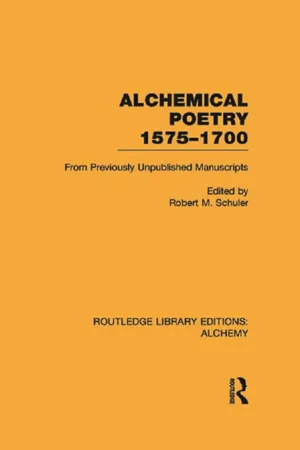
Of interest to interdisciplinary historians as well as those in various other fields, this book presents the first publication of 14 poems ranging from 12 to 3,000 lines. The poems are printed in the chronological order of their composition, from Elizabethan to Augustan times, but nine of them are verse translations of works from earlier periods in the development of alchemy. Each has a textual and historical introduction and explanatory note by the Editor. Renaissance alchemy is acknowledged as an important element in the histories of early modern science and medicine. This book emphasises these poems' expression of and shaping influence on religious, social and political values and institutions of their time too and is a useful reference work with much to offer for cultural studies and literary studies as well as science and history.
- 712 pages
- English
- ePUB (mobile friendly)
- Available on iOS & Android
eBook - ePub
About this book
Information
ELIZABETHAN VERSIFYING ALCHEMISTS
Edward Cradock
I. A Treatise Touching the Philosopher’s Stone
Most of what we know about Edward Cradock (ca. 1536–ca. 1594) is associated with Oxford University. A Staffordshire man, he matriculated at Christ Church in 1552 at the age of 16, and he was to remain there for the rest of his known life. When Queen Mary came to the throne, he conformed to Catholicism, only to revert to the reformed church upon Elizabeth’s accession. He graduated B.A. on 11 January 1555/6 and M.A. on 10 February 1558/9, both degrees being in divinity; he took holy orders in the latter year. Although Wood says he was “numbered among the learned men of his time,” he cites the circumstance that Cradock’s election as Lady Margaret professor on 24 October 1565 was “upon a great scarcity of Protestant divines in the university,” perhaps implying that he was not in the first rank of theologians.1 Nevertheless, he held the professorship for nearly thirty years, resigning it only in 1594, probably near the end of his life, at age 58. There is no record of him after this date.
Cradock’s only theological writing is a long account of God’s providence, The Shippe of Assured Safetie (1572). He signs himself here, as he does in his alchemical works, “Doctor and Reader of Divinitie in the Universitie of Oxford,” and he dedicates his treatise to his “Patrone” Robert Dudley, Earl of Leicester (who was also chancellor of the university). The title page explains that the work has been “Compyled” by Cradock, and there is nothing remarkable or controversial in the 499-page treatise, nor does it reveal anything about a specific religious orientation in his alchemy. There are, for instance, only occasional hints of his interest in matters scientific. Early on in his argument for God’s providence, he points to “the commodities that we receave by the [heavenly] bodies that are above, and by the four Elements,” and he devotes the next chapter to proofs derived from “perusing the Anatomie of mans bodie.” A few pages later, he reasons that “Philosophie, as the lighte of nature, is not to be despised”;2 but these are all conventional proofs for a providential universe. Cradock’s only other published work is a Latin commendatory poem of twelve lines in Robert Peterson’s translation of Giovanni della Casa’s Galateo … or rather, a treatise of manners (1576; STC 4738).
If Cradock’s official position at Oxford was that of a lecturer in divinity, his chief preoccupation there seems to have been alchemy. Wood claims that “he addicted himself much to chymistry, spent many years in obtaining the Philosophers stone, and was accounted one of the number of those whom we now call Rosycrucians.”3 The only other datable event in his life probably had an alchemical connection: a meeting with John Dee, who recorded in his diary a three-day visit to him in Oxford in 1581. (Cradock may also have consulted the astrologer Simon Forman, probably in the early 1590s, when Forman’s London practice was thriving.)4 Cradock’s alchemical activities and connections imply not only that Renaissance universities were not inimical to occult studies,5 but also that Cradock may indeed have had a significant place among Elizabethan occultists, as Wood suggests.
Cradock’s alchemical writings, if perhaps no more original than his theological treatise, are nevertheless of some interest. There are three distinct works, all surviving in Bodleian Library manuscripts. Two are in Latin: a brief prose text headed Lapis Philosophicus est Duarum Materiarum (MS Ashmole 1408, fols. 22v–23r), and a lengthy poem, Tractatus de Lapide Philosophico, Latinus Versibus Conscriptus (MS Ashmole 1415, article V, fols. 33r–40r). The third of Cradock’s alchemical writings is the 726-line English poem printed here: A Treatise Touching the Philosopher’s Stone, which he dedicated to Queen Elizabeth. Its workaday title may lead one to believe that this is an English version of his Latin verse treatise, but the two works are not the same. At line 87 of the English poem, for example, Cradock refers his reader to a “Proofe” developed “in my Latin verses” from a certain alchemical author. This tells us both that the Latin poem had been written earlier and that it contains material not in the English text.6 The English verse Treatise exists in two manuscript copies, and a third transcription had been planned, so Cradock’s poem was certainly thought worthy of study by his contemporaries.7
Cradock’s Treatise has three main parts: (1) a verse dedication to Queen Elizabeth (50 lines) and an eight-line “blessing” of her (51–58); (2) the Treatise proper (59–672), in 28 numbered sections that range in length from 8 to 48 lines; and (3) a 54-line conclusion and exhortation to the reader (673–726). In content the Treatise is typical of pre-Paracelsian alchemy of the Elizabethan period. As the variant title indicates, it is “Gathered out of the best authors that have written upon that arte.” It makes no pretensions to originality but provides a coherent discussion of alchemical theory and offers detailed practical instructions for making the philosopher’s stone. It is, in all, a good example of a purely didactic verse compilation, wholly without mythological or symbolic elements; though it maintains the customary piety of most alchemical tracts, it is devoid of any mystical or theological speculation.
The versifier is, of course, bound by the usual cryptic vocabulary of “spirits” (volatile substances) and the usual technical terminology, but there are no green lions or basilisks. In writing of his obscure subject, Cradock tries to “runne a plaine and ordinary race” (207), and he wryly notes that Arnaldus de Villanova, among others, “loved clowds / And wrapt himselfe most commonly in shrowds” (209–10). Cradock is also careful to deny that “man maketh gold” (237), asserting that the alchemist is only an instrument and that Art only achieves in less time what Nature would do at a much slower pace. All this takes place only through God, who “makes him [the alchemist] understand / What is to doe and how he should proceed” (265–66).
The theoretical part of the Treatise (sections 1–9) is based mainly on these premises: that gold must be made from the “seed” of gold; that like begets like; and that the stone (or gold) grows in the vessel in the same way that the fetus grows in the womb. The practical part (sections 10–25) describes the technical processes of calcination (lines 274ff.), putrefaction (333ff.), dissolution and distillation (363ff.), the creation of “philosophical mercury” (383ff.), fermentation (415ff.), concoction (479ff.), cibation (526ff.), and multiplic...
Table of contents
- Cover
- Halftitle
- Title
- Copyright
- Dedication
- Contents
- List of Illustrations
- General Introduction
- Introduction
- Acknowledgments
- Bibliography
- Part One: Elizabethan Versifying Alchemists
- Part Two: Three Verse Translations from Middle French by William Backhouse (1644)
- Part Three: Interregnum “Epic”: Chymical Medicine and Spiritual Alchemy
- Part Four: Six Anonymous Verse Translations (ca. 1700)
- Part Five: Hermetic Mysticism and Augustan Satire
- Index
Trusted by 375,005 students
Access to over 1.5 million titles for a fair monthly price.
Study more efficiently using our study tools.
Frequently asked questions
Yes, you can cancel anytime from the Subscription tab in your account settings on the Perlego website. Your subscription will stay active until the end of your current billing period. Learn how to cancel your subscription
No, books cannot be downloaded as external files, such as PDFs, for use outside of Perlego. However, you can download books within the Perlego app for offline reading on mobile or tablet. Learn how to download books offline
Perlego offers two plans: Essential and Complete
- Essential is ideal for learners and professionals who enjoy exploring a wide range of subjects. Access the Essential Library with 800,000+ trusted titles and best-sellers across business, personal growth, and the humanities. Includes unlimited reading time and Standard Read Aloud voice.
- Complete: Perfect for advanced learners and researchers needing full, unrestricted access. Unlock 1.5M+ books across hundreds of subjects, including academic and specialized titles. The Complete Plan also includes advanced features like Premium Read Aloud and Research Assistant.
We are an online textbook subscription service, where you can get access to an entire online library for less than the price of a single book per month. With over 1.5 million books across 990+ topics, we’ve got you covered! Learn about our mission
Look out for the read-aloud symbol on your next book to see if you can listen to it. The read-aloud tool reads text aloud for you, highlighting the text as it is being read. You can pause it, speed it up and slow it down. Learn more about Read Aloud
Yes! You can use the Perlego app on both iOS and Android devices to read anytime, anywhere — even offline. Perfect for commutes or when you’re on the go.
Please note we cannot support devices running on iOS 13 and Android 7 or earlier. Learn more about using the app
Please note we cannot support devices running on iOS 13 and Android 7 or earlier. Learn more about using the app
Yes, you can access Alchemical Poetry, 1575-1700 by Robert M. Schuler in PDF and/or ePUB format, as well as other popular books in Literature & European Renaissance History. We have over 1.5 million books available in our catalogue for you to explore.