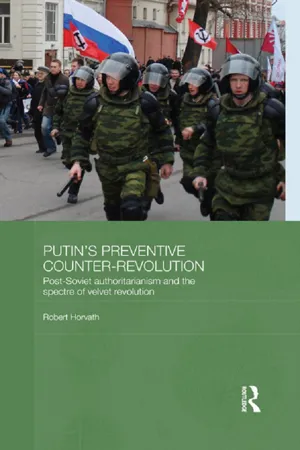
This book examines the 'preventive counter-revolution,' a programme of reforms and repression that transformed the face of Russian politics during Vladimir Putin's second term as president. Kremlin propagandists hailed this programme as a defence of national sovereignty against Western attempts to foment a 'velvet revolution' in Russia. But this book shows that the Putin regime was reacting to a real domestic threat: opposition leaders and youth activists who had begun to employ 'velvet' revolutionary methods in a campaign to harness popular grievances and to challenge Putin in the streets and at the ballot box. It traces the formulation and implementation of the regime's two-track response, which was based on a careful analysis of the lessons of the recent 'velvet' (or 'coloured') revolutions in Georgia and Ukraine. The first track was repressive: the imposition of controls on NGOs, restrictions on electoral competition, and a crackdown on opposition demonstrations. The second was the mobilisation of supporters in 'patriotic' youth organisations that employed both gang violence and 'velvet' revolutionary techniques. Drawing on a wide range of Russian-language sources, including opposition activists' blogs, this book charts the end of Russia's experiment with liberal democracy and the emergence of a new type of authoritarian order.
eBook - ePub
Putin's Preventive Counter-Revolution
Post-Soviet Authoritarianism and the Spectre of Velvet Revolution
- 274 pages
- English
- ePUB (mobile friendly)
- Available on iOS & Android
eBook - ePub
Putin's Preventive Counter-Revolution
Post-Soviet Authoritarianism and the Spectre of Velvet Revolution
About this book
Information
1
The diplomacy of counter-revolution
Today we are witnessing a European-type, velvet bloodless, democratic and nation-wide revolution which aims at the bloodless removal of President Shevardnadze from his post.
– Mikheil Saakashvili, 21 November 2003
The classification ‘velvet revolution’ in this case is unacceptable, first because I don’t think it was a revolution, and second, because there was no velvet there.
– Igor’ Ivanov, Russian foreign minister, 26 November 2003
The political crisis in Georgia in November 2003 marked the beginning of ‘velvet’ ferment in the former Soviet space. The Georgian opposition replicated the scenario that had unfolded three years ago in Belgrade. Like Milošević, Shevardnadze was brought down by the subversive mockery of young agitators, a coordinated election monitoring programme, and flower-bearing demonstrators protesting against election fraud. By applying the lessons of the Serbian revolution, this ‘Rose Revolution’ helped to codify the ‘velvet’ strategy, transforming the improvisations of the Serbian opposition into a ‘revolutionary script’, a set of methods, slogans and axioms about the instigation and conduct of a ‘velvet revolution’. Soon that script was adopted by protesters confronting electoral authoritarian regimes across Eurasia.
Although its impact on Russian domestic politics was negligible, the ‘Rose Revolution’ became an obsession for Russian diplomats. Within the borders of the Georgian state, three Russian client regimes were under threat. Across the Commonwealth of Independent States (CIS), Russia’s allies were confronted by disturbances that were attributed to the spread of the ‘velvet virus’. One sign of an approaching election was speculation about the possibility of a re-enactment of the ‘Georgian scenario’. This epidemic threatened not only to destabilise the region, but also to disrupt the Kremlin’s efforts to reassert Russian hegemony over the former Soviet space. The cornerstone of this enterprise was the Single Economic Space (Edinoe ekonomicheskoe prostranstvo), which promised to achieve the economic integration of Russia, Belarus, Kazakhstan, and Ukraine as the first stage in the construction of an EU-style multinational entity. As the spectre of a ‘Georgian scenario’ loomed in Ukraine during the autumn of 2004, the fate of this grandiose project became inextricably bound up with the problem of ‘velvet revolution’.
To contain the ‘velvet’ contagion, the Kremlin attacked its sources and undertook preventive measures to bolster threatened regions. On the one hand, it pursued an increasingly confrontationalist policy towards Georgia, the homeland of ‘velvet’ agitation in the former Soviet space and a symbol of the possibility of an alternative, democratic path. To prevent the export of the ‘Rose Revolution’ during elections in the separatist mini-state of Abkhazia, Putin personally intervened in support of his preferred candidate. At the same time, the Kremlin launched a campaign, unprecedented in its scale and intrusiveness, to secure the election of its preferred candidate in Ukraine’s presidential election. As this chapter demonstrates, these interventions became a fiasco, helping to trigger the revolutionary upheavals they were intended to prevent.
Seeds of the ‘Rose Revolution’
The fall of Eduard Shevardnadze in Georgia was not the stuff of nightmares for Russia policymakers. For a decade, Shevardnadze had pursued a pro-Western foreign policy and had become one of the world’s largest recipients of US aid. He was an ardent advocate of Georgia’s membership of NATO and the European Union. He was also one of the instigators of the Baku–Tbilisi–Ceyhan pipeline, which loosened Russia’s grip over the export of Caspian oil. The effects of this alignment with the West were exacerbated by Shevardnadze’s tactlessness. Months before his ouster, he provoked Russian fury by drawing a parallel between Putin’s threats about pre-emptive strikes against terrorist bases in foreign states and the history of Nazi aggression.1
The Kremlin’s stance towards the ‘Rose Revolution’ was ambivalent. On the one hand, Putin responded to an eleventh-hour plea for help from Shevardnadze by enlisting its Georgian ally, Aslan Abashidze, the autocratic ruler of the separatist region of Ajaria. To counter the insurgent crowds in Tbilisi, Abashidze dispatched buses of supporters to stage a pro-Shevardnadze, ‘anti-fascist’ demonstration outside the parliament building on 18 November 2003.2 This show of support emboldened the Georgian authorities belatedly to announce election results, which implausibly awarded Abashidze’s Revival movement second place in the poll, ahead of the major opposition party. But Russia’s tilt towards Shevardnadze was short lived. On 23 November, on the morning after the storming of the parliament, Russia’s foreign minister, Igor’ Ivanov, arrived in Tbilisi as a mediator. In a poignant speech outside the parliament, he won the sympathy of the revolutionary crowd by disclosing for the first time that his mother was Georgian and that ‘half of my heart is here’.3 By mediating talks that led to Shevardnadze’s resignation from the presidency, Ivanov made a notable contribution to the peaceful outcome of the uprising.4
In public, the Kremlin shed no tears over Shevardnadze’s ouster. On 24 November, Putin told the Russian cabinet that he was unsurprised by the upheaval: regime change in Georgia was ‘a logical consequence of the systematic errors of the previous leadership of the country in its foreign, domestic, and economic policies’. In a comment that was obviously intended to illuminate his own achievement in restoring the ‘vertical of power’, he lambasted Shevardnadze’s role in the breakdown of central authority:
In domestic policy, instead of strengthening the institutions of democracy and the foundations of Georgian statehood, we observed only impotent manoeuvering between different political forces in the country, and economic policy amounted to a struggle for humiliating donations from abroad.5
Less easy to accept were the circumstances of Shevardnadze’s ouster in a popular uprising that was described by its leaders as a ‘velvet revolution’. For the new Georgian leaders, ‘velvet revolution’ was not merely a strategy for seizing power but also a slogan that asserted their claim to a place in Europe at a moment when the European Union was preparing to admit East Central European states that had been crucibles of ‘velvet revolutions’ in 1989. At the height of the mass protests in Tbilisi on 21 November 2003, Mikheil Saakashvili boasted that ‘today we are witnessing a European-type, velvet bloodless, democratic and nation-wide revolution which aims at the bloodless removal of President Shevardnadze from his post’.6 The following evening, after leading his rose-bearing supporters into the parliament, he invoked the phrase ‘velvet revolution’ from the speaker’s podium.7 Announcing his candidacy for the presidency on 26 November, he proclaimed the triumph of ‘a peaceful, velvet revolution of roses’.8
Neither the Kremlin nor its Georgian allies were prepared to accept the term. In his comments to the Russian cabinet, Putin highlighted the role of violence in the revolution. Russia was concerned, he declared, by the fact that ‘the change of power in Georgia took place against a background of forceful pressure’. Those ‘who organised and encourage such actions bear an enormous responsibility before the people’.9 A similar line was taken by Aslan Abashidze, who drew attention to the ‘ransacking’ of the Tbilisi offices of his Revival Union. There were, he claimed, no ‘velvet revolutions’: ‘All revolutions are bloody.’10 Russian diplomats were also dismissive of Saakashvili’s ‘velvet’ pretensions. Days after Shevardnadze’s resignation as Georgian president, Igor’ Ivanov told Polish journalists that ‘the classification “velvet revolution” in this case is unacceptable, first because I don’t think it was a revolution, and second, because there was no velvet there’.11 During Mikheil Saakashvili’s first official visit as president to Moscow in February 2004, the only sign of tension was his observation that Putin preferred to call the events in Tbilisi a ‘coup’ (perevorot’) rather than ‘velvet revolution’.12
This rejection of the revolutionary discourse of the new Georgian leadership was reinforced in the Russian media by conspiracy theories about the decisive role of foreign intervention in the upheaval.13 On 30 November 2003, Rossiya television station broadcast a purported exposé of the Georgian revolution. It featured an interview with Shevardnadze, who dismissed the notion that his ouster should be understood as a ‘velvet revolution’: ‘in reality this was a coup’ that resulted from foreign subversion. ‘There is’, he argued, ‘a whole conception on how to conduct elections in order to get different people into government.’ He identified two actors involved in the implementation of this ‘conception’. First, George Soros’s Open Society Institute had funded Georgian analogues of the youth and media organisations that fomented the Serbian revolution. Second, US-financed election monitors had produced the exit-polling that cast doubt upon the integrity of the electoral process.14 Shevardnadze’s allegations about a coordinated programme of subversion were embellished by former FSB (Federal Security Service) chairman Nikolai Kovalev, deputy chairman of the Duma’s security committee, which had just held hearings on the Georgian crisis. Kovalev explained that the events in Tbilisi were a ‘Belgrade-style coup’. According to him, ‘the Georgian opera was played smoothly and harmoniously. It was composed in Yugoslavia three years ago.’ Its instigators ‘selected suitable politicians who might help stage a velvet revolution and trained them’ in camps outside Belgrade. But the fall of Shevardnadze was not the end of the matter. Kovalev warned that the graduates of the Serbian camps included activists from Ukraine, Moldova, Armenia, and Azerbaijan. The narrator concluded that it was ‘difficult to dispute’ the claim that a coup in the post-Soviet space had been conducted according to a foreign scenario, and that Russia would now scrutinise ‘the creative work of script writers and directors outside the CIS, and the political stage nearer home’.15
Russian democrats, preoccupied with the Duma election campaign, did little to contradict the fulminations of officialdom. Boris Nemtsov, one of the leaders of the Union of Right Forces (SPS), praised the contribution of Russian diplomacy to Shevardnadze’s peaceful departure, but the leaders of the uprising and their ‘velvet’ methods evoked little enthusiasm in opposition circles.16 As a failing state ravaged by corruption, economic collapse and ethnic separatism, Georgia was an unattractive model for Russian politicians concerned about their patriotic credentials on the eve of elections. The distaste of Russian liberals for Georgia was exemplified by Moscow News, the weekly edited by Yevgenii Kiselev, the former NTV anchor who was to play a prominent role in efforts to unite the democratic opposition in the aftermath of the Ukrainian revolution. Kiselev was not afraid of courting controversy: in early November, he had published a long interview with George Soros.17 But Moscow News’ coverage of the triumph of democracy in Georgia was singularly contemptuous. On 3 December, days after Nikolai Kovalev’s televised denunciation of the ‘Belgrade-style coup’, it ridiculed the delusions of those who likened the events in Tbilisi to the original ‘Velvet Revolution’ in Prague:
Lots of people find it hard to see what is so velvety or rosy about a bunch of thugs bursting onto a session of a newly elected parliament, leaping on desks in apelike fashion, throwing chairs about, and tussling with the deputies.
Talk of the dawn of a new era and a transition to Western-style democracy was ‘romanticism bordering on idiocy’. Far from being a beacon of peaceful democratic change, Georgia was tainted by a ‘thieving culture’ that earned it sixth-worst place on Transparency International’s corruption index. Prospects for democracy were also constrained by tension between ethnic groups that fragmented political authority and threatened to erupt into violence. The article concluded with obvious sarcasm:
And how do the Georgians plan to cope with these headaches? Elementary. They’ve elected as their president… that admirer of Stalin, Mikheil Saakashvili, a rabid nationalist who is on record as having insulted and threatened every one of those ethnic groups.18
No less disdainful was Sergei Kovalev, the former dissident and human rights activist, who argued that the fact of a popular uprising in a country like Georgia was not a reason for celebration. Recalling the nationalist excesses of the Gamsakhurdia era, he suggested that ‘the Georgian majority has made mistakes more than once, and has made mistakes with very serious consequences’. An admirer of Václav Havel and Czechoslovakia’s original ‘Velvet Revolution’, Kovalev disparaged the ‘velvet’ pretensions of the Georgian rebels. ‘I am not at all convinced’, he declared, ‘that what they call a “velvet revolution” will remain a “velvet revolution” and that a better outcome than Shevardnadze will be found.’ This scepticism was reinforced by Kovalev’s hostility towards Saakashvili, some of whose inflammatory statements ‘make my flesh creep’.19
What made the condescension of Russian liberals particularly ironic was the fact that Georgia’s democratic breakthrough had coincided with the decimation of Russia’s libe...
Table of contents
- Cover
- Title
- Copyright
- Dedication
- Contents
- List of abbreviations
- Acknowledgments
- Introduction
- 1 The diplomacy of counter-revolution
- 2 The shock of the ‘Orange Revolution’
- 3 The spectre of a ‘Moscow Maidan’
- 4 Nashi: the mobilisation of patriotism
- 5 The taming of civil society
- 6 The death of politics
- 7 The ‘extremists’: ‘The Other Russia’ and the struggle for the streets
- Conclusions
- Notes
- Select bibliography
- Index
Trusted by 375,005 students
Access to over 1.5 million titles for a fair monthly price.
Study more efficiently using our study tools.
Frequently asked questions
Yes, you can cancel anytime from the Subscription tab in your account settings on the Perlego website. Your subscription will stay active until the end of your current billing period. Learn how to cancel your subscription
No, books cannot be downloaded as external files, such as PDFs, for use outside of Perlego. However, you can download books within the Perlego app for offline reading on mobile or tablet. Learn how to download books offline
Perlego offers two plans: Essential and Complete
- Essential is ideal for learners and professionals who enjoy exploring a wide range of subjects. Access the Essential Library with 800,000+ trusted titles and best-sellers across business, personal growth, and the humanities. Includes unlimited reading time and Standard Read Aloud voice.
- Complete: Perfect for advanced learners and researchers needing full, unrestricted access. Unlock 1.5M+ books across hundreds of subjects, including academic and specialized titles. The Complete Plan also includes advanced features like Premium Read Aloud and Research Assistant.
We are an online textbook subscription service, where you can get access to an entire online library for less than the price of a single book per month. With over 1.5 million books across 990+ topics, we’ve got you covered! Learn about our mission
Look out for the read-aloud symbol on your next book to see if you can listen to it. The read-aloud tool reads text aloud for you, highlighting the text as it is being read. You can pause it, speed it up and slow it down. Learn more about Read Aloud
Yes! You can use the Perlego app on both iOS and Android devices to read anytime, anywhere — even offline. Perfect for commutes or when you’re on the go.
Please note we cannot support devices running on iOS 13 and Android 7 or earlier. Learn more about using the app
Please note we cannot support devices running on iOS 13 and Android 7 or earlier. Learn more about using the app
Yes, you can access Putin's Preventive Counter-Revolution by Robert Horvath in PDF and/or ePUB format, as well as other popular books in Social Sciences & Ethnic Studies. We have over 1.5 million books available in our catalogue for you to explore.