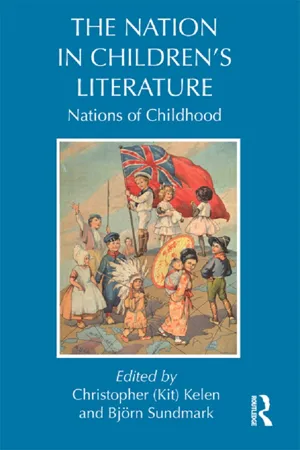
This book explores the meaning of nation or nationalism in children's literature and how it constructs and represents different national experiences. The contributors discuss diverse aspects of children's literature and film from interdisciplinary and multicultural approaches, ranging from the short story and novel to science fiction and fantasy from a range of locations including Canada, Australia, Taiwan, Norway, America, Italy, Great Britain, Iceland, Africa, Japan, South Korea, India, Sweden and Greece. The emergence of modern nation-states can be seen as coinciding with the historical rise of children's literature, while stateless or diasporic nations have frequently formulated their national consciousness and experience through children's literature, both instructing children as future citizens and highlighting how ideas of childhood inform the discourses of nation and citizenship. Because nation and childhood are so intimately connected, it is crucial for critics and scholars to shed light on how children's literatures have constructed and represented historically different national experiences. At the same time, given the massive political and demographic changes in the world since the nineteenth century and the formation of nation states, it is also crucial to evaluate how the national has been challenged by changing national languages through globalization, international commerce, and the rise of English. This book discusses how the idea of childhood pervades the rhetoric of nation and citizenship, and how children and childhood are represented across the globe through literature and film.
eBook - ePub
The Nation in Children's Literature
Nations of Childhood
- 282 pages
- English
- ePUB (mobile friendly)
- Available on iOS & Android
eBook - ePub
The Nation in Children's Literature
Nations of Childhood
About this book
Information
Part One
The Child and the Nation
Lessons in Citizenship
Chapter One
A New “Bend in the Road”
Navigating Nationhood through L. M. Montgomery's Anne of Green Gables
National identity is fostered on several fronts, but a nation's literature serves a crucial role in the formation of a country's official identity. “Official” refers to the concept promoted by a nation's government—through its educational mandates and endowments to the arts. It also signals the fact that literature can resist homogeneous depictions of national identity, focusing instead on the complexities of difference. “Official” national identities highlight the shared traits and values of the group. Joep Leerssen's assertion that literature “often counts as the very formulation of . . . cultural identity” is a bold, yet compelling, claim (268). If reading is simply viewed as a passive activity, rather than a thought-provoking process, then the link between literature and national identity may seem tenuous. If, however, the accumulative effect of observing what it is to “be” Canadian or British or any other nationality is considered, the influence of literature on national identity becomes apparent.
On July 1, 1867, the Canadian Confederation came into being with the passing of the British North America Act. Debates about the nature of Canada's identity ensued. One of the most pressing questions was how to distinguish Canada from Britain and America; that is, what makes Canada Canada (other than a legal document)? While no consensus was achieved, in those early days of the country's existence, the role of literature in the forging of national identity was recognized. As Elizabeth Galway notes, Canadian literature was regarded “as a powerful tool to be used to help build the nation”(2). Janice Fiamengo offers a similar assessment: “critics stressed the need for a national literature to enable Canadians to imaginatively possess their homeland” (234). Identification with the new country requires more than a political act; it hinges on an imaginative act. It is a point highlighted in the “Preface” to Thomas Young's Canada, and Other Poems (1887): “the literature of this country is in its infancy. It must not remain so, or the expectations we have [of] making it a great nation, will never be fulfilled” (Qtd. in Galway 2). Literature reflecting the reality of Canada, but infused with those qualities associated (at least theoretically) with being Canadian, was desired during the country's development.
The quickest way to establish a new identity is to target the country's children. Elizabeth Waterston's assertion that “children's books offer national acculturation and international illumination” highlights the dual function of national literature (Children's Literature 11). Such texts display the desired traits and behaviours of the nation for the domestic reader; simultaneously, they export those characteristics to the world as a “statement” about the country. Following Confederation, Galway argues, “writers . . . were . . . promoting and constructing specific ideologies of national identity” (5). It smacks of propaganda, but literature with a didactic purpose has a well-established place in children's literature. Books for children often reflect the concerns of adults, and in the years following Confederation, many adults were concerned with shaping their nation. Children's literature seemed to be a logical means to an end.
The issue of Canadian identity, however, remains a contentious one. The struggle to define ourselves continues to stymie Canadians. We are very good at proclaiming what we are not (usually American), but less clear when stating what we are. In 1997 Perry Nodelman, editor of the Canadian Children's Literature journal, requested papers on what makes “Canadian Children's Literature Canadian.” The responses were surprising: “Some were deeply suspicious about the value of ever doing any thinking at all about literature in terms of issues of nationality. Some were convinced that the project was a conspiracy to promote one particular view of Canadian identity over others, with upsetting or dangerous political ramifications” (15). Nodelman's seemingly straightforward query brought to the surface Canada's anxiety about its identity. The nature of the reactions reinforces the emotional investments and fears lurking behind the label Canada. Nodelman wisely shifted his focus, asking for short answers which he published as “What's Canadian about Canadian Children's Literature? A Compendium of Answers to the Question.”
The answers to the Nodelman's question were diverse, even contradictory. While there was little agreement, several commonalities did emerge affording a tentative characterization of Canadian children's literature. What stands out in the disparate responses is an emphasis on the importance of place—physical and emotional, literal and symbolic—a concern with home, and a struggle to balance the desire for independence with the need to belong. One text in particular was cited numerous times as an enduring representative of Canadian children's literature: Anne of Green Gables; indeed, the novel incorporates the three features most frequently associated with the nation's books for children. Significantly, it is also a narrative immersed in the emerging debate about Canada's nationhood.
From the vantage point of the twenty-first century, Canada's national identity is a contested concept with various groups vying for recognition. Writing at the turn of the twentieth century, however, L. M. Montgomery foregrounds national identity as a verifiable fact. Marilla Cuthbert's criteria for adopting include being Canadian born: “give me a native born at least . . . I'll feel easier in my mind . . . if we get a born Canadian” (59). While recognizing the erasure of the First Nation's Peoples in Marilla's statement, there is a kind of logic in her reasoning: security is found in the familiar. For Marilla, the fact that “Nova Scotia is right close to the Island” means the orphan “can't be much different from ourselves” (60). Marilla does not elaborate on what makes a Canadian other than geographic proximity. Montgomery does offer a model of national identity in Anne Shirley.
Anne of Green Gables was published in 1908—forty-one years after the formation of Canada, and thirty-five years after Prince Edward Island joined that country. The novel itself is set in the 1890s. National identity is still tentative, which may account for Marilla's suspicion of the foreign; and yet, Anne's “foreignness” is as clear as her bright red braids. As the novel progresses, Montgomery builds a character that has, in the words of Irene Gammel, been “exported into the world as a synecdoche for Canada itself” (“Life Writing” 9). What are Anne's, and, by implication, Canada's traits? She is romantic, imaginative, in tune with nature, capable in a crisis, cheerful in the face of adversity, industrious. Anne optimistically anticipates “the joys of sincere work and worthy aspiration and congenial friendship”; she is convinced “nothing could rob her of her birthright of fancy” (332-334). It is a birthright that is both familial and national.
From the novel's first appearance, Canadian readers have enthusiastically adopted the red-haired waif as their own; the love affair has endured into the twenty-first century. Montgomery's literary career encompasses many more novels and short stories, but Anne of Green Gables is her legacy in Canada. Montgomery's contributions to Canadian literature earned her an official place in Canada's history. “Shortly after her death in 1942,” James De Jonge observes, “she was designated a person of national historic significance . . . and was memorialized in 1948 by a cairn and plaque at Green Gables” (253). Montgomery and her work of fiction have become entwined with the public history of Canada—her creation is literally part of our national landscape. The act is not without its irony. Writing in her journal about the confusion between fact and fiction, Montgomery concedes “defeat”: “It seems of no use to protest that it is not ‘Green Gables’—that Green Gables was a purely imaginary place. Tourists by the hundred come here” (Qtd. in De Jonge 56). What could easily have been viewed as a regional story, given its specific and evocative depictions of P. E. I., has been embraced as a Canadian story. Montgomery's recognition is on both a provincial and national level.
If Montgomery is a national treasure, then Anne Shirley is a national icon. Anne's character is well known in Canada: red braids, straw hat, and mischievous smile, garbed in clothes from a bygone era. The image of the young girl is clearly dated and yet the vitality of Anne continues to charm readers. It is dated in another sense: Montgomery did not freeze Anne in time, opting instead to have her grow up. But the enduring image of Anne remains that of a young girl, not a wife and mother. The first novel remains the most popular in Montgomery's series. It is logical, then, that the young Anne is the more familiar image to Canadians. Indeed, Cecily Devereux suggests that “Knowing Anne of Green Gables is a mark of the ‘Canadianness’ that, in some way, she epitomizes” (32). Note the use of “knowing”—it may imply, but does not hinge upon, reading: Anne has become part of Canada's popular landscape.
We first encounter Anne Shirley in Chapter II—a key chapter in that it not only introduces Anne, but many of the central concerns of the novel. She is immediately established as an anomaly: she is neither the desired boy the Cuthberts requested nor the “Avonlea type of well-bred little girl” (67). Anne is defined by what she is not; that is, her identity, at this point, is in opposition to two other established identities: the hired boys and respectable girls. Her propensity to talk is quickly established—another anomaly in a period when “children should be seen and not heard” (67). In this instance, Anne's resistance to expectation is conscious, but polite; she asks Matthew, “am I talking too much? . . . Would you rather I didn't talk? If you say so I'll stop” (67). Anne is spirited, not spiteful. Nothing in Matthew's life has prepared him for Anne; his sister Marilla is even more unprepared for the waif about to arrive on her doorstep. Despite Marilla's conviction that a “native born” orphan is more acceptable, Anne is a foreign figure (59). It is a point reinforced through her subsequent escapades; Anne unintentionally, but repeatedly, stumbles against Avonlea's social expectations. Brilliant red braids signal Anne's outsider status, but they also align her with P. E. I.’s famous red roads. Anne confides, “I've never had a real home since I can remember. It gives me that pleasant ache . . . just to think of coming to a really truly home” (71). As soon as she sees Green Gables, it feels like home to Anne—her response is intuitive, and premature (73). The chapter ends with a “lonely, heart-hungry, friendless child” crying “herself to sleep” in the east gable (81). Not exactly a cliff-hanger—the title is Anne of Green Gables—but what is in doubt is how Anne will make Avonlea her home. Can the “foreign” be accommodated in this small community or must the foreigner somehow accommodate the community? It is a crucial concern in the novel. At this point in the story she literally remains unnamed (and as such, unclaimed)—we only learn Anne's name when Marilla asks it in Chapter III. Marilla resists Anne's attempt to christen herself “Cordelia,” but Anne will self-identity as “Anne of Green Gables” (76, 109).
Despite the delay in naming, readers are provided insights into Anne's identity in Chapter II. Montgomery pulls on the reader's heartstrings and issues a challenge to be an extraordinary observer: “an ordinary observer would have seen this: A child of about eleven, garbed in a very short, very tight, very ugly dress—She wore a faded brown sailor hat and beneath the hat, extending down her back, were two braids of very thick, decidedly red hair. Her face was small, white and thin, also much freckled” (63). To the ordinary eye, the poverty of Anne would stand out; in her ill-fitting clothes she might strike a viewer as deprived. Anne's vulnerability is foregrounded; she is an object of pity. An extraordinary observer, however, would detect something more than a mere waif: “an extraordinary observer might have seen that the chin was very pointed and pronounced; that the big eyes were full of spirit and vivacity; that the mouth was sweet lipped and expressive; that the forehead was broad and full; in short . . . no commonplace soul inhabited the body of this stray woman-child” (63-64). Her situation merits compassion, but Anne is not presented as defeated by her circumstances. While her story of exploitation remains unarticulated in this chapter, Anne does express her intense desire to belong: “it seems so wonderful that I'm going to live with you and belong to you. I've never belonged to anybody . . . the asylum was the worst . . . It's worse than anything you could imagine” (65). The reader is left to fill in the gaps in Anne's narrative, but her loneliness is palpable. Her past is one of pain and yet Anne retains a sense of optimism, wonderment, and openness. “Spirit” and “vivacity” charm rather than inspire pity. Anne's strength is highlighted and yet she herself has not become hard or bitter. What shines forth is her resilience and ability to adapt: Anne is a survivor, but one determined to thrive.
Moving beyond the physical appearance of Anne, Montgomery deftly establishes the character traits that will set her apart from the residents of Avonlea. The role of the imagination in Anne's life is inescapable: variations of the term appear twenty-five times in thirteen pages. We are immediately made aware of the power of her imagination when she informs Matthew of her plan to sleep in the “cherry-tree and imagine [she was] dwelling in marble halls” if he did not arrive (64). While her desire for “scope for the imagination” may seem comical at first, it becomes clear that it is a survival strategy for Anne (65). “When we got on the train I felt as if everybody must be looking at me and pitying me,” she confides. “But I just went to work and imagined that I had on the most beautiful pale blue silk dress . . . I felt cheered up right away”(66). Imagining compensates for the shortfalls in her life—here the clothes to ward off pity, elsewhere the imaginary friends to alleviate her loneliness. Her imagination is a protective device, but it is also what keeps Anne from being distorted by her experiences.
The necessity to relocate is a tangible effect of Anne's orphan status; that transitory status is crucial to Montgomery's novel on several levels. In a practical sense, only a dispossessed child could be sent to a new home, setting in motion the plot. Montgomery is, of course, continuing a long literary tradition of utilizing an orphan for a protagonist. The “outsider” who becomes an “insider” is a poignant figure. Anne's quest to belong—at any price, as she tells Marilla, “I'll try to do and be anything you want me, if you'll only keep me”—plays on the reader's emotions (97). The struggle to discover her identity and true home also raises philosophical issues about the very nature of identity. Can Anne really be “anything” Marilla wants? That is, what is the relationship between personal and collective identity?
The figure of the orphan is particularly apt when considering Canada's nationhood. “The journey of the novel's eponymous and orphaned heroine,” Galway proposes, “as she gradually finds a place of belonging in her new community and develops a strong sense of self, mirrors Canada's own journey towards claiming an identity for itself” (37). Confederation was simultaneously an act of destruction and construction. The colonial status was deconstructed and, in a way, the inhabitants were “orphaned.” Breaking ties with Great Britain and attempting to distinguish itself from America meant Canada needed to place itself on the world map. The struggle to self-identify—to construct a personal identity while situating yourself within the larger community—is a shared effort of Montgomery's character and the newly formed country she calls home.
Discovering her true home entails adaptation on Anne's part; while not requiring the drastic change of becoming “anything” that Marilla deems fit, Anne does need to be “pruned down and branched out” (304). The romantic daydreamer must plant her feet—if ever so lightly—on sensible P. E. I. soil. Along the way to becoming “Anne of Green Gables,” however, Anne will inspire a few changes of her own. She functions as a much-needed catalyst for the Cuthbert siblings and the residents of Avonlea. They are all in desperate need of a little romance and imagination. Avonlea's belief in practicality, hard work, and social obligations is not negated in the story, but it is tempered by Anne's addition of passion and inquisitiveness. Anne exp...
Table of contents
- Front Cover
- Half Title
- Title Page
- Copyright
- Contents
- List of Figures
- Series Editor’s Forward
- First Things—Introduction
- PART I The Child and the Nation—Lessons in Citizenship
- PART II Subversive Tales—Critiquing the Nation
- PART III Nations Before and Within
- PART IV Empire, Globalization, and Cosmopolitan Consciousness
- PART V Childhood as Nation Imagined—Once Upon a Time to Be
- Postscript: Where Children Rule?
- Contributors
- Index
Trusted by 375,005 students
Access to over 1.5 million titles for a fair monthly price.
Study more efficiently using our study tools.
Frequently asked questions
Yes, you can cancel anytime from the Subscription tab in your account settings on the Perlego website. Your subscription will stay active until the end of your current billing period. Learn how to cancel your subscription
No, books cannot be downloaded as external files, such as PDFs, for use outside of Perlego. However, you can download books within the Perlego app for offline reading on mobile or tablet. Learn how to download books offline
Perlego offers two plans: Essential and Complete
- Essential is ideal for learners and professionals who enjoy exploring a wide range of subjects. Access the Essential Library with 800,000+ trusted titles and best-sellers across business, personal growth, and the humanities. Includes unlimited reading time and Standard Read Aloud voice.
- Complete: Perfect for advanced learners and researchers needing full, unrestricted access. Unlock 1.5M+ books across hundreds of subjects, including academic and specialized titles. The Complete Plan also includes advanced features like Premium Read Aloud and Research Assistant.
We are an online textbook subscription service, where you can get access to an entire online library for less than the price of a single book per month. With over 1.5 million books across 990+ topics, we’ve got you covered! Learn about our mission
Look out for the read-aloud symbol on your next book to see if you can listen to it. The read-aloud tool reads text aloud for you, highlighting the text as it is being read. You can pause it, speed it up and slow it down. Learn more about Read Aloud
Yes! You can use the Perlego app on both iOS and Android devices to read anytime, anywhere — even offline. Perfect for commutes or when you’re on the go.
Please note we cannot support devices running on iOS 13 and Android 7 or earlier. Learn more about using the app
Please note we cannot support devices running on iOS 13 and Android 7 or earlier. Learn more about using the app
Yes, you can access The Nation in Children's Literature by Kit Kelen, Bjorn Sundmark, Kit Kelen,Bjorn Sundmark in PDF and/or ePUB format, as well as other popular books in Literature & Literary Criticism. We have over 1.5 million books available in our catalogue for you to explore.