![]()
1 Local administration
From the perspective of mainstream historiography, how Orthodox Christians were administered is clear: they had their own separate organisations under their own leaders. Ottomanists, especially in Turkey, do not delve into the administrative mechanisms of non-Muslims, but instead relegate them to an outside world where they ran their autonomous administrations.1 Likewise Greek traditional historiography, even though it pays relatively more attention to the Ottoman administrative structures, focuses on the ‘internal’ administration of Orthodox Christians, following a dominant discourse of communal insularity.2 All of this suggests the presence of an isolated and homogenous space where an Orthodox Christian community existed with clearly defined boundaries.
How useful is this outlook in understanding the administrative affairs of Orthodox Christians? Neither is current scholarship of much help on this point. Very recently, a study on the administrative frameworks of Orthodox Christians in modern day Istanbul complained how little we know about the history of these structures, i.e. about the make-up of Christian communal administration and its relations with the state authorities during the Ottoman times.3 Even though this is not totally uncharted territory either for Istanbul or for Anatolia, our knowledge is indeed surprisingly limited and fragmented especially regarding the practical functioning of Christian administration. What is especially lacking in the extant scholarship is a rather simple-sounding yet rarely done delineation of the administrative sphere(s) to identify the actors, frameworks and issues. Who administered what and for whom? When the inhabitants of a town wanted to send their children to learn letters, what were the options available to them? What would these people do if they had a complaint about the running of the churches in their region, or wanted to discuss the prices of agricultural goods or settle disputes over property ownership?
The virtues, then, of having both Ottoman and Greek sources at hand should be utilised in an exploration of the different administrative networks available to Orthodox Christians – mainly, but not only, Ottoman and Christian administrations. This exploration includes the challenge of superimposing these frameworks on one another and examining them in combination. Such an analysis is rarely done, yet it is crucial for a sharper and broader understanding of Orthodox Christians, because this was how the two different frameworks existed at the local level in the eyes of the people: in the same place at the same time. This chapter, then, examines the structures of administration, tracing both the ways in which people set up, affirmed and used the institutions, and the ways in which they challenged, abused or ignored them.
Ottoman and Orthodox Christian administrations
At the local level, the main Orthodox Christian administrative division was the communal unit (koinotita). According to the registers compiled by the administrators of this unit, it comprised the Orthodox Christians of a town and sometimes those of the surrounding villages. In the ecclesiastical–administrative hierarchy of the Orthodox Church, these communal units made up the metropolitan bishoprics, i.e. the ecclesiastical provinces tied to the Constantinopolitan Patriarchate. At the lowest level, the unit was composed of, or divided into, enorias which denoted the Orthodox Christians of a village or a town neighbourhood. The size of the communal units varied. Some included only the town itself while others involved a number of villages around that town. In Mudanya, for example, the communal unit comprised the Orthodox Christians of Mudanya only and did not include anyone from the surrounding villages.4 The situation in Tirilye was similar, where the borders of the Christian unit were the same as the borders of the town.5 Bandırma, on the other hand, covered a much larger area, which comprised not only the town but also several villages around it.6
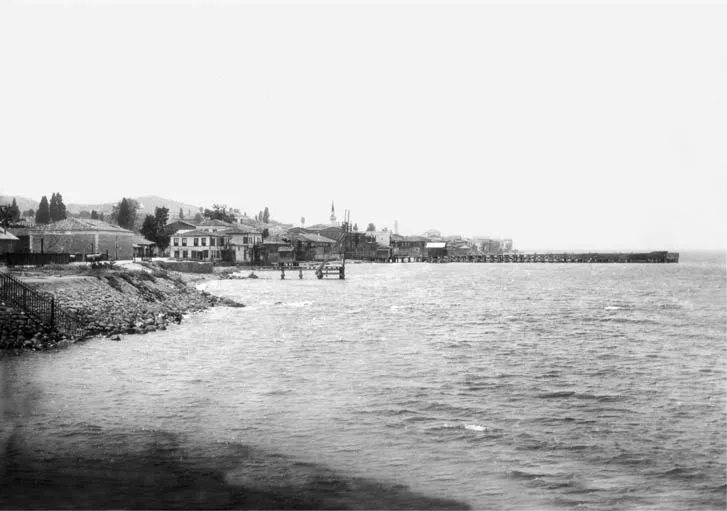
Figure 1.1 Mudanya
Source: Sébah and Joaillier, 1894, Deutsches Archaeologisches Institut-Istanbul, archive no. 10359
On the Ottoman side, these major towns of the local sphere were kaza centres which almost always included the villages around that settlement, making up the complete kaza units. In the Ottoman administrative hierarchy, these kaza units (or sub-districts) made up the sancaks which were the districts of the much wider provincial units or vilayets. Mudanya and Gemlik, for example, were kaza centres of the Bursa sancak and they comprised the villages around them. Bandırma and Ayvalık on the other hand were tied to the Karesi sancak. While Bandırma was the centre of a wider kaza unit, that of Ayvalık, rather exceptionally, included only one village other than the town itself. Both of them, and the other towns of that region, were part of the Karesi district (sancak) which along with Bursa and other districts made up the Hüdavendigar province. The province in turn was tied to Istanbul.
Even though they followed the major settlements of the region, it was only to a certain extent that the Ottoman and the Christian administrative divisions corresponded to one another. There was, in fact, much discrepancy between the two networks especially when one left the towns and either ascended or descended in the administrative hierarchy. The defining logic of these two spheres was different. The Ottoman administrative hierarchy covered the entire population of an area. It essentially drew boundaries on land. The Orthodox network, on the other hand, covered only a segment of that population – the Orthodox Christians – and as such was dependent on people rather than land.7 Certainly, the Orthodox hierarchy, too, defined/s geographic boundaries for its metropolitan bishoprics. In practice, however, it addressed only a specific part of the population who lived in that geographical division. It was according to the towns and villages where Orthodox Christians resided that communal units were drawn. There were certainly other people who were not Orthodox Christians but lived along with them in these lands. In the province of Hüdavendigar it was mainly Muslims and much less so Armenians who constituted the rest of the population.8
The size of the kaza, the main Ottoman administrative division on the local level, differed from that of the Orthodox communal unit. The kaza of Bandırma, for example, comprised 85 villages around Bandırma, the central town of the kaza.9 In the Orthodox administrative system, the Bandırma communal unit comprised only 11 villages around the town.10 Edincik, for instance, was designated as one of the villages of the Bandırma communal unit in the Orthodox Christian administrative network. In the Ottoman hierarchy, however, it had a more significant status: the Ottoman provincial yearbook defines it as the central town of the Ottoman administrative division of the nahiye11 of Edincik and in contrast to the Orthodox Christian hierarchy there were another 21 villages tied to this town. Looking at the administrative frameworks in the communal registers, one would get the impression that Edincik was an Orthodox Christian settlement. But Ottoman records show that its total population was 3,480 people12 with only 200 Orthodox Christians divided among 30 households.13 Other Greek documentation confirms this information given by the Ottoman archives.14 Furthermore, the whole nahiye itself comprised 7,919 people and only 329 were Orthodox Christians.15 These figures challenge the notion of a geographical continuity of Orthodox Christians. There was not an uninterrupted Orthodox Christian space, contrary to what is suggested by the communal registers.
At the same time, however, the Orthodox Christian administrative divisions laid out in the communal registers give us a part of the picture which simply does not exist in the Ottoman archives. Imperial documents occasionally refer to communal councils, but communal administrative frameworks, i.e. koinotitas, are consistently ignored by the Ottoman authorities and accordingly by most Ottomanists, who consult the Ottoman sources only. Communal registers on the other hand minutely delineate the Orthodox Christian administrative sphere and what this documentation immediately suggests to us is that, unlike what Ottoman historiography has long believed, this sphere did not govern each and every aspect of administration for Orthodox Christians. It was specifically concerned with a space defined, directly or indirectly, by one’s faith. This administration then was mainly responsible for an Orthodox Christian sphere.
The communal unit
What exactly, then, was this communal sphere? What was the koinotita? A koinotita was a communal administrative unit which was established according to written codes issued by the communal notables. Five or six of these notables were elected to form the demogerontia, i.e. the council of elders. The demogerontia was the main communal administrative council – the one that also occasionally appears in Ottoman sources. It was composed of lay notables of the town. Its president was the metropolitan of the bishopric; in practice one of the deputies of the metropolitan usually filled this office since the metropolitan himself could not always be present in every area throughout his bishopric and only occasionally visited the towns, as was the custom.16 This information is supplied to us by the proceedings of the demogerontia meetings, which were also registered in the same books as the codes. The codes laid out a series of rules and regulations on communal life. According to these rules, communal administration did not cover every administrative sphere. It dealt exclusively with the management of religious and educational institutions, i.e. churches, cemeteries, schools and, where they existed, philanthropic and cultural institutions.17 It was also engaged with matters such as the election of local representatives for the patriarchal elections, which was yet another faith-related issue within the Orthodox Christian framework.
Religious, educational and philanthropic institutions constituted the main mechanism through which Orthodox Christian ties were created. It was through these institutions that the local communal unit exclusively addressed the Orthodox Christians of an area; that a resident of a town was of the Orthodox Christian faith directly mattered in this realm. Accordingly, the demogerontia as the main administrative council of the communal unit defined communal relations and opened communal channels by administering the institutions that it designated as common to Orthodox Christians. This mechanism forged a set of Orthodox Christian relations, with churches and schools comprising the skeleton of the administrative structure. The communal unit took shape and attained visibility through the consolidation of these institutions. Churches and schools became the markers and reference points of the formation of communal ties. The communal unit would not exist without the communal institutions. The communal unit was the communal institutions.
The demogerontia, however, did not find a ready-made group of Orthodox Christians which it then went on to administer. Being an Orthodox Christian was the essential condition for belonging to the communal unit and the communal codes addressed all of the Orthodox Christians of the settlements they covered,18 but just as this unit did not cover every administrative sphere, neither was every Orthodox Christian part of this unit. The fact that someone was Orthodox Christian did not automatically make him a member of the unit, which has led some scholars to differentiate between the ‘commune’, i.e. the administrative unit, and the ‘community’, i.e. co-religionists who were in that area.19 This is because in Greek, the term koinotita covers both meanings. Likewise, there is only one word in Turkish, cemaat, even though this refers to the latter meaning – a loose definition of co-religionists – as the Ottomans did not recognise the first entity.20 Indeed, what has been wrongly construed is the direct association of the administrative unit with all of the co-religionists in an area. An individual might be among the Orthodox Christians of a region, but this did not mean that he was part of the commune, either with or without his volition.
Membership of the commune meant that a person could vote in the demogerontia elections and thus have a say in communal matters.21 To qualify for membership this person – a he – had to be an Ottoman subject, a permanent resident in that particular area and above a certain age, which was usually 25. He also had to be regularly paying his property tax.22 Only those who fulfilled these requirements could be a part of the communal administrative affairs. A certain Miltiyadi, for example, who was originally from the Greek island of Syros, resided in the village of Karaağaç near Kemer, where he had olive groves. The same olive grove was also claimed by Kostanti, the son of Panayi who, although originally from Ayvalık,23 was a resident in the town of Kemer on a temporary basis. If Miltiyadi or Kostanti wanted to take part in communal decision-making, neither of them could do so, because the former did not have Ottoman nationality and the latter was not a permanent resident o...