Social Anthropology explains and illustrates the methods of modern anthropology, tracing its development from pre-nineteenth-century philosophical speculations and the empirical work of explorers, missionaries and colonial servants, up to the second half of the twentieth century.
First published in 1951.
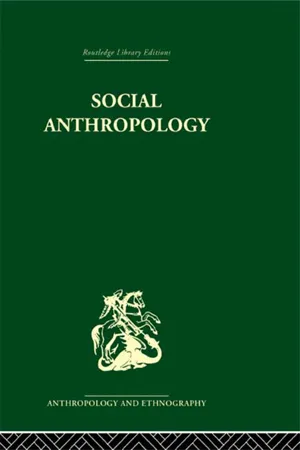
- 144 pages
- English
- ePUB (mobile friendly)
- Available on iOS & Android
eBook - ePub
Social Anthropology
About this book
Information
II
THEORETICAL BEGINNINGS
In this, my second, lecture and in the following lecture I propose to give you some account of the history of social anthropology. I do not intend to present you with a mere chronological arrangement of anthropologists and their books, but to attempt to trace the development of its general concepts, or theory, using some of these writers and their works as illustrations of this development.1
As we have seen, social anthropology is a very new subject in the sense that it has only recently been taught in our universities, and still more recently under that title. In another sense it may be said to have begun with the earliest speculations of mankind, for everywhere and at all times men have propounded theories about the nature of society. In this sense there is no definite point at which social anthropology can be said to have begun. Nevertheless, there is a point beyond which it is hardly profitable to trace back its development. This nascent period of our subject was the eighteenth century. It is a child of the Enlightenment and bears throughout its history and today many of the characteristic features of its ancestry.
In France its lineage runs from Montesquieu (1689–1755). His best known book, De L’Esprit des Lois (1748),a treatise on political, or perhaps social, philosophy, is best remembered for some rather odd notions Montesquieu had about the influence of climate on the character of peoples and for his remarks on the separation of powers in government. But what is of chief interest to us is that he had the idea of everything in a society and its ambient being functionally related to everything else. One can only understand international, constitutional, criminal, and civil law by considering them in relation to each other and also in relation to the physical environment of a people, their economy, their numbers, their beliefs, their customs and manners, and their temperaments. The object of his book is to examine ‘all these interrelations: they form taken together that which one calls the Spirit of the Laws’.1
Montesquieu used the word ‘laws’ in a number of different senses, but in a general sense he meant ‘the necessary relations which derive from the nature of things’,2 that is to say, the conditions which make human society possible at all and those conditions which make any particular type of society possible. Time will not allow me to discuss his argument in detail, but it should, I think, be noted that he distinguished between the ‘nature’ of society and its ‘principle’, its ‘nature’ being ‘that which makes it to be what it is’ and its ‘principle’ being ‘that which makes it function’. ‘The one is its particular structure, and the other the human passions which make it work’.3 He thus distinguished between a social structure and the system of values which operate in it.
From Montesquieu the French lineage of social anthropology runs through such writers as D’Alembert, Condorcet, Turgot, and in general the Encyclopaedists and Physiocrats, to Saint Simon (1760–1825), who was the first to propose clearly a science of society. This descendant of an illustrious family was a very remarkable person. A true child of the Enlightenment, he believed passionately in science and progress and desired above all to establish a positive science of social relations, which were to him analogous to the organic relations of physiology; and he insisted that scientists must analyse facts and not concepts. It is understandable that his disciples were socialists and collectivists, and perhaps also that the movement ended in religious fervour and finally evaporated in a search for the perfect woman who would play the part of a female messiah. Saint Simon’s best known disciple, who later quarrelled with him, was Auguste Comte (1798–1857). Comte, a more systematic thinker than Saint Simon, though just as eccentric a person, named the proposed new science of society ‘sociology’. The stream of French philosophical rationalism which comes from these writers was later, through the writings of Durkheim and his students and Lévy-Bruhl, who were in the direct line of Saint Simonian tradition, to colour English anthropology strongly.
Our forbears in Great Britain were the Scottish moral philosophers, whose writings were typical of the eighteenth century. The best known names are David Hume (1711–1776) and Adam Smith (1723–1790). Most of them are very little read today. They insisted that societies are natural systems. By this they meant in particular that society derives from human nature and not from a social contract, about which Hobbes and others had written so much. It was in this sense that they talked about natural morality, natural religion, natural jurisprudence, and so forth.
Being regarded as natural systems or organisms, societies must be studied empirically and inductively, and not by the methods of Cartesian rationalism. Thus, the title of Hume’s thesis of 1739 was A Treatise of Human Nature: Being an Attempt to introduce the experimental Method of Reasoning into Moral Subjects. But they were also highly theoretical thinkers and were chiefly interested in the formulation of what they called general principles and what would today be called sociological laws.1
These philosophers had also a firm belief in limitless progress—what they called improvement and perfectibility—and in laws of progress. To discover these laws they made use of what Comte was later to call the comparative method. As they used it, it implied that, human nature being fundamentally everywhere and at all times the same, all peoples travel along the same road, and by uniform stages, in their gradual but continuous advance to perfection; though some more slowly than others.
It is true that there is no certain evidence of the earliest stages of our history but, human nature being constant, it may be assumed that our forefathers must have lived the same kind of life as the Redskins of America and other primitive peoples when they lived in similar conditions and at a similar level of culture. By comparing all known societies and arranging them in order of improvement it is thus possible to reconstruct what the history of our own society, and of all human societies, must have been, even though it cannot be known when or by what events progress took place.
Dugald Stewart called this procedure theoretical, or conjectural, history. It is a kind of philosophy of history which attempts to isolate broad general trends and tendencies and regards particular events as mere incidents. Its method is admirably set forth by Lord Kames: ‘We must be satisfied with collecting the facts and circumstances as they may be gathered from the laws of different countries: and if these put together make a regular system of causes and effects, we may rationally conclude, that the progress has been the same among all nations, in the capital circumstances at least; for accidents, or the singular nature of a people, or of a government, will always produce some peculiarities.’1
Since there are these laws of development and there is a method by which they can be discovered it follows that the science of man these philosophers proposed to establish is a normative science, aiming at the creation of a secularist ethics based on a study of human nature in society.
We have already in the speculations of these eighteenth-century writers all the ingredients of anthropological theory in the following century, and even at the present day: the emphasis on institutions, the assumption that human societies are natural systems, the insistence that the study of them must be empirical and inductive, that its purpose is the discovery and formulation of universal principles or laws, particularly in terms of stages of development revealed by the use of the comparative method of conjectural history, and that its ultimate purpose is the scientific determination of ethics.
It is on account of their attachment to the formulation of general principles and because they dealt with societies and not with individuals that these writers are of particular interest in the history of anthropology. In seeking to establish principles their concern was with institutions, their structural interrelations, their growth, and the human needs they arose to satisfy. Adam Ferguson, for example, in his An Essay on the History of Civil Society (1767) and other works writes of such matters as the manner of subsistence, varieties of the human race, the disposition of men to society, the principles of population growth, arts and commercial arrangements, and ranks and social divisions.
The importance of primitive societies for the questions which interested these philosophers is evident, and they occasionally made use of what was known of them, but, outside their own culture and time, Old Testament and classical writings were their main sources. Little was, in any case, as yet known about primitive societies, though the voyages of discovery in the sixteenth century had even in Shakespeare’s time led to a general representation of the savage in educated circles, portrayed in the character of Caliban; and writers on politics, law and custom were already beginning to be aware by that time of the great diversity of custom presented by peoples outside Europe. Montaigne (1533–1592), in particular, devoted many pages of his Essays to what we would today call ethnographic material.
In the seventeenth and eighteenth centuries philosophers cited primitive societies in support of their arguments about the nature of rude society in contrast to civil society, that is to say, society before the establishment of government by contract or acceptance of despotism. Locke (1632–1714) especially, refers to these societies in his speculations about religion, government and property. He was familiar with what had been written about the hunting Redskins of New England, and the fact that his knowledge was restricted to only one type of American Indian society much biassed his account.
French writers of the time drew their picture of man in a state of nature from what had been published about the Indians of the St. Lawrence, especially Gabriel Sagard’s and Joseph Lafitau’s accounts of the Hurons and Iroquois.1 Rousseau’s portrait of natural man was largely drawn from what was known of the Caribs of South America.
I have mentioned the use made of accounts of primitive peoples by some writers of the seventeenth and eighteenth centuries, because we can see in it the beginnings of that interest in the simpler societies as valuable material for theories about the nature and improvement of social institutions which in the middle of the nineteenth century was to develop into what we now call social anthropology.
The writers I have named, both in France and England, were of course in the sense of their time philosophers, and so regarded themselves. In spite of all their talk about empiricism they relied more on introspection and a priori reasoning than on observation of actual societies. For the most part—Montesquieu should perhaps be excepted from this stricture—they used facts to illustrate or corroborate theories reached by speculation. It was not till the middle of the nineteenth century that systematic studies of social institutions were made. In the decade between 1861 and 1871 there appeared books which we regard as our early theoretical classics: Maine’s Ancient Law (1861) and his Village-Communities in the East and West (1871), Bachofen’s Das Mutterrecht (1861), Fustel de Coulanges’ La Cité Antique (1864), McLennan’s Primitive Marriage (1865), Tylor’s Researches into the Early History of Mankind (1865) and his Primitive Culture (1871), and Morgan’s Systems of Consanguinity and Affinity of the Human Family (1871).
Not all these books were concerned primarily with primitive societies. Maine wrote about the early institutions of Rome and, more generally, of the Indo-European peoples, and Bachofen was chiefly interested in the traditions and mythologies of classical antiquity; but those which were least concerned with them dealt with comparable institutions at early periods in the development of historical societies and they dealt with them, as I shall show, in a sociological manner.
It was McLennan and Tylor in this country, and Morgan in America, who first treated primitive societies as a subject which might in itself engage the attention of serious scholars. It was they who first brought together the information about primitive peoples from a wide range of miscellaneous writings and presented it in systematic form, thereby laying the foundations of social anthropology. In their writings the study of primitive societies and speculative theory about the nature of social institutions met.
These authors of the middle of the nineteenth century, like the philosophers before them, were anxious to rid the study of social institutions of mere speculation. They, also, thought that they could do this by being strictly empirical and by rigorous use of the comparative method. We have noted that this method was utilized, under the title of hypothetical or conjectural history, by the moral philosophers. It was given a new and more precise definition by Comte in his Cours de Philosophie Positive (1830). As we shall see, it was later to be restated without its historicism by modern anthropology as the functional method.
According to Comte, there is a functional relation between social facts of different kinds, what Saint Simon and he called series of social facts, political, economic, religious, moral, etc. Changes in any one of these series provoke corresponding changes in the others. The establishment of these correspondences or interdependencies between one kind of social fact and another is the aim of sociology. It is attained by the logical method of concomitant variations, since in dealing with very complex social phenomena, in which simple variables cannot be isolated, this is the only method which can be pursued.
Using this method, not only the writers to whom I have referred, but also those who came after them, wrote many large volumes purporting to show the laws of the origin and development of social institutions: the development of monogamous marriage from promiscuity, of property from communism, of contract from status, of industry from nomadism, of positive science from theology, of monotheism from animism. Sometimes, especially when treating religion, explanations were sought in terms of psychological origins, what the philosophers had called human nature, as well as in terms of historical origins.
The two favourite topics for discussion were the development of the family and the development of religion. Victorian anthropologists were never tired of writing about these two subjects, and a consideration of some of their conclusions about them will help us to understand the general tone of anthropology at that time, for though they disputed violently among themselves about what could be inferred from the evidence, they were agreed about the aims and methods to be pursued.
Sir Henry Maine (1822–1888), a Scot, a lawyer, and the founder, in England, of comparative jurisprudence, held that the patriarchal family is the original and universal form of social life and that the patria potestas, the absolute authority of the patriarch, on which it rests has produced everywhere at a certain stage agnation, the tracing of descent through males exclusively. Another jurist, the Swiss Bachofen, reached a precisely opposite conclusion about the form of the primitive family; and it is curious that he and Maine published their conclusions in the same year. According to Bachofen, there was first everywhere promiscuity, then a matrilineal and matriarchal social system, and only late in the history of man did this system give way to a patrilineal and patriarchal one.
A third lawyer and another Scot, J. F. McLennan (1827–1881), was a great believer in general laws of social development, though he had his own paradigm of stages and ridiculed those of his contemporaries. In his view, early man must be assumed to have been promiscuous, though the evidence shows him first as living everywhere in small matrilineal and totemic stock-groups which practised the blood feud. These hordes were politically independent of one another and each w...
Table of contents
- Cover
- Title Page
- Copyright Page
- Original Copyright Page
- CONTENTS
- PREFACE
- I THE SCOPE OF THE SUBJECT
- II THEORETICAL BEGINNINGS
- III LATER THEORETICAL DEVELOPMENTS
- IV FIELDWORK AND THE EMPIRICAL TRADITION
- V MODERN ANTHROPOLOGICAL STUDIES
- VI APPLIED ANTHROPOLOGY
- SELECT BIBLIOGRAPHY
Trusted by 375,005 students
Access to over 1.5 million titles for a fair monthly price.
Study more efficiently using our study tools.
Frequently asked questions
Yes, you can cancel anytime from the Subscription tab in your account settings on the Perlego website. Your subscription will stay active until the end of your current billing period. Learn how to cancel your subscription
No, books cannot be downloaded as external files, such as PDFs, for use outside of Perlego. However, you can download books within the Perlego app for offline reading on mobile or tablet. Learn how to download books offline
Perlego offers two plans: Essential and Complete
- Essential is ideal for learners and professionals who enjoy exploring a wide range of subjects. Access the Essential Library with 800,000+ trusted titles and best-sellers across business, personal growth, and the humanities. Includes unlimited reading time and Standard Read Aloud voice.
- Complete: Perfect for advanced learners and researchers needing full, unrestricted access. Unlock 1.5M+ books across hundreds of subjects, including academic and specialized titles. The Complete Plan also includes advanced features like Premium Read Aloud and Research Assistant.
We are an online textbook subscription service, where you can get access to an entire online library for less than the price of a single book per month. With over 1.5 million books across 990+ topics, we’ve got you covered! Learn about our mission
Look out for the read-aloud symbol on your next book to see if you can listen to it. The read-aloud tool reads text aloud for you, highlighting the text as it is being read. You can pause it, speed it up and slow it down. Learn more about Read Aloud
Yes! You can use the Perlego app on both iOS and Android devices to read anytime, anywhere — even offline. Perfect for commutes or when you’re on the go.
Please note we cannot support devices running on iOS 13 and Android 7 or earlier. Learn more about using the app
Please note we cannot support devices running on iOS 13 and Android 7 or earlier. Learn more about using the app
Yes, you can access Social Anthropology by E.E. Evans-Pritchard in PDF and/or ePUB format, as well as other popular books in Social Sciences & Anthropology. We have over 1.5 million books available in our catalogue for you to explore.