Included in this volume are papers which are recognized as some of the foundations of post-Keynesian Economics, analysing problems set in historical time and starting from 'real world' observations. The book reflects Geoff Harcourt's contribution to economic debate over more than three decades. It also includes intellectual biographies of some of the most prominent and leading unorthodox economists, such as Kenneth Boulding, Eric Russell and Lorie Tarshis.
In Mrs Robinson’s celebrated article ‘The production function and the theory of capital’ (1953–4, reprinted in part in J. Robinson 1960b: 114–31; all subsequent references are to the second source), it is not made clear whether the ‘man of words’, whose doings are contrasted with those of the ‘man of deeds’, is an economist or an accountant. It is assumed in this chapter that he is an accountant, and it is proposed to examine how accurate is the accountant’s measure of the rate of profit under ‘Golden Age’ conditions where uncertainty is absent, expectations are fulfilled and the rate of profit has an unambiguous meaning.1 The following question is asked: would the answer obtained by using the accountant’s measure of the rate of profit correspond with what is known, under the assumed conditions, to be the right answer, namely, that the ex post rate of return equals the ex ante one? This does not seem to be an entirely pointless exercise, since a number of ‘men of words’, economists this time, have used the accountant’s measure in their empirical investigations (see, for example, Kuznets 1952a; Phelps Brown and Weber 1953, especially pp. 272 and 283–8; Barna 1957, especially pp. 25 and 30; Lutz and Hague 1961: 82–5; Minhas 1963, chapter 5; Nevin 1963, especially p. 646), and conclusions have been drawn from both the relative and the absolute size of their estimates. Thus Minhas used cross-section studies of the rates of return in the same industries in different countries to test his hypothesis about factor reversals, and Nevin was depressed by the stable low level of rates of return in British manufacturing in the post-war period. But if it can be shown that the measure is faulty, even in the equilibrium conditions of a ‘Golden Age’, it is unlikely to prove a realistic measure in real-world situations.
The chapter is in six sections. In the first the various cases which are examined and the assumptions of the chapter are outlined; the following sections deal in detail with each case; and a concluding section draws the findings together. The principal conclusion is that the accountant’s measure of the rate of profit is extremely misleading, even under ‘Golden Age’ conditions. The measure is shown to be influenced by the pattern of the quasi-rents associated with individual machines in a stock of capital, by the method of depreciation used, by whether or not the stock of capital is growing, and by what assets are included in the stock of capital. What is more, no easy ‘rule of thumb’ which would allow adjustments for these factors to be made in the estimates emerges from the analysis.
The various cases outlined
Four main cases, each of which contains further sub-cases, are considered. The first case is that of the rate of profit, as measured by an accountant, in a business which has a balanced stock of identical machines. The second case concerns the rate of profit in a business, the gross investment in machines of which grows at a constant rate each year. Then, following a suggestion by Mr H.R. Hudson, variants of the two cases are examined: in the balanced stock case, it is assumed that the accumulation of financial assets, which are purchased as a result of allowing for depreciation as the stock of machines builds up but before any replacement expenditure occurs, is included in the capital of the business; in the constant growth case, it is supposed that the accumulation of financial assets, which occurs from the beginning of the firm until the first year of replacement, plus the further accumulation associated with the difference between current depreciation allowances and the replacement expenditure of subsequent years (the ‘Domar effect’), are included in the capital of the business. The first two cases might be regarded as representative of stationary and growing ‘Golden Age’ economies respectively, because the capital in them consists entirely of physical assets. The second two cases can be regarded as representative of firms which hold financial assets as well, and which operate in ‘Golden Age’ economies. (Holdings of financial assets, of course, cancel out for an economy as a whole.)
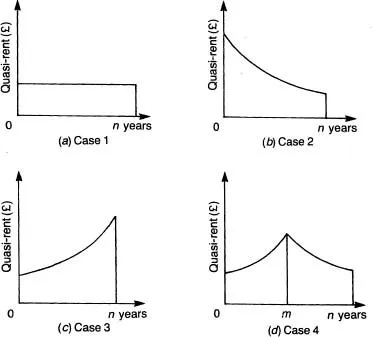
For each of the four general cases, four special cases are considered: first, it is assumed that the machines are ‘one-hoss shays’ and that the expected quasi-rents of each year of operation are equal. This is referred to as the case of the constant qs, where qi is the expected quasi-rent of year i (i = 1,…, n, n being the life of the machine) and q1 = q2 = … = qn (With the present assumptions, expected and actual quasi-rents always coincide.) Cases 2 and 3 are those of falling and rising qs respectively; for convenience, it is assumed that qi = bqi–1 (i = 2,…, n) where b < 1 (case 2), and qi = aqi–1 (i = 2,…, n) a > 1 (case 3). Case 4 is a combination of cases 2 and 3; it is assumed that up to qm (m < n), qi = aqi–1 (i = 2,…, m), a > 1; and from qm on (but not including qm), qj = bqj–1 (j = m + 1, …, n), b < 1. The patterns of the quasi-rents over the life of a machine are shown for the four cases in Fig. 1.1. The cases most likely to be met in practice are cases 1, 2 and 4, with m <
; perhaps case 2 is the most common case. Prices and wages are assumed to remain constant, so that the various patterns show the changes in productive efficiency over the lifetimes of the machines.
Let r be the expected rate of profit of each machine. The expected rate of profit in a ‘Golden Age’ is the internal rate of return – the rate of discount which makes the present value of the expected quasi-rents equal to the supply price of each machine. Then, because expectations are always realized in a ‘Golden Age’, and the rate of profit is uniform throughout the whole economy, it is known that each machine, and each business, is in fact earning r. The question which is analysed in this chapter is whether the accountant’s measure of the rate of profit gives a value of r for each of the four patterns of surpluses for each of the four cases. To answer it, two further sub-cases are introduced, the first assuming that the accountant uses straight-line depreciation when calculating annual accounting profit and the book value of capital, the second assuming that he uses reducing-balance depreciation. The accountant’s measure of the rate of profit is taken to be the ratio of annual accounting profit to the average of the opening and closing book values of the assets in the business concerned. It is assumed, as is reasonable in a ‘Golden Age’, that any financial assets owned by a business themselves earn r. Expressions for the accountant’s rate of profit for the two subcases of the four patterns of surpluses of the four types of business are presented in the remaining sections, and their values for particular ranges of values of the relevant variables are examined. Where no clear-cut patterns in the accountant’s rate of profit were discernible when, for example, the length of life of machines was varied, the numerical values of the rate of profit were found by running a program on a computer.2
Figure 1.1
It is not suggested, of course, that an ...
Table of contents
Cover
Title Page
Copyright Page
Original Copyright Page
Contents
List of tables
Preface
Acknowledgements
Introduction
Part I Issues in post-Keynesian economics
Part II The capital theory controversies
Part III Surveys of approaches to economic theory
Part IV Theoretical methods
Part V Post-Keynesian policy
Part VI Intellectual biographies
Bibliography
Name index
Subject index
Trusted by 375,005 students
Access to over 1.5 million titles for a fair monthly price.
Study more efficiently using our study tools.
Frequently asked questions
Yes, you can cancel anytime from the Subscription tab in your account settings on the Perlego website. Your subscription will stay active until the end of your current billing period. Learn how to cancel your subscription
No, books cannot be downloaded as external files, such as PDFs, for use outside of Perlego. However, you can download books within the Perlego app for offline reading on mobile or tablet. Learn how to download books offline
Perlego offers two plans: Essential and Complete
Essential is ideal for learners and professionals who enjoy exploring a wide range of subjects. Access the Essential Library with 800,000+ trusted titles and best-sellers across business, personal growth, and the humanities. Includes unlimited reading time and Standard Read Aloud voice.
Complete: Perfect for advanced learners and researchers needing full, unrestricted access. Unlock 1.5M+ books across hundreds of subjects, including academic and specialized titles. The Complete Plan also includes advanced features like Premium Read Aloud and Research Assistant.
Both plans are available with monthly, semester, or annual billing cycles.
We are an online textbook subscription service, where you can get access to an entire online library for less than the price of a single book per month. With over 1.5 million books across 990+ topics, we’ve got you covered! Learn about our mission
Look out for the read-aloud symbol on your next book to see if you can listen to it. The read-aloud tool reads text aloud for you, highlighting the text as it is being read. You can pause it, speed it up and slow it down. Learn more about Read Aloud
Yes! You can use the Perlego app on both iOS and Android devices to read anytime, anywhere — even offline. Perfect for commutes or when you’re on the go. Please note we cannot support devices running on iOS 13 and Android 7 or earlier. Learn more about using the app
Yes, you can access On Political Economists and Political Economy by Professor Geoffrey Harcourt, Claudio Sardoni in PDF and/or ePUB format, as well as other popular books in Business & Business General. We have over 1.5 million books available in our catalogue for you to explore.