Filling a significant gap in the cross-cultural and cross-disciplinary literature within the field of Pasifika (Polynesian) and Maori identities and mental health, this volume focuses on bridging mental health related research and practice within the indigenous communities of the South Pacific. Much of the content reflects both differences from and relationships with the dominant Western theories and practices so often unsuccessfully applied with these groups. The contributors represent both experienced researchers and practitioners and address topics such as research examining traditional and emerging Pasifika identities; contemporary research and practice in working with Pasifika youth and adolescents; culturally-appropriate approaches for working with Pasifika adults; and practices in supervision that have been developed by Maori and Pasifika practitioners. Chapters include practice scenarios, research reports, analyses of topical issues, and discussions about the appropriateness of applying Western theory in other cultural contexts. As Pasifika cultures are still primarily oral cultures, the works of several leading Maori and Pasifika poets that give voice to the changing identities and contemporary challenges within Pacific communities are also included.
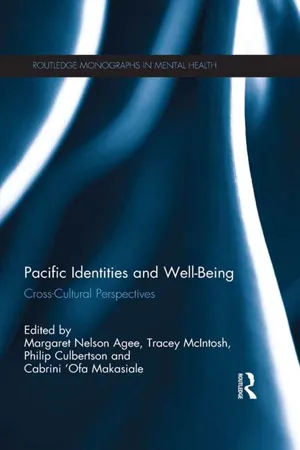
eBook - ePub
Pacific Identities and Well-Being
Cross-Cultural Perspectives
- 320 pages
- English
- ePUB (mobile friendly)
- Available on iOS & Android
eBook - ePub
Pacific Identities and Well-Being
Cross-Cultural Perspectives
About this book
Information
Part I
Identity
Checklist
| Brown eyes | check |
| Unruly hair | check |
| Big boned | check |
| Speaks a Pacific language | |
| Can perform a Pacific dance at will | |
| Mother of Pacific Island origin | check |
| Father of Pacific Island origin | |
| Born in a Pacific Island (not including New Zealand) | |
| Raised in a Pacific Island (not including Waiheke) | |
| Emigrated from a Pacific Island in formative early years | |
| Attends a Pacific Island church or has church-based affi liations | |
| (ao talavou, ao faipese etc.) | |
| Owns several seasonal Pacific wear (puletasi etc) | check |
| Three or more weekly occurrences of tying back one' hair(fa'apaku etc) | check |
| Has an uku comb (lice detector) in the cupboard | |
| Owns and/or commonly wears Pasifi ka jewellery, defi ned as comprising in whole or part thereof, raw materials manufactured within or popularly purported to be originating from, the Pacific. These include shell, bone, coconut husk and/or fi bre, and tapa cloth | check |
| Laughs like hurricane rain on a tin roof | check |
| Has an unusually strong parental bond, born out of alofa and a sense of duty, oftentimes manipulative in nature | check |
| Lives with extended family (equal to or greater than 9 members) | check |
| Nurtures kinship ties in non-traditional settings | check |
| Weathers judgements of other Pacific Islanders regarding the “authenticity” of one' cultural identity | check |
| No longer cares about the above | check |
Please ensure all questions have been answered to the best of your validity.
Thank you.
—Selina Tusitala Marsh
Battle Plan 1
It doesn't matter
that daddy blessed the house
the aitu come
because I alone
because the red curtains
because I weak from pain
I need the small house
I need go back to Samoa
my sister, she there
she look after me
I sick all time
too many drugs.
The short Indian driver
say the Chinese doctor useless
can't even speak the English
he needs his daughter to transfer for him
stupid idiot
he pay 35 dollar to make him bigger
I say:
Which one you want bigger?
Your leg or between your leg? Ah so!
Two weeks later
it not working
nothing working.
Sometime there's sound
when I by myself
I say
Show me your face
And I'll put the hot water in your head!
Because I'm alone
the aitu come
I say
hey! Cut it out! I fi ke you all the way!
In war
you need to know who your enemy is
who you're fi ghting your life for
today
it's the man who sold her the bed
it makes her bones ache
she can't sleep
feels like throwing up
can't turn without pain
the mattress is too soft/hard
the base too soft/hard
the inner springs too soft/hard
that man tricked her
now he's going to pay
she's no over-stayer
she's a Niu Sila citizen
who's gonna get a brand new queen size bed
with a harder/softer mattress.
We're getting ready to leave
for the furniture shop now
just waiting for the grey rain to clear
she strategising our plan of attack
because if he says this
then she'll say that
then if he butts in with this
she'll counter attack
and bring the manager into it
and the warrantee.
I'll guard the sides
silently knowing it didn't warrantee
against cancer
but that's her battle, not mine
and when you're not fi ghting
you're dying.
—Selina Tusitala Marsh
Sagasaga (Job's Tears)*
the fruit of sagasaga are shaped like tear drops
they are natural beads whose soft insides
are easily pierced and strung into rosaries
Don't cry. Be a good girl. Stay away from the boys.
Obey your parents. Go to church. Sweep the leaves.
Use a white cup and saucer for the milo for your uncle.
migrants leave a bit of themselves behind
pack something of themselves into a suitcase
they're as strong as eggshells crowded with ghosts
as vulnerable as fl ipped turtles under the sun
we're born into a world balancing on ancient stones
who are restless, prone to shifting and splintering
and some of us are falling through the cracks
bit
by
bit
or plummeting all at once
we're lost in streets and games and spaces
where logos, dollar signs, tats and tags
are the glyphs of storytellers and loan sharks
so I'll shake gourds netted with hundreds of sagasaga
to amplify our sorrow for whoever's listening
while we huddle around what comfort we find
our tears raining like Job's
—Serie Barford
_______________
* The imagery is based on the Samoan sagasaga plant, also known as Job's Tears. The poem speaks of those who come to Aotearoa for a better life but lose parts of themselves when they leave home and then things don't always work out in the land of dreams and promises, leaving them even emptier. They lose relationship with the traditional narratives and instead listen to the voices of streets, game arcades, tats, and those who try to fl eece them. In the very old days, sagasaga beads were shaken as part of the ritual of communicating with the gods. Now, they are used primarily in rosaries and jewelry. The alternative name, “Job's Tears,” communicates the trials that our people face.
1 Adolescent Racial–Ethnic Identity
Behaviors, Perceptions, and Challenges in Urban Multiethnic School Contexts
Early adolescents in New Zealand today are grappling with the questions “Who am I?” and “How do I belong?” in a distinctly different cultural context from that of past generations because New Zealand is more racially, ethnically, culturally, and linguistically diverse than ever before. A notable demographic change between the 1991 and 2006 censuses was the increasing ethnic diversifi cation of the New Zealand population. While the European racial–ethnic group still comprises the largest share of the total population (78%), the number of people identifying as European increased by only 8% in the 15 years between 1991 and 2006. Over that same period, the number who identified as Māori increased by 30%, the Pacific people's racial–ethnic group increased by 59%, and the number of “Asian” people increased by 255% (Ministry of Social Development, 2006).
The need to better understand the salience of racial–ethnic identity constructs and cultural orientation has grown. Salience is the mechanism through which identity becomes relevant in daily life (Yip & Fuligni, 2002) and it has become increasingly clear that aspects of adolescents’ cognitive and social-emotional development vary according to race, ethnicity, and cultural background (Chao, 2000, 2001; Harwood, Miller, & Irizarry, 1995; Rogoff, 2003). Given the multiethnic nature of New Zealand society, REI can have significant implications for early adolescents attending multiethnic high schools to the extent that race or ethnicity becomes salient in everyday activities. It is therefore critical to gain an understanding of the role that REI plays in the lives of adolescents by capturing the variability in the ways that individuals defi ne themselves and their group membership.
The Psychological, Social, and Political Functions of Racial–Ethnic Identity
It is psychologically important for adolescents to defi ne themselves positively in terms of REI. Research continues to reinforce the long-standing positions proposed by Helms (1990) and Cross (1991) that a positive relationship exists between REI and self-esteem. REI has been empirically associated among adolescent youth with positive psychological characteristics such as self-esteem, resiliency, hope, self-reliance, academic self-efficacy, and prosocial behavior (Chavira & Phinney, 1991; Lorenzo-Hernandez & Ouellette, 1988; Umana-Taylor, Diversi, & Fine, 2002), and the absence of negative characteristics such as anxiety, loneliness, depression, school problems, and violence (Chavira & Phinney, 1991; Verkuyten, 2008). Roberts et al. (1999) found that people with a positive sense of REI tended to have higher self-esteem and better psychological outcomes, while Negy, Shreve, Jensen, and Uddin (2003) also contended that a strong REI is associated with higher levels of self-esteem, self-confidence, and a positive purpose in life. Adolescents who have explored and made a clear and positive commitment to their REIs score higher on measures of self-esteem, self-evaluation, sense of mastery, and social and peer interactions than do those who have not made such a commitment (Phinney, 1989; Phinney & Alipuria, 1990).
It seems that a strong sense of REI provides adolescents with a repertoire of social identities that allows them successfully to negotiate difficult situations such as being faced with negative stereotypes and unfair treatment, and high levels of secure and positive REI can help adolescents to buffer the effects of discrimination or racism on their psychological well-being (Crocker, Luhtanen, Blaine, & Broadnax, 1994; Oyserman, Gant, & Ager, 1995; Quintana, 1998; Sellers, Smith, Shelton, Rowley, & Chavous, 1998). A study with Jewish adolescents showed that while students with more advanced levels of REI were more sensitive to culture-specific stressors such as discrimination and race-based encounters, their strong sense of REI helped them to develop effective coping strategies (Dubow, Pargament, Boxer, & Tarakeshwar, 2000).
In an increasingly ethnically diverse society, REI is also an important social referent for many adolescents. This social and psychological construct enables individuals both to distinguish themselves from others and to identify with a broader collective group, and REI is therefore continually being renegotiated and redefi ned. The temporal nature of REI can be characterized as a response to contextual demands whereby individuals are trying to maintain existing identities while concurrently adapting to their changing environments. Knowledge of one's group memberships, and the value and emotional significance attached to them, comprise part of an individual's self-concept, and among some visible and marginalized minority populations in New Zealand, racial, ethnic, and cultural identities are constructed, enacted, and manifested in very conscious ways. For adolescents, REI is both a political and a social act, “providing individuals with a unified system by which to understand and experience society” (Williams, 1996, p. 192). Racial–ethnic identity can therefore be regarded as a political and social resource that can be used by members of both dominant and minority groups for the purpose of enhancing the position of their social identities and pursuing their own interests.
An individual's REI can provide a lens through which everyday experiences are filtered. So, while a group of ethnically diverse individuals might in some way experience exactly the same race-based encounter, each individual may have different interpretations of the content, impact, and cause of the event, based on the psychological, social, and political meanings they attach to their REI and the REI of the person responsible for the encounter. The significance of REI is complex and dependent upon the personal characteristics of an individual and the immediate situation, as well as macrolevel features such as the racial–ethnic composition of the context, immigration policy, and the social and political status of one's racial–ethnic group. While societal defi nitions of a racial–ethnic group may influence identification, they clearly do not fully defi ne personal experience, and vice versa.
The Enactment of Racial–Ethnic Identity
The idea has been consistently established across diverse areas of research that context can alter individuals’ sense of REI, personality, or even communication style (Deaux & Ethier, 1998; Lawson & Sachdev, 2000; Swann, Bosson, & Pelham, 2002). Racial–ethnic identity is a dynamic and interactive aspect of self-concept that is responsive to situational differences and has “different meanings in different social settings for different individuals” (Matute-Bianchi, 1991, p. 237). R...
Table of contents
- Cover
- Half Title
- Full Title
- Copyright
- Contents
- Acknowledgments
- About the Editors
- About the Contributors
- Introduction
- PART I Identity
- PART II Therapeutic Practice
- PART III Death and Dying
- PART IV Reflexive Practice
- Glossary
- Index
Trusted by 375,005 students
Access to over 1.5 million titles for a fair monthly price.
Study more efficiently using our study tools.
Frequently asked questions
Yes, you can cancel anytime from the Subscription tab in your account settings on the Perlego website. Your subscription will stay active until the end of your current billing period. Learn how to cancel your subscription
No, books cannot be downloaded as external files, such as PDFs, for use outside of Perlego. However, you can download books within the Perlego app for offline reading on mobile or tablet. Learn how to download books offline
Perlego offers two plans: Essential and Complete
- Essential is ideal for learners and professionals who enjoy exploring a wide range of subjects. Access the Essential Library with 800,000+ trusted titles and best-sellers across business, personal growth, and the humanities. Includes unlimited reading time and Standard Read Aloud voice.
- Complete: Perfect for advanced learners and researchers needing full, unrestricted access. Unlock 1.5M+ books across hundreds of subjects, including academic and specialized titles. The Complete Plan also includes advanced features like Premium Read Aloud and Research Assistant.
We are an online textbook subscription service, where you can get access to an entire online library for less than the price of a single book per month. With over 1.5 million books across 990+ topics, we’ve got you covered! Learn about our mission
Look out for the read-aloud symbol on your next book to see if you can listen to it. The read-aloud tool reads text aloud for you, highlighting the text as it is being read. You can pause it, speed it up and slow it down. Learn more about Read Aloud
Yes! You can use the Perlego app on both iOS and Android devices to read anytime, anywhere — even offline. Perfect for commutes or when you’re on the go.
Please note we cannot support devices running on iOS 13 and Android 7 or earlier. Learn more about using the app
Please note we cannot support devices running on iOS 13 and Android 7 or earlier. Learn more about using the app
Yes, you can access Pacific Identities and Well-Being by Margaret Nelson Agee, Tracey McIntosh, Philip Culbertson, Cabrini 'Ofa Makasiale, Margaret Nelson Agee,Tracey McIntosh,Philip Culbertson,Cabrini 'Ofa Makasiale in PDF and/or ePUB format, as well as other popular books in Psychology & Mental Health in Psychology. We have over 1.5 million books available in our catalogue for you to explore.