- 424 pages
- English
- ePUB (mobile friendly)
- Available on iOS & Android
eBook - ePub
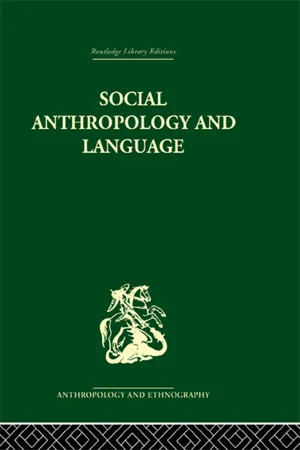
Social Anthropology and Language
About this book
Providing a critical framework for the consideration of the relationship between modern social anthropology and linguistics, this volume covers topics such as classification, symbolism, and structuralism. The relevance of the works of Saussure, Lévi-Strauss and Chomsky is considered. There are two case-studies: the first outlines a 'social history' of the succession of pidgins that are documented on the West African coast, ending with Pidgin English. The second analyzes the status of three language varieties used in a 'trilingual' community in the Carnian Alps.
Originally published in 1971.
Information
PART I
Social Anthropology, Language, and Sociolinguistics
Hilary Henson
Early British Anthropologists and Language
Bronislaw Malinowski asserted as early as 1920 that: ‘Linguistics without ethnography would fare as badly as ethnography would without the light thrown on it by language’ (1920: 78). It is only recently, however, that the full implications of such a statement have begun to be appreciated by British social anthropologists, and any explanation of this must take account of the distinctive British attitude towards the relationship between linguistics and anthropology during the formative years of the subject.
In contrast to the American or the French approach, very few British anthropologists considered that language required study in its own right within the bounds of their discipline. With the exception of Müller, who from his half-century of teaching in Oxford falls here into the British context, they merely used it as supplementary evidence to support and extend theories developed within anthropology.1 Language was indeed such a peripheral interest that very few ideas had evolved any further at the end of the period considered in this paper than at the beginning. For this reason, the material below is grouped according to topic rather than date. The dates chosen for the period as a whole, 1850 to 1920, cover the history of social anthropology from the time at which there was an upsurge of interest in other cultures, both for their own sakes and for the light they could throw on Western society and its origins, until the time when, with the development of fieldwork techniques, increasing emphasis was laid on the use of native categories, and the pragmatic application of linguistics to anthropology.
LANGUAGE AND RACE
One important area of nineteenth-century anthropology in which appeal was early made to linguistic evidence was that of racial distribution and differentiation. Anthropologists were concerned not so much with contemporary racial distributions as with giving them a history, and most of their attempts were dependent on the implicit assumption that linguistic distributions and interrelations exactly paralleled those of race and could thus be used as a substitute proof. The example for such reconstructions came from the early comparative linguists themselves, who assumed that they had deduced elements of a real language that had once been spoken by a people whose descendants were now scattered throughout Europe and Asia, Max Müller, for example, wrote:
‘It is hardly possible to look at the evidence hitherto collected … without feeling that these words are the fragments of a real language, once spoken by a united race at a time which the historian has till lately hardly ventured to realise’ (1856: 351).
Anthropologists accepted the linguists’ claim that their subject was a historical one, and that their hypothetical Indo-European forms could be used to reach back into man’s past (‘This method of making language itself tell the history of ancient times’ – Müller, 1856: 320). Many of them further accepted the implicit assumption that language could be equated with race. John Kennedy, for example, wishing to prove that the American Indians were all immigrants from other continents, and thus not the result of a separate Creation, used the vague resemblance between fourteen Carib words and certain West African equivalents to prove that the Caribs, at least, had come from Africa (Kennedy, 1856). Hyde Clarke made a more ambitious use of comparative linguistics. He classified all the languages of the world according to certain characteristics he claimed to find in them, assigned them to races which he assessed on a scale of progressive civilization, and produced from this a chronology of world colonization (Clarke, 1874).2
Some anthropologists did, however, recognize that such an application of linguistic evidence was merely an attempt to use the prestige of the linguists’ apparent success in uncovering history to provide anthropology with a history where it had none before. Tylor (1881) pointed out that the equation of language with race was false, since there were many cases both of different races sharing one language and of races changing from one language to another. The Rev. A. H. Sayce replied to Clarke in the year following the publication of his paper: ‘Society implies language, race does not’ (Sayce, 1875: 213). In the discussion that followed, Professor Whitney made a neat statement of the way in which language is culturally and not physically determined:
‘One’s language is learned, not made by him.… It is virtually an institution, a part of the acquired culture of the people to whom it belongs; and, like every other part of culture, it is capable of transference’ (Whitney, 1875: 216–217).
But in spite of such arguments to the contrary, some anthropologists continued to maintain that there was an observable connection between the distinctive characteristics of a language and the mentality of the race that created it. As late as 1883, Gustav Oppert, a professor of Sanskrit, defended this theory in the Journal of the Royal Anthropological Institute:
‘A language preserves, as it were instinctively, its peculiar construction, and if it does not always coincide, either with the particular nation or person who speaks it, it certainly indicates the race of those who spoke it first, and this, in spite of all apparent change, and it retains the mode of thought of those among whom it first sprung up as their natural means of communication, though that race itself might exist no longer’ (Oppert, 1883: 33).
It certainly appears that it was the Sanskrit linguists who were most responsible for such arguments. John Crawfurd, in an attack on the theory that Indo-European was ever spoken by such a thing as an Aryan race, claimed that: ‘The theory in its ripest state is most fully described by the learned and ingenious Orientalist Professor Max Müller’ (1861: 268). In his early writing, Müller certainly did assume that the Aryan language could be used to discover the Aryan race (e.g. 1856), but by 1872 he attacked uncompromisingly any approach that did not differentiate between language and racial characteristics, although he was still prepared to deduce certain cultural patterns from linguistic evidence:
‘It is but too easily forgotten that if we speak of Aryan and Semitic families, the ground of classification is language, and language only. There are Aryan and Semitic languages, but it is against all rules of logic to speak, without an expressed or implied qualification, of an Aryan race, of Aryan blood, of Aryan skulls, and to attempt ethnological classification on purely linguistic grounds. These two sciences, the Science of language and the Science of man, cannot, at least for the present, be kept too much asunder; and many misunderstandings, many controversies, would have been avoided, if scholars had not attempted to draw conclusions from language to blood, or from blood to language. When each of these sciences shall have carried out independently its own classification of men and of languages, then, and then only, will it be time to compare their results’ (1872: 187).
THE IDEA OF THE PRIMITIVE LANGUAGE
The received idea that languages were linked to the mental capacity of the races that used them assumed in effect that language was physically determined. This was consistent with the general evolutionary bias of nineteenth-century anthropology, which was itself dependent on a biological analogy. It was an axiom that just as certain races were primitive, so the languages that they spoke were similarly simple and undeveloped. Those anthropologists who used comparative linguistic material classified it according to broad structural resemblances between languages, but the ordering of these classifications into stages of evolution was essentially dependent on the initial anthropological assumption that cultures could be so classified. An example is to be found as late as 1901 in the JRAI: ‘Compared with an Aryan language, Tagalo is deficient in many qualities which have made European tongues the vehicle of civilisation’ (Mackinlay, 1901: 214). One of the ‘qualities’ of Aryan languages quoted by the writer is the possession of grammatical gender. The ethnocentric approach to language was common to almost all the anthropologists of the period, and it was largely this which prevented them from seeing that there was no such thing as a ‘primitive’ language. The non-Indo-European languages were judged by their exotic nature, and their primitiveness was determined by the extent to which they differed from the European languages.
In any discussions of primitive languages there were two common assumptions about their inadequacy. The first was that the languages, and hence the speakers of the languages, were incapable of anything beyond a minimal generalization and abstraction:
‘Savages will have twenty independent words each expressing the act of cutting some particular thing, without having any name for the act of cutting in general; they will have as many to describe birds, fish and trees of different kinds, but no general equivalents for the terms “bird”, “fish”, or “tree”’ (Payne, 1899: 103).3
The second assumption was that, conversely, primitive languages were incapable of precision and specification, because their vocabularies were extremely small and limited, this failure being exacerbated by their harsh and indeterminate pronunciation: ‘By means of more or less significant sounds, then, Fuegian society compounds impressions, and that somewhat imperfectly’ (Marett, 1912: 139). Marett’s example of extreme primitiveness in language is taken from the same society that first prompted Darwin to speculate on the origins of man.
A further commonly held belief about primitive languages was that they were subject to rapid change:
‘Indeed, anyone who will attend to how English words run together in talking may satisfy himself that his own language would undergo rapid changes like those of barbaric tongues, were it not for the schoolmaster and the printer, who insist on keeping our words fixed and separate’ (Tylor, 1881: 142).
E. J. Payne, who poetically described the rapidly changing vocabulary of savages as ‘slippery and unstable as a dream’ (1899: 89), gave as evidence for this belief two versions of the Catechism translated into the Mosetena language for the Collegio de Propaganda Fide, the first dating from 1834 and the second thirty years later. It is true that the forms of the words in the two lists show a considerable difference, but it does not appear to have occurred to Payne that perhaps both lists merely represented the faulty transcriptions of untrained recorders.
An inspection of the evidence on unwritten languages which was available to anthropologists, at least during the earlier part of this period, makes it easier to understand their belief in the existence of ‘primitive’ languages. Admittedly, the inadequacy of the material in use affected the whole of anthropological research during this period, but certain areas of ethnographic data were at least partially open to observation and interpretation by the untrained traveller. The recording of exotic languages, on the other hand, could avoid ethnocentricity only by a conscious development of techniques, and this was never achieved during the period.
The recorders of these languages used a phonetic notation adapted from that used for the European languages that they knew. This explains the frequent tales of indeterminate and wavering pronunciations, where the phonemic system of a language did not overlap with the one used by the investigator. To give an example, a Scottish missionary, the Rev. Hugh Goldie, wrote of the Efik language:
‘B is frequently interchanged with p; or rather, a sound between the two, is very frequently employed. D has often r as a substitute, or rather, through imperfect enunciation, has the sound of r given to it. It is occasionally substituted for F’ (1868: 5–6).
The recorders applied unquestioningly to their material the semantic and grammatical categories of the main European languages, once again explaining the lack of correspondence by a failing on the part of the primitive languages. Accounts of primitive languages generally consisted of brief word-lists elicited from interpreters, or from sessions of pointing and asking for names. In addition there was generally a short grammar based on the traditional categories of Latin and Greek, together with remarks on the more unusual constructions. In the early volumes of the JRAI there are many such descriptions. (On the Australian languages alone, there are Taplin, 1871; Barlow, 1872; and Mackenzie, 1873.) The anthropologists themselves never developed techniques that would have permitted them to describe language in its own terms.
PRIMITIVE LANGUAGES AND THE ORIGIN OF LANGUAGE
The assumption that the languages spoken by the small-scale, technologically simple societies of the world were primitive, and lower on the evolutionary scale, was relied on by several anthropologists interested in finding the origins of language. This was by no means the exclusive interest of anthropology alone, having been discussed by philosophers and linguists for centuries, yet it was peculiarly relevant to nineteenth-century anthropology, with its conviction that: ‘To know what Man is, we ought to know what Man has been’ (Müller, 1856: 302), since it was clear that: ‘The grand characteristic which distinguishes man from all other mundane beings is articulate speech’ (Hale, 1891: 414). Because of this, Horatio Hale continued: ‘It is language alone which entitles anthropology to its claim to be deemed a distinct department of science’ (1891: 414).
Although Hale can be assumed to have been closely associated with British anthropology, in spite of his Canadian affiliations, as is shown by his contributions to the JRAI, and by his donation of a copy of his book on the Chinook Jargon to Tylor, it must be admitted that the number of anthropologists in this country who would have agreed with his assessment of the importance of language was small. But of those who held the same opinion, it was the concern of many to find the origin of language. That Hale himself was more interested in the origins of the differentiation between language groups can be seen in his ingenious orphan theory.4
Many of those who were most influenced by the work of the comparative linguists once more took as their model of early language the linguists’ hypothetical Proto-Indo-European, since this was thought to be of greater antiquity than any recorded language. The ‘words’ of Indo-European were then believed to be built on monosyllables, called by the linguists ‘roots’, and these could be used to support the argument that language had developed from a set of undifferentiated animal noises, the monosyllabic roots representing early elaborations of grunts and cries. This was suggested by, for example, Oppert (1883). This p...
Table of contents
- Cover
- Half Title
- Title Page
- Copyright Page
- Original Copyright Page
- Dedication
- Contents
- Editor’s Preface
- Introductory Essay: Social Anthropology and Language
- Part I Social Anthropology, Language, and Sociolinguistics
- Part II Multilingualism and Social Categories
- Part III Social Anthropology and Language Models
- Notes on Contributors
- Author Index
- Subject Index
Trusted by 375,005 students
Access to over 1.5 million titles for a fair monthly price.
Study more efficiently using our study tools.
Frequently asked questions
Yes, you can cancel anytime from the Subscription tab in your account settings on the Perlego website. Your subscription will stay active until the end of your current billing period. Learn how to cancel your subscription
No, books cannot be downloaded as external files, such as PDFs, for use outside of Perlego. However, you can download books within the Perlego app for offline reading on mobile or tablet. Learn how to download books offline
Perlego offers two plans: Essential and Complete
- Essential is ideal for learners and professionals who enjoy exploring a wide range of subjects. Access the Essential Library with 800,000+ trusted titles and best-sellers across business, personal growth, and the humanities. Includes unlimited reading time and Standard Read Aloud voice.
- Complete: Perfect for advanced learners and researchers needing full, unrestricted access. Unlock 1.5M+ books across hundreds of subjects, including academic and specialized titles. The Complete Plan also includes advanced features like Premium Read Aloud and Research Assistant.
We are an online textbook subscription service, where you can get access to an entire online library for less than the price of a single book per month. With over 1.5 million books across 990+ topics, we’ve got you covered! Learn about our mission
Look out for the read-aloud symbol on your next book to see if you can listen to it. The read-aloud tool reads text aloud for you, highlighting the text as it is being read. You can pause it, speed it up and slow it down. Learn more about Read Aloud
Yes! You can use the Perlego app on both iOS and Android devices to read anytime, anywhere — even offline. Perfect for commutes or when you’re on the go.
Please note we cannot support devices running on iOS 13 and Android 7 or earlier. Learn more about using the app
Please note we cannot support devices running on iOS 13 and Android 7 or earlier. Learn more about using the app
Yes, you can access Social Anthropology and Language by Edwin Ardener in PDF and/or ePUB format, as well as other popular books in Social Sciences & Anthropology. We have over 1.5 million books available in our catalogue for you to explore.