- 239 pages
- English
- ePUB (mobile friendly)
- Available on iOS & Android
eBook - ePub
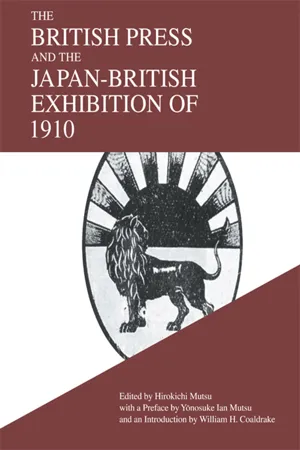
The British Press and the Japan-British Exhibition of 1910
About this book
The Japan-British exhibition in London, 1910 was the most concerted and systematic attempt by Meiji Japan to explain its traditional society and arts, modern industry and empire, to its most important international ally, Great Britain. This is a facsimile edition of the original book compiled and edited for the exhibition by Count Hirokichi Mutsu (1869-1942) and published in London and Tokyo in four parts in 1910 and 1911 by the Imperial Japanese Commission. This compendium of newspaper and journal articles, starting in March 1909 and ending in December of 1910, covers the preparation, activities and immediate aftermath of the Exhibition.
Making widely available a veritable treasure trove of information and insight, it will be of interest to students and scholars of Japan and Britain alike, providing authoritative insights into contemporary attitudes in each country towards the other.
THE
BRITISH PRESS
AND THE
JAPAN-BRITISH
EXHIBITION

THE IMPERIAL JAPANESE COMMISSION
No. 1.
LONDON, 1910
BEYOND the expectations of those concerned in the organization of the Japan-British Exhibition of 1910, a most gratifying reception has been accorded to the undertaking by the Press in this country, both before and since the Opening of the Exhibition, and the signal success which the Exhibition has been enabled to attain is in a large measure due to the cordial and generous support given to the enterprise by the British Press.
In order, therefore, to place on record the high appreciation of the Imperial Commission of the kind sentiments and goodwill thus manifested towards the Japanese nation, some of the thousands of these notices which have appeared from March, 1909, to the end of May, 1910, have been reprinted with the result as herein embodied. Some of the Notices appearing from June, 1910, will be reprinted at a later date, and it is also hoped that these pamphlets may serve as a brief chronicle of the principal events which have taken place in connection with the Exhibition.
THE IMPERIAL JAPANESE COMMISSION.
LONDON, 1910.
THE BRITISH PRESS
AND THE
JAPAN-BRITISH EXHIBITION

JAPANESE EXHIBITION IN LONDON
TIMES
March 29, 1909
We are officially informed that an Exhibition of the arts, sciences, manufactures, industries, and products of Great Britain and of Japan, on an extensive scale, will be held at Shepherd’s Bush next year.
The Imperial Japanese Government are supporting the scheme with keep interest, and financial aid will also be forthcoming. A Bill relating to the Exhibition has just received the approbation of the Imperial Diet, and in the case of the House of Representatives the sanction was given unanimously.
There is reason to believe that the British Government are also in sympathy with the project.
Some officials of the Japanese Department of Agriculture and Commerce sent by the Government have lately been in London, and they have returned to Japan, after having concluded satisfactory arrangements with the British organizers.
Distinguished personages in this country have already identified themselves with the proposed Exhibition, and signs are not lacking that it will prove to be a very important and successful event in the coming year.
MORNING POST
April 24, 1909
Prince Arthur of Connaught has accepted the Honorary Presidency of the Japanese Exhibition, to be held at Shepherd’s Bush next year.
TIMES
April 24, 1909
The Japanese Exhibition, to be held at Shepherd’s Bush next year, is now a definitely settled matter, and preparations for it are being made in this country as well as in Japan.
It will be a unique Exhibition, the like of which has never been held either in this country or in any other part of the world outside the Japanese Empire. It will be the most extensive Japan has ever undertaken abroad, and in view of its official character, the Exhibition cannot fail to be important and instructive. Both the Government and the people of Japan are keenly interested in the project, and the Imperial Diet has sanctioned a grant of 1,800,000 yen in its favour.
A special bureau dealing with the affairs of this Exhibition has just been organized in the Government at Tokio. Baron Oura, Minister of Agriculture and Commerce, is appointed President; Baron Masanao Matsudaira, Vice-President; and Mr. Hikojiro Wada, who was recently in London, the Commissioner-General.
As to the exact details of the Exhibition, it is as yet premature to make a definite statement, as in many respects they are still undecided. It is, however, certain that there will be a strong’ representation of Japan’s products and manufactures, as well as of her arts, and a portrayal of the ancient and feudal Japan as well as of the Empire to-day. The space acquired for the Exhibition. exceeds that devoted to the Franco-British Exhibition of last year. A special feature of the Exhibition will be the Japanese gardens.
The fact that this country is in close sympathy with the project is shown by the fact that many eminent people have already consented to serve on the committee and in other capacities for the Exhibition. Prince Arthur of Connaught, who, it will be remembered, recently headed the Garter Mission to Japan, has accepted the Honorary Presidency of the Exhibition.
Among those who have already identified themselves with the Exhibition are the following:—Lord Alington, Lord Avebury, Lord Barnard, Lord Belper, Admiral Sir Cyprian A. G. Bridge, Lord Blyth, Major-General Lord Cheylesmore, Lord Clinton, Sir John Cockburn, Lord Curzon, Lord Craven, Lord Dufferin and Ava, Lord Derby, Lord Dartmouth, Lord Denbigh, Field-Marshall Lord Grenfell, Lord Grimthorpe, Sir Ian Hamilton, Lord Jersey, Lord Kintore, Lord Kinnoull, Lord Kinnaird, the Duke of Leeds, Lord Lamington, Lord Monkswell, Lord Northampton, Lord Northbrook, Lord Plymouth, Lord Redesdale, Lord Stamford, Lord Savile, Lord Suffield, Lord Strathcona, Lord Saltoun, Lord Stalybridge, Lord Swaythling, Lord Saye and Sele, Admiral Sir Edward H. Seymour, Lord Selby, Lord Tweeddale, Lord Vaux of Harrowden, Lord Warwick, Lord Weardale, Lord Waldegrave, and Lord Wenlock.
DAILY TELEGRAPH
May 20, 1909
The Japanese. Ambassador, accompanied by Madame Kalo, presided at the eighteenth annual dinner of the Japan Society, held at the Whitehall Rooms last night, the attendance being exceptionally large. Among those supporting His Excellency were Prince Hiroyasu Fushimi, the Chinese Minister, Lady Hart, Baron G. Hiyashi (Ambassador at Rome), Mr. J. Sakata (Consul-General), Sir John Trevor Lawrence, Sir George and Lady Chubb, Sir Thomas Jackson, Lady Fry, Mr. Arthur Diosy, and Mr. John P. Reid and Mr. Y. Komma (Chancellor, Japanese Consulate-General), Hon. Secretaries.
Proposing the health of King Edward, the Japanese Ambassador said His Majesty was beloved by his own subjects, and admired and respected by the people of other countries, but by none more than the subjects of his friend and ally, the Emperor of Japan. (Cheers.)
Admiral Sir Edward Seymour, proposing “The Emperor of Japan,” remarked that Japan was rich in many things, but to his mind in nothing more than what was called “bushido,” which he translated as “passionate patriotism,” and a country which possessed passionate patriotism was safe.
Mr. W. Crewdson (Chairman of Council), responding to the toast of the evening, proposed by the Chinese Minister, reminded the company of the Anglo-Japanese Exhibition to be held at Shepherd’s Bush next year. From his Japanese friends he understood that the project was an official one with their Government, that it would be on an exceptional scale, and that the entire nation was interested in its success. That interest, he was sure, they all sincerely shared. It had already enlisted many prominent and influential people in the two countries, Prince Arthur of Connaught heading the list by accepting the Hon. Presidency. The Exhibition would afford all who had taken a lifelong interest in things Japanese an opportunity of studying the marvellous developments of our allies, and at the same time of appreciating how their art had added to the dignity and loyalty of the people, having penetrated from the highest to the lowest in the land.
“The President” was entrusted to Sir Joseph Dimsdale.
FROM OUR OWN CORRESPONDENT, Tokio, June 1
MORNING POST
June 2, 1909
Prince Sadanaru Fushimi has been appointed an Honorary President of the Anglo-Japanese Exhibition which is to take place at Shepherd’s Bush in 1910.
THE JAPAN-BRITISH EXHIBITION OF 1910
TIMES
July 12, 1909
The Japanese section of the Japan-British Exhibition to be held at Shepherd’s Bush, which will be open from May 3 to the end of October next year, promises to be most interesting as well as instructive. The Imperial Japanese Commission recently appointed for the purpose in Tokio has for its Honorary President His Imperial Highness Prince Sadanaru Fushimi, who brought an important mission to the King from the Emperor in 1907; and for President, Baron Oura, Minister for Agriculture and Commerce. It has also enlisted the services of such distinguished officials as Baron M. Matsudaira, Vice-President, who is a member of the House of Peers and gained much valuable experience at the St. Louis Exposition of 1904; and Mr. Hikojiro Wada, Commissioner-General, who recently came over to this country, and holds a similar position with regard to the Grand Exhibition to be held in Tokio a few years hence. Count Mutsu, until lately a member of the Japanese Embassy here, is remaining in this country for the Exhibition in the capacity of a commissioner.
The idea of an Anglo-Japanese Exhibition in London is a very popular one with our allies, and all the departments of the Japanese Government—the Imperial Household, War, Navy, Home Affairs, Finance, Communications, Education, Agriculture and Commerce, Railways, etc.—are vying with one another to make a notable display, and signs are not lacking that their sanguine hopes will be more than realized.
The Japanese Section will be divided into eighteen groups—that is to say, those relating to (1) education, (2) fine arts, (3) liberal arts, (4) mechanical engineering, (5) electricity, (6) civil engineering and transportation, (7) agriculture, (8) horticulture, (9) forests, sport, fishing, etc., (10) alimentation, (11) mines and metallurgy, (12) decoration and furnishing, (13) textiles, (14) chemical industries, (15) various industries, (16) social economy, (17) colonization, (18) armament, etc.
As will be expected, however, the most fascinating part of the great Exhibition will be its section of art. A special committee, under the chairmanship of Mr. Masaki, President of the Tokio Fine Art Academy, supported by such distinguished connoisseurs as Marquis Inouye, the veteran statesman; Mr. Takashi Masuda, a great collector; and Baron Makino, who is the late Minister of Education and ex-Ambassador to Austria, are organizing an exhibition of ancient as well as modern arts. As there are very few opportunities, even in Japan, of witnessing really good exhibitions of this Kind. the rare and valuable specimens of ancient art being mainly in the permission of noblemen’s families or of collectors, and very seldom shown in public the display in the Fine Arts Palace at the “White City” will be unprecedented, and will afford experts in this country a very unique opportunity for studying Japanese art.
There will be very interesting exhibits coming from Korea, from the Japanese Concessions in Manchuria, and from Formosa.
The following may give some idea of the exhibits by the different Government Departments:- Models of the Imperial wild duck hunting-grounds; model of Todaiji Temple at Nara, the ancient capital of Japan; plans showing harbour improvements at Yokohama and Kobe; uniforms, armour, weapons, etc., used by the armies of Japan and historically arranged from the 16th century down to the present day; models of the battle-ground at Port Arthur; models of Japanese men-of-war, showing the developments of the last half-century; exhibits showing the different stages of educational institutions; examples of means of communication, displayed according to different periods; models of ships of different ages, those of Japanese railway engines and carriages; exhibits from Kwantung Province; horticulture, fishing, forestry, and mining products, in which Japan is rich; exhibits from the Japanese Red Cross Society, one of the most extensive and best-equipped organizations of the kind in the world; beautiful specimens of Japanese textile industries, costumes, models, and pictures, etc., showing the change of fashions in different periods, etc.
The local prefectural authorities, public bodies, and companies are also keenly interested in making a creditable display, and several important cities have organized societies for arranging their exhibits, expending large sums of money for that purpose. Even single individuals will rank among them as very extensive exhibitors. For example, Mikimoto, the well-known pearl producer, alone, is taking a space amounting to some 15,000 square feet. Regarding the apportionment of the buildings at the “White City” secured by the Japanese authorities for their exhibits, considerably over one-third of the extensive space will be assigned to the exhibits of the various Government Departments, a similar portion being devoted to the exhibits of individuals and companies. The Japanese gardens will naturally be a special feature of the Exhibition. Skilled experts in this line will come over to this country from Japan for...
Table of contents
- Cover Page
- Title Page
- Copyright Page
- Contents
- Preface
- Introduction
- Selected Bibliography of the 1910 Japan-British Exhibition and the Mutsu Family
- The British Press and the Japan-British Exhibition No. 1
- The British Press and the Japan-British Exhibition No. 2
- The British Press and the Japan-British Exhibition No. 3
- The British Press and the Japan-British Exhibition No. 4
- Index
- Japan at the White City A Paper Read Before The Royal Society of Arts, London, January 19th, 1910
Trusted by 375,005 students
Access to over 1.5 million titles for a fair monthly price.
Study more efficiently using our study tools.
Frequently asked questions
Yes, you can cancel anytime from the Subscription tab in your account settings on the Perlego website. Your subscription will stay active until the end of your current billing period. Learn how to cancel your subscription
No, books cannot be downloaded as external files, such as PDFs, for use outside of Perlego. However, you can download books within the Perlego app for offline reading on mobile or tablet. Learn how to download books offline
Perlego offers two plans: Essential and Complete
- Essential is ideal for learners and professionals who enjoy exploring a wide range of subjects. Access the Essential Library with 800,000+ trusted titles and best-sellers across business, personal growth, and the humanities. Includes unlimited reading time and Standard Read Aloud voice.
- Complete: Perfect for advanced learners and researchers needing full, unrestricted access. Unlock 1.5M+ books across hundreds of subjects, including academic and specialized titles. The Complete Plan also includes advanced features like Premium Read Aloud and Research Assistant.
We are an online textbook subscription service, where you can get access to an entire online library for less than the price of a single book per month. With over 1.5 million books across 990+ topics, we’ve got you covered! Learn about our mission
Look out for the read-aloud symbol on your next book to see if you can listen to it. The read-aloud tool reads text aloud for you, highlighting the text as it is being read. You can pause it, speed it up and slow it down. Learn more about Read Aloud
Yes! You can use the Perlego app on both iOS and Android devices to read anytime, anywhere — even offline. Perfect for commutes or when you’re on the go.
Please note we cannot support devices running on iOS 13 and Android 7 or earlier. Learn more about using the app
Please note we cannot support devices running on iOS 13 and Android 7 or earlier. Learn more about using the app
Yes, you can access The British Press and the Japan-British Exhibition of 1910 by Hirokichi Mutsu in PDF and/or ePUB format, as well as other popular books in History & British History. We have over 1.5 million books available in our catalogue for you to explore.