- 342 pages
- English
- ePUB (mobile friendly)
- Available on iOS & Android
eBook - ePub
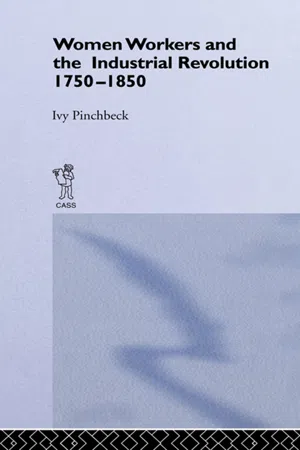
Women Workers in the Industrial Revolution
About this book
First Published in 2004. It is often assumed that the woman worker was produced by the Industrial Revolution, and that since that time women have taken an increasing share in the world's work. This theory is, however, quite unsupported by facts. In every industrial system in the past women have been engaged in productive work and their contribution has been recognised as an indispensable factor. This volume is devoted to women's employment inagriculture and the agrarian revolution.
Information
PART I
THE EMPLOYMENT OF WOMEN IN AGRICULTURE
CHAPTER I
WOMEN IN AGRICULTURE IN THE EIGHTEENTH CENTURY
IN 1750, England was still in the main an agricultural country, over the greater part of which the old type of rural organisation persisted with its open-field farms and common lands. During the next seventy years great changes took place. As in the industrial world large commercial undertakings took the place of many of the domestic industries, so in agriculture the large enclosed farm succeeded smaller occupations in the open village. In the past, farming had been conducted mainly for subsistence and to supply the needs of the immediate community; it now became a capitalistic trade, aiming at increased production to supply the new markets in the growing industrial areas.
These economic changes were accompanied by far-reaching social effects. The old village organisation was broken up, and a new social structure evolved. For some, enclosures and engrossing meant increased wealth and a rise in the social scale; a greater number lost their proprietary interest in the soil, and with it their economic independence. The social changes accompanying this organisation are reflected in the lives of the women of the period, who then contributed to a greater extent than at present to the maintenance of the family. Not only did the changes of the agrarian revolution affect the position of their husbands which women naturally shared, but they also exercised an important influence on their own productive capacity with which was involved their own economic independence. The mistress of a large farm, who at the beginning of our period was actively concerned in the management and productive work of a large household, had at the end of it as a result of the increase in wealth, joined the ranks of the leisured classes. The wife of the small freeholder or tenant farmer, who lost his land, became dependent upon her husband, because with the land went her opportunity of contributing to the resources of the family. If ultimately she became a wage earner, it was at a scale on which she could not adequately maintain herself, still less contribute to the support of the family. In the following pages an attempt is made to describe the conditions of women’s lives on the eve of the agrarian revolution and to show how their work and economic position were affected by it.
In considering women’s work in agriculture, it is not necessary to enter into the legal classification of people on the land; it is simpler to consider them as farmers’ wives on both large and small holdings, servants in husbandry and cottagers’ wives, whose husbands eked out their small allotments by occasional earnings as day labourers, and who themselves were often accustomed to work for wages at hay and harvest.
FARMERS’ WIVES
In the eighteenth century it was still customary for the wife of a large farmer to take an active share in the management of the household, although there were some households in which the mistress had already handed over the main responsibilities to a servant.1 In such cases a wealthy farmer’s wife often took a keen interest in the purely agricultural side. Marshall, in 1782, mentions a large occupier of £17,000 a year, who was able to manage without a steward or bailiff, because he had the assistance of “his lady, who keeps his accounts,”2 and two farmers who went to investigate Coke’s agricultural experiments at Holkham, after riding round the estate with Mrs. Coke, expressed their “agreeable surprise in meeting with an amiable lady in high life, so well acquainted with agriculture, and so condescending as to attend two farmers out of Kent and Sussex a whole morning to show them some Norfolk farmeries.”3
In the days when almost all the food and a good deal of the clothing were provided at home, the household management of a large farm was no light undertaking. In addition to the purely domestic side, the farmer’s wife had also charge of the dairy—including the care of calves and pigs—the poultry, the garden and orchard and all financial dealings connected with them. The butcher, the higler and the cheese factor who came to make purchases at the farm, usually transacted their business with the mistress. In his Survey of Devonshire, Vancouver describes a custom which was not confined to that county, by which the wife undertook to support the household out of the profits of her own domain. “It is a common practice among them on marriage, to give to their wives what is called pin-money; this consists of poultry, pigs, and the whole produce of the dairy; with which supply the wife is expected to clothe and (exclusive of bread, corn, and other vegetables) support the whole household; and here it is but common justice to say, that the industry and attention to business of the farmer’s wives and daughters, with the neatness displayed in all their market ware at Exeter, and in other large towns, are subjects deserving the highest praise.”4 An ability to deal in business matters was as necessary to the farmer’s wife in her sphere, as it was for her husband in his, and the well-being of the family depended not a little on the business capacity of the mistress.
Apart from the supervision of the dairy and stock the domestic management of a farm called for a good deal of organisation. A large farm in Oxfordshire in 1768 had living in it seventeen men, five boys and five maids in addition to the family;1 a household of twenty was common, while day labourers also were sometimes given partial board. On farms such as these one maid was necessary for the brewing and baking alone; another was required for the laundry and the rest divided among them the work of the dairy, milking and the care of stock, household work and winter provisioning. In the evenings all were expected to assist in the sewing and in spinning flax and wool, for every farm provided its own yarn for linen, blankets and a certain amount of clothing for the members of the family. Everything came under the supervision of the mistress and not a little of her time was taken up in training the maids in their respective duties.
On a smaller holding, the farmer’s wife, having less assistance, was more actively engaged in manual work. On many farms the entire labour was performed by the members of the family alone, and where this was the case a good deal of outdoor work fell to the lot of the women. A North Country farmer writing in The Farmer’s Magazine in 1801 speaks of the small occupier’s “necessity of turning out his wife or daughter to drive the plough in the depth of winter.” The wife was obliged to undergo the drudgery of outdoor work as “upon such farms there is little occasion for day-labourers, except an old woman or two which they employ in harvest.”2
In other respects their work was similar to that on a large farm, and since raising the annual rent was a matter which required the utmost industry among smallholders, the greatest care was taken to make the most out of their dairies, poultry and eggs. On a large farm dairy produce was often sold to the badger or higler who collected eggs, poultry and butter at the farm; on a smaller holding the wife or daughter of the farmer was accustomed to take her produce to the market where she retailed it herself. Many housewives and dairymaids rode into market on horseback, their butter, poultry and eggs carefully packed in panniers; and at the Norwich market, which Marshall believed in 1789 to be “beyond comparison the first in the kingdom,” the women also supplied veal, pork and lamb.3 Norfolk was already celebrated for its turkeys and the skill of the housewives of the county in breeding and rearing poultry: “Poultry of every species are sold, in the markets, ready picked and skewered fit for the spit; and are in general, so well fatted, and dressed up in such neatness and delicacy, as shew the Norfolk housewives to be mistresses in the art of managing poultry.”4 The farmers’ wives of Sussex bred “the fattest geese and largest capons” for the London market, and from Suffolk came every year the great droves of turkeys; of Stratford-on-Stour it was said “that 300 droves of turkies have passed in one season over its bridge towards London, computed at 500 in a drove one with another.”1
On many small farms it was necessary to engage in some form of domestic industry to eke out the proceeds from agriculture. In Westmorland and Cumberland farmers’ wives spun their own wool and brought the yarn to market every week;2 on Welsh farms flannel was produced for the market and in woollen districts a few pieces of cloth were made and sold each year. More often as in Shropshire, the home-grown flax was made up into linen. “Besides brewing, baking, providing for the family where workmen are maintained in the house, and managing the dairy,” writes the Reporter, “the farmer’s wife, with the assistance of her maid-servants in the evenings, and at spare hours, carries on a little manufacture, and gets up a piece of linen cloth for sale every year.”3 Where manufacture was not carried on for sale, it was still customary in the North in the mid-eighteenth century to produce a “coarse grey woollen cloth, made from a mixture of black and white wool, for the clothing of the farmer and his family.” One or two black sheep were kept to provide wool for the stockings of the family, and during the winter flax was spun for sheets, table linen and shirts.4
On the death of a farmer who had no son to succeed him, it was customary for his widow or daughter to retain the holding and take over the entire responsibility of the farm. The fact that the wife usually shared the business transactions of her husband, and had already experience of buying and selling stock, enabled her to run a farm with greater ease than if she had only been concerned with the domestic side of affairs. Arthur Young and other agricultural writers make frequent mention of women who were successfully managing their farms. On one of his tours Young writes: “At Henley, I was very glad to find that Mrs. Clarke had kept the lucerne, which the late Mr. Clarke sowed; and very much to the credit of this female cultivator, I found it without a weed and in admirable tilth.” At Little Malvern he went purposely to view the farm of Mrs. Williams who “had some meadows of extraordinary fertility.” In Oxfordshire, Mrs. Latham of Clifton had “one of the completest sheep-yards, if not the most so, in this county”; Mrs. Hall of Little Brickhill, Buckinghamshire, on a farm of 500 acres, kept “breeding ewes for fattening lambs for the London market.”5 The awards made to women by the new agricultural societies at the end of the eighteenth century when agricultural improvements were beginning to be more widely adopted, give abundant evidence of the interest and experiments of a large number of successful women farmers.
DAIRYWOMEN
The most important and the most productive branch of women’s work in agriculture in the eighteenth century was dairy-farming. A certain amount of butter and chees...
Table of contents
- Cover Page
- Half Title Page
- Title Page
- Copyright Page
- Dedication
- Contents
- Introduction
- Part I The Employment of Women in Agriculture
- Chapter I Women in Agriculture in the Eighteenth Century
- Chapter II The Agrarian Revolution
- Chapter III The Appearance of Women Day-Labourers
- Chapter IV Agricultural Depression and the Poor Law
- Chapter V Rural Conditions in the Mid-Nineteenth Century
- Part II Women in Industry and Trade
- Chapter VI Textile Industries—The Domestic System
- Chapter VII Textile Industries—The Spinners
- Chapter VIII Textile Industries: The Handloom Weavers
- Chapter IX Textile Industries: Factory Workers
- Chapter X The Smaller Domestic Industries
- Chapter XI Women's Work in Mines and Metal Trades
- Chapter XII Craftswomen and Business Women
- Conclusion
- Appendix Occupations of women in 1841.
- Bibliography
- Index
Trusted by 375,005 students
Access to over 1.5 million titles for a fair monthly price.
Study more efficiently using our study tools.
Frequently asked questions
Yes, you can cancel anytime from the Subscription tab in your account settings on the Perlego website. Your subscription will stay active until the end of your current billing period. Learn how to cancel your subscription
No, books cannot be downloaded as external files, such as PDFs, for use outside of Perlego. However, you can download books within the Perlego app for offline reading on mobile or tablet. Learn how to download books offline
Perlego offers two plans: Essential and Complete
- Essential is ideal for learners and professionals who enjoy exploring a wide range of subjects. Access the Essential Library with 800,000+ trusted titles and best-sellers across business, personal growth, and the humanities. Includes unlimited reading time and Standard Read Aloud voice.
- Complete: Perfect for advanced learners and researchers needing full, unrestricted access. Unlock 1.5M+ books across hundreds of subjects, including academic and specialized titles. The Complete Plan also includes advanced features like Premium Read Aloud and Research Assistant.
We are an online textbook subscription service, where you can get access to an entire online library for less than the price of a single book per month. With over 1.5 million books across 990+ topics, we’ve got you covered! Learn about our mission
Look out for the read-aloud symbol on your next book to see if you can listen to it. The read-aloud tool reads text aloud for you, highlighting the text as it is being read. You can pause it, speed it up and slow it down. Learn more about Read Aloud
Yes! You can use the Perlego app on both iOS and Android devices to read anytime, anywhere — even offline. Perfect for commutes or when you’re on the go.
Please note we cannot support devices running on iOS 13 and Android 7 or earlier. Learn more about using the app
Please note we cannot support devices running on iOS 13 and Android 7 or earlier. Learn more about using the app
Yes, you can access Women Workers in the Industrial Revolution by Ivy Pinchbeck in PDF and/or ePUB format, as well as other popular books in Politics & International Relations & Politics. We have over 1.5 million books available in our catalogue for you to explore.