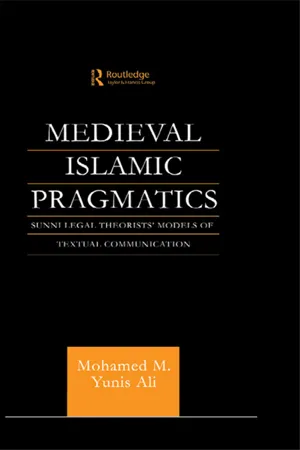
This book deals with two different pragmatic approaches to textual communication: (i) the mainstream approach followed by the 'Ash'ari s, Hanafi s and Mu'tazili s, (ii) the salafite approach followed mainly by the Hanbali s, defended and elaborated by Ibn Taymiyyah. One of the primary aims of the book is to explore and formulate several Muslim legal theorists' pragmatic theories, communicative principles and linguistic views, construct them in the form of models and set them within a general uniform framework. Another aim is to reveal a corpus of information and data which, though highly relevant to modern pragmatics, is still unknown. This study, which can be seen as an extensive introduction to 'medieval Islamic pragmatics', is the first attempt to examine the approaches followed by the Salafi s or the mainstream from a pragmatic viewpoint. There has been no attempt to explain the principles and the strategies utilised by the medieval Sunni Muslim legal theorists in their account of how communication works and how successful interpretation is achieved. Of course, a lot of work has been done on different Islamic sects and their different positions over the interpretation of the Quran and Sunnah, but these studies fall short of delving into the underlying communicative principles that motivate their differences over interpretation. The author's formulation of the Muslim legal theorists' views is enhanced by setting up a reliable theoretical foundation and by delving into their underlying philosophical principles. This involves relating the legal theorists' insights into interpretation and communication to their relevant ontological, epistemological and theological outlooks, and comparing these insights with their modern pragmatic counterparts.
eBook - ePub
Medieval Islamic Pragmatics
Sunni Legal Theorists' Models of Textual Communication
- 284 pages
- English
- ePUB (mobile friendly)
- Available on iOS & Android
eBook - ePub
Medieval Islamic Pragmatics
Sunni Legal Theorists' Models of Textual Communication
About this book
Information
Table of contents
- Cover
- Half Title
- Title Page
- Copyright Page
- Dedication
- Contents
- Acknowledgements
- Transliteration conventions
- Abbreviations
- Chapter One – Introduction
- Chapter Two – Wadc and Use
- Chapter Three – Interpretation
- Chapter Four – Ibn Taymiyyah’s Contextual Theory of Interpretation
- Chapter Five – Ways of Signification
- Conclusion
- Bibliography
- Index
Trusted by 375,005 students
Access to over 1.5 million titles for a fair monthly price.
Study more efficiently using our study tools.
Frequently asked questions
Yes, you can cancel anytime from the Subscription tab in your account settings on the Perlego website. Your subscription will stay active until the end of your current billing period. Learn how to cancel your subscription
No, books cannot be downloaded as external files, such as PDFs, for use outside of Perlego. However, you can download books within the Perlego app for offline reading on mobile or tablet. Learn how to download books offline
Perlego offers two plans: Essential and Complete
- Essential is ideal for learners and professionals who enjoy exploring a wide range of subjects. Access the Essential Library with 800,000+ trusted titles and best-sellers across business, personal growth, and the humanities. Includes unlimited reading time and Standard Read Aloud voice.
- Complete: Perfect for advanced learners and researchers needing full, unrestricted access. Unlock 1.5M+ books across hundreds of subjects, including academic and specialized titles. The Complete Plan also includes advanced features like Premium Read Aloud and Research Assistant.
We are an online textbook subscription service, where you can get access to an entire online library for less than the price of a single book per month. With over 1.5 million books across 990+ topics, we’ve got you covered! Learn about our mission
Look out for the read-aloud symbol on your next book to see if you can listen to it. The read-aloud tool reads text aloud for you, highlighting the text as it is being read. You can pause it, speed it up and slow it down. Learn more about Read Aloud
Yes! You can use the Perlego app on both iOS and Android devices to read anytime, anywhere — even offline. Perfect for commutes or when you’re on the go.
Please note we cannot support devices running on iOS 13 and Android 7 or earlier. Learn more about using the app
Please note we cannot support devices running on iOS 13 and Android 7 or earlier. Learn more about using the app
Yes, you can access Medieval Islamic Pragmatics by Muhammad M. Yunis Ali in PDF and/or ePUB format, as well as other popular books in Social Sciences & Ethnic Studies. We have over 1.5 million books available in our catalogue for you to explore.