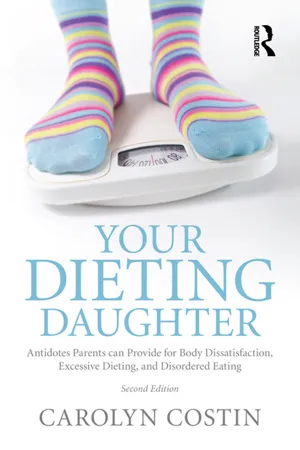
Your Dieting Daughter is a must read for anyone wanting to help contribute to a young woman's development of a healthy self and body esteem, whether she is 13 or 30. Costin has updated the first edition of this book to reflect her 15 additional years of expertise on dealing with the tricky issues of body image, food, and weight in a culture that places an unhealthy emphasis on being thin. From aiding a young girl to lose weight for health reasons; to encouraging a young woman to accept her natural body size; to helping detect, prevent, and understand eating disorders, this second edition is full of practical and invaluable information. Chapters guide parents in the Do's and Don'ts that will help a daughter to accept, respect, and care for her body. Readers will learn the importance of setting a good example and the critical need to take the focus from numbers and measurements - such as scale weight, clothing size, miles run, or sit-ups accomplished - to important goals like health, body acceptance, and finding physical activity to enjoy. Whether you are interested in being a good role model for you daughter, helping girls and women who are currently suffering from an eating disorder or body image issues, or raising the next generation of girls to value the size of their heart over their body size, this is a book not to be missed.
eBook - ePub
Your Dieting Daughter
Antidotes Parents can Provide for Body Dissatisfaction, Excessive Dieting, and Disordered Eating
- 240 pages
- English
- ePUB (mobile friendly)
- Available on iOS & Android
eBook - ePub
Your Dieting Daughter
Antidotes Parents can Provide for Body Dissatisfaction, Excessive Dieting, and Disordered Eating
About this book
Information
1 “My Daughter Wants/Needs to Diet”
Definition of dieting: Severely restricting calories, eliminating whole categories of food, skipping meals or snacks, taking diet pills or other weight-loss supplements, and doing anything else to lose weight that does not give you the fuel and nutrients you need and that you would not want to do or be able to do for the rest of your life.
Carolyn Costin
Among 8-to 10-year-olds, 13 percent to 41 percent of girls reported using some form of dieting behavior, including exercise and diet foods, in order to lose weight.1
Kirsten is bigger than all the other girls her age. I am so scared. I have been overweight and unhappy my whole life and she is taking after me. I want to help her lose weight so she won’t ruin her life by being fat.
Mother of girl with binge eating disorder
I don’t know what to do about Molly. She keeps telling me she is fat and now she says she wants to go on a diet. She is a bit chubby, but she is only seven. I don’t know what to do.
Concerned mother
If your daughter wants to diet or if you think she has a problem with her weight or eating, when and how to help or intervene is a difficult and tricky dilemma. First of all, how do you know if your daughter is overweight? Is it based on appearance or are there other indicators you should go by? When does her size become a problem verses a natural example of the range of human shapes and sizes outside of the cultural thin ideal? When does losing weight become an important health issue you should help your daughter address and when does helping her lose weight become an inappropriate quest to achieve the accepted standard of beauty? If you want to help your daughter lose weight, how do you ensure that you are improving her health and self-esteem rather than contributing further to her problems by lowering her metabolism, setting her up for failure, contributing to her body dissatisfaction and even possibly planting seeds for the development of an eating disorder?
Consider the various scenarios below:
- What do you do when your teenage daughter is sitting at the dinner table pushing her food around on the plate, picking at it, and not eating much of anything? How would your reaction differ if she were normal weight, underweight, or overweight?
- How should you react when you find empty boxes of laxatives, diet pills, and numerous candy wrappers stashed in your daughter’s room?
- What kind of limits should you impose on your skeletal looking daughter regarding visits to the gym or participation on the track team upon discovering that she is no longer menstruating?
- What do you say to your daughter when she comes home from school crying because the other kids are making fun of her for being fat?
The following are possible responses to #4, the last scenario. Which would you choose?
- Reassure her that she is not fat and tell her to ignore the other kids.
- Tell her that you will help her go on a diet to lose weight.
- Tell her that people come in all shapes and sizes, and it’s what’s on the inside that counts.
- Get her professional help, for example, a dietitian.
Some of the responses above are better than others, but none of them are sure bets to resolve the problem. You may have thought of other responses not listed here, but whatever response you select depends on many circumstances, including your daughter’s current weight.
For the sake of continuing with our example, assume your daughter is “overweight” according to her doctor is above the recommended range for her age and needs to lose weight. You have been trying not to make a big issue out of her weight, but when she comes home crying because the other kids are teasing her for being fat, you can’t just sit back and do nothing. You want to respond but you’re not sure how. Let’s explore the responses listed earlier in detail.
Reassure her that she is not Overweight and tell her to Ignore the other Kids
This is not a bad response but your daughter will not trust you if you tell her she is not overweight and she knows she is, at least compared to the other kids and to what the doctor and “charts” say. In any case, you don’t want your daughter to think you will lie to her just to make her feel better. It won’t work. Also, whether your daughter is overweight or not, if she is being teased by others, telling her to ignore the other kids is like telling her to ignore the world around her. At this age her peers are her world and what they think of her may mean more than what you think.
Tell her that you will help her go on a Diet to Lose Weight
The idea of helping your daughter lose weight may sound good, but it is full of dangerous implications. Don’t suggest dieting to your daughter, as it is very likely that dieting won’t work and will cause more harm than good. There is little support for the notion that dieting leads to lasting weight loss or health benefits.2 Research repeatedly shows that diets are not the answer.3 We know that dieting slows down the metabolism4 and changes other hormones making it hard to maintain weight loss and when the weight is gained back, which it usually is, it is much harder to lose weight again.5 In one study dieters are at least two to three times more at risk of being overweight at a later date as non-dieters.6 Dieting sets people up to binge eat, gain more weight than even before the diet, and in susceptible individuals can lead to an eating disorder.7 8 9 If you are going to help your daughter, dieting is out and the focus must be on improving her health, not her weight. Besides, offering to help your daughter lose weight may include you in the category of people who she thinks find her “unattractive” and “unacceptable” because of her appearance. Tell her you are willing to help her get healthier. It is possible weight loss will come as a result. Discuss with your daughter any behaviors she is doing that might contribute to her current weight, such as emotional eating or not paying attention to her hunger and fullness. Rather than putting her on a diet help her listen to her body and make healthier overall food choices but avoid using a scale.
Tread lightly, whatever you do, because if you become over involved or attached to certain ideas or regimens, she may hide things from you or stop telling you the truth. You do not want your daughter to hide food or lie about eating or exercise. Becoming overly invested in your daughter’s weight loss is a set up for both of you. Being invested in her health is much less fraught with complications and downfalls.
Even if you reframe the situation and are helping your daughter “get healthier,” it is unwise to have her go on some kind of eating plan that is different than the rest of the family. If your focus is on health then the whole family will benefit, otherwise the message given is that “healthy eating” is really dieting to help overweight people lose weight. Your daughter may resent it if you and other family members are eating things she is not supposed to eat and she may try to eat those foods secretively. The best idea is for the entire family to work at adopting healthier eating habits and a healthy, active lifestyle. Always remember the overall idea is to focus on how the body functions and works, not how much it weighs on a scale.
Tell her that People come in all Shapes and Sizes, and It’s what’s on the Inside that Counts
Excellent! Teaching your daughter not to value image over substance is an important and critical task. It is also very difficult because the culture and most likely her peers will be giving her the opposite message. Make sure that you and the whole family consistently reinforce that people come in all shapes and sizes and that not everyone can fit into the current standard ideal. Messages that focus on internal versus external qualities should be repeated and demonstrated over and over many times for young girls, but they probably won’t be enough once a problem with body image arises. For example, if your daughter is being teased for being overweight, other action will likely be necessary. Make sure to talk to your daughter about how she feels, what she might say back to her peers, and what else she would like to do. Work together on building her self-and body esteem.
Get her Professional Help, for Example, a Dietitian or Therapist
After talking to your daughter and exploring things further, if you get information suggesting there is a problem, e.g., she is overly distraught and emotional, she is already bingeing, she is taking diet pills, or is throwing away her school lunches, then getting professional help is warranted. Parents often wait too long to explore this option. If you choose this route, there are certain precautions. Your daughter may take this action as a sign that you find her unacceptable, or too difficult to deal with. How you present the idea of getting professional help is very important and will affect your daughter’s feelings about it and willingness to follow through. Tell her you want to find someone who can help her achieve her goals in a healthy way. The professional should be a specialist in the field of nutrition, eating disorders or weight control, and one who takes a non-diet approach and/or is familiar with the concept of Health at Every Size®.10 You want to be sure the person helping you and your daughter has the mindset and skills to focus on her health, not her appearance or what the scale says. The professional should work with your daughter and also include the whole family, age appropriately. If you choose a dietitian, make sure he or she has training in counseling skills and ideally in eating disorders as well. If you take her to see a therapist, make sure the person has experience treating people with eating disorders. Eating disorder specialists will be able to assess whether or not your daughter has an eating disorder and will be able to devise the appropriate treatment plan to help. If there is no evidence of an eating disorder, these professionals will also know how to help you and your daughter to prevent her issues with food and weight from developing into one.
As an eating disorder therapist, parents bring their young daughters to me all the time for “consultations” and/or eating disorder treatment. Children are often brought in because their parents consider them “overweight.” Some of these children are overweight, have medical issues, and do need help with eating habits and lifestyle changes. On the other hand, in many cases, the child is not substantially overweight, has no medical problems, and the parent’s concern is important but exaggerated and this needs to be addressed. Many parents are doing what they think best when trying to prevent their daughter from suffering health problems or size discrimination that some of them have experienced in their own life. If you are worried about your daughter’s weight, you have to be careful not to unwittingly become the first source of discrimination against her by giving her the message that, because of her body size and appearance, she is unacceptable. Of course it is important to pay attention to your child’s eating and weight. Parents are in the best position to prevent a problem from turning into a disaster. Stepping in early can make all the difference. Turning your daughter’s focus to health not weight can prevent a myriad of future problems. Dieters have a higher risk for being overweight than non-dieters. In a 2006 study, researcher Diane Neumark-Sztainer reports that, “dieting and weight-control behaviors, particularly unhealthful weight-control behaviors, were associated with weight gain.”11 Furthermore, dieting was found to be strongly predictive of disordered eating behaviors five years later. The risk–benefit ratio for dieting is high and needs to be taken seriously.12
I applaud parents for acting quickly when they see signs of a problem. Any parent should be on the lookout even when their daughter is at a very young age. In the last 15 years both the average age girls start dieting and the average age they develop an eating disorder has continued to decline.13 14 15 One study, tracking eating disorder admissions to a hospital, showed that from 1999 to 2009 “hospitalizations for children under age 12 increased 72 percent.”16 Parental involvement and early intervention are important in dealing with weight issues and in preventing and treating eating disorders. Studies show that parental involvement is key in facilitating successful recovery in adolescents who develop anorexia nervosa if it is caught early on.17
Dealing with a daughter who wants to diet, or is already dieting, is fraught with complications and implications that can seem overwhelming. Deciding how to respond to your daughter’s food and/or weight issue, whether or not she asks for your help, involves not only learning how best to help her but also necessitates addressing your own thoughts, beliefs, and behaviors. Parental attitudes and expectations are critical in influencing young girls about their bodies and dieting.
A mother can influence her daughter’s body image and decision to lose weight by displaying her own issues with her body, food, weight, and dieting. Loving, feeding, and nurturing one’s own body are good ways for a mother to have a positive influence. On the other hand, a mother who makes negative or critical comments about her own body, sets a poor example for her daughter. Mothers who make decisions based on the number on the scale and/or practice unhealthy dieting or weight-loss habits can easily pass on these habits to their daughters. In trying to help, a mother may give an unclear message, making her daughter feel unacceptable the way she is, thus, doing more harm than good. Chapter 3, “Mothers, Daughters and Food,” and Chapter 4, “Mirror, Mirror on the Wall,” will discuss these issues in more detail and provide numerous suggestions.
A father may influence his daughter’s opinion about her body and her decision to diet or lose weight in several ways. A father who focuses more on his daughter’s (and all other females’) external rather than internal qualities gives her the message about which one is more important. A daughter who hears her father make comments about female bodies, even if not directly about her own, learns what is “attractive and acceptable.” Fathers who are exercise enthusiasts may unwittingly promote the idea that fitness is for appearance’ sake, or in...
Table of contents
- Cover
- Half Title
- Title Page
- Copyright
- Dedication
- Contents
- Contributors
- Preface
- Acknowledgments
- Introduction: Dying to be Thin
- 1. “My Daughter Wants/Needs to Diet”
- 2. The Pursuit of Thinness
- 3. Mothers, Daughters, and Food
- 4. Mirror, Mirror on the Wall . . .
- 5. Daddy’s Girl (Co-authored with Keesha Broome)
- 6. Fit or Fanatic? (Co-authored with Dawn Theodore)
- 7. The Thin Commandments
- 8. Diet to Disorder: Canaries in the Coal Mine
- 9. What’s Going On in There?
- 10. If My Daughter Has a Problem, What Do I Do?
- 11. So . . . You Want to Go On a Diet? (To Be Given to a Dieting Daughter)
- 12. Dear Mom, and Other Letters
- Appendix I: Suggested Reading
- Appendix II: Eating Disorder Organizations and Referral Sources
- Notes
- Index
Trusted by 375,005 students
Access to over 1.5 million titles for a fair monthly price.
Study more efficiently using our study tools.
Frequently asked questions
Yes, you can cancel anytime from the Subscription tab in your account settings on the Perlego website. Your subscription will stay active until the end of your current billing period. Learn how to cancel your subscription
No, books cannot be downloaded as external files, such as PDFs, for use outside of Perlego. However, you can download books within the Perlego app for offline reading on mobile or tablet. Learn how to download books offline
We are an online textbook subscription service, where you can get access to an entire online library for less than the price of a single book per month. With over 1.5 million books across 990+ topics, we’ve got you covered! Learn about our mission
Look out for the read-aloud symbol on your next book to see if you can listen to it. The read-aloud tool reads text aloud for you, highlighting the text as it is being read. You can pause it, speed it up and slow it down. Learn more about Read Aloud
Yes! You can use the Perlego app on both iOS and Android devices to read anytime, anywhere — even offline. Perfect for commutes or when you’re on the go.
Please note we cannot support devices running on iOS 13 and Android 7 or earlier. Learn more about using the app
Please note we cannot support devices running on iOS 13 and Android 7 or earlier. Learn more about using the app
Yes, you can access Your Dieting Daughter by Carolyn Costin in PDF and/or ePUB format, as well as other popular books in Psychology & Abnormal Psychology. We have over 1.5 million books available in our catalogue for you to explore.