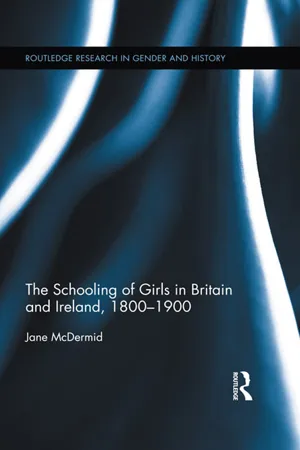
This book compares the formal education of the majority of girls in Britain and Ireland in the nineteenth century. Previous books about 'Britain' invariably focus on England, and such 'British' studies tend not to include Ireland despite its incorporation into the Union in 1801. The Schooling of Girls in Britain and Ireland, 1800-1900 presents a comparative synthesis of the schooling of working and middle-class girls in the Victorian period, with the emphasis on the interaction of gender, social class, religion and nationality across the UK. It reveals similarities as well as differences between both the social classes and the constituent parts of the Union, including strikingly similar concerns about whether working-class girls could fulfill their domestic responsibilities. What they had in common with middle-class girls was that they were to be educated for the good of others. This study shows how middle-class women used educational reform to carve a public role for themselves on the basis of a domesticated life for their lower class 'sisters', confirming that Victorian feminism was both empowering and constraining by reinforcing conventional gender stereotypes.
- 216 pages
- English
- ePUB (mobile friendly)
- Available on iOS & Android
eBook - ePub
The Schooling of Girls in Britain and Ireland, 1800- 1900
About this book
Information
1 Introduction
This book is an attempt to compare and contrast the formal education of the majority of girls in the UK of Britain and Ireland in the nineteenth century. Previous studies of female education have generally been concerned with one of the countries which make up the UK, the majority being on England. Books about ‘Britain’ also invariably centre on England with occasional references to Scotland and little noted specifically about Wales. Such ‘British’ studies tend not to include Ireland despite its incorporation into the Union in 1801.1 Building on these works as well as an earlier study of the schooling of working-class girls in Victorian Scotland, the aim here is to present a comparative synthesis of the formal education of working- and middle-class girls in the same period with the emphasis on the interaction of gender, social class, religion and nationality across the UK.2 In the following chapters, similarities as well as differences between both the social classes and the constituent parts of the Union will be examined.3
The opportunity in 2005 to participate in the Economic and Social Research Council (ESRC) seminar series on social change in the history of education in the UK since 1800, and in particular to work with Deirdre Raftery and Gareth Elwyn Jones, convinced me of the gains which such a comparison between the education of girls in the constituent parts of the Union would offer.4 This is the case as much for what they had in common as for what distinguished them. For example, across the UK there were strikingly similar concerns about whether working-class girls could fulfil their domestic responsibilities, either in their own home or employed in someone else’s, though as will be shown in Chapter 2, there was disagreement over where such skills should best or more appropriately be taught.
My study of working-class girls’ education in nineteenth-century Scotland questioned whether the educational tradition, summed up in the phrase ‘democratic intellect’, had any relevance for girls since it was an essentially masculine construct, represented by the ‘lad of parts’ or talented boy whose poverty should not bar him from university.5 Lindy Moore had already shown that girls in the mixed-sex parish schools might be taught the ‘university’ subjects of classics and mathematics.6 I found that what girls and boys were taught in the parish schools before 1872 and in the board schools thereafter depended very much on local circumstances. For example, since the early nineteenth century, Aberdeenshire’s parish schools had benefited from the Dick (1833) and Milne (1846) bequests which encouraged the teaching of higher or university subjects.7 These bequests ensured that a higher proportion of university-educated masters were employed in the region’s parish schools than elsewhere in Scotland, highlighting the other masculine figure at the heart of the national tradition in education, the dominie, who as will be seen in Chapter 4 continued to dominate the teaching profession even when outnumbered by women.8 For Helen Corr, this is a reflection of the later development of feminism in Scotland, at least within the teaching profession, compared to England.9 The implication is that compared again to England, Scotland was a deeply, even peculiarly, patriarchal society, and yet a study of Presbyterianism in Scotland found no concerted campaign by the churches against higher education for women.10 Such complications led me to look at the place of women teachers within the board schools after 1872 and compare it with the situation in England, which is developed here in Chapter 4.11
This book approaches education in the narrow sense of formal and systematic instruction, though especially in the case of middle-class girls, there was little in the way of either aspect at least until the end of the period. Whereas the focus is on girls, the analysis rests heavily on gender as a social and cultural determinant of what, where, why and how girls were educated. Gender, of course, was not the only factor influencing their education, nor was it always the primary one, though it was almost always in the mix with social class, family values and needs, religion and politics.
The perspective is that of observer. The primary sources used, such as the reports of government commissions into education and pamphlets written by educational and feminist reformers, do not tell us much about how the taught experienced schooling, as distinct from what the teachers, educationalists, clergy, feminists and politicians thought about the state of their education, how it might be improved and the parameters within which they should be educated. Again, this is especially the case for working-class girls whose schooling is examined in Chapter 2. Very few working-class women in this period wrote autobiographies, though as Jonathan Rose has observed whatever their social class ‘memoirists are not entirely representative’.12 Most of the evidence used here consists of observations of and judgments about them presented by their social superiors who were rarely flattering though often sympathetic, if condescending, in their views. They were certainly not neutral: they brought their own assumptions and values to bear in their reports on education—and more generally in the case of the lower classes also on their lives and morals—as well as on the questions they asked and the decisions they made on what to record or omit. Still, such reports provide a mass of material which, whatever the prejudices, can be revealing about both the expectations and the reality of female education, highlighting gaps, if not contradictions, between the ideology of domesticity and the ideal of separate spheres, on the one hand, and, on the other, the underlying realities of most Victorian women’s lives.
The main subjects of this study are the majority of girls of the working and middle classes who were educated in the standard ways and not those who were regarded as outside the norm, whether ideologically, socially or morally. Thus, for example, ideas of radicals on education, particularly of girls and women, are not included here, though previous studies have pointed out that even the Owenite call for intellectual equality was not intended primarily for women’s personal development: in line with the ideas discussed in this study it was more for the good of their families.13
The focus here is also on day schools and in particular on state intervention in the education of the poor. Indeed, the question of the role of the state in education was another mark of social class distinction. Thus in 1864 Harriet Martineau (1802–1876) declared that ‘there is nobody in England who for a moment dreams of asking the state to undertake … the education of the daughters of the most active, practical, and domestic class of English citizens’.14 Yet while she believed that the best place for educating girls of her own social class was the home, she held that the state had a role to play in the education of the working class. Moreover, middle-class women saw themselves as having a duty of philanthropy towards the poor, especially girls and women, for example, through Sunday and charity schools, which state intervention could not replace but rather would facilitate.
State intervention in the formal schooling of working-class children came at different times in the constituent parts of the UK. It was seen first in Ireland in 1831 and nearly four decades later in England and Wales (1870) and Scotland (1872). Before state intervention, the education of girls in charity, dame and other private (or adventure) schools had always been weighted towards the domestic, with poor girls more likely to be taught sewing and knitting than reading and writing, related to both the domestic tasks expected of females and the more restricted range of wage-earning occupations open to women of the lower classes.15 The curriculum in such establishments was very limited, though some organisers of Sunday schools for working-class children and adults offered supplementary evening classes in secular subjects during the week, while in the latter part of the nineteenth century, school boards also ran evening continuation classes for girls and boys. Both concentrated on elementary and vocational subjects, and neither challenged contemporary understandings of women’s role. Some Mechanics’ Institutes (established by middle-class male philanthropists for working-class men) set up day schools for members’ children, girls and boys, for example, in Liverpool and Leeds, but these were for a tiny minority and not for the poorest, while the curriculum for girls emphasised their domestic duties. Moreover, the more radical Owenites and Chartists were suspicious of the education offered by the Institutes as ‘so many traps to catch the people’ set by the rich and powerful.16
There were some female Chartist speakers, and a few women gave lectures in the Institutes as they did in the Owenite Halls of Science, but it was more common for the Institutes either to bar women or to admit them only as onlookers.17 Moreover, despite the rivalry between the Owenite Halls and the Mechanics’ Institutes, both tended to see the need to educate women primarily for their wifely duties.18 June Purvis has highlighted the significance of both Mechanics’ Institutes and Working Men’s Colleges in helping to shape ‘patterns of provision that reinforced patriarchal and familial ideologies as well as the divisions between the social classes and between men and women’.19 Like both movements, though to a more limited degree and with the general aim of social control, government legislation on the education of the Victorian poor aimed to raise their cultural standards, while in keeping with all the efforts directed at educating the working class, it continued to place great emphasis on domestic subjects in the curriculum for girls. Indeed, the late nineteenth and early twentieth centuries saw an even greater part of the girls’ curriculum taken up with domestic subjects under the influence of social Darwinism and eugenics.
This chapter will now set the context—political, social, economic, cultural and ideological—for the education of girls in the Victorian period. The next five sections will focus on the UK as a whole, while the sixth, ‘Home rule for women’, records a significant difference between Britain and Ireland in the role of Protestant lay women in the management of the schooling of the poor after the educational legislation of 1870 for England and Wales and 1872 for Scotland established local school boards to which women who met the property requirements could both vote in and stand for election. In Ireland, the intention behind the 1831 legislation to establish non-denominational schooling had been thwarted by the 1860s, with national schools run locally by the churches with, as will be seen in Chapter 2, religious orders dominant in the schooling of the Catholic poor.
Politics, Society and Education
The ‘long’ nineteenth century (from the l780s until the early 1900s) was a period of considerable interest in and anxiety about education across the UK. This was partly reaction to perceived social and political problems in the wake of the unrest caused by or related to the French Revolution of 1789 and the subsequent revolutionary wars, not least the Irish Rebellion of 1798 which was brutally suppressed and led to the incorporation of Ireland into the British state in 1801. There was also radical politics within Britain, from the Corresponding Societies to Owenism and from the Chartists with their petitions for universal male suffrage to the middle-class campaigns for limited electoral reform as well as calls for constitutional change—again notably the movement for Home Rule in Ireland—which forced the ruling elite to consider the need for popular education through government intervention.20 That in turn brought concerns in Ireland, Scotland and Wales, often related to religious differences, over increasing centralization and the potential for Anglicization. Churches of all denominations tended to resist state control of education even as they increasingly needed state funding to subsidize their own efforts. Outside of the north, Ireland was predominantly Catholic but subject to a minority Protestant Anglo-Irish Ascendancy even after the Act of 1869 disestablished the Church in Ireland. Similarly in Wales, the Anglican elite was deeply resented by the Nonconformist majority which led to stiff resistance among the latter to state interference in the education of the poor. In contrast to both Ireland and Wales, Scotland’s Established Church was that of the majority, but the century after 1750 had been one of increasing turbulence within Presbyterianism, culminating in the Disruption of 1843.21 After that, the Presbyterian churches welcomed state intervention as a means to ensure the continuation of a national system of education, borrowing ideas and practices from the English, not least in the domestic education of girls, but also preserving aspects of the Scottish educational tradition which privileged boys.
Another factor underpinning the focus on perceived educational problems was the process of industrialization, though that was experienced rather differently across the British Isles. In addition, there was pressure from rapid urbanization, related to the growth in migration from rural to urban areas and between the constituent parts of the UK, most notably from Ireland to Britain which grew dramatically with the impact of the Great Famine in the second half of the 1840s. Whereas Irish Catholics were peripheral to Victorian Wales, they were the most significant minority in Scotland: by 1910, they made up ten per cent of the population in the latter but 17.6 per cent of Glasgow’s population.22 England was the largest, wealthiest and the dominant member of the Union, with political power concentrated at Westminster.23 By 1901 over 30 million people lived in England compared to just below four million in Ireland, whose population had halved since the Famine, and 4.5 million in Scotland; and though there was a higher birth rate in Scotland than in England, there was also a higher rate of emigration. Indeed, the rate of emigration from Scotland was one of the highest in nineteenth-century Europe after Ireland and then Norway.24 The population of Wales exceeded two million by 1911, but while it was considerably smaller than the other parts of the UK, the rate of Welsh emigration to the colonies was also much lower than that of either the Irish or the Scots.25
There had always been a certain suspicion among the upper classes in England about education potentially giving the poor ideas above their station: as late as 1861 the educationalist and penal reformer Mary Carpenter (1807–1877) counselled the National Association for the Promotion of Social Science (NAPSS) that in the education of the children of the poor ‘there must be nothing to pamper self-indulgence, to raise the child in his own estimation above his n...
Table of contents
- Cover
- Title
- Copyright
- Dedication
- Contents
- Acknowledgments
- 1 Introduction
- 2 Gender and Social Control in the Education of Working-Class Girls
- 3 The Education of Young Ladies
- 4 The Making of a Female Teacher
- 5 Conclusion
- Notes
- Bibliography
- Index
Trusted by 375,005 students
Access to over 1.5 million titles for a fair monthly price.
Study more efficiently using our study tools.
Frequently asked questions
Yes, you can cancel anytime from the Subscription tab in your account settings on the Perlego website. Your subscription will stay active until the end of your current billing period. Learn how to cancel your subscription
No, books cannot be downloaded as external files, such as PDFs, for use outside of Perlego. However, you can download books within the Perlego app for offline reading on mobile or tablet. Learn how to download books offline
We are an online textbook subscription service, where you can get access to an entire online library for less than the price of a single book per month. With over 1.5 million books across 990+ topics, we’ve got you covered! Learn about our mission
Look out for the read-aloud symbol on your next book to see if you can listen to it. The read-aloud tool reads text aloud for you, highlighting the text as it is being read. You can pause it, speed it up and slow it down. Learn more about Read Aloud
Yes! You can use the Perlego app on both iOS and Android devices to read anytime, anywhere — even offline. Perfect for commutes or when you’re on the go.
Please note we cannot support devices running on iOS 13 and Android 7 or earlier. Learn more about using the app
Please note we cannot support devices running on iOS 13 and Android 7 or earlier. Learn more about using the app
Yes, you can access The Schooling of Girls in Britain and Ireland, 1800- 1900 by Jane McDermid in PDF and/or ePUB format, as well as other popular books in Education & Education Theory & Practice. We have over 1.5 million books available in our catalogue for you to explore.