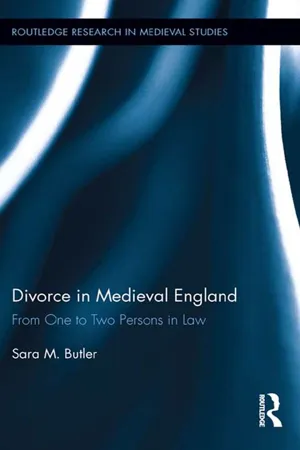
Divorce in Medieval England is intended to reorient scholarly perceptions concerning divorce in the medieval period. Divorce, as we think of it today, is usually considered to be a modern invention. This book challenges that viewpoint, documenting the many and varied uses of divorce in the medieval period and highlighting the fact that couples regularly divorced on the grounds of spousal incompatibility. Because the medieval church was determined to uphold the sacrament of marriage whenever possible, divorce in the medieval period was a much more complicated process than it is today. Thus, this book steps readers through the process of divorce, including: grounds for divorce, the fundamentals of the process, the risks involved, financial implications for wives who were legally disabled thanks to the rules of coverture, the custody and support of children, and finally, what happens after a divorce. Readers will gain a much greater appreciation of marriage and women's position in later medieval England.
- 200 pages
- English
- ePUB (mobile friendly)
- Available on iOS & Android
eBook - ePub
1 Why Did They Leave?
If the medieval church did not consider incompatibility sufficient reason to leave one's spouse, then what did it believe was a good cause for divorce? This is not necessarily an easy question to answer. Time and place, in large part, are key factors. Canon law in the Middle Ages was an evolving body of legislation that developed over hundreds of years out of the highly specialized intellectual debates of academics. Their reasoning derived only partly from biblical precedent: Christian tradition, Roman law, natural law and even common sense all contributed to contemporary perceptions of acceptable grounds for divorce. The history of adultery as a justification for marital dissolution provides an excellent window into the process of developing canon law. Following biblical directive, early Christian legislation put forward by Constantine permitted divorce for adultery but restricted it to the wife as perpetrator. Although a wife could sue for divorce if her husband was engaged in murder, poisoning or grave robbery, the early Roman church did not see a man's adultery as a failing sufficient to grant divorce.1 Under emperors Theodosius and Valentinian, this position changed: adultery by the husband also became a legitimate basis for divorce. This egalitarian perspective did not extend much beyond the fall of Rome, however. The Council of Friuli in 796 once again limited divorce only to a wife's adultery.2 With Gratian's new textbook of canon law in the twelfth century, the tides turned against adultery. Although Gratian was willing to permit adultery as a legitimate rationale for a couple to separate, divorce was out of the question. Nonetheless, the evidentiary process was still highly gendered. As Rufinus later observed, the wife “was at a legal disadvantage, since a man was entitled to charge his wife with adultery on suspicion alone, while a woman could bring such a charge against her husband only with hard proof.”3 Even still, Peter Abelard, who taught canon law at the University of Paris in the twelfth century, instructed his students that men could divorce their wives for adultery but that canon law did not permit wives to do so.4 In the thirteenth and fourteenth centuries, canonists shifted the focus of their query significantly. Although they consistently accepted the adultery of either partner as good grounds for separation, canonists were more interested in the implications of a separation on property, focusing especially on an adulterous wife's right to claim dower.5
As this case history suggests, canonical interpretations of the acceptability of adultery as justification for divorce have evolved greatly over time. Regional diversity is also a key factor. Although we glibly refer to the “medieval church,” no such monumental, unified institution ever existed in the Middle Ages. Churches were decidedly regional; thus, English canon lawyers sometimes applied the law in different ways than their continental counterparts. To offer a pertinent example, although the English church courts rarely entertained the notion of permitting couples to separate, the Franco-Belgian courts of the same period had an “extensive separation jurisdiction,” awarding an astonishingly high number of separations and boasting an exceptionally formalized process that even included hired arbiters to oversee the separation of marital goods.6
Given these limitations, this chapter does not aspire to universality; rather, it addresses only the practices of the English church concerning divorce litigation during the later medieval period. The only exceptions to this exclusively English focus are the communications resulting from English appeals to Rome. The nature of the sources inevitably guides this discussion. The medieval church permitted annulments only when valid impediments existed, implying that the marriage had never truly been valid. Thus, divorce litigation centered on those claims deemed acceptable by the church, such as incest, pre-contract (bigamy), under-age marriage, coerced marriage and impotence. Because of the visibility of those claims in the medieval records, this chapter addresses them first. The church awarded judicial separations only to couples whose marriages had evolved to a point where one or both spouses were endangered, either physically or spiritually. Although heresy was an acceptable justification for judicial separation, adultery and cruelty dominated the English suits for separation. Moreover, litigants tended to connect these allegations in their requests for separation; therefore, this chapter addresses adultery and cruelty jointly. Finally, self-divorce presents the most difficult obstacles in terms of discerning the context for marital dissolution. The sources that offer the most information are those of the ecclesiastical courts, in which the courts cited a wife for not adhering to her husband (or vice versa). In these circumstances, the responses of the individual give us some indication as to why he or she chose to self-divorce.
INCEST
Incest was one of the foremost causes for divorce. The reasoning behind the concern for incestuous marriage had nothing to do with modern fears of genetic disorders; rather, as Thomas Aquinas argued, the ban on couples marrying when too closely related had more to do with the need to create boundaries so that lust did not reign supreme in the close quarters of a household.7 In the medieval context, couples divorced on these grounds frequently were divorced against their wills and sought to remarry. The church expected a couple to probe into their family backgrounds before entering into marriage. The publication of the banns three Sundays in advance of the wedding was an additional safeguard to detect any underlying issues that might be mortifying if discovered down the road.8 However, the rules of incest in the medieval church were so convoluted that tracing impediments required a vast amount of research and good memory.9 Canonists defined incest not only through blood relationships; sexual encounters and religious sponsorship also created lasting family relations that acted as impediments to marriage. How earnestly did couples apply themselves to uncovering incestuous relationships? The survival of genealogical trees among the church's records expresses a positive dedication by some couples to ensure the validity of their union. Affluent couples actually hired people to investigate their pedigrees: the dispensation awarded to John Moubray and Elisabeth de Vrer, daughter of the earl of Oxford, states specifically that “persons more skilled in the law than those consulted by [the couple] before marriage” had discovered the incestuous relationship, prompting their request for dispensation.10 Because the church did not always practice what it preached, permitting couples to apply for a papal dispensation when too closely related (even when related within the second degree), some couples believed the church might not strenuously object when an impediment was discovered.11 Regrettably, this erroneous perception provoked a good deal of suffering among couples divorced against their wills. The papal petitions record plenteous examples of couples divorced on the grounds of incest and then granted a dispensation with permission to remarry; but the Vatican priced dispensations well beyond the reach of the ordinary individual. The costs of saving a marriage were predicated also on a couple's ignorance: the church required couples who married knowing an impediment existed to make a financial settlement to a curial official. Consciously violating church law also led to a sentence of excommunication, which might only be alleviated by further fines from the affluent or physical penance from the poor. Altogether, this meant that some couples paid dearly for the privilege of remaining married, and there was no guarantee that the papal court would side with the spouses' wishes.
Of all the impediments, incest was the most open to manipulation, simply because it was so easy to create an impediment. Surely, for an individual wishing to get out of a marriage, a recently discovered (or manufactured) incestuous relationship was a good excuse.12 Indeed, historians have argued repeatedly that “kings and nobles might have resisted church jurisdiction over marriage if they had not had the ‘forbidden degrees’ escape route to fall back on.”13 Even those lower down on the social scale took advantage of this loophole. Many divorces on these grounds have all the earmarks of invention. For example, in 1356, Christine Spicer petitioned the bishop of Carlisle for a divorce from her husband, John de Distyngton. Grounds for divorce centered on a previous “carnal knowledge” of her daughter, Agnes. After interviewing all the concerned parties, the bishop sided with Christine and awarded a divorce.14 How could the couple have married without knowing about this previous impediment? Even if John had kept it to himself, surely Christine's daughter would have spoken up. The most likely explanation for this divorce is that Christine wanted out of her marriage, and she knew her daughter would support her through perjury.15 Divorces awarded on these grounds were common enough; each time the records describe the couple's “shocking” discovery that they are related within prohibited degrees, even though in many situations, it is hard to imagine how they could possibly have been that ignorant. For example, a 1414 mandate to the bishop of Lincoln relates how Richard Boteler and Joan Lymebrenner had learned only after they entered into a valid marriage that Richard had previously been married to Joan's aunt (her mother's sister).16 How could the couple have not known this before they were married?
David D'Avray sees marriage within incestuous lines as a deliberate strategy among the wealthy. He notes, “[t]he more church justice blocked the path to divorce, the more the magnates tended to choose marriages which they knew could be annulled at need.”17 The impact on the church's reputation, however, was damning. Such “frequent annulments” inevitably “made the system look two-faced: unbreakable monogamy in principle, but a popular loophole to facilitate changing wives.”18 D'Avray's perspective on aristocratic resistance to the ecclesiastical model of marriage not only is critical for a clearer understanding of why medieval individuals resorted to divorce but reaffirms that England is not an anomaly. Georges Duby's 1978 study of marriage among the French aristocracy draws essentially the same conclusion.19 The chief distinction between the two settings lay in the degree of animosity: where the French upper crust struggled with competing models of marriage (one ecclesiastical, the other secular and aristocratic), in England, as Frederik Pedersen has argued, the “struggle” was largely absent.20 Although the English certainly had their own “coherent lay aristocratic agenda,” they preferred passive resistance, exploiting the impediments to achieve their own ends.21 Moreover, the manipulation of provisions for divorce in England was never restricted only to the moneyed ranks. Although the poor most likely engaged in self-divorce, wealthier peasants (the group Barbara Hanawalt has labeled “primary villagers”) were accustomed also to employing the courts to address their marital problems.22
Although the laity sometimes saw incest as a strategy to undermine the permanence of the marital union, the church saw it as a means of protecting the sanctity of marriage. The church assiduously devoted itself to divorcing incestuous couples who befouled the institution. Its dedication is evident in the myriad cases of marital dissolution on the grounds of sponsorship. Although today the church sees religious sponsorship as creating more of an allegorical relationship between sponsor and child, the medieval church adopted a very different perspective: “Because the sponsors had become parents-in-God, or godparents, to the child, they were incorporated into his or her family. They became spiritual relatives of the child and of the child's parents, all of whom were bound to one another by mutual obligations of trust and help.”23 Once again, however, a gap existed between secular and ecclesiastical perceptions. Although the church considered godparentage to create a lasting family relationship, communities themselves plainly did not share this belief. Parents regularly appointed godparents for their children from among their neighbors and friends, generally that same pool of people with whom they exchanged their children in marriage. Godparentage tended to occur within social strata rather than across, such that “[m]erchants godparented the children of other merchants, artisans godparented those of artisans, the nobility other nobles.”24 Furthermore, the lines of sponsorship in a village multiplied not only through the greater number of births in the Middle Ages but also because the church assigned each child three godparents (two of his or her own sex, one of the opposite) at baptism and then again at confirmation.25 The bonds of family established at baptism and confirmation were not limited only to the child and his sponsors: “sponsorship established a tie of coparenthood between the godparent and all of the adult members of the godchild's family.”26 With all of these obstacles working against them, a couple from the same village, for example, might easily find themselves related through sponsorship. Once again, although the church was often willing to provide a dispensation for couples who wished to remain married despite the impediment, the couple had to pay dearly for that dispensation. Sometimes the pope took pity on a couple: Isabel Martiner and John Cheyne of the diocese of Lincoln pleaded poverty when asking to remain in their marriage: John's first wife had been godmother at the baptism of one of Isabel's children from a former marriage, thus they required a papal dispensation to stay married but could not afford to pay for one. The pope granted the dispensation regardless.27 Many couples clearly believed purchasing a dispensation was worthwhile, even when uncertainty existed. For example, the dispensation awarded to Thomas Gray and Alice de Elwyk of Durham diocese reveals that they were not entirely certain of the nature of the impediment that existed between them. Alice's mother had been godmother to one of the twins of Thomas's mother, but they were not sure whether she was godmother to Thomas or his twin brother.28 Many couples married despite the impediment, simply because they had no other choice: the dispensation awarded to Thomas de Leuth and Alice, daughter of John Beteler of Wych, states that their impediment derived from the fact that Thomas was godfather at confirmation to Alice's son by a former husband. The couple knew of this impediment when they married, but, as Thomas declared, they married at a rather unfortunate time: “[he] knew no one else whom he could marry at the time of the pestilence.”29
PRE-CONTRACT (BIGAMY)
Many scholars have highlighted the centrality of pre-contracts as a pretext for divorce.30 The ease of marriage making in medieval England sometimes led to confusi...
Table of contents
- Cover
- Half Title
- Routledge Research in Medieval Studies
- Full Title
- Copyright
- Contents
- List of Abbreviations
- Acknowledgments
- Introduction
- 1 Why Did They Leave?
- 2 The Logistics of Divorce
- 3 The Risk Factor
- 4 Whose Property Is Whose?
- 5 What Happened to the Children?
- 6 What Happened Next?
- Conclusions
- Notes
- Works Cited
- Index
Trusted by 375,005 students
Access to over 1.5 million titles for a fair monthly price.
Study more efficiently using our study tools.
Frequently asked questions
Yes, you can cancel anytime from the Subscription tab in your account settings on the Perlego website. Your subscription will stay active until the end of your current billing period. Learn how to cancel your subscription
No, books cannot be downloaded as external files, such as PDFs, for use outside of Perlego. However, you can download books within the Perlego app for offline reading on mobile or tablet. Learn how to download books offline
Perlego offers two plans: Essential and Complete
- Essential is ideal for learners and professionals who enjoy exploring a wide range of subjects. Access the Essential Library with 800,000+ trusted titles and best-sellers across business, personal growth, and the humanities. Includes unlimited reading time and Standard Read Aloud voice.
- Complete: Perfect for advanced learners and researchers needing full, unrestricted access. Unlock 1.5M+ books across hundreds of subjects, including academic and specialized titles. The Complete Plan also includes advanced features like Premium Read Aloud and Research Assistant.
We are an online textbook subscription service, where you can get access to an entire online library for less than the price of a single book per month. With over 1.5 million books across 990+ topics, we’ve got you covered! Learn about our mission
Look out for the read-aloud symbol on your next book to see if you can listen to it. The read-aloud tool reads text aloud for you, highlighting the text as it is being read. You can pause it, speed it up and slow it down. Learn more about Read Aloud
Yes! You can use the Perlego app on both iOS and Android devices to read anytime, anywhere — even offline. Perfect for commutes or when you’re on the go.
Please note we cannot support devices running on iOS 13 and Android 7 or earlier. Learn more about using the app
Please note we cannot support devices running on iOS 13 and Android 7 or earlier. Learn more about using the app
Yes, you can access Divorce in Medieval England by Sara M. Butler in PDF and/or ePUB format, as well as other popular books in History & European Medieval History. We have over 1.5 million books available in our catalogue for you to explore.