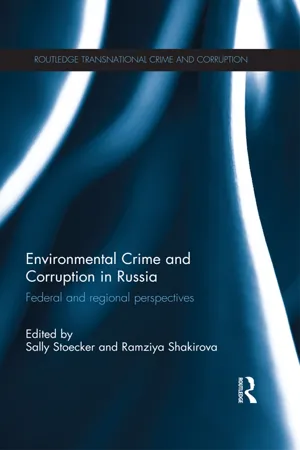
Environmental devastation, a significant consequence of industrial activity in Soviet times, continues to be a major problem in Russia. Specific problems include radioactive pollutants from inadequately monitored nuclear plants, illegal logging and wildlife poaching which have grown into hugely profitable businesses for criminal gangs, and toxic waste from unsanctioned and poorly controlled metallurgical, petroleum and agricultural chemical industries. This book presents a wide ranging assessment of the environmental problems faced by Russia and of the crime and corruption which contribute to them. It also discusses the attitude of the Russian government which seems to view environmental protection as something for rich countries, something to be postponed until Russia is on the same economic footing as wealthier Scandinavian and western European countries. It concludes, gloomily, that the problems are getting worse and that little is being done to tackle them.
eBook - ePub
Environmental Crime and Corruption in Russia
Federal and Regional Perspectives
- 154 pages
- English
- ePUB (mobile friendly)
- Available on iOS & Android
eBook - ePub
Environmental Crime and Corruption in Russia
Federal and Regional Perspectives
About this book
Information
1 Envisaging environmental crime in Russia
Past and present realities

Environmentalists care not only about clean rivers, but also clean hands.
Vladimir Artiakov, Governor of Kuibyshev
Environmental crime in Russia, as in many countries, is a multi-faceted, intractable, and health and habitat-degenerating dilemma. Environmental crimes, like most crimes, are latent and therefore pose challenges for law enforcement to apprehend perpetrators in the act of poaching, felling timber, mishandling toxic substances, or smuggling enriched uranium. Legal and administrative mechanisms to cope with environmental crimes are often inadequate, ignored, or non-existent. For example, shortcomings of anti-corruption and environmental protection laws impede proper investigation and prosecution of crimes against nature; a regulatory culture of non-compliance and non-enforcement persists;2 frequent reorganisation of environmental oversight responsibilities and structure by state agencies.3 Interagency collaboration between state and regional nature protection agencies (rosprirodnadzor) and law enforcement bureaus is lacking. In addition, priority is often placed on investigating economic and violent crimes over environmental crimes, with little to no priority given to crimes against humanity. All of this inhibits the prevention or prosecution of environmental crimes that harm human health as a result of air, water, or soil pollution, radioactivity, to the the loss of habitat for numerous types of wildlife as forests are denuded by criminal loggers.
Globalization has brought with it new ways of conceptualizing criminal activity. Seldom confined to a country’s own territory, many crimes spread across borders, involve actors in different countries and continents, can be planned via the internet, and can be carried out with the aid of mobile phones, hence environmental crimes can be transnational. Rob White, in his recent book on this topic, defines transnational environmental crimes (TEC) as “crimes that involve cross-border transference and global dimension, related to pollution of air, water, and land and crimes against wildlife (including illegal trade in ivory as well as animals)”.4 TEC also extend to crimes against humanity, which are often the fault of the government or corporations that either exploit, or sanction the exploitation of, the air, water, and soil.
In Russia, however, one key element that is limited in most discussions of environmental crimes and accidents is the voice of the people. Traditionally, Russia has shunned public dissent or debate over governmental programs. Civil society is still developing and activities such as investigative reporting can be a dangerous endeavor. We recall that even General Secretary Mikhail Gorbachev, who permitted debate and openness (glasnost’) in the mid-1980s to an unprecedented degree, was reluctant to share news about the nuclear explosion in reactors in Chernobyl, Ukraine, in April 1986. As a result, the time lag in announcing the travesty and enlisting foreign assistance cost lives and infuriated surrounding regions and countries that were affected by the radiation as it moved across the continent.
To be fair, at the same time, other countries also are responsible for the pollution of Russia (and the whole planet), because many countries ship their nuclear waste to Russia. Although this is legal and the Russian government has agreements for the importation and burial of nuclear waste, it is still of very high concern to the Russian population,5 just as the proposed Yucca Mountain disposal facility in Nevada has resulted in public outcry and political wrangling for more than ten years in the United States.6 Factories in China have dumped toxic chemicals into areas of the Russian Far East, contaminating Russian rivers.7 In March, 2011, the earthquake and tsunami that caused the explosion of the nuclear power complex in Fukushima, Japan is also said to have affected neighboring countries with radiation. In our interdependent world today we are all responsible for the global environment.8
However, unlike most other countries, the sheer size and expanse of the Russian Federation facilitates, and indeed invites, the perpetration of environmental crimes. Russia’s geographic expanse also presents challenges for law enforcers responsible for investigating crimes throughout Russia’s vast and, in the winter months, often impenetrable territory. Russia is the largest country in the world, nearly one-sixth of the world’s land mass, almost twice the size of the United States, and is home to the largest boreal forests (taiga) in the world, spanning 12 million square kilometers.9 Unique, but endangered, species of flora and fauna thrive in the multitude of Russian forests and hundreds of inland waterways, the deepest freshwater lake in the world, and access to the Pacific, Arctic and other seas. Russia straddles Asia and Europe, and shares borders with numerous countries, including China to the east, Finland to the west, Kazakhstan to the south, and the Arctic Ocean to the north. The Transsiberian Railway traverses 9,259 kilometres or 5,753 miles, from the eastern city of Vladivostok to the northwest capital of Moscow–a journey of its whole length takes eight days and spans eight time zones.
Governing a country of this scale and scope is a daunting task. When the Soviet Union was captive to “totalitarian” ideology and the Communist Party ruled the people, strict border and passport controls and a array of Communist Party organizations and cells throughout the USSR kept the citizenry in obeisance, under control and in place. With the demise of the USSR in 1991, the structure of the country changed gradually as the 15 former Soviet republics became countries in their own right. The Russian Federation was constituted in 1993 and today consists of 83 federal subjects and eight federal districts.10 Federal districts were introduced in 2001 by President Putin as means of extending federal power over distant regions. The envoys of the districts are appointed by the president and serve as a liaison between the federal subjects and the federal government. In spite of these efforts to oversee the districts with special envoys, the expanse of Russia and the proliferation of subjects is too great for any meaningful control over their environmental protection to materialize. The federal subjects or “regions” must assume responsibility for their own environmental protection and should have enough regional authority to do that. Local governments at municipal level also should have enough means and power to be able to effectively organize and control environmental issues. Former Russian President Dmitri Medvedev stated in a recent meeting on environmental issues: “It is wrong [for the government] to take away control over environmental affairs from municipalities, because that is where the [majority] of people reside—neither in Moscow nor in large cities, but in municipalities.”11
Over the decades, the mythology surrounding Russia’s limitless and malleable resources has lead to depleted and poisoned soil, air, and water in an all-out quest to exploit natural resources: drilling for oil and gas, clearing forests for railroads, mining quarries for diamonds, diverting rivers to irrigate crops, and many others.12 In addition, the disposal of tons of nuclear and chemical waste remains a conundrum, yet Russian authorities have entered into lucrative agreements with many countries to buy their depleted uranium for disposal in Russia. In 2001, President Vladimir Putin signed legislation allowing for the import of radioactive waste and spent nuclear fuel (SNF) from other countries—raising concerns by many Russian citizens that these wastes will contaminate the country further.13 Russia has been the recipient of a total of some 1,298 pounds of highly enriched uranium fuel from Bulgaria, the Czech Republic, Germany, Latvia, Lithuania, Poland, Romania, Serbia, Uzbekistan and Vietnam. Russia is also transporting SNF within its own borders. In 2011, SNF from a nuclear facility near St. Petersburg was transported to Sosnovy Bor in Central Siberia by train, raising many concerns about the safety of the populations residing in the territory through which the 300-train caravan travelled.14 Coping with so much toxic and radioactive waste left over from the cold war is one of the biggest environmental clean-up challenges that Russia faces.
Legal tools for addressing environmental crime
Russia’s first nature-protection laws date back to the Tsarist era in the seventeenth century and were included in legal codes (ulozhenii) until the Revolution in 1917.15 In 1920, the criminal code, as it was then called, addressed the protection of trees and for the first time named forest fires a crime.16 Two years later, the protection of trees was elaborated in article 99 of the criminal code, providing for the punishment of individuals and forest administrations (leskhozy) that violated the established government economic plan by hunting and fishing at prohibited times and places. The major addition to the 1926 code, in terms of the environment, was protection of marine life, as well as rivers and lakes. The misuse of the earth (nedr) via extraction of natural resources was deemed criminal in article 87.
The 1960 Criminal Code, signed into law by First Secretary of the Communist Party Nikita Khrushchev, expanded the code of 1926 and contained 12 norms that could be applied to environmental protection, including the violation of veterinary laws (art. 160), illegal hunting of seals and beavers (art. 164), and the pollution of reservoirs and air (art. 223). Environmental crimes were contained in the criminal code’s chapter on economic crimes thereby illustrating their subordination to the latter.17 At this time in Soviet history, the preamble to the law on protecting the environment emphasized the economic benefits to be derived from exploiting the country’s vast natural resources, and “extensive” approach as opposed to an “intensive” approach that would use natural resources wisely and treat them in a way that ensured renewal and regeneration. Nature was viewed as a boundless source of raw material for industrial and agricultural production; emphasis in the law on means of protecting natural resources or human health was limited.
Nature and her resources in the Soviet state made up the natural basis for developing the economy and served as a source of continual growth of material and cultural values that provide the best conditions for work and recreation.18
In the 1960s few convictions for environmental crimes were handed down. In 1963, there were five; in 1967, twelve.19 Efforts to investigate and prosecute air and water pollution crimes were stymied by the Soviet emphasis on fulfilling and over-fulfilling industrial and agricultural five-year plans. Poorly regulated and neglected nuclear and industrial complexes emitted radioactivity and toxic levels of air pollution, and grandiose and unsustainable river diversion schemes all were byproducts of the Soviet command-administrative system engineered by General Secretary of the Soviet Union Joseph Stalin, and were geared toward fulfilling ...
Table of contents
- Cover
- Half Title
- Title Page
- Copyright Page
- Table of Contents
- List of illustrations
- List of contributors
- Acknowledgments
- Introduction
- 1 Envisaging environmental crime in Russia: past and present realities
- 2 Russia’s nuclear industry and the environment
- 3 Forest auctions in Russia: how anti-corruption laws facilitate the development of corrupt practices
- 4 Combating corruption and organized crime in the forest sector of the Trans-Baikal Territory
- 5 Environmental crimes in the territory adjacent to the petroleum-storage facility in the town of Kama in the Kambarsk Region of the Udmurt Republic
- 6 The impact of metallurgical and cement industrial waste on Central Russia’s environment
- 7 Environmental contamination and public health in the Republics of Tatarstan and Mari El, Russian Federation
- Index
Trusted by 375,005 students
Access to over 1.5 million titles for a fair monthly price.
Study more efficiently using our study tools.
Frequently asked questions
Yes, you can cancel anytime from the Subscription tab in your account settings on the Perlego website. Your subscription will stay active until the end of your current billing period. Learn how to cancel your subscription
No, books cannot be downloaded as external files, such as PDFs, for use outside of Perlego. However, you can download books within the Perlego app for offline reading on mobile or tablet. Learn how to download books offline
Perlego offers two plans: Essential and Complete
- Essential is ideal for learners and professionals who enjoy exploring a wide range of subjects. Access the Essential Library with 800,000+ trusted titles and best-sellers across business, personal growth, and the humanities. Includes unlimited reading time and Standard Read Aloud voice.
- Complete: Perfect for advanced learners and researchers needing full, unrestricted access. Unlock 1.5M+ books across hundreds of subjects, including academic and specialized titles. The Complete Plan also includes advanced features like Premium Read Aloud and Research Assistant.
We are an online textbook subscription service, where you can get access to an entire online library for less than the price of a single book per month. With over 1.5 million books across 990+ topics, we’ve got you covered! Learn about our mission
Look out for the read-aloud symbol on your next book to see if you can listen to it. The read-aloud tool reads text aloud for you, highlighting the text as it is being read. You can pause it, speed it up and slow it down. Learn more about Read Aloud
Yes! You can use the Perlego app on both iOS and Android devices to read anytime, anywhere — even offline. Perfect for commutes or when you’re on the go.
Please note we cannot support devices running on iOS 13 and Android 7 or earlier. Learn more about using the app
Please note we cannot support devices running on iOS 13 and Android 7 or earlier. Learn more about using the app
Yes, you can access Environmental Crime and Corruption in Russia by Sally Stoecker,Ramziya Shakirova in PDF and/or ePUB format, as well as other popular books in Social Sciences & Ethnic Studies. We have over 1.5 million books available in our catalogue for you to explore.