Originally published between 1920-70,The History of Civilization was a landmark in early twentieth century publishing. It was published at a formative time within the social sciences, and during a period of decisive historical discovery. The aim of the general editor, C.K. Ogden, was to summarize the most up to date findings and theories of historians, anthropologists, archaeologists and sociologists. This reprinted material is available as a set or in the following groupings:
* Prehistory and Historical Ethnography
Set of 12: 0-415-15611-4: £800.00
* Greek Civilization
Set of 7: 0-415-15612-2: £450.00
* Roman Civilization
Set of 6: 0-415-15613-0: £400.00
* Eastern Civilizations
Set of 10: 0-415-15614-9: £650.00
* Judaeo-Christian Civilization
Set of 4: 0-415-15615-7: £250.00
* European Civilization
Set of 11: 0-415-15616-5: £700.00
- 424 pages
- English
- ePUB (mobile friendly)
- Available on iOS & Android
eBook - ePub
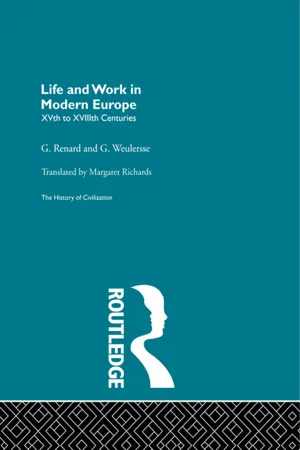
Life and Work in Modern Europe
About this book
Chapter I
Spain and Portugal
§ 1. Spain.
Summary of political development—Short period of prosperity; causes of decline—Royal fiscal system counteracts advantages offered to national trade by new facilities—Short-lived boom in industry; lack of economic sense; introduction of foreign manufactures and workers—Agricultural prosperity ruined by the expulsion of the Moors, by the growth of great estates, by the encouragement of sheep-farming, and by the fiscal and commercial policy of the Government—Depopulation; widespread poverty; wretched condition of the working classes—Slight increase in national prosperity in the eighteenth century.
THE history of Spain in the period we are studying falls into three periods. Up to the last thirty years of the sixteenth century she was the first country in Europe; from that time until about 1730 her power declined; but the last part of the eighteenth century saw her partial restoration.
At the beginning of the modern era Spain possessed vast dominions in Europe; she had crossed the Pyrenees and hemmed France in on all sides; in Italy she already possessed some territory and laid claim to still more; she was proud of her infantry, which passed for the finest in the world. United to Austria by the succession of Charles V, she was a menace to the balance of power in Europe. Meanwhile overseas she was conquering a vast empire whence her galleons returned laden with silver. Her prestige suffered slightly when Philip II succeeded the Emperor-King, but even so his court was the most luxurious and stately in Europe. He prided himself on being the defender of Christianity against the Turks, over whom his brother, Don John, won the naval victory of Lepanto in 1571. He was the champion of the Counter-Reformation, in the interests of which he launched his famous and ill-fated Armada against England, seized Portugal, dreamt of securing the throne of France, and laboured to crush political and religious freedom in the Low Countries. While Madrid was thus the centre of a policy of limitless ambitions, it was at the same time the scene of a brilliant Renaissance of art and literature. Cervantes, Lope de Vega, Calderon, Velasquez, Ribera, to mention no others, are as famous in their own spheres as Ignatius Loyola or St. Theresa in theirs, and bear witness to the creative genius of their race at that time. It is true to say that for nearly a hundred years Spain was the dominant nation, to be imitated and admired, to be feared and to be fought.
Such a position could not possibly have been won without an accompanying development in the economic life of the nation, and, in fact, Spain in those days was very far from being the impoverished country which we, with our knowledge of her later history, too easily picture her.
She was rich in actual bullion; her doubloons, which bought her allies and paid her fleets and armies, were current throughout the whole of Europe; from 1545 onwards her mines in Mexico and Peru produced on an average about 300 tons of silver a year.
As a result of her natural position, commanding both the Atlantic and the Mediterranean, she had two navies, one stationed at Cadiz, the other at Barcelona. Ferdinand and Isabella opened their ports to the vessels of other nations and encouraged them in various ways. They abolished the barbarous right of wreckage, which gave the salvage of a wrecked ship to the inhabitants of the shore on which it was wrecked and made the coasts of Spain as perilous as those of the Barbary pirates. They also freed from customs duties such foreign ships as put into their ports for anchorage and not for trade. But at the same time they did their best to protect their own ships and shipowners. An edict of September, 1500, on the same lines as the Navigation Act which Cromwell drew up later, forbade all merchants, Spanish or otherwise, to give any cargo to a foreign ship if a ship flying the royal flag were available. Indeed, for about a hundred years, the Spanish navy was really prosperous; at the beginning of the sixteenth century it numbered a thousand vessels. Barcelona carried on a prosperous trade with Alexandria, Naples, Sicily and even the Barbary States, and though it gradually declined as a result of the raids of the Turkish pirates and the growing importance of the trans-Atlantic discoveries, trade with America more than compensated Spain for her loss in the Mediterranean. On the north and west the Castilians maintained a flourishing trade with Flanders, London, Nantes and La Rochelle through their ports on the Gulf of Gascony, and Seville shared with Bilbao the valuable monopoly of trade with America.
Industry was no less prosperous. The leather of Cordova, the weapons of Toledo, the paper and silk of Jaen and other places still retained their old reputation. After the reunion of the crowns of Castile and Aragon, Ferdinand and Isabella had wisely encouraged manufactures, and since 1484 had attracted many Italian and Flemish craftsmen to Spain by offering them exemption from taxation for ten years. Such an appeal to the foreigner was then not a symptom of decadence but of progress. They had protected young and struggling industries against the disastrous attacks of foreign competition, and it was in pursuance of this policy that for two years the importation of cloth had been forbidden in Murcia and of Neapolitan silk thread in Granada. During the first half of the sixteenth century the textile trades flourished: linen and silk at Toledo, cloth at Saragossa, where 16,000 looms were at work, and at Barcelona and Valencia. Ocana became famous for its soap, and still more for its gloves, which were known throughout Europe. Seville, Cadiz and Valladolid manufactured articles designed to meet the needs of the colonies.
Agriculture at first seemed to be quite as successful as trade or industry. The Spanish climate was dry, but provided that the farmers would take the trouble to overcome this defect, Spain was well suited to the production of oil, wine, fruit and even grain. The Moors, a race of skilled cultivators, trained in irrigation in a harsher climate, had settled in Spain and had transformed vast stretches of parched land into marvellous gardens and made of Andalusia a fertile and prosperous country, which was a model to all Southern Europe. Even when pitiless fanaticism had driven 400,000 of them from the kingdom of Granada (1492), those who remained were still a source of profit to the heartless country which persecuted them. In remote districts of the Betic Mountains a few of them succeeded in keeping themselves alive, and even to-day you may see the results of their patient and scientific toil in the greater fruitfulness of these places. Until the beginning of the seventeenth century1 twenty-two thousand Moorish families continued to occupy the plain of Valencia, which they succeeded in turning into the huerta or model garden. There the science of irrigation was brought to perfection, and the waters of the Guadalaviar, jealously husbanded, had enabled them to develop plantations of sugarcane, as well as ordinary Mediterranean products like the mulberry and the orange. Thus during the greater part of the sixteenth century agriculture preserved throughout the kingdom some measure of the prosperity given it by the Moors. The magnificent olive plantations of Andalusia were at their best; the tithe on oil at Seville reached the considerable sum of 32,000 ducats, while the yield was big enough to supply important soap-works. Other crops, unknown to the Moors or avoided by them for religious reasons, were also cultivated: such as flax in the damp northern regions, or, in hot Castile, the vine, which even encroached on cereals. The heavy wines of the uplands found a profitable market in America, while all Europe sought after the famous wines of the south such as Alicante, Malaga and Xeres.
Nevertheless, Spain, in spite of her command of two seas, in spite of the advantage she gained in being the first of the powers to carve out an empire in the New World, suffered a rapid decline. The reasons for this are to be found both in the political and moral life of the country, and in external and internal affairs. It resulted not only from the competition of neighbouring countries, such as Holland, England and France, whose people were more active and industrious and whose policy was more enlightened, but also from a series of mistakes in the conduct of Spanish affairs.
In the hrst place, the sovereigns did not realise the economic unity of the countries under their sway. Ferdinand and Isabella, indeed, at the end of the fifteenth century, did suppress some of the burdensome seignorial tolls, though only sueh as had been established in recent years, and in 1496 they issued a decree urging the adoption of a single system of weights and measures. But the natural formation of the peninsula, cut up as it is by rugged mountain ranges, the marked variation in climate from district to district, as well as historical tradition, made their task difficult, and the provincial separatism of Spain has lasted almost to our own times. It was not until Philip V introduced the French idea of big public works that a network of highroads, radiating from Madrid, made communication between the chief cities a little casier.1 Soon, however, the kings themselves, burdened by the expenses of gigantic wars and a luxurious court, found themselves forced to raise in their own interests the barriers which their predecessors had tried to break down in the interests of commerce. From the reign of Philip II the internal customs duties multiplied, and the alcabala, an indirect tax on all purchases and sales, which it was not always possible to escape by means of a contract, was scarcely less harmful to merchants than to artisans. Smuggling spread rapidly, and only served to increase the demand of the royal revenue. Ferdinand and Isabella at least kept their currency from depreciating, but Philip III, when he wanted money, did not hesitate to debase the coinage.
In the second place, the absolute power of the king was used in the interests of the Catholic Church, and this clerical despotism had disastrous results on national life. Philip II, like an Asiatic king, kept majestically aloof in his gloomy palace of the Escurial, built on the model of the gridiron of St. Lawrence. He swept away what remained of seignorial and civic liberty, and pursued his policy of extravagant expenditure, war and intrigue without restraint. He followed his ideal of religious unity to the death, both in Spain and elsewhere, saying, "I would rather reign in a desert than in a country peopled with heretics." Thus the Holy Inquisition, with its attendant train of idle monks and auto-da-fé, triumphed disastrously in Spain. The intellectual life of the nation received a permanent check, since all those who bought, sold or read forbidden books were condemned to lose all their property and be burnt alive. Moreover, all suspected books were seized at the frontier, and thus a sort of intellectual customs barrier was created, which effectively cut Spain off from all contact with foreign culture. Those who followed the teaching of the Reformation were ruthlessly put to death. Commerce and agriculture declined after the expulsion of the Jews and the persecution of the Moors. In the Low Countries there was a long struggle against the Calvinists and Lutherans, who were destined to shake off the yoke and to become on the sea the most redoubtable enemies of their old lords. Even outside his hereditary dominions, in England, in France and in Sweden, Philip II attempted to impose the rule of the Holy Office, and in pursuit of this fantastic and fanatic ambition he spent the vital force and fortune of his people.
As is usual in such cases the people had their share in responsibility for the general impoverishment. The Aragonese and Castilian nobles were essentially soldiers, whose mission it had been to reconquer Spain from the Moors. This done, it was beneath the dignity of these hidalgos to work with their hands or even to employ their money in business; that had been the affair of these Mussulmans and Israelites whom they had driven out, and would still provide employment for the subject populations whom they had freed from the despotism of the Crescent. The eldest sons of the nobility lived in idleness on the revenue of their estates, which were subject to the law of primogeniture; the younger sons, with only their pride for their fortune, were ashamed to work when their elder brothers lived in noble idleness, and preferred to vegetate in noble poverty. If the heads of the great families happened to have any money to dispose of, they did not dream of risking it in business, but dignity—or prudence—counselled them to lend it to the State, in which case it could be entailed. But the worst of all was that the pecheros, the descendants of the people liberated by the hidalgos, quickly grew to share the prejudices of their new masters. Since they were despised and loaded with taxes like the land-tax, it became the sole aim of the richest and cleverest of them to enter the hidalguia. At the end of the seventeenth century there were 625,000 nobles in Spain, at least four times as many as there ever were in France, which had a far larger population; and when at last in 1682 the government decided to issue a proclamation declaring that industry was not degrading, it was too late. The poor found a refuge for their idleness in the monasteries, which increased in number incessantly, and always supported a whole train of beggars. Craftsmanship itself became rare as the population decreased, and the enforeed idleness of the too numerous religious festivals reduced still further the amount of effective work that could be obtained from a working class already too few in number.
Spain still had a source of wealth in her colonies, but from them she received little more than precious metals. The treasure was first accumulated in the celebrated Golden Tower, and later made its way to the treasury of the capital by an old Roman road, which is still called to-day the Camino de la Plata. The real trade in exotic products was soon to fall into the hands of the Dutch and the English, established at Curasao and Jamaica, who bought cheaply at Carthagena and Porto-Bello Peruvian bark, indigo and cotton. As to the manufactured articles which Spain sent to America, the consignments were very irregular and depended entirely on the number of ingots which the Indians brought to the factories of the New World; it was useless to attempt to impose upon them a fixed amount of purchases. Moreover, privateers of other nations, Dutch, English and French, intercepted the galleons. In the second half of the seventeenth century Cadiz succeeded to the diminished heritage of Seville, the great city of the Guadalquivir, which was said at certain periods to have had 300,000 inhabitants, of whom 130,000 were workmen. Cadiz tried for a time to increase her trade with the Adriatic and Levantine coasts, but all the foreign trade of the kingdom was hampered by the almost prohibitive duties which the Madrid government, usually for purely fiscal purposes, levied on imports and exports. What chance had trade under these conditions?
It seemed at first that an important and influential class of rich merchants would grow up in the country, and in fact towards the end of the sixteenth century the merchant-princes of Seville were marrying their daughters to gentlemen. On the other hand, nobles were invited to take a share in great trading ventures, and an edict of 1626 proclaimed that it was not derogatory for a noble to be connected with trade, provided that he did not buy and sell himself or carry on business in his house. But the terrible exactions of a government as ambitious as it was impecunious crushed without pity those who had, at their own risk and peril, grown rich in overseas trade. The government policy was really confiscation; they cloaked it by handing over government stock in exchange, though they usually forgot not only to pay back the capital but even to make up arrears of interest. The officials, who had to be bribed, exerted still further pressure on these voluntary taxpayers; if they were Portuguese Jews they got no mercy. Thus the upper-middle class of Spain died almost as soon as it was born, and that at a time when the country stood in dire need of its ability and its wealth.
Spain was forced to rely instead upon foreigners, against whom, in the early years of the sixteenth century, a whole series of laws had been passed forbidding them to engage in retail trade or to act as middlemen or brokers. Then foreigners had been feared as competitors; now they were regarded as indispensable allies. The king, always in want of money, was the first to welcome the aid of Genoese or German bankers, who demanded in return not only a high Tate of interest but also privileges which were still more remunerative. For example, the Fuggers, the celebrated Augsburg bankers, extorted the monopoly of exporting wool, timber and iron; in the same way, in 1700, the town of Santander signed a special agreement with English shippers. The English, following in the track of the Germans and the Dutch, had long since obtained the right to create a special commercial court at Seville or at Cadiz. Five-sixths even of the internal trade had passed out of Spanish hands. When the seventeenth century opened, 160,000 foreigners were already monopolising the large-scale trade, and soon were to seize upon the large-scale industries of the kingdom.
The growth of industry had closely followed the reunion of the crowns of Aragon and Castile. But even during its brief period of prosperity it soon found itself lacking every necessity —capital, middlemen, labour. Not only was manual labour despised, but industry was hampered by a series of laws such as might be expected from an assembly of hidalgos entirely lacking in economic knowledge. The Cortes of Castile and Aragon would not have tolerated the ...
Table of contents
- Cover
- Title
- Copyright
- Contents
- FOREWORD
- INTRODUCTION: THE ECONOMIC AND SOCIAL REVOLUTION AT THE BEGINNING OF THE MODERN ERA (FIFTEENTH AND SIXTEENTH CENTURIES)
- CHAPTER I: SPAIN AND PORTUGAL
- CHAPTER II: THE NETHERLANDS
- CHAPTER III: ENGLAND
- CHAPTER IV: FRANCE
- CHAPTER V: ITALY
- CHAPTER VI: SWITZERLAND
- CHAPTER VII: GERMANY AND AUSTRIA-HUNGARY .
- CHAPTER VIII: THE SCANDINAVIAN STATES
- CHAPTER IX: POLAND—RUSSIA
- CONCLUSION
- INDEX
Trusted by 375,005 students
Access to over 1.5 million titles for a fair monthly price.
Study more efficiently using our study tools.
Frequently asked questions
Yes, you can cancel anytime from the Subscription tab in your account settings on the Perlego website. Your subscription will stay active until the end of your current billing period. Learn how to cancel your subscription
No, books cannot be downloaded as external files, such as PDFs, for use outside of Perlego. However, you can download books within the Perlego app for offline reading on mobile or tablet. Learn how to download books offline
Perlego offers two plans: Essential and Complete
- Essential is ideal for learners and professionals who enjoy exploring a wide range of subjects. Access the Essential Library with 800,000+ trusted titles and best-sellers across business, personal growth, and the humanities. Includes unlimited reading time and Standard Read Aloud voice.
- Complete: Perfect for advanced learners and researchers needing full, unrestricted access. Unlock 1.5M+ books across hundreds of subjects, including academic and specialized titles. The Complete Plan also includes advanced features like Premium Read Aloud and Research Assistant.
We are an online textbook subscription service, where you can get access to an entire online library for less than the price of a single book per month. With over 1.5 million books across 990+ topics, we’ve got you covered! Learn about our mission
Look out for the read-aloud symbol on your next book to see if you can listen to it. The read-aloud tool reads text aloud for you, highlighting the text as it is being read. You can pause it, speed it up and slow it down. Learn more about Read Aloud
Yes! You can use the Perlego app on both iOS and Android devices to read anytime, anywhere — even offline. Perfect for commutes or when you’re on the go.
Please note we cannot support devices running on iOS 13 and Android 7 or earlier. Learn more about using the app
Please note we cannot support devices running on iOS 13 and Android 7 or earlier. Learn more about using the app
Yes, you can access Life and Work in Modern Europe by G. Renard,G. Weulersse in PDF and/or ePUB format, as well as other popular books in History & World History. We have over 1.5 million books available in our catalogue for you to explore.