Tavistock Press was established as a co-operative venture between the Tavistock Institute and Routledge & Kegan Paul (RKP) in the 1950s to produce a series of major contributions across the social sciences.
This volume is part of a 2001 reissue of a selection of those important works which have since gone out of print, or are difficult to locate. Published by Routledge, 112 volumes in total are being brought together under the name The International Behavioural and Social Sciences Library: Classics from the Tavistock Press.
Reproduced here in facsimile, this volume was originally published in 1967 and is available individually. The collection is also available in a number of themed mini-sets of between 5 and 13 volumes, or as a complete collection.
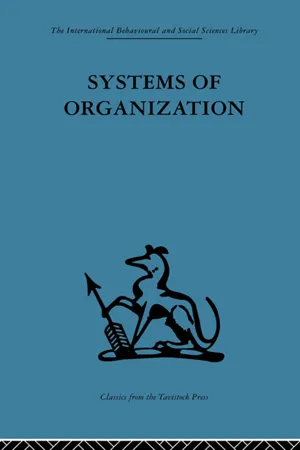
eBook - ePub
Systems of Organization
The control of task and sentient boundaries
- 312 pages
- English
- ePUB (mobile friendly)
- Available on iOS & Android
eBook - ePub
Systems of Organization
The control of task and sentient boundaries
About this book
Information
Part I
A Conceptual Framework
| Introduction | |
| 1 | Systems of Activity and their Boundaries |
| 2 | Individuals, Groups, and their Boundaries |
| 3 | Task Priorities and Constraints |
| 4 | Organizational Model-Building |
Introduction
Any enterprise may be seen as an open system which has characteristics in common with a biological organism. An open system exists, and can only exist, by exchanging materials with its environment. It imports materials, transforms them by means of conversion processes, consumes some of the products of conversion for internal maintenance, and exports the rest. Directly or indirectly, it exchanges its outputs for further intakes, including further resources to maintain itself. These import-conversion-export processes are the work the enterprise has to do if it is to live.
One intake of a biological organism is food; the corresponding conversion process is the transformation of food into energy and waste matter. Some of the energy is used up in procuring further supplies of food, some in fighting, or in securing shelter from, hostile forces in the environment, some in the functioning and growth of the system itself, and some in reproductive activities. In the same way, a joint stock company imports capital through the sale of shares or the raising of loans, converts the capital into income by investment in commercial and industrial enterprises, uses some of the results to maintain itself and to grow, and exports the remainder in the form of dividends and taxes. A manufacturing enterprise imports raw materials, converts them into products, and sells the products. From its returns on the sale it acquires more raw materials, maintains and develops the enterprise, and satisfies the investors who provided the resources to set it up.
Other kinds of enterprise have different intakes and different conversion processes, and the returns they obtain from the environment in exchange for their outputs take different forms. An educational enterprise, for example, imports students, teaches them and provides them with opportunities to learn; it exports ex-students who have either acquired some qualification or failed. The proportion that qualifies and the standard the individuals are perceived to have attained determine the extent to which the environment provides students and resources to maintain the enterprise. In a learned society the primary pay-off may not be expressible in monetary terms or in terms of securing further material or human intakes but rather in prestige and self-esteem. Such pay-offs, however, are important for educational enterprises and may not be unimportant for profit-making enterprises as well.
Just as the study of living organisms requires the integration of many different theories, so the study of enterprises requires scientific theories corresponding to the anatomical, physiological, and ecological disciplines of the biologists. Organizational anatomy is concerned with the nature and structure of the resources through which the enterprise carries out its tasks; organizational physiology with the processes of task performance, including the interrelations of different internal processes; and organizational ecology with the place of the enterprise in its physical, social, cultural, and economic environment.
But we are concerned in this book not merely with developing theories that will help us to understand the structure and functioning of enterprises; we have also to bear in mind that enterprises and human beings, unlike other living organisms, need theories to apply to the solution of their own practical problems of organization.
Accordingly, in presenting our theoretical framework in Part I, we start in Chapter 1 with an examination of the systems of activity through which the enterprise carries out its import-conversion-export processes. We attempt to use concepts at a level of abstraction that makes them applicable to the functioning of all types of enterprise.
Activities, however, require resources to produce them and all enterprises have to employ some human resources. Any theory of organization therefore entails a theory of individual and group behaviour. An outline of such a theory is presented in Chapter 2.
Organization is the means through which the enterprise secures the performance of its tasks. In Chapter 3 we discuss a method of analysing task priorities and of determining the resources needed for, and the constraints on, task performance.
In Chapter 4 we put forward a system theory of organization and discuss model organizational forms through which resources can be deployed in systems of activity. We then examine the types of regulation that are required to relate people to tasks and to take into account the constraints that are imposed by the employment of human resources.
Chapter 1
Systems of Activity and their Boundaries
In this chapter we shall first consider the enterprise in terms of the systems of activity through which the import-conversion-export processes are carried out. We shall distinguish between operating activities and maintenance and regulatory activities, and we shall then discuss the definition of the boundaries of systems of activity and the control of transactions across them.
The Processes and Activities of an Enterprise
A process is a transformation or a series of transformations brought about in the throughput of a system, as a result of which the throughput is changed in position, shape, size, function, or some other respect.
An activity is a unit of work. The transformations that contribute to a process are brought about through interaction of the inherent characteristics of the throughput and operating activities, which are carried out on the throughput. Activities may be carried out by people or by mechanical or other means. We call the producers of activities resources.
An enterprise relates to its environment through a variety of import-conversion-export processes, which require a corresponding variety of activities. A manufacturing company, as we have said, imports raw materials, converts them into products, and acquires a pay-off from selling the products. But it also recruits employees, trains them, assigns them to jobs, and sooner or later exports them by resignation, retirement, or dismissal. It imports and consumes stores and power. It also collects intelligence about its market and its competitors, analyses this information, makes decisions about design, quantity, quality, and price of products, and issues communications of different kinds as a result of the decisions taken.
In the analysis of an enterprise, or of a unit within an enterprise, we reserve the term operating activities for those activities that directly contribute to the import, conversion, and export processes which define the nature of the enterprise or unit and differentiate it from other enterprises or units. Thus in a shoe-manufacturing company the operating activities are those that procure the leather and other raw materials, convert these materials into shoes, and sell and dispatch the shoes to customers. Similarly, in an airline the operating activities are those that directly contribute to the process of transforming potential travellers into ticketed passengers and of transporting these passengers from a departure point to a destination. If the unit of analysis is an accounts department, then the operating activities will be those through which the relevant data are acquired, processed, and exported in the form of invoices, cheques, cost reports, payrolls, and accounts of various kinds.
Besides operating activities, two other types of activity may be identified: maintenance and regulation.
Maintenance activities procure and replenish the resources that produce operating activities. Thus not only the purchase, maintenance, and overhaul of machinery, but also the recruitment, induction, training, and motivation of employees come under this heading.
Regulatory activities relate operating activities to each other, maintenance activities to operating activities, and all internal activities of the enterprise (or unit) to its environment.
Maintenance and regulatory activities can themselves be analysed in import-conversion-export terms. In regulatory activities, for example, the intake is information about the process being regulated, the conversion process is the comparison of the data against objectives or standards of performance, and the output the decision to stop or to modify (or not to stop or modify) the process, or the decision to accept or to reject the the product. Similarly, to take the selection procedure for new employees as an example of a maintenance process, import activities procure an applicant, conversion activities apply the procedure through which comes the decision to select or to reject, and export activities place the new employee or dispose of the rejected applicant.
Systems of Activity
A system of activities is that complex of activities which is required to complete the process of transforming an intake into an output.
A task system is a system of activities plus the human and physical resources required to perform the activities.
The term 'system', as we use it here, implies that each component activity of the system is interdependent in respect of at least some of the other activities of the same system, and that the system as a whole is identifiable as being in certain, if limited, respects independent of related systems.
Thus a system has a boundary which separates itfrom its environment. Intakes cross this boundary and are subjected to conversion processes within it. The work done by the system is therefore, at least potentially, measurable by the difference between its intakes and its outputs.
But a measurable difference between output and intake does not of itself imply that the boundary so identified is the boundary of a system of activities. For example, in an automatic transfer line a component passes through a succession of machines, each of which performs a distinct operation, the output/input ratio of which can be measured; yet the machines are so interconnected that all either operate together or stop together. Even if variable-feed devices are introduced between the machines, the output/input ratio that is significant is that of the whole line. A system boundary implies a discontinuity. We make the hypothesis that the discontinuity at the boundary constitutes a differentiation of technology, territory, or time, or of some combination of these (Miller, 1959).
In a simple system there are no internal system boundaries either between one operating activity and another or between operating activities on the one hand and maintenance and regulatory activities on the other. A complex system contains such internal boundaries. In a large complex system there may be several orders of differentiation: major operating systems themselves being differentiated into bounded sub-systems, which in their turn may also be differentiated, and so on until simple undifferentiated systems are reached.
Most enterprises have the characteristics of complex systems: they include a number of identifiable sub-systems of activities through which the various processes of the enterprise are carried out. These constituent systems, like the enterprise as a whole, are open systems which acquire intakes from the environment, transform them, and export the results. Thus one department in a manufacturing process may have as its intakes part-processed products which are the outputs of departments preceding it in the process. In its turn, it exports to succeeding departments the same products at a later stage in manufacture. The total enterprise is therefore a significant part of the environment for its component systems of activity.
When maintenance activities are carried out in differentiated component systems of an enterprise they too can be treated as systems of activity with their own operating activities and related maintenance and regulatory activities.
Monitoring and Boundary Control Activities
What distinguishes a system from an aggregate of activities and preserves its boundary is the existence of regulation. Regulation relates activities to throughput, ordering them in such a way as to ensure that the process is accomplished and that the different import-conversion-export processes of the system as a whole are related to the environment.
Most processes are in some measure 'self-regulating in the sense that the nature or structure of the process imposes disciplines and constraints on the associated system of activities. Thus a given operation that is part of a series of operations is 'regulated' by preceding and succeeding operations. Similarly, in parts of the chemical industry, once chemicals have been mixed, and heating, flow, and other processes started, technology takes over and for the most part determines quantity, quality, and speed of output. Important though these inherent constraints and disciplines are, they are not regulatory activities as such.
In...
Table of contents
- Cover Page
- Half Title Page
- Organizational Behaviour
- Title Page
- Copyright Page
- Original Title Page
- Original Copyright Page
- Contents
- Preface
- Acknowledgements
- Part I A Conceptual Framework
- Part II Transactions across Enterprise Boundaries
- Part III Disentanglement of Coincident Task Boundaries
- Part IV Temporary and Transitional Task Systems
- Part V The Elimination of Organizational Boundaries within Enterprises
- Part VI Task and Sentient Systems and their Boundary Controls
- References
- Index
Trusted by 375,005 students
Access to over 1.5 million titles for a fair monthly price.
Study more efficiently using our study tools.
Frequently asked questions
Yes, you can cancel anytime from the Subscription tab in your account settings on the Perlego website. Your subscription will stay active until the end of your current billing period. Learn how to cancel your subscription
No, books cannot be downloaded as external files, such as PDFs, for use outside of Perlego. However, you can download books within the Perlego app for offline reading on mobile or tablet. Learn how to download books offline
Perlego offers two plans: Essential and Complete
- Essential is ideal for learners and professionals who enjoy exploring a wide range of subjects. Access the Essential Library with 800,000+ trusted titles and best-sellers across business, personal growth, and the humanities. Includes unlimited reading time and Standard Read Aloud voice.
- Complete: Perfect for advanced learners and researchers needing full, unrestricted access. Unlock 1.5M+ books across hundreds of subjects, including academic and specialized titles. The Complete Plan also includes advanced features like Premium Read Aloud and Research Assistant.
We are an online textbook subscription service, where you can get access to an entire online library for less than the price of a single book per month. With over 1.5 million books across 990+ topics, we’ve got you covered! Learn about our mission
Look out for the read-aloud symbol on your next book to see if you can listen to it. The read-aloud tool reads text aloud for you, highlighting the text as it is being read. You can pause it, speed it up and slow it down. Learn more about Read Aloud
Yes! You can use the Perlego app on both iOS and Android devices to read anytime, anywhere — even offline. Perfect for commutes or when you’re on the go.
Please note we cannot support devices running on iOS 13 and Android 7 or earlier. Learn more about using the app
Please note we cannot support devices running on iOS 13 and Android 7 or earlier. Learn more about using the app
Yes, you can access Systems of Organization by E. J. Miller, A. K. Rice, E. J. Miller,A. K. Rice in PDF and/or ePUB format, as well as other popular books in Medicine & Health Care Delivery. We have over 1.5 million books available in our catalogue for you to explore.