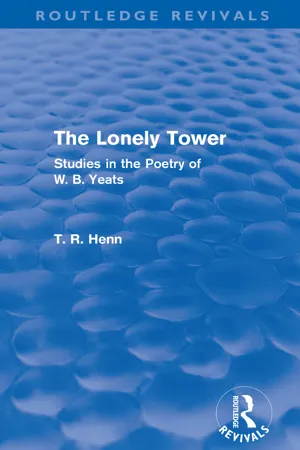
First published in 1965, this reissue of the second edition of T. R. Henn's seminal study offers an impressive breadth and depth of meditations on the poetry of W. B. Yeats. His life and influences are discussed at length, from the impact of the Irish Rebellion upon his youth, to his training as a painter, to the influence of folklore, occultism and Indian philosophy on his work. Henn seeks out the many elements of Yeats' famously complex personality, as well as analysing the dominant symbols of his work, and their ramifications.
eBook - ePub
The Lonely Tower (Routledge Revivals)
Studies in the Poetry of W. B. Yeats
- 388 pages
- English
- ePUB (mobile friendly)
- Available on iOS & Android
eBook - ePub
About this book
Information
CHAPTER ONE
The Background
'You have come again,
And surely after twenty years it was time to come.’
I am thinking of a child's vow sworn in vain
Never to leave that valley his fathers called their home.1
And surely after twenty years it was time to come.’
I am thinking of a child's vow sworn in vain
Never to leave that valley his fathers called their home.1
Sligo town lies in a cup of the hills, where a short but broad river takes the waters of Lough Gill into the Atlantic. As you stand facing the sea, there are two mountains: Knocknarea on the left hand, with a tumulus on the summit, said to be Queen Maeve's grave, and called in the Irish Árd-na-riagadh, the Hill of the Scaffolds.2 On the right, far beyond the town and river, a great shoulder of mountain drops to the plain that stretches towards Lissadell and the sea; this is Ben Bulben, where Diarmuid and Grainne were pursued by Finn, and where Diarmuid, Adonis-like, was wounded by the enchanted boar. The liver flows through a long twisting estuary, guarded towards the mouth by a beacon, The Metal Man, which is to be seen in Jack Yeats’ foreshortened drawing of Rosses Point; the little village that lies among the sand-dunes, with the sea to the west of it. The two mountains are full of legend. An old servant of Yeats’ uncle, George Pollexfen, described Maeve and her women on Knocknarea:
… They are fine and dashing looking, like the men one sees riding their horses in twos and threes on the slopes of the mountains with their swords swinging.3
Both mountains and plains are ancient battlegrounds. After the Battle of Sligo in A.D. 537 Eoghan Bel ‘was buried standing, his red javelin in his hand, as if bidding defiance to his enemies’.
There in the tomb stand the dead upright…
Beside Glencar there is a precipice where a troop of horsemen were led to their death; and one of my friends had heard on Ben Bulben the beat of miniature horse-hoofs on the plateau at the mountaintop, and seen the grass beaten down and springing up again as if a troop of horse had passed that way:
What marches through the mountain pass?
No, no, my son, not yet;
That is an airy spot,
And no man knows what treads the grass.1
No, no, my son, not yet;
That is an airy spot,
And no man knows what treads the grass.1
The whole neighbourhood is ‘airy’ :2 perhaps because of the battlefields that the conformation of the ground has determined through the centuries, perhaps because the fresh and the salt waters from the mountains and the estuary meet so violently and quickly there.3
At the head of the lake, which is studded with wooded islets (Innisfree among them), there is the village of Dromahair, where a man stood among a crowd and dreamed of faery-land.4 Near the coast, north-west of Sligo town, is the village of DrumclifF (‘An ancestor was rector there’); the church among its rook-delighting trees beside the river that flows out of Glencar. It is full of ancient history; near it there is a monastery said to have been founded by St Columba, and this part too of the Sligo Plain was an ancient battlefield. On the wooded sides of the lake stood the great houses, Hazelwood of the Wynnes, Cleaveragh of the Wood-Martins, Markree of the Coopers, and many more up and down the countryside; Lissadell of the Gore-Booths was the most important in Yeats’ boyhood and manhood. In and about Sligo there were relatives of the Yeats family; and farther south, in Mayo and Galway, the ‘half-legendary men’, the ancestors whom he drew into his own legend of great place.
To the south-west, beyond Ballisodare (the scene of a spirited battle with the French who landed at Killala Bay in 1798), are the Ox Mountains. At Collooney the Sligo Plain ends and the mountains begin. Near by is Tullaghan Well, said to have burst forth as a spring at the prayer of St Patrick, and whose waters ebb and flow mysteriously, perhaps in relation to the far-away tides. Such wells are often sacred, in past myth and as places of Christian pilgrimage; they may be linked to poetic inspiration. Of this last kind, ‘each is surrounded, it is said, by nine imperishable hazel trees, from which the showers of ruddy nuts were dropped periodically into the spring. These nuts were eagerly watched by the salmon at the bottom of the spring who, when they saw them drop upon the surface, dashed up and ate them as fast as they could, after which they glided into the neighbouring rivers.’1 Beside are two rocks, The Hungry Rock and the Hawk's Rock: and this is perhaps the setting of ‘At the Hawk’s Well’.
The society and life of the early part of the century was in many ways peculiar. It is a very different world from that of Synge or of O'Casey. Everywhere the Big House, with its estates surrounding it, was a centre of hospitality, of country life and society, apt to breed a passionate attachment, so that the attempt to save it from burning or bankruptcy became an obsession (in the nineteen-twenties and onwards) when that civilization was passing. The gradual sale of the outlying properties, as death duties and taxation rose higher, is recorded in Lady Gregory's struggle to save Coole Park, and was the fate of many estates.2 The great families were familiar with each other and with each other's history; often, perhaps commonly, connected by blood or marriage. They had definite and narrow traditions of life and service. The sons went to English Public Schools, and thence to Cambridge, or Oxford, or Trinity College, Dublin: the eldest would return to the estate and its management, the younger went to the Services, the Bar, the Church. There were
…Great rooms where travelled men and children found
Content or joy; a last inheritor
Where none has reigned that lacked a name and fame
Or out of folly into folly came.1
Content or joy; a last inheritor
Where none has reigned that lacked a name and fame
Or out of folly into folly came.1
The great age of that society had, I suppose, been the eighteenth and early nineteenth centuries; from the eighteen-fifties onwards it seems to have turned its eyes too much towards England, too conscious of its lost influence in its hereditary role of The Ascendancy. By 1912 it was growing a little tired, a little purposeless, but the world still seemed secure:
We too had many pretty toys when young:
A law indifferent to blame or praise,
To bribe or threat; habit that made old wrong
Melt down, as it were wax in the sun's rays;
Public opinion ripening for so long
We thought it would outlive all future days.2
A law indifferent to blame or praise,
To bribe or threat; habit that made old wrong
Melt down, as it were wax in the sun's rays;
Public opinion ripening for so long
We thought it would outlive all future days.2
The image of the house and its fall lingered with Yeats to the end, as in the play Purgatory.
Great people lived and died in this house;
Magistrates, colonels, members of Parliament,;
Captains and Governors, and long ago;
Men that had fought at Aughrim and the Boyne …
… to kill a house
Where great men grew up, married, died,
I here declare a capital offence.3
Magistrates, colonels, members of Parliament,;
Captains and Governors, and long ago;
Men that had fought at Aughrim and the Boyne …
… to kill a house
Where great men grew up, married, died,
I here declare a capital offence.3
In the furnishings of a great house, or in its library, one became aware that most of the work had been done between, say, 1750 and 1850, over the bones of a rebellion and two famines. The original building might date from Cromwell's time, or before; modernized, perhaps, by adding a frontage from a Loire chateau, or a portico from Italy. Some of these were of great beauty:
Many ingenious lovely things are gone
That seemed sheer miracle to the multitude,
Protected from the circle of the moon
That pitches common things about.1
That seemed sheer miracle to the multitude,
Protected from the circle of the moon
That pitches common things about.1
But the whole Anglo-Irish myth, the search for beauty and stability in the midst of poverty and defeat, the dreams that oscillated between fantasy and realism, has yet to be described.
It is against this background, I believe, we must see the Recognition and Reversal in Yeats’ poetry that came out of the Rebellion and its aftermath. Before the First World War that aristocratic culture seemed to have given so much: pride of race, independence of thought, and a certain integrity of political values. It could be perceived (even then) in relation to the great eighteenth-century tradition, which, foreshortened and perhaps not wholly understood, held so much fascination for Yeats. It could be seen as representing the Anti-Self or Mask to which he was striving: whether in the image of the hero, or soldier, or horseman, or that symbolic Fisherman who occurs repeatedly:
… I choose upstanding men
That climb the streams until
The fountain leap, and at dawn
Drop their cast at the side
Of dripping stone; I declare
They shall inherit my pride,
The pride of people that were
Bound neither to Cause nor to State,
Neither to slaves that were spat on,
Nor to the tyrants that spat,
The people of Burke and of Grattan
That gave, though free to refuse
Pride, like that of the morn…2
That climb the streams until
The fountain leap, and at dawn
Drop their cast at the side
Of dripping stone; I declare
They shall inherit my pride,
The pride of people that were
Bound neither to Cause nor to State,
Neither to slaves that were spat on,
Nor to the tyrants that spat,
The people of Burke and of Grattan
That gave, though free to refuse
Pride, like that of the morn…2
Lady Gregory and the Gore-Booths had shown hircTthe security that came from the wealth of the great estates, and the life, leisured and cultured, that it seemed to make possible:
Surely among a rich man's flowering lawns
, Amid the rustle of his planted hills,
Life overflows without ambitious pains;
And rains down life until the basin spills,
And mounts more dizzy high the m...
, Amid the rustle of his planted hills,
Life overflows without ambitious pains;
And rains down life until the basin spills,
And mounts more dizzy high the m...
Table of contents
- Cover
- Half Title
- Full Title
- Copyright
- The Lonely Tower
- Acknowledgements
- Contents
- Illustrations
- INTRODUCTIONS
- TEXTS AND ABBREVIATIONS
- 1 THE BACKGROUND
- 2 CHOICE AND CHANCE
- 3 THE MASKS — SELF AND ANTI-SELF
- 4 WOMEN OLD AND YOUNG
- 5 YEATS AND SYNGE
- 6 THE STUDY OF HATRED
- 7 BETWEEN EXTREMITIES
- 8 THE DEVELOPMENT OF STYLE
- 9 IMAGE AND SYMBOL
- 10 MYTH AND MAGIC
- 11 THE PHASES OF THE MOON
- 12 A VISION AND THE INTERPRETATION OF HISTORY
- 13 BYZANTIUM
- 14 PAINTER AND POET
- 15 THE POETRY OF THE PLAYS
- 16 THE ACHIEVEMENT OF STYLE
- 17 LAST POEMS
- 18 ‘HORSEMAN, PASS BY!’
- SELECT BIBLIOGRAPHY
- INDEX
- University Paperbacks
Trusted by 375,005 students
Access to over 1.5 million titles for a fair monthly price.
Study more efficiently using our study tools.
Frequently asked questions
Yes, you can cancel anytime from the Subscription tab in your account settings on the Perlego website. Your subscription will stay active until the end of your current billing period. Learn how to cancel your subscription
No, books cannot be downloaded as external files, such as PDFs, for use outside of Perlego. However, you can download books within the Perlego app for offline reading on mobile or tablet. Learn how to download books offline
Perlego offers two plans: Essential and Complete
- Essential is ideal for learners and professionals who enjoy exploring a wide range of subjects. Access the Essential Library with 800,000+ trusted titles and best-sellers across business, personal growth, and the humanities. Includes unlimited reading time and Standard Read Aloud voice.
- Complete: Perfect for advanced learners and researchers needing full, unrestricted access. Unlock 1.5M+ books across hundreds of subjects, including academic and specialized titles. The Complete Plan also includes advanced features like Premium Read Aloud and Research Assistant.
We are an online textbook subscription service, where you can get access to an entire online library for less than the price of a single book per month. With over 1.5 million books across 990+ topics, we’ve got you covered! Learn about our mission
Look out for the read-aloud symbol on your next book to see if you can listen to it. The read-aloud tool reads text aloud for you, highlighting the text as it is being read. You can pause it, speed it up and slow it down. Learn more about Read Aloud
Yes! You can use the Perlego app on both iOS and Android devices to read anytime, anywhere — even offline. Perfect for commutes or when you’re on the go.
Please note we cannot support devices running on iOS 13 and Android 7 or earlier. Learn more about using the app
Please note we cannot support devices running on iOS 13 and Android 7 or earlier. Learn more about using the app
Yes, you can access The Lonely Tower (Routledge Revivals) by Thomas Rice Henn in PDF and/or ePUB format, as well as other popular books in Literature & English Literary Criticism. We have over 1.5 million books available in our catalogue for you to explore.