- 256 pages
- English
- ePUB (mobile friendly)
- Available on iOS & Android
eBook - ePub
About this book
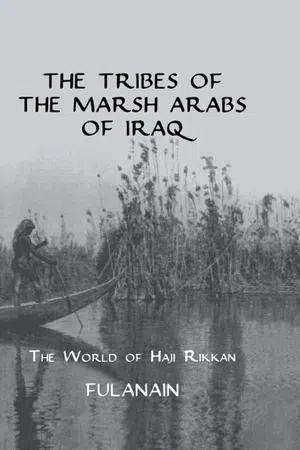
The Arab tribes of Iraq differ widely in custom but remain in all essentials of thought and conduct a distinctive and unique group. Their land embraces wide deserts, fertile fields and boundless swamps; its unique features shape the lives of its people. Taking the figure of Haji Rikkan as a central focus, the writer-traveller attempts to create a picture of Arab tribal life as a whole.
Information
HAJI RIKKAN
Chapter 1
THE PEDLAR
STANDING in the prow of his uncle’s bitumen-coated birkash, Bahalul bent leisurely to his pole; in the stern sat his twin brother, Jahalul, guiding the clumsy craft with deft strokes of his paddle. They followed a narrow water-way which twisted and turned between walls of high green reeds. From a sky a shade less blue than the still marsh water, a brilliant sun shone down on the brown bodies of the brothers, naked but for a cloak of coarse wool twisted round the waist. It bronzed the rusty paraffin tins containing the tea, coffee, spices and flaked tobacco which comprised the stock in trade of Haji Rikkan, and warmed the bones of the old pedlar himself as he sat cross-legged in the “belly” of the boat. From my place facing him I watched the changeful monotony of the marsh, the wilderness of reeds and water in which I was privileged to accompany his wanderings. A cool breeze stirred the feathery, dun-coloured heads of the tall reeds, the water sighed and lapped among their roots, no louder sound than the ripple from Jahalul’s paddle broke the intense quiet of the spring day.
Behind me Jahalul began to sing. “Braying forcedly in the nose” is Doughty’s unkind description of the singing of the Arabs; but the plaintive air which, beginning in a burst of sound, rose and fell mournfully until it died away on the sub-dominant, a long-drawn note only terminated by the failure of the singer’s breath, was far from being to my ears a “hideous desolation”. Of the words I could distinguish few, until Haji Rikkan repeated the rhyming lines.
“An exaggeration”, he said, with a laugh that was half apologetic, half defensive, for the Arabs have a high regard for their poets and their poetry.
Jahalul sang to the woman he loved. The words were in the homely marsh dialect despised by purer-speaking Arabs, but they clothed a romantic idealism in strange contrast with the rough and primitive conditions of human life in the marshes.
“As one the cannon strikes, stricken am I
Now that thy cheeks, like apple-blossom fair,
Or flower of pomegranate, are far away.
So fragile are thy slender shoulders, sweet,
That e’en the lightest silken veil would bruise
And chafe the skin of my most lovely one.”
Not once, but many times the gentle, droning voice of Jahalul repeated the song, until it was cut short by an abrupt order from Haji Rikkan.
“Bank in!”
We had left behind the narrow channel with its flanking ramparts of reeds, and had come out into a clearing of open water, above the surface of which barely rose the flat shapes of two low islands. To the nearest of these Jahalul turned the boat, and as the high curved prow ran aground the elder twin shipped his pole, leapt lightly out, and splashing back through the water joined his brother in the stern. The two began to chat together in low tones, as though this banking in on a lonely and deserted islet were an occurrence to which they were accustomed.
Haji Rikkan, holding out upturned palms, began to recite.
“In the name of Allah, the Merciful, the Compassionate. Praise to Allah, Lord of the Worlds, … Master of the day of requital …”—the rest of the muttered invocation was lost in his beard. He sat for a while, silently contemplating the barren islands; then a brisk “Y’Allah!” sent his nephews to their places, and the boat, gliding across the open water, slid once more into the cool shadows of one of the by-ways of the marsh.
“Dost ask why I have said the Fatihah?” said Haji Rikkan. “Ask rather why in my wanderings I am accompanied by my two nephews, not by my grown sons. Where are they? May thy head be whole! Because of a man’s love for a woman my breast is straitened with grief, and loneliness fills my heart. Sorrow has been mine since the days when Shaikh Saihud fought against the Turks, and fleeing, sought refuge in Huwaiza. Many of his following went with him, and among them one Tahir. Now ’Addai bin Sa’dun, who was my friend, loved this man’s daughter; and one day he came to me, saying, ‘I would cross the marsh to visit Tahir, but my tribe is at feud with the Albu Ghanam, and I fear to meet them. Let me travel under thy tisyar—thy protection—and I shall cross in safety. For this service I will give thee what thou askest.’
“‘Willingly’, I replied. ‘Talk not of the price; I may yet require a like service of thee.’
“We set out on that journey, he and I together. On the second day we passed two men hunting fish with their spears, and one of them called aloud, ‘’Addai bin Sa’dun, thou?’
“‘Ee’ he replied, for it had been shame to deny his name.
“‘Hast dared to come here?’ cried the fisherman, and ’Addai replied, ‘I am ready.’
“‘Hast forgotten the feud?’ the other called again, and again ’Addai answered, ‘I am ready.’
“Seeing their threatening looks, I spoke, telling the men that he was under my protection; but one replied, ‘We do not recognise thy tisyar. Prepare, O ’Addai!’
“‘Stay in thy place, stay!’ I cried. ‘Come not nearer, or my tribe will claim hashim,’—for by our custom a woman must be paid in compensation, if he who goes under protection is but threatened.
“‘I care not, my blood is hot,’ shouted the fisherman, he who had first called to us; and with that he hurled his fishing spear at ’Addai, and leapt back into the reeds. I fired, but they escaped untouched.
“The spear had passed through his body, and because of the barbs I could not draw it out; so I held the shaft in my hand to ease his pain, and bade my two sons paddle swiftly to the nearest village to find a smith who would cut off the barbs. But when we reached the village, we were told that the smith had gone to a neighbouring tribe; and as we followed him, ’Addai died, calling for Khadija whom he loved.
“Quickly we returned to our tribe, and told the headmen what had befallen. Now the custom of the marsh is clear on such a matter: if a man under our protection is killed, we must fight for a day to avenge his death; aye, the Albu Ghanam must fight with us for the space of a day, or if they would not fight they must pay us forty women, leaving their islands for three days that we might pound our coffee there, and show to all men that they were beaten and broken. But we are not without pride, even we of the marshes, and no tribe has been known to submit to that humiliation.
“Our headmen therefore planted war-flags before their houses, and messengers were sent to call in all the tribesmen. We laid our plans, and when the day came we met the Albu Ghanam in battle—on the two islands which we left but now. But they were prepared for us, and were more numerous than we, so that after a bitter struggle our people broke at last and fled, leaving many dead and wounded.
“In the evening I returned with some others to the islands under the protection of a Saiyid.
“‘A truce, a truce,’ he called aloud, that all the Albu Ghanam might hear. ‘It is I, Saiyid Sadiq, who am come to bury the dead and bear away the wounded.’
“Soon I found Mataghar, the youngest of my three sons.
“‘Bring my brothers to me,’ he whispered, ‘for I am dying.’
“I searched among the fallen and found Mohammad, dead. Long I sought for Khalaf, calling him by name, until I saw some of our tribe dragging a body from the water. ‘Who, who?’ I cried. ‘We cannot see,’ they answered. I held a torch of flaming reeds, and saw the face of Khalaf. Y’abouya, y’abouya! All three sons dead! From that hour I became as thou seest me now, an old man, white-bearded. Because ’Addai loved Khadija, my sons were lost to me. But why speak I thus? It was so decreed from the beginning.”
Silence followed Haji Rikkan’s tale. Slowly the boat glided over the clear water, unruffled and smooth as a mirror, and green with the reflection of the thick reeds. Patches of flowering weeds, pink and white, floated here and there on its surface, swaying gently as we passed. Smiling, serene, untroubled the marsh seemed under the radiant sky, a haven of quiet and peace, a refuge from the world; yet the grief of human hearts was here, and the wilderness of reeds did but hide the despair and endurance of men.
We had travelled all day, and had seen no faces but each other’s. Now we began to come upon traces of habitation. The reeds were trampled down in patches; a group of water-buffaloes, half-submerged, were browsing among the rushes; we heard voices, and with unexpected suddenness the high reeds fell away on either side, as we came out into open water.
Facing us was a group of the strange mounds or ishans which here and there, in the marshes of Southern ’Iraq, stand out high, or seeming high in that vast watery expanse. On these, the remains of ancient cities, where once rich men feasted under the sway of mighty Babylon, or Abbasid merchants bartered their goods, the marshman builds his hut. Alike in pattern but varying in size, the huts are of the simplest construction; bundles of tall reeds are bent and fixed to the ground to form a tunnel-shaped framework, over which are thrown a number of mats of plaited reeds. At one end is a low and narrow aperture which serves as doorway, window, and chimney combined; on the rush-strewn and miry floor sleep men and women, children and buffaloes, in warm proximity.
Here dirt and disease should have given death an easy victory, yet here was life triumphant. On this bright morning the houses, closely huddled together, looked picturesque enough to make one forget the wretched conditions in which their owners live. In this malarious swamp, tormented by flies and by the insects innumerable bred in the mud—the ground of his hut often oozing water at every step, and every sanitary precaution neglected—the Marsh Arab attains a surprisingly high physical level. It is a case of the survival of the fittest, for the infant mortality is appalling; but those who survive to maturity have hardened in the process. Under the scorching sun of summer and in the bitterly cold winter winds alike, they are content with one scanty garment, or with none. The men are thickset and muscular, powerful swimmers and capable of great endurance, though lazy enough when work is not absolutely necessary. With their strong, well-built bodies, flashing white teeth, and thick black hair worn in two plaits, the Ma’dan or Marsh Arabs compare favourably with the townsmen, and need not fear comparison with the pure-bred tribesmen of the desert.
To my eyes, fresh from the soft tones of the marsh, the village seemed full of colour. The yellow reeds of the newer huts gleamed against the sky, and the swinging draperies of the women who moved to and fro between them were gaily red, blue, and orange. The sturdy women of the Ma’dan, dark-eyed and warmly brown in colouring, are often handsome, even beautiful, though they age early. In contrast with the men’s, their dress is ample and copious, high to the neck and trailing on the ground. The old crones who squatted at the doors of the huts were dressed in sombre, dingy black, with heavy swathed turbans of black stuff on their heads. Under the prows of a row of moored mashhufs, a group of village children played in comfortable nakedness.
Mashhufs abounded, for every household must possess its means of transport—the only means in these three million acres of trackless swamp. The marsh itself supplies most of the simple needs of the marshman: reeds and rushes provide shelter, bedding, and fuel, baskets, ropes, and fodder for the buffaloes whose milk, eaten curdled, is with the abundant fish his staple diet. By the sale of reeds, either as fuel for brick-kilns, or plaited into the mats used throughout ’Iraq for a variety of purposes, he obtains money for the purchase of such small luxuries as those sold by Haji Rikkan, or of the rifle which, in this land of blood-feuds, no man can afford to be without.
The marshman’s household goods are of the scantiest. At the first hint of danger he can pile them all into his boat, roll up the mats which make his house, and driving his buffaloes before him retire to the heart of his swampy fastness, there to defy the outside world as he has done for centuries past.
We approached the largest ishan, where a group of women were busy at the water’s edge with their black cooking-pots. These were the Haji’s prospective customers, and he hailed them with the traditional call of his profession.
“Come, O women, come! Tea, sugar, coffee, tobacco. Cucumbers and onions, weight for weight with rice. O comely ones! Henna and perfumes. Dates, sweet dates—exchange rice for dates, twice their weight in rice. Mirrors for brides—needles, thread, combs. Come, O women! Pretty ones, come!”
Trade did not seem very brisk. A few women came to the boat with shallow baskets of rice on their heads, and squatted on the bank to bargain. One man had a badger’s skin to barter, an old woman a sack of feathers; but the day’s trading was soon done. Haji Rikkan continued to call his wares round the other islands, but there was no answering hail. In a few minutes Bahalul turned the boat’s head, and the high reeds soon hid the village from our sight.
“By Hasan and Husain, in these days there is no money in all ’Iraq,” muttered Haji Rikkan. “I am become like the bathman’s donkey, which does but carry fuel to the fire, and ashes from the fire.”
“Or like the ...
Table of contents
- Cover
- Halftitle
- Title
- Copyright
- Dedication
- Preface
- Contents
- List of Illustrations
- Chapter I. The Pedlar
- Chapter II. Across the Marsh
- Chapter III. A Pilgrimage
- Chapter IV. The Shrine of ’Ali al Sharji
- Chapter V. The Place of Casting
- Chapter VI. The Fort of Kassara
- Chapter VII. The Coming of the English
- Chapter VIII. The Flag of ’Abbas
- Chapter IX. In Favour of Discretion
- Chapter X. The Burden of the Shaikh
- Chapter XI. Ghalib the Exile
- Chapter XII. The Chains
- Chapter XIII. The Burning of the Bait Hatim
Trusted by 375,005 students
Access to over 1.5 million titles for a fair monthly price.
Study more efficiently using our study tools.
Frequently asked questions
Yes, you can cancel anytime from the Subscription tab in your account settings on the Perlego website. Your subscription will stay active until the end of your current billing period. Learn how to cancel your subscription
No, books cannot be downloaded as external files, such as PDFs, for use outside of Perlego. However, you can download books within the Perlego app for offline reading on mobile or tablet. Learn how to download books offline
Perlego offers two plans: Essential and Complete
- Essential is ideal for learners and professionals who enjoy exploring a wide range of subjects. Access the Essential Library with 800,000+ trusted titles and best-sellers across business, personal growth, and the humanities. Includes unlimited reading time and Standard Read Aloud voice.
- Complete: Perfect for advanced learners and researchers needing full, unrestricted access. Unlock 1.5M+ books across hundreds of subjects, including academic and specialized titles. The Complete Plan also includes advanced features like Premium Read Aloud and Research Assistant.
We are an online textbook subscription service, where you can get access to an entire online library for less than the price of a single book per month. With over 1.5 million books across 990+ topics, we’ve got you covered! Learn about our mission
Look out for the read-aloud symbol on your next book to see if you can listen to it. The read-aloud tool reads text aloud for you, highlighting the text as it is being read. You can pause it, speed it up and slow it down. Learn more about Read Aloud
Yes! You can use the Perlego app on both iOS and Android devices to read anytime, anywhere — even offline. Perfect for commutes or when you’re on the go.
Please note we cannot support devices running on iOS 13 and Android 7 or earlier. Learn more about using the app
Please note we cannot support devices running on iOS 13 and Android 7 or earlier. Learn more about using the app
Yes, you can access The Tribes Of The Marsh Arabs of Iraq by Fulanain,0 Fulanain, in PDF and/or ePUB format, as well as other popular books in Política y relaciones internacionales & Políticas de Oriente Medio. We have over 1.5 million books available in our catalogue for you to explore.