- 560 pages
- English
- ePUB (mobile friendly)
- Available on iOS & Android
eBook - ePub
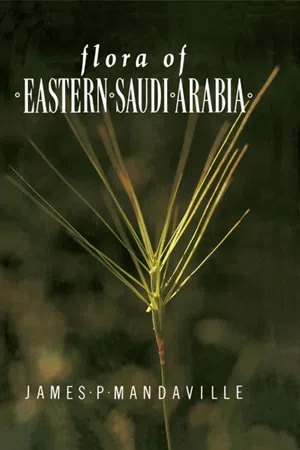
Flora Of Eastern Saudi Arabia
About this book
First published in 1990. A practical manual for identifying the plants of Saudi Arabia's Eastern Province. This guide is useful for development and conservation of natural resources, includes botanical terminology and so will appeal to those with this knowledge, but also due to the colour plates, to the non-specialist who might be interested in desert wildflowers of the area.
Information
1. HISTORY OF BOTANICAL INVESTIGATIONS IN EASTERN SAUDI ARABIA
Early Travelers: Modern botanical exploration in northeastern Arabia had tentative beginnings in that golden age of Asian species description celebrated in 1867 with the first volume of Boissier’s Flora Orientalis. Plant collecting began here as an incidental pursuit of British travelers who were exploring and describing the fringes of the Indian Empire. English thus became the first language of east-Arabian botany, and London was for long its principal herbarium.
Lieutenant Colonel Lewis Pelly, who as British Political Resident for the Gulf crossed into what is now the Eastern Province of Saudi Arabia from Kuwait territory on 21 February 1865, was the first to bring plant specimens from this region to European herbaria. A secondary purpose of his diplomatic mission to Riyadh, as related in his official report of 1866, was to study the geography of the area, ‘collecting at the same time, such natural specimens as one might be able, en route.’ Dr W. H. Colville, Civil Surgeon of the Residency at Bushire, traveled as medical officer of Pelly’s party and was apparently assigned responsibility for the scientific studies.
Pelly and his group left Kuwait on 18 February, traveling on camels and entering the present Eastern Province north of Abraq al-Kabrit. From here their direction was southwest, across the Wari’ah ridge and on to the edge of the Summan at the wells of Wabrah. From Wabrah a generally southerly course took them across the Summan and the Dahna sands to Rumayhiyah, near Rumah on the threshold of Najd.
Pelly’s return route from Riyadh, which led by way of al-Hasa to the Gulf port of al-’Uqayr opposite Bahrain Island, apparently followed the well known Darb Mazalij to al-Hufuf. His plant collecting — and it is not clear whether Pelly himself or Dr Colville did most of this field work — was restricted almost entirely to the Kuwait-Riyadh portion of the journey. The collection totaled 60 specimens, and of these about 25, as indicated by the data published from his sheets, could have been gathered within the present Eastern Province. The specimens were deposited at Kew, and J. D. Hooker provided a list of names published with Pelly’s report to the Government of India (Pelly 1866).
It was not until 58 years later, when R. E. Cheesman undertook his expedition to al-Hasa and Yabrin, that there were any certain records of further botanical collecting in the Eastern Province. Although the earlier 1900s saw the first systematic exploration of the area by Europeans, precedence in this was given to mapping, and political conditions made scientific work extremely difficult.
Colonel S. G. Knox, British Political Agent at Kuwait who around 1907 collected plants with Sir Percy Cox in Kuwait territory, made inland trips to ar-Ruq’i and Hafar al-Batin in 1906 and south to Nita’ in 1908. He did not, apparently, bring back specimens from our area. Knox’s successor, Captain W. H. I. Shakespeare, was the son of a former Indian forestry officer and according to Blatter (1933) collected plants at Kuwait that were sent to the British Museum. His extensive travels in the future Eastern Province between 1909 and 1914, however, did not seem to include any botanical work.
In early 1912, while al-Hasa province was still under Ottoman occupation though soon to be reunited with the Saudi state, the young Danish geographer Barclay Raunkiaer crossed eastern Arabia from Kuwait to Riyadh and then back to al-’Uqayr.His father was Christen Raunkiaer (1860 — 1938), an internationally recognized botanist still well known today to ecology students for his ‘life form’ classification of vegetation (see chapter 6), and during his Arabian journey the son carried plant collecting equipment provided by the University of Copenhagen Botanical Gardens. The suspicions of his escorts, however, prevented his collecting specimens, and his contribution to botany at that troubled moment in Arabian history was limited to a few general remarks on the vegetation contained in his account of the trip (Raunkiaer 1913). It is difficult, in these mechanized and more ordered times, to appreciate how knowledge of a land’s plant life was once intelligence of high significance to the animal transport of armies. To the practical desert mind of that period, such surveys raised only visions of colonialist ventures.
Explorers and Collectors, 1917–1950: H. St. John Philby, the British political officer, explorer and later adviser to the King of Saudi Arabia, entered the Arabian scene through the Eastern Province port of al-’Uqayr on a political mission in 1917. Philby, determined to excel in all phases of Arabian knowledge, made biological specimen collecting an essential part of all his major expeditions. This ambition, coupled with a personal bent for natural history dating back to his boyhood, the opportunities of his Arabian journeys, and his prompt publication of results, all led to significant advances in knowledge of the biology of Arabia.
Philby’s contribution to botany was not as significant as that to zoology — particularly ornithology — but his plant collections in the Rub’ al-Khali in 1931 and the ’Asir mountains in 1936 provided some of the earliest data for these regions. Philby also had more ‘feel’ for vegetation than most other early Arabian explorers. Able to make maximum use of his guides’ knowledge of terrain, landmarks and place names, he soon appreciated that among the desert Arabs important keys to this lore lay in the composition of vegetation and its zonal boundaries.
Philby entered Arabia in 1917 with equipment to collect plants as well as other specimens. He seems to have reserved these resources, however, until embarking on the previously unexplored part of the season’s itinerary south of Riyadh toward Wadi ad-Dawasir; specimens sent by him to Blatter in Bombay after this trip all appear to have been gathered in central Arabia. Nor did he collect plants in the Eastern Province during any of his several subsequent crossings out of Najd to Kuwait and Iraq, although his geographical notes contain useful references by Arabic name to plants and vegetation he encountered (Philby Papers).
Philby’s 1918 collection of plants from central Arabia reached Ethelbert Blatter, S. J. in Bombay as that botanist was preparing for press the first volume of his Flora Arabica, the first attempt at a Peninsula-scale flora of Arabia (Philby Papers). Blatter, Professor of Botany at St. Xavier’s College, Bombay, published his flora at Calcutta in six parts from 1919 to 1936 as Volume VIII of Records of the Botanical Survey of India.
Aimed at including ‘all the information available regarding the systematic botany of Arabia’, Blatter’s work was premature, undertaken at a time when major parts of the Peninsula were still unseen by scientific observers or collectors. Based almost entirely on specimens already at Kew and the British Museum, it was nevertheless a useful summary of the state of botanical knowledge up to the 1920s. It listed species by family, recording all known specimens without keys or descriptions, and consisted largely of records from southern Arabia, which had seen British collecting activity and from Yemen, the part of Arabia with the longest record of scientific study by Westerners.For the present Eastern Province of Saudi Arabia Blatter had only 19 records, of which three were specimens collected by Cheesman and the rest by Pelly.
Eastern Saudi Arabia, meanwhile, had seen another expedition by a British collector — one more directly oriented toward natural history: Major R. E. Cheesman, personal secretary to the British High Commissioner in Iraq, Sir Percy Cox. Cox, long an active patron of the natural sciences in Arabia, had arranged permission from King ’Abd al-’Aziz Al Sa’ud for Cheesman to make a collecting trip in 1923–24. Cheesman, primarily a field zoologist, brought back with many bird, insect and mammal specimens a collection of 23 plant species that were listed with notes by R. Good and C. Norman of the British Museum (Natural History) in their appendix to Cheesman’s book (1926).
Cheesman in 1921 had explored by ship the Arabian coast on the Bay of Salwah south of al-’Uqayr. In 1923–24 he landed at al-’Uqayr and traveled inland to the al-Hasa Oasis where he made collecting excursions. From there he moved south along the eastern flanks of al-Ghawar to Yabrin, the major objective of the trip and as yet unvisited by Westerners. Cheesman’s plant collection was limited in scope but included specimens of several community dominants that were thus correctly identified for the first time. An unusual discovery was the European swamp orchid, Orchis laxiflora, growing in the al-Hasa reed swamps. It has not been found again in Eastern Arabia.
The turn of the decade saw interest in east Arabian scientific travel focusing on an almost entirely unknown part of the country, the Rub’ al-Khali. Philby and Bertram Thomas, the Adviser to the Ruler of Muscat and Oman, were vying for first honors in a crossing of the southern sands.
Thomas in his 1929 – 1930 season had explored the southern fringe of the sands around Wadi Muqshin and al-’Ayn. In December 1930 he launched his full crossing following a south-to-north route into Qatar along the 51st Meridian. He collected insects, reptiles and a few mammals, but apparently no plants, although his route descriptions (1932) contain references to vegetation by vernacular names. Like other travelers able to communicate beyond rudiments with his Bedouin guides, he soon became conscious of the major vegetation zones so important to nomads and to any traveler depending on animal transport.
Thomas’ victory in this race was a bitter disappointment to Philby who then, still driven to excel, aimed his route the following season into even more remote quarters. His early-1932 trip took him through Yabrin to an intersection of Thomas’ route at Farajah and then kept to new territory to the south, making a wide triangular circuit just south of the 20th Parallel. He left the sands in the west near Wadi ad-Dawasir after overcoming great hardships across a wide waterless sector. The list of his plant specimens, provided by J. Ramsbottom as an appendix in Philby’s book describing the journey (1933), includes some 43 names. These are given without locality, and some clearly came from areas outside the Rub’ al-Khali proper. Philby’s major contribution to botany lay not in the few specimens he brought back, but in the frequent descriptions of vegetation contained in his minutely detailed route notes. These, until very recently, provided the only botanical data for some parts of the Rub’ al-Khali.
The following years up to the time of World War II — the early period of oil exploration and discovery — saw little botanical activity in eastern Saudi Arabia. It was at this time, however, that Mrs (later Dame) Violet Dickson of Kuwait began her extensive Kuwait plant collections for Kew in work that provided the first comprehensive floristic list for northeastern Arabia. Dame Violet’s numerous field outings with her husband, Colonel H. R. P. Dickson, on several occasions touched on the northern plains region of the Eastern Province, and their trips in 1942 and 1947 allowed her to collect along routes between Kuwait and Dhahran and from Dhahran to al-Hasa. She published a first Kuwait list in 1938 (Dickson 1938) and later a more fully annotated list in book form with sketches (1955). This includes a number of records from eastern and central Saudi Arabia. B. L. Burtt and Patricia Lewis (1950, 1952, 1954) began a detailed taxonomic account of Dame Violet’s specimens in Kew Bulletin, but this work unfortunately was terminated after publication of three installments covering 23 families.
In other parts of Arabia, meanwhile, British-led regional cooperation in anti-locust campaigns led to the first ecological field work in the Peninsula aimed at gaining information about this economic scourge of the Middle East. A wealth of data on plant life as well as the associated fauna was soon being gathered.
Saudi Arabia was represented at the Fourth International Anti-Locust Conference in Cairo in 1936, but it was the threat of wartime famine that led to the first anti-locust field work in eastern Saudi Arabia. Directed from the Middle East Supply Centre in Cairo, a series of five annual cool-season campaigns was carried out in Arabia under the direction of Desmond Vesey-Fitzgerald. A small mobile unit with mixed British and Indian personnel operated in Oman and eastern Saudi Arabia in 1942 – 1943. That season set the pattern for three succeeding expeditions and included a large motor convoy from Cairo to Baghdad, Basra, Kuwait and Dhahran. The campaign was remodeled on civilian lines with the closure of the Middle East Supply Centre in October 1945, and Arabian headquarters was established at Burayman near Jiddah (Uvarov 1951). The Saudi Arabian Government took over anti-locust operations in succeeding years and continued to play a major role in international efforts to study and combat the locust threat.
Hundreds of plant specimens — including some from the Eastern Province — were collected by anti-locust ecologists and entomologists, and many were studied and identified by Dorothy Hillcoat of the British Museum (Natural History)’s Department of Botany. Vesey-Fitzgerald, on the basis of these findings, provided the first general description of the main plant communities of eastern Arabia (Vesey-Fi...
Table of contents
- Cover Page
- Half Title Page
- Title Page
- Copyright Page
- Contents
- Preface and Acknowledgements
- Foreword
- PART I – INTRODUCTION
- PART II – THE FLORA
Trusted by 375,005 students
Access to over 1.5 million titles for a fair monthly price.
Study more efficiently using our study tools.
Frequently asked questions
Yes, you can cancel anytime from the Subscription tab in your account settings on the Perlego website. Your subscription will stay active until the end of your current billing period. Learn how to cancel your subscription
No, books cannot be downloaded as external files, such as PDFs, for use outside of Perlego. However, you can download books within the Perlego app for offline reading on mobile or tablet. Learn how to download books offline
We are an online textbook subscription service, where you can get access to an entire online library for less than the price of a single book per month. With over 1.5 million books across 990+ topics, we’ve got you covered! Learn about our mission
Look out for the read-aloud symbol on your next book to see if you can listen to it. The read-aloud tool reads text aloud for you, highlighting the text as it is being read. You can pause it, speed it up and slow it down. Learn more about Read Aloud
Yes! You can use the Perlego app on both iOS and Android devices to read anytime, anywhere — even offline. Perfect for commutes or when you’re on the go.
Please note we cannot support devices running on iOS 13 and Android 7 or earlier. Learn more about using the app
Please note we cannot support devices running on iOS 13 and Android 7 or earlier. Learn more about using the app
Yes, you can access Flora Of Eastern Saudi Arabia by Mandaville in PDF and/or ePUB format, as well as other popular books in Social Sciences & Anthropology. We have over 1.5 million books available in our catalogue for you to explore.