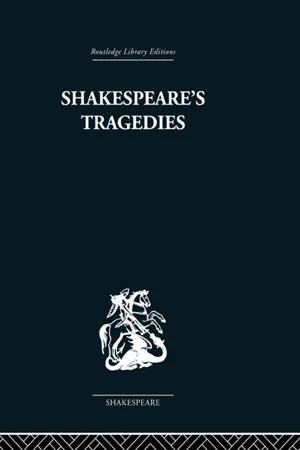
G B Harrison here recognizes that Shakespeare's tragedies were intended for performance in a theatre and that the playwright's conspicuous gift among his contemporaries was a sympathy for joy and sorrow, pity and terror, and right and wrong of his people. The plays covered are: Titus Andronicus, Romeo and Juliet, Julius Caesar, Hamlet, Troilus and Cressida, Othello, King Lear, Macbeth, Antony and Cleopatra, Coriolanus and Timon of Athens.
Trusted by 375,005 students
Access to over 1 million titles for a fair monthly price.
IN the year 1904, Andrew Cecil Bradley published Shakespearean Tragedy, a series of lectures which he had delivered as Professor of Poetry before the University of Oxford. At that time they were regarded as the last and final word, the highest pitch of Shakespearean criticism. But fashions in criticism change almost as completely as fashions in costume. Few modern critics have Bradley’s point of vision. He was a philosopher, a moralist. He regarded Shakespeare’s tragedies as the supreme presentation of a view of life, an explanation or at least a glimpse of the great problem of the nature of good and evil; and he thus expressed it:
Sometimes from the very furnace of affliction a conviction seems borne to us that somehow, if we could see it, this agony counts as nothing against the heroism and love which appear in it and thrill our hearts. Sometimes we are driven to cry out that these mighty or heavenly spirits who perish are too great for the little space in which they move, and that they vanish not into nothingness but into freedom. Sometimes from these sources and from others comes a presentiment, formless but haunting and even profound, that all the fury of conflict, with its waste and woe, is less than half the truth, even an illusion, ‘such stuff as dreams are made on.’ But these faint and scattered intimations that the tragic world, being but a fragment of a whole beyond our vision, must needs be a contradiction and no ultimate truth, avail nothing to interpret the mystery. We remain confronted with the inexplicable fact, or the no less inexplicable appearance, of a world travailing for perfection, but bringing to birth, together with glorious good, an evil which it is able to overcome only by self-torture and selfwaste. And this fact or appearance is tragedy.
Bradley came before the era of modern scholarship. Though the work of the first Shakespeare Societies and of the Victorian scholars, English and German, was before him, the greatest was still behind—Greg’s edition of Henslowe’s Diary, McKerrow’s edition of Nashe’s Works, Pollard’s studies of the Quartos, Chambers’ erudite compilations. These and a host of others have fundamentally altered our ideas about Shakespeare and his plays, so that nowadays critics are less interested in Shakespeare’s universal morality and more in his plays as expressions of his own times. At one extreme modern critics and scholars see Hamlet as Shakespeare’s picture of the Elizabethan world pattern and at the other as a specimen of the fare offered to playgoers at the Globe Playhouse in the closing months of the reign of Queen Elizabeth.
There are, indeed, a dozen different kinds of study, all complementary to each other and all, if rightly used, contributing something to that ultimate comprehension of a work of art which is the result of long study. We may follow the old paths and regard the tragedy of Lear in the light of Aristotle’s precepts as a fine example of catharsis, the tragic hero, the reversal of the situation, the recognition, and so forth; or, speculating on the use of the balcony or inner stage, as a problem in Jacobean stagecraft; or as a comment on Shakespeare’s times; or as a chapter in his spiritual autobiography; or as a subtle analysis and presentation of character; or as an example of pregnant, symbolic and elaborate use of poetic imagery; or as an illustration of discordant domestic relationship; or as a stage play to be produced before a modern audience. All or any of these ways of approach may aid in the final and completer understanding.
If, therefore, our examination of Shakespearean tragedy is to be fruitful, and if we are to arrive ultimately at any conclusion or general idea of the quintessence—I would say element but that the poor word has been over-worn these four hundred years— the quintessence of Shakespearean tragedy, we must first try to define our terms. What do we mean by Shakespearean, and what by tragedy, and further what is the duty of the modern critic towards his author and reader?
The word Shakespearean means far more than a play written by William Shakespeare, gentleman, of Stratford-on-Avon. It means first that it was written within a period of twenty years, at most twenty-five years, between 1588 and 1613, and since drama is a reflection of life or, in Hamlet’s words ‘holds the mirror up to Nature’, everything that was thought, said or done within that period may in some way be relevant to the understanding of Shakespeare’s dramas. Shakespearean means also that the play was written for performance by a particular Company of Players in their own playhouse, catering to their own special audience; that is, its language, its ideas, outlook and style are now nearly 350 years old. Anyone, be he critic, actor, reader, or spectator, must know something of these matters before he can fully understand any one of Shakespeare’s plays.
Of the man himself we know the facts of his life in considerable detail; but of his personality little that can be certain, except from what is revealed in his work, and every interpreter gives a different version. But at least it is a sure fact that his plays gave his audiences what they wanted without stirring up controversies or prejudices; they therefore reflect their age. In his fundamental notions on most matters in heaven and on earth Shakespeare was of his age, sharing the prejudices, the knowledge and the ignorance of his own generation. He was certain, as were most men who used their five senses and who had not been touched by any of those new-fangled Copernican notions, that the earth was the centre of the universe and that around it in concentric circles moved the sun and the planets, that the stars somehow controlled man’s fate, that at least in theory the King was God’s vicegerent on earth and that children owed absolute obedience to their parents and especially to the father, that all matter was formed of four elements, that it was good to purge and let blood at certain seasons, that the great universe and man the microcosm were elaborately balanced in the intricate order of being.
Shakespeare may have been a great reader. We know some of the books whence he fetched his stories, his ideas and his knowledge, but we may reasonably suspect that he learned far more by using his eyes and listening to talk; for however much we may discuss literary sources, influences or opinions, talk is the greatest of all. This talk has long since been silent. If, therefore, we are to understand Shakespeare’s world, we must study the ideas of his contemporaries as they happen to survive in books, not only in the few famous and obvious works which are described in any history of English literature, such as Bacon’s Essays, Hakluyt’s Voyages, or Hooker’s Ecclesiastical Polity, nor in any of those philosophical works which are especially favoured by the erudite, but rather in ephemeral books which are now obscure, rare and generally unknown, but which were popular and well thumbed when they first appeared. We must study works of Thomas Nashe and Robert Greene, the Sermons of Henry Smith, John Harington’s Metamorphosis of Ajax, the satires of Hall, Marston, Guilpin and Davies, the various literary wrangles such as the controversy between the champions of the Church of England and the Puritan exorcists, the quarrel of the English Seculars and the Jesuits, the arguments of sceptics and believers in judicial astrology and witchcraft—in all of which it may be noted, Shakespeare took some interest.
It needs less scholarship to understand how Shakespeare’s plays were staged and acted. Even school texts nowadays contain a section of the Introduction describing, often with an illustration, the structure and stage of the Globe Playhouse. It is essential knowledge even in interpreting Macbeth and Lear, for all plays are written to be acted on a particular kind of stage, and the form of the drama—that is, its manner of presentation and therefore its writing—must conform to the conventions familiar to the spectators. Greek tragedy by convention normally showed one event in a series of five acts or episodes. A modern drama is usually divided into three acts, each commonly occurring in one place and each a unity in itself. Elizabethan drama was more fluid. Having a multiple stage where action could alternate between main stage, inner stage and upper stage, the dramatist was able to show many episodes, one quickly following the other, so that far more of the story could be seen than in the other forms of drama.
At the same time, the smallness and the form of the theatre encouraged close intimacy between actor and spectator. In the two hours’ traffic of the stage the players spoke some 2,500 lines; that is, they maintained a pace of 140 words or more a minute. Their audiences, must, therefore, have been apt listeners. Indeed they were gluttons for the spoken word. Every educated man was trained in the finer points of rhetoric, of making and listening to speeches. Many touches, therefore, which the modern reader only understands after it has been demonstrated to him, Shakespeare’s audience appreciated by instinct. It was a receptive, sensitive, vibrant instrument which responded at once to the touch.
All this and more is included in the term Shakespearean, which is thus the concern of the scholar, whose activities are endless; for in the pursuit of truth, which is his goal, he must follow every track, wherever it may lead. Nothing, indeed, is irrelevant for the Shakespearean scholar, who must take all Elizabethan knowledge as his particular field. He is thus concerned with Shakespeare himself, his family and their affairs, with Stratford-on-Avon, its church, school, Corporation, town records, tithes, tillage and taxes; with the Players’ Companies and their patrons and playhouses, and their styles of acting; with clowns and tragic actors and their families and lawsuits; and, therefore, with Courts of the King’s Bench, Chancery and Star Chamber; with depositions, examinations, judgements, wills, probates, fines, recognisances and recoveries; with Ecclesiastical Courts, pedigrees, visitations; with heralds of all kinds, shapes and colours; with funeral monuments, parish registers, historical collections; with national, aristocratic, civic records; with current events and national events; with Queens, Kings and nobles, knights and gentlemen; with chronicles, diaries, letters, and Acts of the Privy Council, debates in Parliament; with every kind of printed or written word, works of divinity, science, philosophy, theology, history, political science, geography, venery, toxophily, military science, music and gardening; with translations and romances, poems of all kinds, almanacs, news-pamphlets, sermons by the hundred, sonnets, songs and song books; with volumes of learned publications, articles and journals, notes and queries, theses and bibliographies; with stationers and booksellers, censors, registers, entries, dedications and epistles, first editions and second editions, piracies and cancels, imprints, signatures and gatherings, forgeries and water marks; and so ultimately with the materials of writing, with paper made of rags, parchment which is the inner skin of a sheep, ink formerly made of gall, and finally with quill pens provided by the goose. Small wonder if sometimes the researcher is overwhelemed beneath his material or that some Shakespearean scholars should know everything about the problems and nothing about the plays. The connotations of the word Shakespearean are indeed endless.
The word tragedy was given us by the Greeks.
was their word, a strange combination of τρáγoς, a goat, and ὤδη, a choric song. The learned from the first have been much exercised to discover how such a fantastic compound could have come to denote ‘all that is felt at a performance of Oedipus’. It need not concern us here to decide whether tragedy was first a song which won the prize of a goat, or a passion play in which mummers disguised themselves as goats, or a memorial drama played beside a dead hero’s tomb. Our immediate concern is with two matters: what did the word mean to Shakespeare’s contemporaries, and what, if anything, does the word mean now? What, in a word, is tragedy?
To Shakespeare’s contemporaries, the editors of the First Folio, for instance, tragedy seems at first sight to have meant little more than a play ending in disaster, or to use a phrase I once heard on the lips of a sailor: ‘blood for supper’. Most Elizabethan tragedies end with the stage cluttered with corpses. Shakespeare is fairly modest in his holocausts. In Lear, his most desperate tragedy, there are five dead at the end, four in Hamlet and three apiece in Romeo and Juliet, Othello, and Antony and Cleopatra, but one only in Julius Caesar and Coriolanus, while in Macbeth the signs of death are contracted to one bloody head on a pole.
Nevertheless, though blood was one of the first requirements, other qualities were expected—a certain gorgeous, sombre dignity for instance. In the Induction to A Warning for Fair Women, Tragedy declares:
I must have passions that must move the soul;
Make the heart heavy and throb within the bosom,
Extorting tears out of the strictest eyes—
To rack a thought, and strain it to his form,
Until I rap the senses from their course.
This is my office.
Doubtless the principles of tragedy were much discussed by young gentlemen of the Inns of Court and inevitably by Ben Jonson. One can hear echoes of current theory in Sidney’s Apology for Poetry, but Sidney’s concern was rather for the kind of decorum which he had taken over from the Italian critics who studied and misinterpreted Aristotle’s Poetics and evolved the strict rules of the three unities which Aristotle never intended. Most playgoers still held to the definition given by the Monk in the Canterbury Tales:
Tragedie is to seyn a certeyn storie,
As olde bookes maken us memorie,
Of hym that stood in greet prosperitee,
And is y-fallen out of heigh degree
Into myserie, and endeth wrecchedly;
and his typical examples are Samson, Hercules, Alexander and Croesus. The theme or moral of the Monk’s Tale is that Fortune is a fickle jade and one never knows what dirty trick she will play on a man; so that the tragedy is the sudden reversal, ending or crash.
Tragedy is indeed one of the most difficult of critical terms, a theme for endless discussion and theory. Since, however, both the word and what it denotes are Greek, it is as well to go back to Aristotle, the father of criticism. Not only was he the first to analyse tragedy, but he first distilled the quintessence of tragedy and produced a definition which is still the best attempt to show what Greek tragedy is, or rather what it does.
One of the first points to be assumed by Aristotle, and yet so commonly overlooked, is that a tragedy is a tragic drama and a drama is a doing or an acting. ‘Tragedy is an imitation of an action’, Aristotle observed, and ‘every tragedy must have six parts, which parts determine its quality, namely: plot, character, diction, thought, spectacle, song’. Song is no longer essential; the other parts are as necessary as ever.
Now dramatic action implies three conditions or factors— actors, a place for acting, and spectators; for the art of acting is not merely a presentation of action but an action so presented that it will have a calculated effect on the spectator. There is needed also a dramatist to compose the play. His contribution is in the form of a written script in which are given primarily the words to be spoken by the actors, but often also instructions for the manner of speaking the words, the actors’ comings and goings, their gestures and appearance and, with more recent dramatists, even an exact description of the setting and scenery. With this script as guide, the actors perform the play.
A drama is thus not a story written in a peculiarly irritating manner, or a collection of speeches in prose or verse to be read by the solitary reader, but an experience to be created and shared between the actors and their spectators. The words printed in the volume called Hamlet are thus not the drama of Hamlet, any more than the musical notes printed on the page are the symphony. The expert musician doubtless from the score alone can, in his imagination, recreate the full harmony of the orchestra; and the unheard melody may be sweeter than any human performance. Nevertheless, Beethoven’s Fifth Symphony is not a book to be taken from the library but an experience to be enjoyed with others in the concert hall. In the same way, tragedy is not something to be read privately, but an experience to be shared in the theatre. Indeed, Aristotle in his famous definition of tragedy shows that true tragedy only exists when it produces in the spectators a definite emotional reaction, which he calls catharsis or purging. ‘Tragedy,’ he says, ‘through pity and fear effects the proper catharsis [or purgation] of these emotions.’
Catharsis has been furiously debated, generally by those who have never experienced it. Milton expressed the idea quite simply at the close of Samson Agonistes:
All is best, though we oft...
Table of contents
Cover
Half Title
Title Page
Copyright Page
Original Title Page
Original Copyright Page
Dedication
Table of Contents
Preface
1. Shakespearean Tragedy
2. Titus Andronicus
3. Romeo and Juliet
4. Julius Caesar
5. Hamlet
6. Troylus and Cressida
7. Othello
8. King Lear
9. Macbeth
10. Antony and Cleopatra
11. Coriolanus
12. Timon of Athens
Epilogue
Index
Frequently asked questions
Yes, you can cancel anytime from the Subscription tab in your account settings on the Perlego website. Your subscription will stay active until the end of your current billing period. Learn how to cancel your subscription
No, books cannot be downloaded as external files, such as PDFs, for use outside of Perlego. However, you can download books within the Perlego app for offline reading on mobile or tablet. Learn how to download books offline
Perlego offers two plans: Essential and Complete
Essential is ideal for learners and professionals who enjoy exploring a wide range of subjects. Access the Essential Library with 800,000+ trusted titles and best-sellers across business, personal growth, and the humanities. Includes unlimited reading time and Standard Read Aloud voice.
Complete: Perfect for advanced learners and researchers needing full, unrestricted access. Unlock 1.4M+ books across hundreds of subjects, including academic and specialized titles. The Complete Plan also includes advanced features like Premium Read Aloud and Research Assistant.
Both plans are available with monthly, semester, or annual billing cycles.
We are an online textbook subscription service, where you can get access to an entire online library for less than the price of a single book per month. With over 1 million books across 990+ topics, we’ve got you covered! Learn about our mission
Look out for the read-aloud symbol on your next book to see if you can listen to it. The read-aloud tool reads text aloud for you, highlighting the text as it is being read. You can pause it, speed it up and slow it down. Learn more about Read Aloud
Yes! You can use the Perlego app on both iOS and Android devices to read anytime, anywhere — even offline. Perfect for commutes or when you’re on the go. Please note we cannot support devices running on iOS 13 and Android 7 or earlier. Learn more about using the app
Yes, you can access Shakespeare's Tragedies by G B Harrison in PDF and/or ePUB format, as well as other popular books in Literature & Literary Criticism. We have over one million books available in our catalogue for you to explore.