eBook - ePub
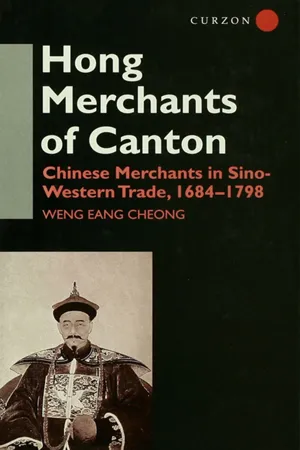
The Hong Merchants of Canton
Chinese Merchants in Sino-Western Trade, 1684-1798
- 388 pages
- English
- ePUB (mobile friendly)
- Available on iOS & Android
eBook - ePub
About this book
This study eschews the uncritical acceptance of secondary sources that has characterized studies in this field, going back to and reinterpreting previously neglected primary sources, thereby enabling it to chart linkages between the European and Asian trades that have been regarded as parallel but unrelated (or at best competing) activities. In so doing, the work sheds new light on this crucial period.
Information
1
The Early Merchants, 1684–1740
THE EARLY PERIOD
In December 1683, Admiral Shih Lang1 successfully petitioned the throne to open Chinese ports to foreign trade and repeal the Ch’ing ban on Chinese overseas navigation which had been in force intermittently from 1656.2 The Ch’ing pacification of southern China had preceded this new liberal policy and the reorganization of the former feudal domains in the south along traditional lines of provincial administration followed. Ming prohibition of overseas navigation from 1522 had never been strictly enforced, especially after 1567 when Hai Cheng on the Chiu Lung River in Fukien was opened for ocean-going junks, but the junk trade was significantly reduced by the prohibition and was eclipsed by the better-organized and more regular European carrying trade at Macao, Tainan, Kelung and Tamsui and the privileged Spanish trade at Amoy and Ch’üanchou. Although in the period 1633–83, the Spanish, Portuguese and Dutch, for different reasons, had withdrawn to their colonial entrepôts, the junk trade itself was unable to benefit from the absence of the Europeans and expand because it was restrained at first by the war of conquest and then from 1656 by Ch’ing prohibition.
Peace, a new administration, a laissez-faire policy on trade, the restoration of the junk trade’s important role in the Asian carrying trade, and the prospect of a new European trade were the ingredients in the new prosperity of the Southern Chinese ports. The restraining effect of the prohibition on the junk trade was amply demonstrated when the ban on Chinese overseas navigation was lifted in 1684. Virtually unhindered by European competition, the junk trade expanded for some thirty years.3 The new Ch’ing policy had generated a new mobility among Chinese merchants on the coast which was the prelude to the restructuring of the Chinese trade. The eventual specialization of the ports in particular trades was to determine the distribution of the merchants’ functions at each port. Ningpo re-established its pre-eminence in the trade with countries of the Eastern Ocean,4 which had been disrupted when the Ningpo Superintendency was closed in 1522. Amoy’s junk trade with the Southern Ocean (maritime Southeast Asia) and the Vertical Ocean (coastal ports of China) expanded rapidly5 and Amoy soon eclipsed Ch’üanchou, the traditional centre of these trades and the seat of the Circuit Intendant, whose brief included Amoy. Canton became the centre for the European trade with a strong control over the coastal trade with neighbouring tributary states in Indochina and Thailand. The early history of the Hong merchants of Canton was therefore closely related to the broader history of the trade and merchants along the whole coast of South China in the period immediately following the implementation of the new policy.
The lack of European competition in the late seventeenth and early eighteenth centuries was not for want of European enterprise or interest. Indeed, European trade in Asia was undergoing a restructuring and reordering of priorities which was to make the China trade a main aim by the 1720s and, thereafter, the main target of European commerce in Asia. To begin with, the China trade changed hands in the 1680s. The demise of the Dutch and Iberian operations in the China Sea ended an era starting from the adoption of the mid-Ming closed-door policy (1522) during which, for long periods, they virtually supplanted Chinese junks on certain routes in the Asian carrying trade. Into the breach stepped the English and the French, initially in search of new marts but becoming initiators of the tea trade and China’s principal trade partners. It was also the end of the first phase of European expansion in which the Far Eastern trade had always been secondary to trade with Southeast Asia and India. Although in time the Far Eastern carrying trade rivalled bilateral operations to Europe and Spanish America in value and volume, until the advent of China teas, it lacked a staple of comparable popularity to the spices of the old trunk route trade.
The new trade in teas revolutionized the China trade. In a short time and in countries thousands of miles away, the successful cultivation of a taste for the brew had set in motion in China the highly organized system to source, ship and market the raw product on a scale and for a duration exceeding that of the spice trade. Silk soon lost its leading place and porcelain acquired a new function as bedding for the precious chests of tea. The tea trade revitalized the bilateral Europe-Asia trade. Ships sailed from Europe for Canton, not a colonial port in India or Southeast Asia, while the despatch of ships from factories in Asia, a practice developed for the intra-Asian carrying trade, lost its raison d’être. The EIC’s rationalization was a model of speed and change: by 1687 the China trade had been detached from its Indian factories and by 1699 a Consul General and President of Council was on his way out to set up a base and Council at Chusan.
Amoy at first attracted most of the European trade. It had benefited from the Dutch attempts to trade in Fukienese ports in the 1660s and 1670s and the English trade there in the later 1670s and early 1680s; between 1684 and 1699, nine ships traded in Amoy and one in Macao.6 However, the determined efforts of the court and the accommodating attitude of local officials and merchants at Canton soon reversed the trend in its favour. When the Canton Hoppo’s Custom’s House was established in 1685, the 2-per-cent surcharge on measurage was dropped. In 1686, Whampoa upriver was opened to foreign shipping7 and the maritime customs quota was reduced by 20 per cent to 43,560 taels per year, where it was to remain until the system ended in 1843.8 An English ship at Macao in 1689 reported favourably on Canton because the men thought the Hoppo in person had attended to its business.9 In 1698, the rate of measurage on European ships was further reduced to the rate for Asian bottoms, entailing an estimated diminution of 30,285 taels in state revenue; from 1699, Portuguese ships at Macao were assessed at the same rate as Chinese ocean-going junks.10
For six years after 1699, intense rivalry between the ports for the European business ensued, with seven, twelve and eight ships calling at Amoy, Ningpo (Tinghai on Chusan Island) and Canton respectively.11 A bad report could easily turn the Company against a port; as early as 1689, English supercargoes at Amoy had suggested relocation from Amoy to Tinghai or Canton12 but, by 1703, the President of the Company’s Council at Chusan, who was responsible for EIC trade in China and Tonquin, concluded that Canton was preferable to Amoy and both to Tinghai.13 By elimination, Whampoa had become the preferred destination for “it was a port of better usage, quicker dispatch and cheapest prices”.14 The French who arrived in 1699 followed suit, although until 1710, both companies continued to send the odd ship to Ningpo or Amoy hoping (in vain) to find better conditions. These were the only Europeans to trade directly with China until 1715. Between 1699 and 1715, the EIC sent forty-three ships and the French twenty-three to China. For each of the years 1716–20, the EIC had two ships in Canton but the French Company had none.15 However, by then, the Ostend Company had started to trade with China; this Company was established in 1717 by European privateers who had purchased a charter from the Austrian Emperor in order to take part legally in the lucrative tea trade monopolized by the chartered companies.
The three or four ships per year on the China coast in the best years gave some employment to only a few merchants at each port but made no port or merchant a specialist in the European trade. Some itinerant operators moved between the three ports to catch the business of all the ships that called. As the European preference for Canton became apparent, merchants from Amoy and Ch’üanchou and even some from the Yangtze ports or further north, moved to Canton encouraged by European supercargoes or the example of peers. Many remained for decades as transients rather than immigrants at Canton. The newcomers, like the locals, also had recent exposure to the new trade, albeit at Amoy or Tinghai, hence the confrontation with the established local merchants was sharp but quite inconclusive. However, the convergence of merchants at Canton and the success of a number of the new merchants ensured the ascendancy of Canton over its northern rivals in the struggle between the ports to attract the European trade.
The Old Guard
Many of the old merchants at Canton were Fukienese. Several were new arrivals, although some were no strangers to the trade; others with long-standing local ties only needed to strengthen them when Whampoa was opened in 1686 and consolidate them when Canton gained favour with the Europeans – a development in which they had a part. Fukienese merchants had a long innings in the trade with the Europeans on and off the coast, starting with the mid-Ming seclusion policy in 1522, and nursed through the last century of Ming rule with the relaxation of metropolitan restraints and opening of Hai Cheng on the Chiu Lung River in 1567. Fukienese ports teemed with activity generated by trade with the Spaniards and Dutch in Taiwan and by European traffic en route to Japan; Fukienese merchants settled in the new European enclaves of Manila and Batavia and others moved south to purvey for the Portuguese at Macao and conduct their own trade with the Southern and Eastern Oceans from Whampoa. Powerful merchant houses like the Chengs of Ch’üanchou16 established a vested interest in the maritime administration, while officials unabashedly participated in the trade.
In the early Ch’ing period, war devastated the ports of Kwangtung and Fukien and prohibition hobbled their commerce, but nothing curbed the cupidity and enterprise of their merchants, who – as the increased usage of the term kuan-shang or official merchant suggests – found new patrons among ...
Table of contents
- Cover
- Half Title
- Title Page
- Copyright Page
- Table of Contents
- List of Tables
- List of Maps
- Dedication
- Acknowledgement
- Introduction
- 1. The Early Merchants, 1684–1740
- 2. The Merchant-Bureaucrat, 1740–98
- 3. The Leaders and Their Firms, 1684–1796
- 4. Officials and the Trade
- 5. Merchant Debts
- Reappraisal
- Histogram of Seventy-Nine Hong Merchants in the European Trade at Canton, 1686–1798
- Glossary
- Sources
- References
- Index
Trusted by 375,005 students
Access to over 1.5 million titles for a fair monthly price.
Study more efficiently using our study tools.
Frequently asked questions
Yes, you can cancel anytime from the Subscription tab in your account settings on the Perlego website. Your subscription will stay active until the end of your current billing period. Learn how to cancel your subscription
No, books cannot be downloaded as external files, such as PDFs, for use outside of Perlego. However, you can download books within the Perlego app for offline reading on mobile or tablet. Learn how to download books offline
Perlego offers two plans: Essential and Complete
- Essential is ideal for learners and professionals who enjoy exploring a wide range of subjects. Access the Essential Library with 800,000+ trusted titles and best-sellers across business, personal growth, and the humanities. Includes unlimited reading time and Standard Read Aloud voice.
- Complete: Perfect for advanced learners and researchers needing full, unrestricted access. Unlock 1.5M+ books across hundreds of subjects, including academic and specialized titles. The Complete Plan also includes advanced features like Premium Read Aloud and Research Assistant.
We are an online textbook subscription service, where you can get access to an entire online library for less than the price of a single book per month. With over 1.5 million books across 990+ topics, we’ve got you covered! Learn about our mission
Look out for the read-aloud symbol on your next book to see if you can listen to it. The read-aloud tool reads text aloud for you, highlighting the text as it is being read. You can pause it, speed it up and slow it down. Learn more about Read Aloud
Yes! You can use the Perlego app on both iOS and Android devices to read anytime, anywhere — even offline. Perfect for commutes or when you’re on the go.
Please note we cannot support devices running on iOS 13 and Android 7 or earlier. Learn more about using the app
Please note we cannot support devices running on iOS 13 and Android 7 or earlier. Learn more about using the app
Yes, you can access The Hong Merchants of Canton by Weng Eang Cheong in PDF and/or ePUB format, as well as other popular books in Social Sciences & Ethnic Studies. We have over 1.5 million books available in our catalogue for you to explore.