eBook - ePub
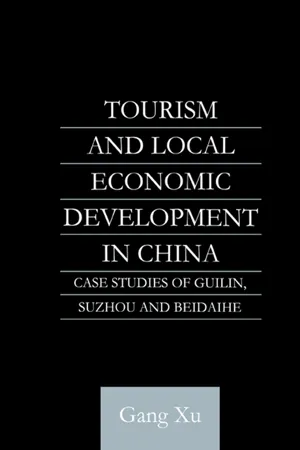
Tourism and Local Development in China
Case Studies of Guilin, Suzhou and Beidaihe
- 262 pages
- English
- ePUB (mobile friendly)
- Available on iOS & Android
eBook - ePub
About this book
The boom in tourism to and within China is quite a recent phenomenon. China is now among the leading international tourist destinations, and demand for domestic tourism is rapidly increasing. This study examines the role of tourism in the local economic development in different areas of China, and identifies the decisive factors in determining the success or failure of tourism-oriented development strategy at the local level. The author juxtaposes case studies of Guilin, a domestic and international tourist destination in a less developed local area, Suzhou, also both a domestic and international destination but in a more mature local economy, and lastly Beidaihe, a mainly domestic tourist destination.
Information
Part I
Theoretical and Empirical Background
1
Introduction
1.1 Tourism Impact Assessment: a Neglected Issue in China
The central theme of the present study is the impact of tourism on local economic development in China.
The booming of tourism to and in China is a quite recent phenomenon. Yet, with 42 million border arrivals and 4.6 billion US$ receipts in 1993, China has become one of the leading destinations of international tourism within a short period of time. Still more spectacular is the rapidly rising travel demand of the Chinese people themselves. It is estimated that in recent years some 300–400 million Chinese have, in one form or another, taken part in domestic tourism per annum, yielding a total revenue of 86 billion RMB yuan.1 Possible statistical inaccuracies notwithstanding, a mere look of the rough orders of these figures suggests that the recent growth of the travel and tourism industry in China is enormous by any standard.
What has been the impact of tourism boom in China? What role can tourism play in the socio-economic change and regional development in China?
These are broad questions related to a research field that has given rise to much controversy in the past few decades. As an expanding economic sector and a socio-cultural phenomenon, international tourism to the ‘pleasure periphery’ has since the 1960s caught considerable attentions from both academics and policymakers.
The size of the literature on tourism is formidable. Geographically, tourism studies cover most parts of the pleasure periphery’ which have been involved or ‘integrated’ in international tourism businesses.2 Thematically, besides studies on tourism’s industrial structure (its operation, management and marketing) and geographical structure (models of spatial development and interactions), research into the effects of tourism expansions in the developing countries, including economic, socio-cultural, political and environmental repercussions, has been the major focus of the literature.3
The key issues raised in the study of tourism and its effects in the developing countries cut across the heart of the major concerns in the field of development studies of the ‘periphery’ in the post-war period.4 However, much dispute exists not only about the nature and extent of the effects of tourism development but over the ways in which they might be assessed.
(1) Economic effects:
The alleged economic benefits brought about by tourism to the developing countries were the major arguments of early tourism advocates. However, due largely to the cross-sectoral nature of the tourism industry as well as paucity of empirical data, controversial statements have arisen about the following issues:5
- the contribution of tourism to the ‘balance-of-payments’;
- the quantity and quality of tourism employment;
- the extent of ‘multiplier effects’ of tourism growth; and
- the role of tourism in balancing sub-national development.
(2) Socio-cultural consequences:
Perhaps as a reaction to the accelerating globalization and as a result of a renewed desire to capture some of the ‘authentic’ life, there has been a growing recognition of the value of cultural diversity worldwide. Consequently, tourism impacts on the host societies, such as erosions of local cultures and traditions, cheapening effects on arts and crafts, and rising consciousness of ‘relative deprivation’, have been assessed increasingly in an undesirable light. At the same time, more weights are being given to critical studies of the issue ‘who benefits from tourism?’6
(3) Environmental repercussions:
Less controversial is the discussion about the environmental ‘costs’ imposed by hitherto tourism expansions, though unfortunately only very recently. In this regard, the consensus-building seems rapid. Although detailed studies remain scant, it is generally held that on net balance the hitherto tourism expansions have been negative for the quality of natural environment. Therefore, genuine concerns for an environmentally friendly tourism development have fostered a worldwide constituency rapidly gaining political potency, reflecting the growing awareness of global environmental problems at large. Physical environment begins to take ‘center stage’ in tourism development and management.7
Most recently, as ‘sustainable development’ has become a catchword at the international level, calls for a paradigm shift in future tourism development are receiving increasing attentions from both academic and industry communities. New concepts, such as ‘sustainable tourism’, ‘appropriate tourism’, ‘soft tourism’, ‘low impact tourism’ and ‘eco-tourism’, are emerging in effect as the ‘impact statements’ of future tourism initiatives. However, while some pragmatic issues related to such a paradigm shift are being addressed, most discussions to date remain philosophical and heuristic in nature.8
Tourism started in China when the first boom of international tourism to the developing world had run its course, and concerns over the socio-cultural and environmental ‘costs’ associated with tourism expansions began to come to the forefront of international debates. Despite the enormous growth, disputes over the ‘benefits and costs’ of tourism development and recent movements toward a new paradigm have found hardly any echoes in China.
Policymakers at both national and local levels are interested primarily in projecting tourism growth and devising tourism policies and long-term strategies which supposedly should be conducive to ‘healthy’ development of tourism and, more recently, ‘market-confirming’ in nature. Most researchers have been preoccupied with tourist resource surveys and ‘tourism planning’ at various levels.9 On the whole, neither policymakers nor indeed tourism researchers have taken an adequate account of the impact issues.
Obviously, in a transitional society in which economic growth is regarded as an overarching objective of all development efforts, the prime interest of the Chinese government in tourism promotion is economic. However, even in the economic respect, the need for critical assessment of the outcomes of hitherto tourism development has not been given sufficient attention. Lessons from other parts of the world in tourism development have been largely ignored. Still rarer are considerations about possible socio-cultural and environmental consequences of tourism expansions. Issues of degradation of cultural and physical environments are more often than not just papered over. Obviously, a myopic stance toward tourism can be costly, both economically and socio-culturally.
1.2 Tourism and Its Effects: Comparative Perspectives
China is a big developing country which, though still labeled as a socialist one, finds itself in a dramatic transitional process. As a developing country, China shares some features and, especially, problems which are characteristic of the developing world in tourism development, such as capital shortage, infrastructure constraints, lack of marketing know-how, and so on.
Nevertheless, the tourism boom and the socio-economic contexts within which it has taken place in China are apparently different to the situations previously formulated in the tourism literature.
(1) International vs. Domestic Tourism
Up till now, studies of tourism and its effects in the developing countries have centered almost exclusively on the international tourism. Issues related to domestic tourism in the developing countries are at most a footnote of the existing literature. Underpinning such a mainstream bias seems the assumption (albeit implicit) that domestic tourism in the developing countries is neither quantitatively nor economically significant. According to most tourism advocates, the major justification for international tourism promotion in the developing world is its alleged contributions to the ‘balance-of-payments’ of the host countries on the one hand, and the search for new tropical and exotic destinations of the tourists from the developed countries on the other.
A parallel development of international and domestic tourism is one of the most salient features of the tourism boom in China.10 Though the primary interest of the Chinese government in tourism promotion is to earn desperately needed hard currency, domestic tourism has become an integral part of China’s tourism industry. The surge of mass domestic tourism has not only documented many aspects of social, political as well as economic changes taking place in contemporary China, but has shown its significant economic effects at both national and local levels.
(2) Institutional Context
Compared to those of other countries, the institutional system governing tourism development in China is unique. China is a big socialist country which is in a rapid move toward a ‘socialist market economy’. Such an institutional context has important implications not only in tourism development itself but for a study of tourism impacts.
First, the governing system of tourism development in China is transitional in nature. Among others, it is characterized by:
- a changing government-business relationship, but pervasive state interventions in and often political influences on tourism development;
- an increasing role of the market mechanism in tourism supply, but frequent and multifold institutional conflicts characteristic of a transitional society at the threshold of a market economy;
- a rapidly growing non-state tourism sector in co-existence with a dominant public sector in key tourism supply areas;
- a growing recognition of the priority of efficiency in tourism investment, but a propensity to ‘quantitative maximization’ thinking;
- an increasing weight being given to local well-being, but a lack of the mechanism which favors people-centered, community-responsive and socially responsible approaches in tourism planning and policy formulations;
- rapidly rising local and individ...
Table of contents
- Cover
- Half Title
- Title Page
- Copyright Page
- Table of Contents
- Acknowledgements
- List of Tables
- List of Figures
- Abbreviations
- Part I: Theoretical and Empirical Background
- Part II: The Growth and Structure of Tourist Demand
- Part III: Tourism Infrastructure Development
- Part IV: Economic Effects
- Part V: Summary, Prospects and Policy Issues
- Bibliography
Trusted by 375,005 students
Access to over 1.5 million titles for a fair monthly price.
Study more efficiently using our study tools.
Frequently asked questions
Yes, you can cancel anytime from the Subscription tab in your account settings on the Perlego website. Your subscription will stay active until the end of your current billing period. Learn how to cancel your subscription
No, books cannot be downloaded as external files, such as PDFs, for use outside of Perlego. However, you can download books within the Perlego app for offline reading on mobile or tablet. Learn how to download books offline
Perlego offers two plans: Essential and Complete
- Essential is ideal for learners and professionals who enjoy exploring a wide range of subjects. Access the Essential Library with 800,000+ trusted titles and best-sellers across business, personal growth, and the humanities. Includes unlimited reading time and Standard Read Aloud voice.
- Complete: Perfect for advanced learners and researchers needing full, unrestricted access. Unlock 1.5M+ books across hundreds of subjects, including academic and specialized titles. The Complete Plan also includes advanced features like Premium Read Aloud and Research Assistant.
We are an online textbook subscription service, where you can get access to an entire online library for less than the price of a single book per month. With over 1.5 million books across 990+ topics, we’ve got you covered! Learn about our mission
Look out for the read-aloud symbol on your next book to see if you can listen to it. The read-aloud tool reads text aloud for you, highlighting the text as it is being read. You can pause it, speed it up and slow it down. Learn more about Read Aloud
Yes! You can use the Perlego app on both iOS and Android devices to read anytime, anywhere — even offline. Perfect for commutes or when you’re on the go.
Please note we cannot support devices running on iOS 13 and Android 7 or earlier. Learn more about using the app
Please note we cannot support devices running on iOS 13 and Android 7 or earlier. Learn more about using the app
Yes, you can access Tourism and Local Development in China by Gang Xu in PDF and/or ePUB format, as well as other popular books in Social Sciences & Ethnic Studies. We have over 1.5 million books available in our catalogue for you to explore.