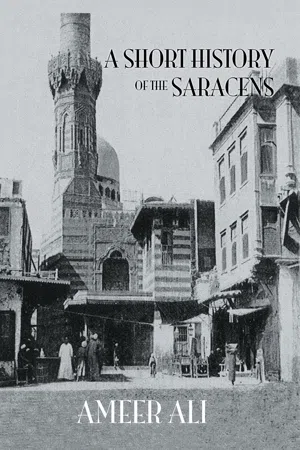
First published in 2008. Written by a barrister and Muslim who also authored the well-known book The Spirit of Islam, this is an unusual and indispensable history of the Saracens, a people who left behind them a great legacy and incredible intellectual wealth. The history of the Saracens is also the history of the spread of Islam. This work chronicles the rise and decline of Saracen power and of the economic, social and intellectual development of the Arab nations.
- 708 pages
- English
- ePUB (mobile friendly)
- Available on iOS & Android
eBook - ePub
About this book
Information
A SHORT HISTORY OF
THE SARACENS
CHAPTER I
Arabia—Its Geographical and Physical Condition—The Ancient Arabs.
Arabia.
ARABIA is a large tract of country in the south-west of Asia. It is bounded on the north by the Syrian Desert; on the east by the Persian Gulf; on the south by the Indian Ocean; and on the west by the Red Sea. This vast region, which embraces an area twice the size of France at the height of her greatness, is divided into several parts or provinces, differing more or less from each other in the character of their soil, their climate, and the appearance of the people.
To the north, lies the hilly portion, which in olden times was inhabited by the Edomites and the Midianites of the Hebrew Testament. Then comes Hijâz proper, containing the famous city of Medîna, called in ancient times Yathreb; Mecca, the birth-place of the Arabian Prophet, and the port of Jeddah, the landing-place of the pilgrims of Islâm. Hijâz stretches from north to south between the Red Sea and the chain of mountains which runs down from the Isthmus of Suez to the Indian Ocean. The south-west corner of the Peninsula is named Yemen. The low-lying lands of Hijâz and Yemen are called the Tihâma, which name is sometimes given to the southern part of Hijâz. Hadhramaut lies to the east of Yemen, bordering the Indian Ocean, while far away eastward lies, resting on the Gulf of the same name, Oman. The high table-land which stretches from the mountains of Hijâz eastward to the desert of al-Ahsa and al-Bahrain on the Persian Gulf, is called Nejd, a vast plateau with deserts and mountain gorges interspersed with green plantations which are called oases, forming so many havens of safety in the desert. Hijâz is now held by an independent Arab king. Nejd is ruled by the Abû Saûd family; whilst Oman belongs to the Sultan of Muscat.
This vast tract has no navigable rivers; the rivulets which exist only here and there make the soil fertile. The rainfall is scanty, and the country generally is arid and sterile, except where water is found in any sufficient quantity. But wherever water exists, the fertility is remarkable. The high lands of Yemen, called Jibâl ul-Yemen, rise almost to the height of Mont Blanc, and are split up into numbers of wide and fertile valleys, where the coffee and the indigo plant, the date-palm, and vegetables and fruit trees of all kinds, are grown. The climate is mild, and in the winter frost is by no means uncommon. There are two wet seasons, one in spring and the other in autumn.
Hijâz is a broken country, especially round about Mecca, which is fifty miles from the shores of the Red Sea, and some thirty from the granite heaps of Jabl Kora. Here rugged rocks reflecting the hot sun in all its fierceness, barren valleys with little herbage from which the flocks gather a scanty subsistence, and dry torrent-beds form the chief features of the country. Eastward of this gaunt and arid country there lies a smiling tract covered with vegetation and shady trees, where apples and figs, pomegranates, peaches, and grapes grow in abundance. This is Tâyef.
The Ancient Arabs
Arabia has at various times been peopled by various races. The earliest settlers are said to have been of the same stock as the ancient Chaldæans. They attained great civilisation, the remains of which are still observable in Southern Arabia, and are supposed even to have extended their power into Egypt and Mesopotamia. They seem to have built huge palaces and temples; and the famous tanks which still exist near Aden are ascribed to them.
The Kahtanites.
These ancient people were destroyed by a Semitic tribe which, issuing from some country towards the east of the Euphrates, settled in Yemen and parts of Hadhramaut. They are said to have been the descendants of Kahtân, also called Joktan, one of whose sons, YAREB, gave his name to the country and the people. The sovereigns of this dynasty were called Sabæan after Yareb’s grandson Abdus Shams (“servant of the sun”), surnamed SABA. The Kahtanite kings were great conquerors and builders of cities, and their dominion in Yemen and other parts of Arabia continued so late as the seventh century of the Christian era.
The Ishmaelites.
The last of the settlers are called Ishmaelites. Ishmael or Ismâil, as he is called by the Arabs, was a son of Abraham, the great patriarch of the Jews. He settled near Mecca, and his descendants peopled Hijâz and became in fact the founders of Arabian greatness. Ishmael is said to have erected the Kaaba, a place of worship regarded with veneration from the earliest times by the Arabs, and which is now the holiest place in the Moslem world. In it is the famous Black Stone.
The Bedouins.
The people of Arabia have always been divided into two classes, viz. “the dwellers of cities,” and “the dwellers of the desert,”—the Bedouins. These latter live in tents, and with their families and flocks roam over the deserts and table-lands in search of pasturage.
Northern and Central Arabia does not appear to have been at any time under foreign rule. In Yemen alone, the Abyssinians exercised a short-lived dominion until expelled by an Arab chief named Saif, son of Zu’l-yezen, with the assistance of the King of Persia. From that time forward, for nearly a century or more, Yemen Proper was ruled by a Persian Viceroy, called a Marzbân.
Their Religion.
The Jews and Christians, large numbers of whom were settled in Arabia, followed their own religions. But the Arabs were mostly worshippers of idols and stars. Each city, like each tribe, had its own separate gods and goddesses, its separate temples and forms of worship. In Mecca, which was considered the centre of their national life, a sort of Rome or Benares, there were ranged in the holy temple of the Kaaba 360 idols representing all the gods and goddesses whom the Arabs worshipped. Even human sacrifices were not infrequent.
The people who inhabited this vast region, especially those who wandered in the desert which lay to the west of the Euphrates, were called by the Greeks and Romans, Saraceni, and this is the name by which they were known in the West when they issued from their homes to conquer the world.1
The word Saraceni is supposed to be derived either from Sahara = desert, and nashîn = dwellers; or from Sharkiin, Eastern,—Shark, in Arabic, meaning east.
1 See Reinaud’s Invasion des Sarrazins (1836), p. 229.
CHAPTER II
Early History—Kossay—Abdul Muttalib—The Abyssinian Attack—The Birth of Mohammed—His Ministry—The Hegira.
Early History.
OUR knowledge of the ancient history of Arabia is derived chiefly from the Koran, which contains much of the old folk-lore of the country, and from the traditions which the Arabs at all times were in the habit of handing down from father to son. These traditions were collected with great care and industry by the Arab historians of the eighth and succeeding centuries of the Christian era. The inscriptions which have been discovered in the south of Yemen, so far as they have been deciphered, largely verify our knowledge of the past as derived from the Koran and the traditions.
The Koraish.
The people in whose history and fortunes we are chiefly interested are the Arabs of Hijâz and Yemen, who made themselves so famous in the Middle Ages. The principal tribe among the former was that of the Koraish, who were descended from Fihr, surnamed Koraish, which in ancient Arabic means a merchant. Fihr lived in the third century of the Christian era. He was descended from Maad, son of Adnân, a descendant of Ishmael. The Koraish have always been proud of their ancestry and their high position among the other tribes, and are considered as the noblest section of the Arabs.
Kossay.
In the fifth century, Kossay, a descendant of Fihr, made himself master of Mecca, and gradually of the whole of Hijâz. Mecca was, until his time, a scattered village, consisting chiefly of huts and tents. Kossay rebuilt the Kaaba, erected for himself a palace in which the principal chamber was used as the Council-hall1 of the people, for the transaction of public business; and made the Koraish live in houses of stone built round the Temple. He also made rules for the proper government of the people, for raising taxes and supplying food and water to the pilgrims who came from many parts of Arabia to worship at the temple.
Abd ud-Dâr.
Kossay died about the year 480 A.C., and was succeeded by his son Abd ud-Dâr. Upon Abd ud-Dâr’s death a dispute broke out among his grandsons and the sons of his brother Abd Manâf about the succession to the rulership of Mecca. This dispute was settled by a division of authority. The administration of the water supply of Mecca and the raising of taxes were entrusted to Abd ush-Shams, a son of Abd Manâf; whilst the guardianship of the Kaaba, of the Council-chamber, and of the Military Standard, was given to the grandsons of Abd ud-Dâr.
Hâshim. Abdul Muttalib.
Abd ush-Shams transferred the authority to his brother HÂSHIM, a leading merchant of Mecca and a man of consequence, noted for his generosity to strangers. Hâshim died about the year 510 A.C., and was succeeded by his brother Muttalib, surnamed “the Generous.” Muttalib died towards the end of the year 520 A.C., and was succeeded by his nephew Shayba, better known by his surname of ABDUL MUTTALIB, a son of Hâshim
Ommeya.
The grandsons of Abd ud-Dâr were meanwhile growing rich. Jealous of the position Hâshim’s family occupied in the public estimation, they were trying to grasp the entire authority, and to make themselves rulers of Mecca. On their side was ranged OMMEYA, the ambitious son of Abd ush-Shams. But in spite of this, the high character of Abdul Muttalib, and the veneration in which he was held by all the Koraish, enabled him to rule Mecca for nearly fifty-nine years. He was assisted in the Government by the Elders, who were the heads of the ten principal families.
The Year of the Elephant.
It was in his time Hijâz was invaded by a large Abyssinian army under the command of Abraha, and as this chief on his march towards Mecca rode on an elephant, an animal the Arabs had never before seen, the year in which the invasion took place (A.C. 570) is called in Arab traditions the “Year of the Elephant.” The invading force was destroyed, partly by an epidemic and partly by a terrible storm of rain and hail that swept over the valley where the Abyssinians were encamped.
Mohammed.
Abdul Muttalib had several sons and daughters. Among the sons four are famous in Saracenic history, viz. Abd Manâf, surnamed ABÛ TÂLIB; ABBÂS, the progenitor of the Abbasside Caliphs; HAMZA, and ABDULLÂH. Another son was Abû Lahab, who is referred to in the Koran as a persecutor of Islam. Abdullâh, the youngest of Abdul Muttalib’s sons, was the father of the Arabian Prophet. Abdullâh was married to a lady of Yathreb named ÂM’NA, but he died in the twenty-fifth year of his age, not long after his marriage. A few days after his death Âm’na gave birth1 to a son, who was named by his grandfather MOHAMMED, or “the Praised One.” Mohammed lost his mother when he was only six years old, and was then thrown upon the care of his old grandfather. Abdul Muttalib died about 579 A.C., confiding the infant son of Abdullâh to the charge of Abû Talib, who succeeded him in the patriarchate of Mecca. It was in the house of his uncle Abû Tâlib that Mohammed passed his early life. Sweet and gentle of disposition, painfully sensitive to human suffering, he was much loved in his small circle. His early life was not free from the burden of labour, for Abû Tâlib was not rich like his ancestors, and the younger members of the family had to take their turn in tending the flocks and herds.
From early youth Mohammed was given to meditation. He travelled twice into Syria with his uncle Abû Tâlib, and there noticed the misery of the people, and their evil ways, their wranglings and strife. In his twenty-fifth year, Mohammed married a lady named Khadîja, who is famous in Arabian history for the nobility of her character. They had several children; all the sons died in infancy, but the daughters lived to see the great events of their father’s life. The youngest, Fâtima, surnamed az-Zahra, “the Beautiful,” called by Moslems “Our Lady,” was married to Ali, the son of Abû Tâlib.
Mohammed lived very quietly for the next fifteen years, appearing only once or twice in public life. He revived the League which had been formed many years before for the protection of widows, orphans, and helpless strangers. He settled by his quick discernment a quarrel which threatened serious consequences; but though these are all we know of his public acts, we know that his gentle disposition and the severe purity of his life, his unflinching faithfulness and stern sense of duty, won for him during this period, from his fellow-citizens, the title of al-Amîn, the Trusty. One of his particular characteristics was his fondness for children, who flocked round him whenever he issued from his house; and it is said he never passed them without a kindly smile. He spent a month every year in meditation and spiritual communion in a cave in Mount Hira, not far from Mecca, and one night as he lay in the cave wrapped in his mantle, God spoke to his soul to arise and preach to his people. Henceforth his life is devoted to the task of raising them from their degradation; of making them give up their evil ways, and of teaching them their duty to their fellow-beings.
His Ministry.
The first to accept his mission and to abandon idolatry was his wife Khadîja. Then followed Ali and several notable men, Abû Bakr, Omar, Hamza, and Osmân. When Mohammed first began to preach, the Koraish laughed at him, but when they found him earnest in his work their animosity grew into persecution. They began to ill-treat him and his followers, some of whom they tortured to death. Many of his disciples took refuge with a good Christian king in Abyssinia, whilst othe...
Table of contents
- Cover
- Halftitle
- Title
- Copyright
- Preface to 1927 Edition
- Preface
- Contents
- List of Illustrations and Maps
- List of Genealogical Tables
- Chapter I
- Chapter II
- Chapter III
- Chapter IV
- Chapter V
- Chapter VI
- Chapter VII
- Chapter VIII
- Chapter IX
- Chapter X
- Chapter XI
- Chapter XII
- Chapter XIII
- Chapter XIV
- Chapter XV
- Chapter XVI
- Chapter XVII
- Chapter XVIII
- Chapter XIX
- Chapter XX
- Chapter XXI
- Chapter XXII
- Chapter XXIII
- Chapter XXIV
- Chapter XXV
- Chapter XXVI
- Chapter XXVII
- Chapter XXVIII
- Chapter XXIX
- Chapter XXX
- Chapter XXXI
- Chapter XXXII
- Appendix
- Bibliographical Index
- Index
Trusted by 375,005 students
Access to over 1.5 million titles for a fair monthly price.
Study more efficiently using our study tools.
Frequently asked questions
Yes, you can cancel anytime from the Subscription tab in your account settings on the Perlego website. Your subscription will stay active until the end of your current billing period. Learn how to cancel your subscription
No, books cannot be downloaded as external files, such as PDFs, for use outside of Perlego. However, you can download books within the Perlego app for offline reading on mobile or tablet. Learn how to download books offline
Perlego offers two plans: Essential and Complete
- Essential is ideal for learners and professionals who enjoy exploring a wide range of subjects. Access the Essential Library with 800,000+ trusted titles and best-sellers across business, personal growth, and the humanities. Includes unlimited reading time and Standard Read Aloud voice.
- Complete: Perfect for advanced learners and researchers needing full, unrestricted access. Unlock 1.5M+ books across hundreds of subjects, including academic and specialized titles. The Complete Plan also includes advanced features like Premium Read Aloud and Research Assistant.
We are an online textbook subscription service, where you can get access to an entire online library for less than the price of a single book per month. With over 1.5 million books across 990+ topics, we’ve got you covered! Learn about our mission
Look out for the read-aloud symbol on your next book to see if you can listen to it. The read-aloud tool reads text aloud for you, highlighting the text as it is being read. You can pause it, speed it up and slow it down. Learn more about Read Aloud
Yes! You can use the Perlego app on both iOS and Android devices to read anytime, anywhere — even offline. Perfect for commutes or when you’re on the go.
Please note we cannot support devices running on iOS 13 and Android 7 or earlier. Learn more about using the app
Please note we cannot support devices running on iOS 13 and Android 7 or earlier. Learn more about using the app
Yes, you can access Short History Of The Saracens by Ameer Ali,Ali in PDF and/or ePUB format, as well as other popular books in Social Sciences & Anthropology. We have over 1.5 million books available in our catalogue for you to explore.