- 200 pages
- English
- ePUB (mobile friendly)
- Available on iOS & Android
eBook - ePub
About this book
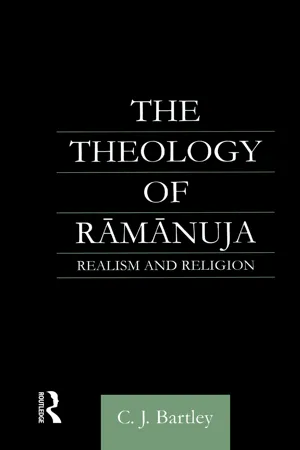
This is the first attempt to understand Ramanuja in the context of his religious and philosophical tradition. It is the only work which establishes his indebtedness to his immediate predecessor Yamuna and which identifies his actual opponents. It is accordingly a contribution to the wider history of classical Indian thought and not just a consideration of a single individual and his tradition.
Information
Chapter One
Some Aspects of Advaita Metaphysics
This chapter will describe some basic concepts of Advaita metaphysics which are the objects of Rāmānuja's polemics. Rāmānuja's presentation of non-dualist tenets is faithful to the views of major Advaitins such as Śaṅkara (650–700 A.D.), Maṇḍana Miśra (650–700 A.D.), Padmapāda (700–750 A.D.), Prakāśātman (950–1000 A.D.), Vimuktātman (950–1000 A.D.) and Sarvajñātman (1000–1050 A.D.).
Advaita Vedānta is a tradition of scriptural exegesis holding that the import of the Upaniṣads is that all experience of difference is the ultimately unreal consequence of ignorance or misunderstanding (avidyā). Reality is autonomous and immediate self-revealing consciousness. Advaita is the philosophy of the radical renouncer (samnyāsin) who divorces himself from the mainstream public religion. For Advaitin consciousness-monists, authentic reality is presented in the Upaniṣads as the Absolute Brahman which is undifferentiated, relationless, static, consciousness and bliss. The self-revealing (sva-saṃvedana) and self-evident (svataḥ siddha) true ‘inner self’ or soul (ātman) which is the permanent and immutable witness (sākṣin) of all conscious states is essentially identical with Brahman thus understood. We are always and only Brahman, homogeneous in essence, non-dual, immutable, unborn, undecaying, undying, immortal, tranquil and the nature of the ātman qua featureless identity. This static conception of the Absolute, evacuated of agency and potentiality is trenchantly criticised not just by the Viśiṣṭādvatin dualists and realists but also in the works of the Kashmiri Absolute Idealists belonging to the Pratyabhijñā school of thought Utpaladeva (925–975 A.D.), Abhinavagupta (975–1030 A.D.) and Kṣemarāja (1000–1050 A.D.) for whom the ultimate principle is wholly autonomous dynamic, reflexive trans-individual consciousness projecting itself as all acts of cognition, individual subjects and objects of awareness through its innate powers of consciousness, precognitive impulse and self-expressive activity. For these thinkers, an inactive absolute principle is impotent.
All plurality of selves, mental events, objects, causes and effects is understood by Advaitins as a function of beginningless ignorance which generates the misapprehension of the self as a personalised individual agent and experient subject to orthodox Vedically defined social and religious duties (varṇa-āśrama-dharma) and transmigration (saṃsāra). The human person is a conflation of spirit and matter. Such a composite has finite and fleeting experiences and is subject to the illusion that it is an agent due to an ultimately unreal centre of individual awareness, a congenital confusion of pure, inactive spirit and the dynamic material sphere. The Advaitic panpsychism's theory of the genesis of personal individuality calls for a radical revision of our everyday understanding of the sort of things that we are. We are not really, in the sense of ultimately, embodied (contingently or not) intentional agents but are rather causally impotent featureless consciousness.
Ignorance of the true identity of the soul and the nature of reality as undifferentiated is the root cause of bondage to the series of births. Non-discursive, gnostic insight, preceded by the renunciation of all ritual actions and caste duties prescribed in the scriptures recognised as binding on and by the orthodox, into the identity of the non-agentive essential self and Brahman negates avidyā and is the necessary condition of release (mokṣa/mukti) from the series of births propelled by motivated and intentional actions.
Salvific knowledge of the Brahman-ātman state can only be derived from the accredited scriptures (śruti) which are the only authoritative means of knowledge (pramāṇa) about trans-empirical reality. Liberating insight is expressed in Upanisadic major statements such as ‘That thou art’ (Tat tvam asi: Ch.Up.6.8.7f.) and ‘I am Brahman’ (Ahaṃ Brahma asmi: Bṛhad Up.1.4.10) apparently asserting the identity of the essential self and the Absolute.
Ritual action and devotion (bhakti), while purifying the mind, cannot of themselves produce release since they presuppose that differences are real and thus belong to the sphere of ignorance. In short, since prescribed actions bind one to transmigration, their renunciation is necessary for release from rebirth.
This essentially gnostic and renunciatory philosophy of non-dualism is obviously antithetical in the extreme to the monotheistic, devotional (bhakti) religion for which Rāmānuja, as a philosopher, is providing a metaphysical and epistemological foundation and articulation. As we have seen, it is a cardinal tenet of Advaita-Vedānta that a form of scripturally derived insight (jñāna) into the identity of the non-agentive self and the absolute reality (Brahman) is the sole necessary and sufficient condition of liberation (mokṣa) from the karma-propelled series of unsatisfactory births in various contingent circumstances (saṃsāra). Religious devotion presupposing a subject-object polarity is obviously at odds with a view of ultimate reality as non-dual and featureless. High on Rāmānuja's agenda were the tasks of combating the monistic interpretation of the Upaniṣadic authorities propounded by Śaṅkara (c.650–700) and his successors, in addition to establishing that our experience of difference (bheda) is veridical.
The Advaitic position that Rāmānuja presents in the Succinct and Major Statements of the Opponent's Position (Laghu and Mahā Pūrva-Pakṣas) in the Śrī Bhāṣya 1.1.1 which is outlined in what follows is an absolute panpsychist monism according to which undifferentiated (nirviśeṣa), inactive, homogeneous consciousness is the sole existent. In terms of this view, Consciousness and Being coincide. But when this Consciousness is somehow sullied by the mysterious force of misconception (avidyā), the universal delusion of plurality arises. It is this pure consciousness (cin-mātra) devoid of every differentiating feature or specific characteristic (viśeṣa) that is called Brahman — the ultimate reality. Everything other than Brahman such as the different mental acts (jñāna) generated by cognisers and objects of cognition is conceptually constructed (parikalpitam) upon Brahman and is false or not fully real (mithyā). The Advaitin derives these claims, in accordance with Vedāntic theological method, from authoritative scriptures (śruti) such as:
Initially this was Being alone, one without a second. (Sad eva, saumya, idam agra āsīd ekam eva advītlyam. (Ch.Up.6.2.1).The Absolute is reality, consciousness, infinite. (Satyaṃ jñānam anantaṃ Brahma. (Tait.Up.2.1.1).Impartite, inactive, tranquil, perfect, flawless. (Niṣkalaṃ niṣkriyaṃ śāntaṃ niravadyaṃ nirañjanam: (Śvet.Up.6.190).Here, there is no diversity whatsoever. (Na nānā'sti kiṃcana: Bṛhad.Up.4.4.16).A modification is a verbal construct whose basis is in language. (Vācārambhaṇaṃ vikāro nāmadheyam: Ch.Up.6.1.4).
The Advaitic protagonist defines falsity (mitbyātva) as that which is eliminated by cognition of an entity as it really is (yathā avasthita vastu), subsequent to erroneous cognition.1 For example, in the case of the snake that is perceived to exist in what is really a rope, the rope is the objective ground upon which the idea of a snake is superimposed. Correspondingly, Brahman is the objective ground upon which the illusion of plurality is superimposed. The Advaitin controversially (because on the micro-level of everyday cognitive error, what is treated as the correcting awareness (‘this is a rope’) will itself be ultimately false) universalises his account of false cognition to an account of the nature of the totality of ordinary experience as logically and ontologically indeterminable. In Rāmānuja's words:
This entire world, with its endless dichotomies which, due to a defect, is conceptually constructed upon the pristine Supreme Brahman which is pure consciousness, is false in that it is eliminated by comprehension of the proper form of Brahman as it really is. The defect is beginningless avidyā, indefinable as being or non-being, which causes the projection of manifold variety and the concealment of the true nature of reality'.2
So salvation derives from knowledge, not devotion or ritual action. The truth will set us free.
Avidyā is to be construed as misconception or misunderstanding (that which is other than knowledge) rather than non-apprehension in accordance with Kaiyaṭa's discussion ad. Pāṇini, Aṣṭādhyāyī, 2.2.6, where the privative affix is given the possible sense ‘other than’). The developed Advaitin tradition is at pains to establish that ignorance may be a positive causal force which it could not be were it construed exclusively as the straightforward absence of knowledge or blank ignorance. Also, it is of crucial significance for the Advaitin that error has an objective ground: it is an erroneous perception of something and not a vain imagination of nothing. Were it so, the way would be clear for the heretical Yogācāra Buddhist idealist ‘mind-only’ view and the Madhyamika Buddhist conclusion that reality is emptiness (śūnyatā). By contrast, the Advaitins are anti-realists about a logically and ontologically indeterminate mind-independent domain.
The Advaitin is accurately depicted as asserting that avidyā is a cosmic force that causes all forms of conceptual construction and misconception about the true nature of reality.
There is something, revealed by perception (pratyakṣa) and inference (anumāna), that is a positive entity (bhāva-rūpa) since it is distinct from the prior absence of knowledge, which is eliminable by knowledge of the true nature of reality, which is expressed by terms such as ajñāna and avidyā, which is indefinable (anirvacanīya) as being or non-being, which is the substrative cause (upādāna) of the superimposition (adhyāsa) upon Reality of manifold external and internal things and which effects the concealment (tirodhāna) of the true nature of reality. Conditioned by that, Brahman is the substrative cause. There is superimposition in the form of cognitions, objects of cognition and the sense of personal individuality (ahaṃkāra) upon the inner self (pratyag-ātman) which is immutable, intrinsically reflexive mere consciousness but whose proper form (svarūpa) is concealed by that super-imposition.3
The theory that Brahman associated with an ontically indefinable delusory force (māyā/avidyā) is the substrative cause of the plural, material world was developed by Prakāśātman (c.950–1000 A.D.) in his Pañcapādikāvivaraṇa: ‘Brahman becomes the universal cause when it is qualified by indeterminable a creative potency.’ (Anirvacanīya-māyā-viśiṣṭaṃ kāraṇaṃ brahmd' (p. 652).
Avidyā is characterised as ‘indefinable as being or non-being’ because the content of a false cognition is a misrepresentation of a mind-independent objective reality (the adhiṣṭhāna...
Table of contents
- Cover
- Half Title
- Title Page
- Copyright Page
- Dedication
- Table of Contents
- Acknowledgements
- Abbreviations
- Tentative Relative Chronology
- Introduction
- 1. Some Aspects of Advaita Metaphysics
- 2. Rāmānuja’s Realistic Metaphysics and Epistemology
- 3. A Panentheistic Theology
- 4. Exegeses of the Mahāvākya, ‘Tat tvam asi’
- 5. Exegeses of the Mahāvākya, ‘Satyaṃ jñānam anantaṃ Brahma’
- Appendix
- Notes
- Bibliography
- Index
Trusted by 375,005 students
Access to over 1.5 million titles for a fair monthly price.
Study more efficiently using our study tools.
Frequently asked questions
Yes, you can cancel anytime from the Subscription tab in your account settings on the Perlego website. Your subscription will stay active until the end of your current billing period. Learn how to cancel your subscription
No, books cannot be downloaded as external files, such as PDFs, for use outside of Perlego. However, you can download books within the Perlego app for offline reading on mobile or tablet. Learn how to download books offline
We are an online textbook subscription service, where you can get access to an entire online library for less than the price of a single book per month. With over 1.5 million books across 990+ topics, we’ve got you covered! Learn about our mission
Look out for the read-aloud symbol on your next book to see if you can listen to it. The read-aloud tool reads text aloud for you, highlighting the text as it is being read. You can pause it, speed it up and slow it down. Learn more about Read Aloud
Yes! You can use the Perlego app on both iOS and Android devices to read anytime, anywhere — even offline. Perfect for commutes or when you’re on the go.
Please note we cannot support devices running on iOS 13 and Android 7 or earlier. Learn more about using the app
Please note we cannot support devices running on iOS 13 and Android 7 or earlier. Learn more about using the app
Yes, you can access The Theology of Ramanuja by C. J. Bartley in PDF and/or ePUB format, as well as other popular books in Social Sciences & Ethnic Studies. We have over 1.5 million books available in our catalogue for you to explore.