- 256 pages
- English
- ePUB (mobile friendly)
- Available on iOS & Android
eBook - ePub
Chivalry
About this book
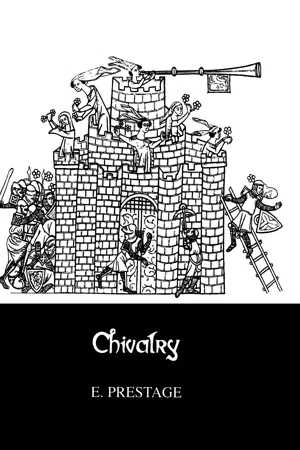
This volume, intended for the general reader, throws a great deal of light on that very characteristic feature of the Middle Ages, the institution of Chivalry. The first chapter deals with the place of chivalry in history, describing its effects and influences. Subsequent chapters address the earliest beginnings of chivalry and its manifestations in France, Germany, Spain, Portugal, etc. Among other subjects dealt with are the Courtesy books, the romances of Chivalry, and the Chivalric ideal. The book is an excellent introduction to a field that has been greatly neglected in recent years. This edition first published in 2005. Routledge is an imprint of Taylor & Francis, an informa company.
Information
CHAPTER IX
LITERATURE
Literature and manners—the Church—the Feudal system—Learning confined to a few—Chronicles—Mediæval poetry a literature of chivalry—Chaucer—Monotony of poetic convention—Cycles of epic and romantic poetry—Provencal—Arabian—Democratic element—Equality in Knighthood and Love—Langue d’oc and langue d’oil—French ascendency—Norman and Celtic, Teutonic, &c. elements in the French romance—Chansons de geste Frankish in origin, French (Romance) in language—Origin of the French language—Eastern Franks (Riparian) retain the Germam speech—French and German nations—Chansons de geste deal with historical personages, German epics with mythological—Other cycles—FJþoþée courtoise—Romans—Welsh—Breton legends—purity of this literature. Doctrine of love þar amours. Fabliaux—Symbolism of romances—Conies and nouvelles—Chronicles and histories—Prose compositions, originating in Northern France, take the places of poems—Other elements—Celtic (Welsh, Breton, Gaelic)—German epics and romances—Rise of English literature.
IF the manners of an age are reflected in the character of its literature, the literature also affects and moulds the manners of the time. To take one instance out of many ; the Renaissance period, taking a starting point from Petrarch, is expressed in its double tendency to reproduce the forms of classical literature and art, and to emancipate itself from mediæval tradition, by the imitation of classical poetry, rhetoric and history, on the one hand, and on the other in a new birth of speculation, and a dramatic and romantic literature classical in form, but modern in subject and sentiment : and this literature in its turn helped to direct philosophical and historical speculation in a modern direction ; whilst the free handling of social subjects, on the stage and in books intended to be read by all classes of society, democratized literature and set a common standard of social and moral conduct.
The most powerful social forces in the middle ages were, on one side the Church, rigid in doctrine, uniform in organization, dignified in ceremony, authoritative in discipline, claiming the entire control over thought and morals, and proclaiming the equality of all men in the sight of God ;. and on the other, the feudal system in war and peace, setting a rule of conduct independent of and often antagonistic to that of the Church, and distinguishing classes by difference of birth expressed in military organization and tenure of land. Books were unknown to all but the clergy, and a few of the noble caste by which the world was governed.
Such works as those of Longland, Gower and Wiclif—to take instances from our own country—in which a democratic spirit breathes, lie aside from the beaten track, and rather foreshadow the outbreaks of popular discontent which accompanied the decay of a military and feudal régime resting upon a settled condition of commerce and agriculture, than speak the current language of the Middle Ages. Those works had to do with the realities of life, the hard rule of churchmen and nobles, and the needy estate of the poor.
If we except the monastic chronicles, which to some extent aimed at setting down things as they were, the popular literature of the chivalric period, no great body of writings, is made up of allegories, apocalypses or visions such as those of Adam de Ros or Longland, church hymns, metrical lives of Saints, mystery plays, popular ballads and stories, political satire and comic or licentious verse ; the remainder, a far larger bulk, is principally in the form of Roman, Chanson de geste, or love-lyric, and deals with the actions of heroes and knights, in war, adventure, or tournament, and with their amours. The poetic literature of the Middle Ages is a literature of chivalry. Poetry took form under chivalric influences, and in its turn affected chivalry. The common people had no share in this, except so far as they might be present when troubadours and trouvères sang or recited their poems in hall, in a language which, if not wholly unknown, was at least unfamiliar to Englishmen of all ranks below the noble or gentle caste. The native literature of England was in abeyance since the Conquest ; or if Chaucer wrote in English for ‘lordynges,’ the influence of his poetry in moulding the language and the poetic temper of England belongs to a later time than his own. Though formed on French models, it is too real, human, and sensible to have much kinship with poets of the conventional French school, a school so conventional that it remained almost unchanged for four centuries. Chaucer ‘makes an epoch and founds a tradition.’1 Like Petrarch, Chaucer is a morning star of poets, and looks forward to the `dayspring of the Renaissance. Dryden, who held him, as ‘the father of English poetry,’ ‘in the same degree of veneration as the Grecians held Homer, or the Romans Virgil,’ calls him ‘a perpetual fountain of good sense’2; and indeed the Renaissance may be called the victory of sense over nonsense. It is not only that Chaucer differed from the French school in his general tone of mind : he found his true expression first after his visit to Italy, where he became acquainted with a literature which had all human life for its material, not a worn-out cycle of imaginary adventure. And so, though he writes of knights and ladies, he does not properly belong to the poetry of chivalry.
It is impossible within the limits of this chapter to do more than trace the outlines of the history of letters before the eleventh and twelfth century. We can only mention the principal sources which combined to form the stream of poetry that runs through the period. Once formed, by the middle of the twelfth century, the accepted conventional’ type varies but little. Allowing for the growth of language,1 an English, German or French romance of the twelfth century hardly differs in sentiment, pictures of manners, and even detail from one of the fifteenth. There is a common stock of ideas and images and a similarity of style which are often tedious. The same cycles of epic and romantic poetry were current in all countries, and furnished models of chivalrous life to the knights and ladies for whom they were written. The gests of Arthur, Roland, Siegfried, Cæsar and Alexander are undistinguishable : time and space have nothing to do with the enterprises of the paladins ; giants and enchanters are as common as knights errant and gentle or hard-hearted ladies. Chivalric romance is summed up in the Orlando Furioso ; with this exception, that what was fairyland to Ariosto was real to the imagination of the Middle Ages,
That birth of new ideas in every branch of thought and action to which we have alluded above, and which marks the first development of the secular civilization of Europe out of Germanic barbarism, had as one of its characteristics a fusion of many national elements into a common convention. National differences exist, besides the main difference of language ; but the type is constant and European, like the mediæval types of architecture and ritual with their divergences of national growth. It is hard to follow the process of fusion by which elements so various and discordant were combined in one. We must look for one model of sufficient strength and development to give its own form to the rest. As the Augustan poetry of Rome, the Elizabethan poetry of England, and that of the eighteenth century take their typical character, apart from the native influences by which they are coloured, from the several forms of Greek, Italian and French poetry ; so in the eleventh and twelfth century, the dominant type, that is, the type of the most polished and reflective poetry, was that of Provence.
The troubadours of Provence were the founders of European poetry. Their own art of song and verse was derived from the Arabs, to whom it had come from Persia.1 All the artifices of rhyme and rhythm had been exhausted by the Arabian poets of Spain, and their methods as well as their subjects and their style were adopted by the Provençals ; and in the matter of form there was little to be added to it.
Arabian poetry spread throughout Christian Spain and through Provence : and a closer connection between Spain and Provence was established by the marriage of Raymond Berenger, Count of Barcelona, in 1112 to Dulcia heiress of Provence, which united the crowns of Catalonia and Provence.
Into the cistern of Provençal poetry flowed streams from very quarter. Among the converging influences which helped to form it we may include that of the higher civilization of Byzantium, brought into light by the Crusades. Byzantine literature, being in an unknown language, did not affect the poetry of Europe : but the sight of so much luxury and ceremonial, the remains of an ancient civilization, as was exhibited to the western barbarians who visited Constantinople in the first and second Crusades could not but touch those of them who, like the Provençals, had already some social refinement. Ceremony had its home at the Eastern court, and was brought back thence into Western Europe. In Eastern Christendom, too, women enjoyed a higher position and had more deference paid to them than in the West, where a wife or a daughter was the property of her guardian, and the forms of Roman or barbaric law tempered the practice of Christian civilization.
The notion of equality in knighthood and love was in harmony with the democratic feeling of Provence. Wherever a country has been completely Romanized, there a sense of civic equality may generally be found. The bourgeoisie is not wholly despised. The South of France was always less feudal than the North. The knighthood of France and Germany belongs only to those who are nobly born. In the South the humblest born jougleur1 may become a troubadour and a knight. Poetry made all poets equal, from princes like William Count of Poitou and Bertrand de Born to Bernard of Ventadour the baker’s son, who was the lover of the Countess of Ventadour his lord’s wife, and then of Eleanor Queen of France.
Something like this equality may be observed north of the Loire in the equality of knighthood.1 The Knights of the Garter and the Golden Fleece, like the Knights of the Round Table, are all equal in chivalry, and bear the name of Companions : the King of France thinks he is receiving as well as conferring an honour when he is knighted by the Chevalier Bayard. The brotherhood of poets is like the brotherhood of knights. Without doubt the less feudal, scholastic, ecclesiastical Provence modified the stiffness of the French aristocracy : but as a general rule it would appear that chivalry in the south tended to equalize different classes, and in the north to keep the noble caste apart.
A feeling of equality in all that concerned love was maintained by the subjection of all questions of faithlessness in love to a Court of Love2 presided over by noble ladies, which might censure lovers alike of high and low degree. That such courts were rather a plaything than a serious institution, like the Earl Marshal’s Court of Honour in England, we may admit : but they must have supplied a corrective to irregular and unlicensed intercourse, and helped to set a conventional standard, which, however low, was higher than what preceded it.
Besides the workmanship of the poetic craft and the regulation of love by legislation, to the Provençals above all belongs that essential of the chivalrous spirit which they called Joy. Joie d’amour is the sum of chivalry. Hence the term ‘gay science’ (gay saber). Love, generosity, courtesy, all depend on joy, the enthusiasm of life. To this belong graceful behaviour, honour to men, respect to ladies, and noble pride (parage). A knight must carry joy into every part of life. He may never be melancholy, except when ...
Table of contents
- Cover
- Halftitle
- Title
- Copyright
- Editorial Preface
- Contents
- List of Illustrations
- Preface
- I. Introductory
- II. Knighthood
- III. Education
- IV. War
- V. Tournaments
- VI. Crusades
- VII. Heraldry
- VIII. Ceremony
- IX. Literature
- X. Military Orders
- XI. International
- XII. Position of Women
- XIII. Religion
- XIV. People
- XV. Decline
- XVI. Merits and Faults
Trusted by 375,005 students
Access to over 1.5 million titles for a fair monthly price.
Study more efficiently using our study tools.
Frequently asked questions
Yes, you can cancel anytime from the Subscription tab in your account settings on the Perlego website. Your subscription will stay active until the end of your current billing period. Learn how to cancel your subscription
No, books cannot be downloaded as external files, such as PDFs, for use outside of Perlego. However, you can download books within the Perlego app for offline reading on mobile or tablet. Learn how to download books offline
Perlego offers two plans: Essential and Complete
- Essential is ideal for learners and professionals who enjoy exploring a wide range of subjects. Access the Essential Library with 800,000+ trusted titles and best-sellers across business, personal growth, and the humanities. Includes unlimited reading time and Standard Read Aloud voice.
- Complete: Perfect for advanced learners and researchers needing full, unrestricted access. Unlock 1.5M+ books across hundreds of subjects, including academic and specialized titles. The Complete Plan also includes advanced features like Premium Read Aloud and Research Assistant.
We are an online textbook subscription service, where you can get access to an entire online library for less than the price of a single book per month. With over 1.5 million books across 990+ topics, we’ve got you covered! Learn about our mission
Look out for the read-aloud symbol on your next book to see if you can listen to it. The read-aloud tool reads text aloud for you, highlighting the text as it is being read. You can pause it, speed it up and slow it down. Learn more about Read Aloud
Yes! You can use the Perlego app on both iOS and Android devices to read anytime, anywhere — even offline. Perfect for commutes or when you’re on the go.
Please note we cannot support devices running on iOS 13 and Android 7 or earlier. Learn more about using the app
Please note we cannot support devices running on iOS 13 and Android 7 or earlier. Learn more about using the app
Yes, you can access Chivalry by Edgar Prestage,Prestage in PDF and/or ePUB format, as well as other popular books in Social Sciences & Anthropology. We have over 1.5 million books available in our catalogue for you to explore.