- 388 pages
- English
- ePUB (mobile friendly)
- Available on iOS & Android
eBook - ePub
About this book
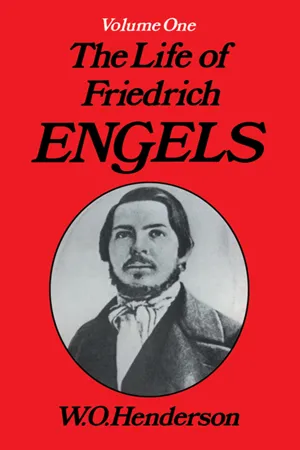
First published in 1976. The year 1970 saw the 150th anniversary of the birth of Friedrich Engels who was Karl Marx's most intimate friend and collaborator. Today the disciples of Marx and Engels are numbered in millions and the way of life of great states is based upon their doctrines. An understanding of the career and work of Friedrich Engels is essential to an appreciation of the origin and development of the Marxist form of socialism in the nineteenth century. This is the first volume in a set of two.
1
THE ROAD TO COMMUNISM 1820–18441
I. Marx and Engels
Life in six cities in three countries helped to mould Karl Marx’s closest friend and colleague into a communist. In Barmen, his birthplace, Friedrich Engels learned to hate the millowners and the Puritan way of life. In Bremen the life of a great seaport gave him his first glimpse of a wider world than that of a small provincial manufacturing town. In Berlin he gained his first experience of military affairs when he served for a year in the Prussian army while at the same time he received intellectual stimulus from his attendance at University lectures and from his contacts with the Young Hegelians. In London he met a group of exiled German workers who had become professional revolutionaries. In Manchester Engels became aware of the social evils brought about by the industrial revolution and he met Julian Harney, James Leach and other Chartists. And a brief visit to Paris in the autumn of 1844 saw the beginning of his collaboration with Karl Marx that lasted for nearly forty years.
Friedrich Engels became the junior partner of the most famous intellectual team of the nineteenth century. Marx and Engels formulated the doctrine of dialectical materialism and spent a lifetime in applying it to politics, to philosophy, to economics, to history, to literature, to art and to science. Together they founded the international socialist movement and gave it a programme in the Communist Manifesto. Together they started a political movement whose adherents accepted its principles with all the fervour of a new religion. The followers of Marx and Engels came to be counted by millions and fifty years after the establishment of the communist régime in Russia the influence of their ideas is more powerful than ever. Karl Marx gave his name to a new system of philosophical ideas and to a new political movement. His genius was recognised in his own day even by those who most detested his ideas and his political aims.
Yet without Engels the genius of Marx might have withered away. It was Engels who was largely responsible for stimulating Marx to apply his philosophical doctrines to the study of economics. It was Engels who gave Marx the financial help that saved him from perishing miserably in his London lodgings. It was Engels who readily placed his facile pen at Marx’s disposal so that the arid pages of Das Kapital sprang to life in Anti Dühring which enabled thousands of readers to understand the basic tenets of the Marxist doctrine. Ten years after Engels’s death the German socialist historian Franz Mehring declared that there was “more danger of underestimating than of overestimating him”.2 Engels was far more than a mere assistant of Marx or an interpreter of Marx’s ideas after his master’s death. He worked with Marx as an independent collaborator and he made his own contributions to socialist doctrines.
II. Barmen 1820–38
The fact that Friedrich Engels was born in Barmen (November 29, 1820)3 had an important influence upon his formative years. Barmen differed in two respects from many other German towns in the 1820s and 1830s. It was part of a manufacturing district in which the social evils of industrialisation could be seen some time before they became evident elsewhere4 and it lay in one of the few regions in which most of the Protestant churches accepted the Pietist – or Puritan – doctrines and way of life. Engels’s father was both a leading industrialist and a staunch Pietist and these two circumstances dominated Engels’s boyhood.
The twin towns of Elberfeld and Barmen – with a population of over 40,000 after the Napoleonic wars – lay in the steep valley of the River Wupper, a tributary of the River Rhine. They formed part of the district of Berg and had been incorporated in the Prussian province of the Rhineland in 1815. In the later middle ages the lime-free waters of the Wupper were found to be suitable for bleaching linen yarn. At first the yarn came from the Low Countries but later some of it was spun and woven locally. By the eighteenth century silk and cotton had been added to the yarns that were bleached in the valley of the River Wupper. Barmen specialised in the production of cotton goods. The first cotton mill to be driven by water power in the valley of the Wupper was erected in 1785.5 At the beginning of the nineteenth century the spinning process was largely mechanised but much weaving was still done on handlooms. In 1809 P. A. Nemnich described the Grand Duchy of Berg – which included the valleys of the Ruhr and the Wupper – as “a miniature England”.6 After the Napoleonic wars the collapse of the Continental System and the consequent revival of English competition led to a depression in Elberfeld and Barmen and many of the handloom weavers were out of work.7
The fortunes of the Engels family had been founded in the second half of the eighteenth century by Johann Caspar Engels (the elder), who was Friedrich Engels’s great-grandfather. This Johann Caspar began his career as a yarn merchant in a small way and in about 1770 he set up his own bleachworks and workshops for the manufacture of lace and ribbons. He became one of the leading citizens of Barmen and had the reputation of being a good employer who assisted his workers to buy their own cottages and gardens.8
In the next generation the firm was carried on by the two sons of the founder, one of whom was Johann Caspar (the younger), the grandfather of Friedrich Engels. He expanded the business and carried on the family tradition of social work by founding a school for the children of his operatives (1796) and by setting up a co-operative granary to provide cheap flour during the food shortage of 1816. On the death of Johann Caspar (the younger), his three sons – Engels’s father Friedrich and two uncles – inherited the business. This partnership did not work smoothly and eventually Engels’s father went into partnership with the brothers Godfrey and Peter Ermen to operate cotton spinning in Manchester,9 Barmen and Engelskirchen10 (1837–41). The German firm combined the manufacture of various kinds of cotton yarn and thread with the old established bleachworks. The English firm owned the Victoria Mills near Pendleton.11 Engels’s father is said to have been one of the first millowners in the Rhineland to install English machines in his factories.12
As a schoolboy Engels became familiar with the cotton trade since so many members of his family were engaged in it and he was sufficiently observant to appreciate something of the conditions under which the operatives and craftsmen of his native town lived and worked. At the age of nineteen he wrote an article in which he described the wretched lives of the lower classes in the Wupper valley and he pilloried the millowners whom he held responsible for this state of affairs. He declared that the weavers were robbed of their health by bending over their looms for excessively long hours, that the tanners were physical wrecks after only three years, that the carriers were “a crew of utterly demoralised fellows”, and that over a thousand children of school age were employed in the factories.13 Many workers suffered from consumption and syphilis because of bad working conditions and poor housing. At week-ends the inns were packed and disgraceful scenes were witnessed at closing time.14 Many years later Engels recalled the evil consequences of the introduction of Prussian brandy into the Wupper valley in the late 1820s. He claimed that he could remember seeing crowds of drunken revellers staggering arm in arm along the streets and that quarrels and knifings were a common occurence.15
All this made a deep impression upon the young Engels. Already he recognised the gulf that separated the two social classes in his native town – the millowners on the one hand and the operatives and craftsmen on the other. He came to detest the millowners – the class to which his own father belonged – for he held them responsible for the wretched condition of the workers. He considered that the middle classes of the Wupper valley were to be condemned not only for the callous way in which they exploited their operatives but for their philistine way of life. “In Elberfeld and Barmen”, he wrote in 1839, “a person is considered to be educated if he plays whist and billiards, talks a little about politics and has the knack of paying a compliment at the right time. These fellows lead an awful life and yet they are quite content. All day long they immerse themselves in figures in their offices and it is difficult to realise how zealously they throw themselves into their work. In the evening all of them regularly go to their clubs to smoke, play cards and talk politics. At the stroke of nine they all go home. One day is just like another without anything changing. And woe to anyone who interferes with this strict routine. The penalty would be to fall into disgrace with all the best families.”16
Elberfeld and Barmen were not only industrial towns but they were also one of the main centres of the Pietist movement in Germany. There had been Puritan sects in Germany in the late seventeenth century and in the eighteenth century which subscribed to the Calvinist doctrine of predestination and ran their affairs on Presbyterian lines. Like the English Puritans they tried to regulate strictly the daily lives of their members. They wore sombre garments, they were strict Sabbatarians, and they frowned upon such worldly pleasures as reading novels, dancing, and visiting the theatre or the opera. Pietism had declined in the late eighteenth century with the rise of the rationalist ideas of the Enlightenment. But the movement revived in a new form in the early nineteenth century as a reaction against the excesses of the French Revolution. It was this type of Pietism – known as “Restoration Pietism” – that flourished in the Wupper valley in the 1820s. The Pietists believed in the literal truth of every word in the Bible and they were intolerant of those who views differed from their own. Their leader in Elberfeld and Barmen was Pastor F. W. Krummacher who eventually became court preacher to Frederick William IV of Prussia. Krummacher was a fiery preacher whose “narcotic sermons” (as Goethe called them) moved his congregation to tears when he described the fate that awaited evildoers in the next world.17
Since Engels’s parents were Pietists he had a strict upbringing at home, in church and at school. Engels does not appear to have reacted against his religious instruction during his school days and when he was confirmed at the age of seventeen he was, at any rate outwardly, a believing Christian. But after he had left home for Bremen his attitude changed. In 1839 he wrote to his friend Friedrich Graeber that the Wupper valley was very properly criticised for its mysticism and obscurantism.18 He claimed that he had never accepted the doctrines of the Pietists and that he was a “supernaturalist”.19 “If, at the age of 18, one has read Strauss,20 the Rationalists and the Kirchen Zeitung one must either stop thinking for oneself or one must begin to doubt one’s Wuppertal faith. I simply do not understand how the orthodox clergy can be as orthodox as they are in view of the fact that the Bible is so full of contradictions.”21
Engels declared that he was “a wholehearted disciple of Strauss”22 and that through Strauss he had taken “the road that leads straight to Hegelianism”.23 He dismissed the Calvinist doctrine of predestination as a patent absurdity24 and he attacked Krummacher for being so silly as to expect his flock to believe that the sun revolves round the earth. “The fellow dares to shout this to all the world on April 21, 1839 and yet he argues that Pietism is not leading us all back to the middle ages. It really is a scandal!”25 In the following year Engels wrote an article describing a lively controversy which had broken out in Bremen when Krummacher delivered two sermons there. Engels attacked “the Pope of the Wuppertal Calvinists and the St Michael of the doctrine of predestination” in no uncertain terms.26 By this time he had taken the first step on the road from Pietism to atheism.27
If Barmen was exceptional because of its relatively early industrialisation and its fervent Pietism, it shared with many other Prussian towns a firm loyalty to the Hohenzollerns. Although the Wupper valley had only been joined to Prussia in 1815 the inhabitants quickly accepted their new rulers. Provided that they could keep the liberal Code Napoléon they were quite prepared to become loyal subjects of the King of Prussia.28 And so Engels grew up in a household in which respect for the throne came second only to unqualified acceptance of Pietism doctrines. Here, too, there is ample evidence that soon after he left home for Bremen, Engels began to deviate from the political views of ...
Table of contents
- Cover
- Halftitle
- Title
- Copyright
- Dedication
- Contents
- Illustrations
- Introduction
- 1 The Road to Communism 1820–1844
- 2 The Condition of the Working Class in England in 1844
- 3 The Young Revolutionary 1845–1850
- 4 The Manchester Years 1850–1870
- 5 Friends in Exile
- Documents
- Index
Trusted by 375,005 students
Access to over 1.5 million titles for a fair monthly price.
Study more efficiently using our study tools.
Frequently asked questions
Yes, you can cancel anytime from the Subscription tab in your account settings on the Perlego website. Your subscription will stay active until the end of your current billing period. Learn how to cancel your subscription
No, books cannot be downloaded as external files, such as PDFs, for use outside of Perlego. However, you can download books within the Perlego app for offline reading on mobile or tablet. Learn how to download books offline
Perlego offers two plans: Essential and Complete
- Essential is ideal for learners and professionals who enjoy exploring a wide range of subjects. Access the Essential Library with 800,000+ trusted titles and best-sellers across business, personal growth, and the humanities. Includes unlimited reading time and Standard Read Aloud voice.
- Complete: Perfect for advanced learners and researchers needing full, unrestricted access. Unlock 1.5M+ books across hundreds of subjects, including academic and specialized titles. The Complete Plan also includes advanced features like Premium Read Aloud and Research Assistant.
We are an online textbook subscription service, where you can get access to an entire online library for less than the price of a single book per month. With over 1.5 million books across 990+ topics, we’ve got you covered! Learn about our mission
Look out for the read-aloud symbol on your next book to see if you can listen to it. The read-aloud tool reads text aloud for you, highlighting the text as it is being read. You can pause it, speed it up and slow it down. Learn more about Read Aloud
Yes! You can use the Perlego app on both iOS and Android devices to read anytime, anywhere — even offline. Perfect for commutes or when you’re on the go.
Please note we cannot support devices running on iOS 13 and Android 7 or earlier. Learn more about using the app
Please note we cannot support devices running on iOS 13 and Android 7 or earlier. Learn more about using the app
Yes, you can access Friedrich Engels by W.O. Henderson in PDF and/or ePUB format, as well as other popular books in Economics & Economic Theory. We have over 1.5 million books available in our catalogue for you to explore.