- 400 pages
- English
- ePUB (mobile friendly)
- Available on iOS & Android
eBook - ePub
About this book
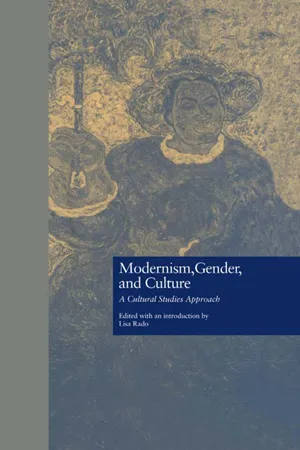
Focusing on cultural practices, and gender issues during a period of the early 20th-century that witnessed radical transformations in sex roles, this anthology of original (and one classic) essays will generate a greater understanding of women's contributions to modernist culture, and explore how that culture was affected by gender issues. The essays provide a wealth of insights into literature, painting, architecture, design, anthropology, sociology, religion, science, popular culture, music, issues of race and ethnicity, and the influence of 20th-century women and sexual politics.
Information
PART I. INTRODUCTION
1 THE CASE FOR CULTURAL/GENDER/
MODERNIST STUDIES
Lisa Rado
If you look at it closely, the field of cultural studies seems a lot like an onion; when you peel away all its layers you won't find anything left in the center. As Simon During, editor of a widely read collection of essays on the subject, admits, this mode of criticism “possesses neither a well-defined methodology nor clearly demarcated fields for investigation” (During 1).
Part of the difficulty in defining cultural theory is the ambiguity of its own primary term. What, exactly, constitutes culture? Material history? Artistic expression? Popular social beliefs and practices? “The best which has been thought and said” (Arnold 6)? That it comprises all of the above and more for contemporary critics is evidenced by the fact that the essays in During's own encyclopedic volume are grouped according to categories as diverse as “theory and method”; “space and time”; “nation”; “ethnicity and multiculturalism”; “sexuality”; “carnival and utopia”; “consumption and the market”; “leisure”; and “media.” Perhaps because of this amorphousness, the field of cultural studies lacks the singular deities and sacred texts that supply authoritative doctrine for orthodox followers of other so-called “high” theories.1 This discipline has its stars, of course, but they all have their own agendas, ideologies, and special interests. While Bakhtin and Stallybras and White focus on the relationship between high and low culture, Adorno and other Frankfurt school theorists focus on twentieth-century cultural hegemony; Jameson centers on Marxism; Foucault on sexuality; Williams on the city; Said, Bhabha, and Spivak on postcolonial issues; Gates and West on African-American studies; Clifford and Geertz on anthropological approaches to culture; Lyotard and Hutcheon on the culture of postmodernism; Haraway and Laqueur on scientific approaches to culture; Sontag and Wicke on popular culture; Lears and Turner on American studies, and so on.
Cultural studies is thus less a theory than a loosely connected series of critical approaches and methodologies whose only unifying principle is the assumption that since cultures have unique historical contexts, an understanding of these contexts and the interactions between them is central to the understanding of any form of cultural production. Even this general definition signals important problems, however. If cultural studies means the identification and understanding of cultural contexts, how much is enough to comprise or authorize critical certainty? In other words, to what degree must one explore national, racial, religious, ethnic, sexual, and other cultural discourses and identities in order to understand or make arguments about a particular individual or text? Despite the fact that it is based on the recognition of subjectivity and difference, the theory implies that the properly equipped scholar can still come to an objective understanding of at least some aspects of culture her- or himself. Yet without any scholarly consensus on formal practice, cultural studies remains open to charges that it is not only itself subjective and idiosyncratic, but also a potentially reductivist and exclusionary mode of inquiry that ironically has the capacity to fall prey to the same kind of ethnocentric bias that it condemns in other theories.
A more fundamental problem with cultural studies is that its claims are ultimately based on causal logic; in other words, arguments following the basic pattern of “x” cultural discourse(s) shaped “y” cultural text/idea/ value or vice versa. Yet as any student of philosophy knows, causal claims are notoriously difficult to verify, as they often rely on associative rather than empirical proofs. The task of proving agency, the actual link between cause and effect, is even harder when both sides of the equation are ideas or theories rather than physical objects or processes. Identifying proximate and remote causes of the form of an aesthetic object, the particular language of a text, or the central emphasis of a theory or belief system can at best be a matter of probability.
With all these shortcomings, why then bother to pursue a cultural studies approach at all? More particularly, why advocate its use for feminist critics, whose personal and political investment in both their scholarship and their audience is so very high? The answer, I will argue, is that despite its ambiguity and philosophical messiness, cultural theory remains the one critical mode that forces us to recognize that individual context matters. By “context,” I mean the specific historical, environmental, and social circumstances in which a person or group of people are situated. Minimizing or denying the relevance of such information for aesthetic and/or textual interpretation, major theoretical “schools” including new criticism, poststructuralism, psychoanalytic criticism, and even some forms of Marxism and feminism end up homogenizing both language and human experience.2 Their analyses are thus not only reductive and even potentially anachronistic; they actually silence important hidden discourses that exist behind, beyond, and around the text at hand. These discourses are crucial for any serious hermeneutical inquiry, for, as Homi Bhabha points out,
It is in the emergence of the interstices-the overlap and displacement of domains of difference-that the intersubjective and collective experiences of nationness, community interest, or cultural value are negotiated. How are subjects formed “in-between,” or in excess of, the sum of the “parts” of difference (usually intoned as race/class/gender, etc.)? (2)
The voices of the “in-between” are precisely what gets left out if one adopts an ahistorical critical approach. That those voices are often gendered female is a fact feminists already know; however, understanding them in all their resonances demands a theoretical method that insists upon tracing their language, symbols, and emphases both to their relevant cultural antecedents and their multiplicitous allegiances to race, sexuality, class, nationality, and so on. This is not to say that all art is reactive. Certainly the dialogue between the aesthetic and the political or social works both ways and often consists of more than one conversation. Yet we simply cannot claim to understand any cultural communication without an understanding of the context of all its major terms.
Given that feminist theory is based on the reality of specific historical experiences of oppression, it would seem natural that a cultural studies approach would offer the best means of documenting and analyzing the manifestations of patriarchal persecution and feminist resistance. One cannot win a war without identifying the villain; unless feminist critics can illuminate the shadowy spectre of paternalism in all its incarnations, we cannot hope to see it vanquished or even to fully authorize our resistance in the first place. Yes, cultural theory has its limitations as a weapon in this struggle. Limited both by the bounds of causal argument and the problems of contextualization that I discussed earlier, it cannot promise to be our Excalibur. However, given that our other options involve using theories based on definitions of experience that are totalizing and incomplete, we cannot afford not to pass by this imperfect but potentially powerful tool. After all, even a slingshot is rumored to have brought down giants.
In addition to supplying an effective arsenal in the struggle to expose and defeat the laws of the fathers, cultural theory offers a means of getting beyond a number of frustrating problems plaguing current feminist theory today. Perhaps the most important of these is the debate over whether feminism as a practice totalizes (female) identity and in doing so reduces its relevance to concrete social problems and alienates numerous subjects from its potential rewards.3 As Linda Nicholson and Nancy Fraser have argued, “Essentialist vestiges persist in the continued use of ahistorical categories like gender identity without reflection as to how, when, and why such categories originated and were modified over time” (33). By better contextualizing such categories, cultural studies has the potential to preserve an identity politics necessary for ideological change while at the same time maintaining important distinctions between women that affect their experiences of oppression and empowerment. Teresa de Lauretis gestures toward this kind of practice when she describes in the conclusion of a recent article a theory
of the female-sexed or female-embodied social subject, whose constitution and whose modes of social and subjective existence include most obviously sex and gender, but also race, class, and any other significant sociocultural divisions and representations; a developing theory of the female-embodied social subject that is based on its specific, emergent, and conflictual history. (267)
Acknowledging the multiplicity of identity, cultural studies can thus work to replace binary, male-female dialogics with more complex constructions of gender that reflect the fact that “femininity … resides in the actuality of its multiple, diverse but determinate articulations, which are themselves criss-crossed by other cultural logics and hierarchies of power” (Felski 201).
Just as it can help provide a more historically specific account of women's experiences and articulations, this mode of criticism can also allow for a richer understanding of cultural hegemony, particularly related to issues of gender. As Judith Butler rightly insists, “it has become increasingly important to resist the colonizing epistemological strategy that would subordinate different configurations of domination under the rubric of a transcultural notion of patriarchy” (35). It is important because by preserving a unitary image of the Father and his Law, we considerably weaken our arguments with avoidable straw-man fallacies and end up alienating women whose experiences of oppression differ from the standard model. However, by carefully locating and identifying the patriarchy's various, ever-evolving discourses and strategies, we will have a more authoritative position from which to expose and critique even its most illicit, underground forms. Of course all forms of paternalism share the common factor of man's lack of recognition of female equality. Yet as theorists like Thomas Laqueur and Gayatri Spivak have shown, how they articulate this ideology differs greatly from culture to culture and century to century. In a literary context, we must recognize that Mary Wollstonecraft's struggle was as rooted in mid-eighteenth-century British discourses of-for example-class, work, and sanity as Toni Morrison's is in late-twentieth-century Midwestern American discourses of race, media, and sexuality.
In addition to better documenting patriarchal repression, cultural studies assures a fuller recognition of women's contribution to culture than other critical modes by elevating the genres traditionally deemed “low” culture to the level of scholarly inquiry and debate. As theorists like Rita Felski and Suzanne Clark have pointed out, sentimental and other so-called nonexperimental discourses have “successfully functioned to promote women's influence and power” (Clark 38) despite the efforts of male culture-bearers to devalue them. Furthermore, by examining the total output of women's creativity over diverse fields such as literature, art, social science, and science, we can come to a much greater understanding of and appreciation for the contribution of women to a particular culture as a whole.
Finally, cultural studies offers a means to establish a far more complex understanding of the relationship between gender and creative production by viewing the imagination as a culturally constructed entity whose concerns extend well beyond the “anxiety of influence” generated by artists of previous generations. While I do not wish to undervalue Bloom's ground-breaking theory, I believe it is important that we acknowledge the rest of the story, which is that artists and intellectuals are human beings themselves situated within a complex network of historically specific interconnecting conversations involving, to use Trollope's phrase, “the way we live now.” Understanding this means recognizing that the process of textual signification involves not only determining the author's voice, but uncovering the dialogic strands connecting the author to an ongoing conversation with historically specific partners, speakers, and listeners. To “read” a text or a work of art is thus to eavesdrop upon, to hear snatches of a much larger cultural interchange to which we must turn if we are to gain a more authoritative perspective on the function and meaning of gender in the production of a particular “speakerly” contribution.
Turning now from its appeal for feminist critics in general to its particular relevance for those of us engaged in the study of the modern period (1890–1945), I would like to sketch out why cultural studies offers a particularly rich approach to modernist art and texts. In my first collection, Rereading Modernism: New Directions in Feminist Criticism, I made a very impassioned case for the necessity of “a more historical and interdisciplinary approach” to a period “in which science, art, psychology, technology, sociology, anthropology, and philosophy were simultaneously undergoing a period of revolutionary change” (12). Arguably witnessing...
Table of contents
- Cover
- Half Title
- Wellesley Studies in Critical Theory, Literary History, and Culture
- Full Title
- Copyright
- Contents
- General Editor's Preface
- Part I. Introduction
- Part II. Modernism's [Em] Space
- Part III. Gendered Modernism from the Margins
- Part IV. Gender and Modernist Arts
- Part V. Gendered Crisscross
- Contributors
- Index
Trusted by 375,005 students
Access to over 1.5 million titles for a fair monthly price.
Study more efficiently using our study tools.
Frequently asked questions
Yes, you can cancel anytime from the Subscription tab in your account settings on the Perlego website. Your subscription will stay active until the end of your current billing period. Learn how to cancel your subscription
No, books cannot be downloaded as external files, such as PDFs, for use outside of Perlego. However, you can download books within the Perlego app for offline reading on mobile or tablet. Learn how to download books offline
Perlego offers two plans: Essential and Complete
- Essential is ideal for learners and professionals who enjoy exploring a wide range of subjects. Access the Essential Library with 800,000+ trusted titles and best-sellers across business, personal growth, and the humanities. Includes unlimited reading time and Standard Read Aloud voice.
- Complete: Perfect for advanced learners and researchers needing full, unrestricted access. Unlock 1.5M+ books across hundreds of subjects, including academic and specialized titles. The Complete Plan also includes advanced features like Premium Read Aloud and Research Assistant.
We are an online textbook subscription service, where you can get access to an entire online library for less than the price of a single book per month. With over 1.5 million books across 990+ topics, we’ve got you covered! Learn about our mission
Look out for the read-aloud symbol on your next book to see if you can listen to it. The read-aloud tool reads text aloud for you, highlighting the text as it is being read. You can pause it, speed it up and slow it down. Learn more about Read Aloud
Yes! You can use the Perlego app on both iOS and Android devices to read anytime, anywhere — even offline. Perfect for commutes or when you’re on the go.
Please note we cannot support devices running on iOS 13 and Android 7 or earlier. Learn more about using the app
Please note we cannot support devices running on iOS 13 and Android 7 or earlier. Learn more about using the app
Yes, you can access Modernism, Gender, and Culture by Lisa Rado in PDF and/or ePUB format, as well as other popular books in Literature & Literary Criticism. We have over 1.5 million books available in our catalogue for you to explore.