- 240 pages
- English
- ePUB (mobile friendly)
- Available on iOS & Android
eBook - ePub
About this book
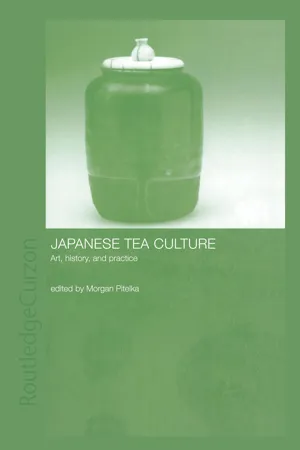
From its origins as a distinct set of ritualised practices in the sixteenth century to its international expansion in the twentieth, tea culture has had a major impact on artistic production, connoisseurship, etiquette, food, design and more recently, on notions of Japaneseness. The authors dispel the myths around the development of tea practice, dispute the fiction of the dominance of aesthetics over politics in tea, and demonstrate that writing history has always been an integral part of tea culture.
Information
1 Commerce, politics, and tea
The career of Imai Sōkyū (1520–1593)
Andrew M. Watsky
Introduction
The ritual preparing and drinking of powdered green tea was significant in sixteenth-century Japan for more than its contribution to a still-reverberating and distinctly Japanese aesthetic. Of equal, if not greater, importance was the role it played as a widely accepted forum for men of different social strata. Tea allowed warriors and merchants to make formal contacts and eased their communications regarding the many concerns they shared. These intertwined aspects of tea – the aesthetic and political – have often been commented on. Sen no Rikyū (1522–1591) in particular has been the subject of countless scholarly writings, for his crucial role in developing the aesthetics of tea in the late sixteenth century and for his politically colored activities as tea master to Toyotomi Hideyoshi.1 The attention accorded Rikyū has had the unfortunate consequence, however, of overshadowing other tea men of the time and thus obscuring some of the rich complexities of the period.
This chapter aims to shed light on one of these marginalized figures, Imai Sōkyū (1520–1593). Throughout the rule of Oda Nobunaga (1534–1582), Sōkyū was pre-eminent among the merchant tea men of the flourishing port city of Sakai. His central role in the rapidly developing tea aesthetic is manifest in his connoisseurship and acquisition of tea utensils that were widely commented on by fellow tea men as the finest in Japan.2 During this period, moreover, no one was so skilled as he in using aesthetic means to achieve decidedly non-aesthetic ends. With Nobunaga’s backing, Sōkyū garnered numerous lucrative appointments and privileges that made him one of the most successful participants in the conflux of art and power that was sixteenth-century tea. Sōkyū should, indeed, be recognized as a model for Rikyū, who enjoyed his most successful years under Hideyoshi, only after the death of Nobunaga and the waning of Sōkyū’s fortunes.
To begin, it is instructive to follow Sōkyū’s account of a Sakai tea gathering held in 1554. The host was the leading tea master of the day, Takeno Jōō (1502–1555). The only two guests were Sōkyū and Matsunaga Hisahide (1510–1577), one of the most powerful warriors in the city. Sōkyū describes the proceedings in his tea diary, first listing the utensils used according to their relative placement within the tea room.3 Among them were a large jar for tea leaves and a small container for powdered tea, identified respectively as the Matsushima jar (tsubo) and the “eggplant” tea caddy (nasu chaire).
Sōkyū lingers in his discussion of these two objects. He notes, “The jar is not very large; there are holes on the front near the base. It is a particularly fine jar.” For the small tea caddy, he provides four precise measurements and comments, “The overall shape is excellent. On the bottom is written in Jōō’s brush the name [of the tea caddy] ‘Miotsukushi,’ and [Jōō’s] cipher.” In this, the opening entry of his tea diary, Sōkyū exercises his considerable powers of connoisseurship and political acumen. He locks his gaze on two utensils that, as will be seen below, captured the attention of the most influential mercantile and political figures of his age, including Nobunaga. Sōkyū used the Matsushima jar and the eggplant tea caddy – and tea culture as a whole – to help further his remarkable career.
Sōkyū’s career can be traced in considerable detail, through a wealth of contemporary materials, including tea diaries and letters, many of which invoke Nobunaga’s name and authority. In this chapter, I begin with the years leading up to his initial contact with Nobunaga, and then focus on the period during which his interactions with the ruler brought him to the height of political influence and commercial success.
Sōkyū’s early years
Sōkyū’s ancestry and early years prior to the 1550s must be pieced together, primarily from retrospective accounts.4 Claiming warrior ancestry for the Imai, an eighteenth-century family lineage states that the clan descended from the Sasaki of Omi province and that during the Bunmei era (1469–1487) Sōkyū’s grandfather was castellan in the town of Imai, in Takashima county, from which the family name was taken.5 Sōkyū later moved to Sakai, and retrospective accounts consistently note his association with the tea master Takeno Jōō.6
The earliest known contemporary reference to Sōkyū dates to 1551, and is found in the tea journal of the prominent Sakai merchant and tea man Tsuda Sotatsu (1504–1566).7 Recording a gathering he had hosted, Sotatsu lists Sōkyū as one of seven guests. But to be invited to a gathering hosted by Sotatsu is evidence of Sōkyū’s entrée into the rarefied circle of Sakai’s tea society that he would eventually come to dominate. Within three years of Sōtatsu’s gathering, Sōkyū was invited to share tea with Takeno Jōō, as mentioned above. In 1554 he returned the invitation to Jōō, to whom he refers with the respectful suffix of “elder” (rō), inviting the master to his residence for a private tea.8 By the mid-1550s Sōkyū had also attained a measure of success in his commercial career, as reflected in a 1554 document that records his substantial cash donation of 170 kan9 to Daisen’in, a sub-temple of Daitokuji.10
In the following year Sōkyū with Jōō and two others attended a gathering hosted by Sen no Rikyū, who thus makes his first appearance in Sōkyū’s extant diary; he is called by the name he then used, Sōeki.11 Sōeki would eventually eclipse Sōkyū in the favor of the ruling elite and in his importance within the historical tea hierarchy. At this time, however, Sōeki was a junior member of the trio of rising merchant tea men that also included Sōkyū and Tsuda Sōtatsu’s son, Sōgyū. The material wealth of Sōeki, also born of a merchant house, may be ascertained by Sōkyū’s account, which notes that on display at the 1555 gathering was a self-inscribed painting by the Southern Song master Muqi, a painter whose works had been treasured and collected in Japan from at least as early as the fourteenth century.12
Sōkyū’s chronicle of successive tea gatherings is interrupted late in 1555 by an entry that records an event of major importance: the death of Takeno Jōō.13 Although he thus lost his father-in-law and tea mentor, Sōkyū apparently gained much from Jōō’s passing. In an account of a gathering he hosted in 1556, Sōkyū notes that he placed on display the Matsushima jar that was once owned by Jōō; the same object that he had two years earlier described with such admiration had apparently passed into his hands.14 Another account of this gathering, described as hosted by “Naya Sōkyū,” may be found in Tsuda Sōtatsu’s diary.15 After providing a comprehensive listing of the objects used, he selects and describes individual pieces in greater detail, including the Matsushima jar. He describes the jar in terms that echo Sōkyū’s earlier comments: “On the bottom of the front, there are small holes in the earth. It is not a very large jar, and the shoulder is not broad. The shape is especially fine.”16
Sōkyū’s professional status may be at least partly understood from the reference to him in this entry as “Naya Sōkyū.” Naya refers...
Table of contents
- Cover
- Title page
- Copyright page
- Dedication page
- Contents
- List of figures
- Notes on contributors
- Acknowledgments
- Introduction to Japanese tea culture
- 1 Commerce, politics, and tea: the career of Imai Sōkyū (1520–1593)
- 2 The transformation of tea practice in sixteenth-century Japan
- 3 Shopping for pots in Momoyama Japan
- 4 Sen Kōshin Sosa (1613–1672): writing tea history
- 5 Karamono for sencha: transformations in the taste for Chinese art
- 6 Tea of the warrior in the late Tokugawa period
- 7 Rikyū has left the tea room: national cinema interrogates the anecdotal legend
- 8 Tea records: kaiki and oboegaki in contemporary Japanese tea practice
- Select bibliography
- Index
Trusted by 375,005 students
Access to over 1.5 million titles for a fair monthly price.
Study more efficiently using our study tools.
Frequently asked questions
Yes, you can cancel anytime from the Subscription tab in your account settings on the Perlego website. Your subscription will stay active until the end of your current billing period. Learn how to cancel your subscription
No, books cannot be downloaded as external files, such as PDFs, for use outside of Perlego. However, you can download books within the Perlego app for offline reading on mobile or tablet. Learn how to download books offline
Perlego offers two plans: Essential and Complete
- Essential is ideal for learners and professionals who enjoy exploring a wide range of subjects. Access the Essential Library with 800,000+ trusted titles and best-sellers across business, personal growth, and the humanities. Includes unlimited reading time and Standard Read Aloud voice.
- Complete: Perfect for advanced learners and researchers needing full, unrestricted access. Unlock 1.5M+ books across hundreds of subjects, including academic and specialized titles. The Complete Plan also includes advanced features like Premium Read Aloud and Research Assistant.
We are an online textbook subscription service, where you can get access to an entire online library for less than the price of a single book per month. With over 1.5 million books across 990+ topics, we’ve got you covered! Learn about our mission
Look out for the read-aloud symbol on your next book to see if you can listen to it. The read-aloud tool reads text aloud for you, highlighting the text as it is being read. You can pause it, speed it up and slow it down. Learn more about Read Aloud
Yes! You can use the Perlego app on both iOS and Android devices to read anytime, anywhere — even offline. Perfect for commutes or when you’re on the go.
Please note we cannot support devices running on iOS 13 and Android 7 or earlier. Learn more about using the app
Please note we cannot support devices running on iOS 13 and Android 7 or earlier. Learn more about using the app
Yes, you can access Japanese Tea Culture by Morgan Pitelka in PDF and/or ePUB format, as well as other popular books in Social Sciences & Cultural & Social Anthropology. We have over 1.5 million books available in our catalogue for you to explore.