- 216 pages
- English
- ePUB (mobile friendly)
- Available on iOS & Android
eBook - ePub
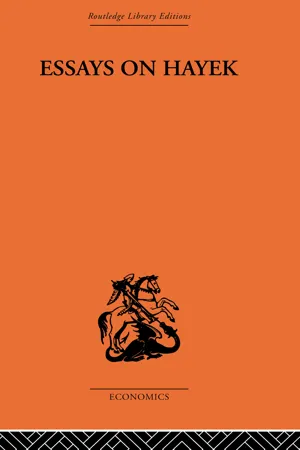
Essays on Hayek
About this book
Varying according to the scope of Hayek's contributions, the papers in this volume include among others:
* An affirmation of the "relevance" of Hayek's work
* A survey of his contribution to knowledge
* An appraisal of Hayek's innovative work on the methodology of the social sciences
* A discussion of Hayek's achievements as scholar and mentor
The contributors are: Fritz Machlup, Geroge Roche, Arthur Shenfield, Max Hartwell, William Buckley, Gottfried Dietze, Shirley Letwin.
George C. Roche III
The Relevance of Friedrich A. Hayek
In the wake of winning the Nobel Prize in Economics, Professor Friedrich Hayek has received renewed attention from commentators throughout the western world. This widespread discussion of his work comes at a time when the mistaken assumptions of contemporary state interventionism and socialism have produced social, economic, and political deterioration on the grand scale. The clarity and perception of Hayek’s world view are needed now as never before.
Friends of the free society have rejoiced in this fresh enthusiasm for Hayek’s work. Always a key figure in the formulation of free market analysis, Professor Hayek has moved far beyond his early work in technical economics, expanding his horizons to include the whole spectrum of social theory. His analysis of the mistaken methodology which lies at the heart of scientism has made The Counter-Revolution of Science one of the important, though neglected, books of our times. His Capitalism and the Historians has played a major role in demythologizing the history of the Industrial Revolution. His Road to Serfdom threw down the gauntlet to the statists and social engineers at a time in the 1940s when the defenders of the free society were virtually without public influence.
Over the years the scope of the Hayek analysis has continued to grow. The Constitution of Liberty and, most recently, the initial volumes of Law, Legislation and Liberty have reflected a wide-ranging intelligence, building upon the premise of free market economics and gradually including all those elements of social, political, and philosophic concern which give vitality and validity to the free market idea.
Professor Hayek has come to believe that individual personality, together with the values, attitudes, and institutions which sustain that personality, form an inseparable portion of free market concerns. How men view themselves and their world finally governs the decisions of the marketplace; indeed, the values which men hold ultimately determine whether or not the market itself will be allowed to survive. As he phrased it in The Constitution of Liberty:
In recent years valiant efforts have also been made to clear away the confusions which have long prevailed regarding the principles of the economic policy of a free society. I do not wish to underrate the clarification that has been achieved. Yet, though I still regard myself as mainly an economist, I have come to feel more and more that the answers to many of the pressing social questions of our time are to be found ultimately in the recognition of principles that lie outside the scope of technical economics or of any other single discipline. Though it was from an original concern with problems of economic policy that I started, I have been slowly led to the ambitious and perhaps presumptuous task of approaching them through a comprehensive restatement of the basic principles of a philosophy of freedom.1
Professor Hayek’s work as a philosopher of freedom is badly needed just now. I need not convince you that the road ahead seems especially dark. Nor do I need elaborate upon the political difficulties, the intellectual barriers, which presently block return to the free sofciety. Those obstacles are clearly formidable and they may well prove insurmountable. Yet we owe it to ourselves, and most certainly to our children, to explore the alternatives to serfdom and to lay the foundations for the moral and intellectual regeneration which the future may bring and which the continued existence of civilization so desperately requires.
Imperishably connected with this spirit of freedom and civilization have been the works of F. A. Hayek. In exploring Hayek’s contributions to scientific knowledge and the free society, we are also exploring solutions to the overwhelming problems which we face today.
The Present State of Western Society
As Hayek has pointed out again and again, there is no such thing as a control over the production of wealth which is not also a control over the lives of men. The enormous bureaucracy necessary for the “activist” state soon usurps the powers constitutionally allotted to the executive and legislative branches. The rule of law becomes a dead letter.
Such has been the process by which the freedom of the individual has been reduced in our time. No violent revolution; no armed dictatorship; everything appears in its usual form. Constitutions are still in force and democracy still functions, creating the illusion that all is well and that the people still rule.
But what a monstrous deception. Beneath the hollow forms of constitutional government grows an increasingly powerful state, manipulating democracy to serve its own ends and steadily reducing the area of individual self-determination.
There is little need to catalog the results: an all-encompassing welfare state, the ravages of inflation, the economic strangulation by state regulatory activity, and the interest-group politics which increasingly dominate the twentieth century. The result has been the politicized society, with all its attendant disasters for a freely working social order.
Economic Science Is Not Enough
Advocates of the free market have consistently opposed the politicized society. The libertarian stance has gained strength over several decades as the failures of collectivism have mounted. The planning ideal, in both its European socialist and American liberal forms, has simply failed to function. The key point of libertarian attack has been the economic sector, since the failures of the collective ideal are most apparent and most easily measurable in that quarter. But as the western world casts about for a means of escape from the collectivist bog into which we have wandered, it is imperative that we remember, with Friedrich Hayek, that not all aspects of men and their institutions are measured within the realm of economics. The failures of collectivism strike at men’s stomachs, but those same failures strike even more directly at men’s souls.
There has been a tendency for libertarian economists to forget this fact, perhaps in an over-zealous attempt to apply scientific analysis to economic concerns. In his Nobel Prize acceptance speech on December 11, 1974, Hayek described the result of that entirely scientistic attitude within the field of economics:
We have indeed at the moment little cause for pride: as a profession we have made a mess of things.
* * *
It seems to me that this failure of economists to guide policy more successfully is closely connected with their propensity to imitate as closely as possible the procedures of the brilliantly successful physical sciences—an attempt which in our subject may lead to outright error.2
In the conclusion of that same acceptance speech, Hayek reminded us:
If man is not to do more harm than good in his efforts to improve the social order, he will have to learn that, in this, as in all other fields where essential complexity of an organised kind prevails, he cannot acquire the full knowledge which would make mastery of the events possible. He will therefore have to use what knowledge he can achieve, not to shape the results as the craftsman shapes his handiwork, but rather to cultivate a growth by providing the appropriate environment, as the gardener does for his plants.3
What is the “appropriate environment” to which Hayek refers? The depth and breadth of Hayek’s scholarship should make clear the interrelation he has discovered between the economic sector and other portions of the social order. We cannot mend the damage of coUectivist philosophy merely by discrediting economic interventionism. If we are to be effective in restoration of the free society, we must also address ourselves to the damage the coUectivist ideal has done in other areas of men’s lives. The working of a free economic order ultimately depends upon the moral and spiritual underpinnings of the free society as a whole.
It is in this area that coUectivist philosophy has done the greatest damage. In fact, the public rejection of modern free market economics has not come about because the market fails to function, but because the collective ideal has distorted the institutional and moral fabric of society. Collectivism has altered how men feel about themselves, their institutions, and their obligations, thus paving the way for the interventionist state. Until advocates of the free society are willing to carry on the argument on a level which reaches the individual and his moral concerns, which reinstates the certitudes and institutions around which men can order their lives and establish their identities, we cannot hope to turn the tide.
The Moral Requirement
No society can function effectively for long without a deeply felt consensus on what it means to be a good man. The free society itself ultimately rests upon a particular conception of what the good man should be. Can the market function without respect for private property? Can individualism endure without respect for our fellow men, without regard for the rights of others? Can self-government exist divorced from what the American founding fathers called civic virtue?
The intensive interdependence of men within a society based upon the division of labor requires more than ever before the existence of a heartfelt moral consciousness. The free society is ultimately based upon the capacity of the individual to govern himself—from within. This capacity for self-government can and will break down if the proper moral climate does not exist. This is precisely what modern collectivism has done. It has eroded respect for all those things which hold a society together and which allow for peaceful social development. In a word, it has destroyed the ethics of the individual—his means to govern himself. By destroying the individual’s only means for self-government from within, the perverted liberalism of our time has effectively destroyed the social matrix required by the free society.
A great many people today have lost their sense of purpose in life, their sense of spiritual direction and their, sense of self-importance. They are without conviction. As C. S. Lewis would say, they are “men without chests.” This loss of the spirit of true individualism poses a dire threat to the free society. Men who have thus lost themselves become ideal candidates for manipulation by others. They long for the crowd, demanding the “security” which the paternalistic state promises. Unable to discover the “unbought grace of life,” people turn to materialism as the remedy. They find their happiness not in the love of friends, family and community, not in the drive for personal improvement, but in the spoiled child psychology—in sensual gratification and material things. Such remedies are never truly satisfying. The unquenchable thirst for greater satisfaction, for larger and larger doses of pleasure, impels such men into the arms of the state—which is more than happy to pose as generous benefactor and guardian. Government thus takes the place of family and community. It governs from without when the individual fails to govern from within. By this process it becomes totalitarian.
Like an individual, a society cut loose from its ethical moorings, contemptuous of its moral heritage, will not long remain free. As Burke said, its unbridled passion serves as the fire which forges its fetters. In fact, it may very well be that those who advocate the absolute freedom and autonomy of the atomistic individual sure actually opposed to the basic conditions which make possible the free society.
The free society requires a competitive market economy. But it also requires an institutional and moral framework which provides the individual with his moral bearings, with a sense of freedom and responsibility. These elements, coupled with a properly limited government, constitute the preconditions for what Friedrich Hayek has described as the Rule of Law.
A Working Definition of Freedom
Men must be free to choose and to act. But if this freedom is to be sustained, it must be guided by a moral awareness of the consequences of our actions upon those around us. In protecting the equality of all men under God and the law, society must be open, but not so open that the values which sustain men and which maintain civilization fall into decay. The elements of status, order, and tradition within the structure are not ends in themselves. They are means for the preservation of freedom and social cooperation. Society, as Mises insisted, is the means whereby we fulfill all our ends. If we destroy society through some misguided notion of pure individualism, we will find ourselves facing an individualism of the “noble savage” and the “trousered ape.” There can be no freedom without a functioning social order. Freedom and order are both needed to hold society together. Social institutions are means for the preservation of peaceful human relations, serving as a governor on individual behavior. They preserve, in short, the Whig tradition which Professor Hayek has so brilliantly defended, preventing the spirit of freedom and civility from collapsing into anarchy.
Thanks, in large measure, to the insights of Professor Hayek, we now realize the intimate connection between freedom and social organization, between liberty and the Rule of Law.
Conservatives, Liberals, and Libertarians
Professor Hayek may have shown us the way toward the free society. But much of contemporary discourse on the subject, even in conservative and libertarian circles, has shown us painfully unable to follow his lead. Perhaps at least a part of the problem lies in semantic confusion. In this confused age, not even our words have consistent meaning. Today such labels as liberal, conservative, and libertarian have so many definitions as to be almost meaningless. And yet these are the labels we have available to discuss our social order. With due apologies to all those liberals, conservatives, and libertarians who will insist that my definitions are inappropriate descriptions of their position, perhaps we should discuss for a moment what sort of political economy would be required to solve our present discontents.
The task that lies before us is of such a nature that neither atomistic libertarianism nor a mere conservatism of things past is sufficient for our purposes. As Professor Hayek has brilliantly pointed out, conservatism in this narrow sense lacks the knowledge of the economic underpinnings of civilization. Its devotion to tradition is frequently misplaced because it fails to see that all traditions themselves come from a break with some still older way of doing things. In addition, coerced tradition, like coerced innovation, is of little social value. Order, like tradition, must originate within society and cannot be imposed from without.
Within the conservative framework, there has often been far too little room for freedom and innovation—for those impulses which keep society functioning. In fact, conservatism, at least in its narrowest sense, has tended to abhor change and extol the virtues of resignation and conformity with the status quo. Frequently such resignation to the past has been accompanied by a total rejection of scientific method as an appropriate tool of social analysis.
It may be objected that the “conservatism” I describe is a caricature of genuine conservatism. I myself am deeply attached to the necessity for tradition, and I harbor a healthy suspicion for the excesses of Utopian rationalism. A loyalty to one’s family, friends, institutions, and preferences is the very stuff of which real individualism and healthy societies are made. My point just now is simply that the negative, limiting side of what many people call “conservatism” provides an inadequate base on which to build a functioning social philosophy.
Neither will the philosophy of atomistic individualism fill our needs. This individualism was so short-lived in the nineteenth century because it contained the seeds of its own destruction, collapsing from within due to a defective core of values. Classical liberalism flourished in opposition to a repressive social structure. It functioned well in opposition to the status quo. When it gained ascendancy and had no more petrified social institutions to assault, when it became its own status quo, it turned inward to destroy itself. This is the history of the change from the classical liberalism of the nineteenth century to the collectivist liberalism of the twentieth century.
Liberalism was inseparably connected with science. It was the social philosophy of reason. But its chief difficulty consisted in its inability to keep scientific principles in their proper place. As one result, the “value free” position of economic science caused serious problems for the social structure. Liberalism has labored under great difficulty in understanding the difference between what is good for scientific analysis and what is good for men as members of society. From the position that science must, for the sake of objectivity, abstain from value judgments, the scientism of the twentieth century came to believe that values themselves are unscientific and—in an age of science—entirely unimportant. Soon the end seemed to justify the means. Values were thought to be “subjective” matters of personal preference. Anything that “worked” became good in and of itself. This is precisely the attitude which today threaten...
Table of contents
- Cover
- Title page
- Copyright page
- Contents
- Notes on Contributors
- Notes from the Editor
- Foreword
- 1 The Relevance of Friedrich A. Hayek
- 2 Hayek’s Contribution to Economics
- 3 Scientism and the Study of Society
- 4 Capitalism and the Historians
- 5 The Road to Serfdom: The Intellectuals and Socialism
- 6 Hayek on the Rule of Law
- 7 The Achievement of Friedrich A. Hayek
- Friedrich A. Hayek: Nobel Prizewinner
- A Selected List of Hayek’s Books in English Currently in Print
- Index
Trusted by 375,005 students
Access to over 1.5 million titles for a fair monthly price.
Study more efficiently using our study tools.
Frequently asked questions
Yes, you can cancel anytime from the Subscription tab in your account settings on the Perlego website. Your subscription will stay active until the end of your current billing period. Learn how to cancel your subscription
No, books cannot be downloaded as external files, such as PDFs, for use outside of Perlego. However, you can download books within the Perlego app for offline reading on mobile or tablet. Learn how to download books offline
Perlego offers two plans: Essential and Complete
- Essential is ideal for learners and professionals who enjoy exploring a wide range of subjects. Access the Essential Library with 800,000+ trusted titles and best-sellers across business, personal growth, and the humanities. Includes unlimited reading time and Standard Read Aloud voice.
- Complete: Perfect for advanced learners and researchers needing full, unrestricted access. Unlock 1.5M+ books across hundreds of subjects, including academic and specialized titles. The Complete Plan also includes advanced features like Premium Read Aloud and Research Assistant.
We are an online textbook subscription service, where you can get access to an entire online library for less than the price of a single book per month. With over 1.5 million books across 990+ topics, we’ve got you covered! Learn about our mission
Look out for the read-aloud symbol on your next book to see if you can listen to it. The read-aloud tool reads text aloud for you, highlighting the text as it is being read. You can pause it, speed it up and slow it down. Learn more about Read Aloud
Yes! You can use the Perlego app on both iOS and Android devices to read anytime, anywhere — even offline. Perfect for commutes or when you’re on the go.
Please note we cannot support devices running on iOS 13 and Android 7 or earlier. Learn more about using the app
Please note we cannot support devices running on iOS 13 and Android 7 or earlier. Learn more about using the app
Yes, you can access Essays on Hayek by Fritz Machlup in PDF and/or ePUB format, as well as other popular books in Business & Business General. We have over 1.5 million books available in our catalogue for you to explore.