Examining the relationship between employment and rates of pay, this book discusses how the choice between different forms of business organization may affect this relationship. For the purposes of the discussion a simple model of an imperfectly competitive economy is constructed and then examined in operation with different organizational forms for the competing firms. Chapters cover the following:
The Captialist Wage Economy; The Non-Discriminating Labour Co-operative; The Capitalist Sharing Economy; Discriminating Labour-Capital Partnerships.
By a Capitalist Sharing firm we mean one in which some or all of the owners of the capital, either directly or through representative managers, take the decisions about output, prices, employment and investment; but in which some or all of the workers receive a part or the whole of their pay in the form of an agreed share of part or the whole of the value added of the firm.
The fund of which the workers receive a contractual share may take either of two forms. In what we will call the Capitalist Revenue–Sharing firm the inclusive rate of pay of the worker can be expressed as
V.a.1
where w' is the worker’s inclusive rate of pay and w is the fixed wage element in his pay, which is supplemented by a proportion, s, of the total revenue of the firm, xp, distributed between the workers, l.
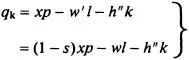
The profit of the capitalist entrepreneurs can then be expressed as
V.a.2
where h" measures the outside market hire–charge for a unit of capital so that h"k represents the total cost of employing the firm’s capital equipment, a cost which takes the form either of a direct payment of interest on borrowed funds or the cost to the capitalist entrepreneurs due the the lost opportunity of earning interest in the market on the funds which they have instead risked in their business.
This is not the only possible form of share–economy arrangement. The arrangement may be to pay to the workers a share, s, of what we may call the ‘accounting profit’ of the firm. In this case qa measures the accounting profit where
qa = xp – wl – hk,
V.a.3
where w is the fixed–wage element in the worker’s pay and h is the fixed–interest element in the return to the capitalists.
The profit of the capitalist entrepreneurs is then
V.a.4
They receive (1 – s)qa as their share of the accounting profit plus the fixed interest paid to them (hk), but from this they must deduct the outside market hire–charge for their capital funds (h"k). We will call this a Capitalist Profit–Sharing firm.
The difference in principle between the two forms of sharing arrangement is as follows. In the revenue–sharing firm the workers are paid their fixed wage and a share of the whole revenue. In the profit–sharing arrangement the workers are paid their fixed wage and the capitalists their fixed rate of return on the capital, and the workers then receive their share of the remainder of the firm’s revenue. As will be shown in what follows, these two different principles can lead to very different results.
It is interesting to note the extreme or pure forms of these two different arrangements. The pure revenue–sharing arrangement is one in which there are no fixed–wage or fixed–interest payments (w = h = 0), all incomes taking the form of a share of the revenue. In this case (V.a.2) becomes
qk = (1 – s)xp – h"k.
V.a.5
It may be noted that the profit–sharing arrangement of (V.a.4) approaches the more nearly to this same result, the smaller are the fixed–pay elements w and h.
The pure profit–sharing arrangement may, however, best be defined as that in which the fixed–pay elements are set at the full market charges for the factors, (i.e. w = w" and h = h") in which case (V.a.4) becomes
qk = (1 – s)(xp – w"l – h"k).
V.a.6
Labour and capital receive their full market costs in a fixed–payment form and simply share between them any pure profit or pure loss which remain.
(b) The Capitalist Sharing Economy with Rigid Pay Parameters and Unemployment
We will start our analysis of sharing arrangements with the assumption that the two pay parameters, namely the workers’ share (s) and the fixed wage (w), are both rigidly fixed by an outside agency (e.g. a rigid national wage bargain or even by government edict.) Similarly, we start with the assumption that the fixed–interest element in the return on capital (h) is rigidly fixed. Whether or not this corresponds to any realistic situation it enables us to analyse some basic relationships which may remain important in so far as these parameters are slow and sticky in their adjustments.
In the case of a revenue–sharing firm with s, w and h" constant differentiation of the value for an individual firm of its
k given by the second expression for qk in (V.a.2) results in
d
k = {(1 + s)
– h"} d
+ {(1 – s)λ – w} d
,
V.b.1
where, ...
Table of contents
Cover
Title page
Copyright page
Contents
Preface
I Introduction
II The Structure of the Model
III The Capitalist Wage Economy
IV The Non–Discriminating Labour Co–operative
V The Capitalist Sharing Economy
VI Discriminating Labour–Capital Partnerships
Select Bibliography
Index
Trusted by 375,005 students
Access to over 1.5 million titles for a fair monthly price.
Study more efficiently using our study tools.
Frequently asked questions
Yes, you can cancel anytime from the Subscription tab in your account settings on the Perlego website. Your subscription will stay active until the end of your current billing period. Learn how to cancel your subscription
No, books cannot be downloaded as external files, such as PDFs, for use outside of Perlego. However, you can download books within the Perlego app for offline reading on mobile or tablet. Learn how to download books offline
Perlego offers two plans: Essential and Complete
Essential is ideal for learners and professionals who enjoy exploring a wide range of subjects. Access the Essential Library with 800,000+ trusted titles and best-sellers across business, personal growth, and the humanities. Includes unlimited reading time and Standard Read Aloud voice.
Complete: Perfect for advanced learners and researchers needing full, unrestricted access. Unlock 1.5M+ books across hundreds of subjects, including academic and specialized titles. The Complete Plan also includes advanced features like Premium Read Aloud and Research Assistant.
Both plans are available with monthly, semester, or annual billing cycles.
We are an online textbook subscription service, where you can get access to an entire online library for less than the price of a single book per month. With over 1.5 million books across 990+ topics, we’ve got you covered! Learn about our mission
Look out for the read-aloud symbol on your next book to see if you can listen to it. The read-aloud tool reads text aloud for you, highlighting the text as it is being read. You can pause it, speed it up and slow it down. Learn more about Read Aloud
Yes! You can use the Perlego app on both iOS and Android devices to read anytime, anywhere — even offline. Perfect for commutes or when you’re on the go. Please note we cannot support devices running on iOS 13 and Android 7 or earlier. Learn more about using the app
Yes, you can access Alternative Systems of Business Organization and of Workers' Renumeration by J.E. Meade in PDF and/or ePUB format, as well as other popular books in Business & Business generale. We have over 1.5 million books available in our catalogue for you to explore.