eBook - ePub
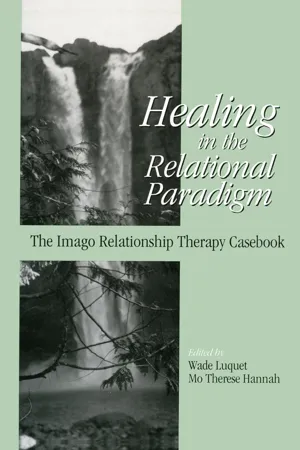
Healing in the Relational Paradigm
The Imago Relationship Therapy Casebook
- 296 pages
- English
- ePUB (mobile friendly)
- Available on iOS & Android
eBook - ePub
Healing in the Relational Paradigm
The Imago Relationship Therapy Casebook
About this book
Already practiced by thousands of therapists around the world, Imago Relationship Therapy (IRT) has aroused the interest of a widening international psychotherapy community. Now, for the first time, Healing in the Relational Paradigm: The Imago Relationship Therapy Casebook brings you directly into the therapists office to see firsthand how the tenets of IRT can translate into powerful and enduring skills for couple clients. Providing access to Imago work with a broad range of couple types, the book reveals ways in which activities, such as Couples Dialogue and the Container Exercise, help couples expand and strengthen their relational vocabulary. The first chapter, which proposes a new way of conceptualizing child development and its impact on the forming and maintaining of intimate relationships, lays the foundation for the chapters to follow. Subsequent topics - each handled by a front lines Imago therapist - reflect a true picture of the spectrum of issues and identities that are present in therapy. The contents cover attachment, exploratory, identity and competence wounded couples. Other contributions describe work with African-American, Hispanic, and gay and lesbian couples, while the impact of HIV/AIDS and Attention Deficit Disorder is explored in a third section. Finally, contributors offer a clear relational lens through which to view the core couple issues of addiction, sexuality, infidelity and spirituality. Healing in the Relational Paradigm demonstrates Imagois flexibility and promise across populations and in the hands of very different practitioners. The book shows the Imago approach to be more than just another technique: it is a profound shift in perspective, reinforced by a network of positive assumptions and communication exercises that together create an environment for healthy change. This volume would be suitable for marriage and family therapists.
Information
Subtopic
History & Theory in PsychologyIndex
PsychologyChapter1
THE RELATIONAL PARADIGM
Wade Luquet
Whatever the year and the place of our birth, we arrive in a culture that has its own unique view of reality—of how things are and how they should be. Socialization embeds in each of us the dominant world view of our time, teaching us appropriate behavior, language, and thought processes. We have, at best, only a faint notion that our version of reality might be specific to our time, and we rarely consider that one day this view might be looked back upon as quaint and naive. Think, for example, of the medieval notion that angels push the sun, planets, and stars around the earth—which now seems amusing, if not ludicrous. Likewise, more enlightened ideas about reality, new paradigms, are certain eventually to replace our present way of thinking.
The science historian Thomas Kuhn first brought the notion of a “paradigm shift” to our attention in his 1970 release of The Structure of Scientific Revolutions. While focused primarily on shifts that occur in science—from Newtonian physics to quantum physics, for example, or from cathode rays to x-rays—Kuhn's work applies equally well to political, cultural, and technological transitions in thinking. Over 30 years after Kuhn's ideas were accepted by the scientific community, we are seeing their relevance to the shifts occurring in our understanding of human behavior.
It was in this work that Kuhn coined the term “paradigm” to describe a way of seeing the world. If we wear pink sunglasses, for instance, it appears pinkish, and “pink” serves as the paradigm through which we interpret the world. Through a blue paradigm, the world appears blue. Because science is constantly evolving, usually several paradigms exist at once, and the adherents of each interpret the world according to their own paradigmatic perspective, upholding that paradigm until one offering better explanations and more compelling evidence comes along. Then, and only then, can a paradigm shift occur. For Kuhn (1970), new paradigms must possess two qualities: “Their achievement was sufficiently unprecedented to attract an enduring group of adherents away from competing modes of scientific activity. Simultaneously, it was sufficiently open-ended to leave all sorts of problems for the redefined group of practitioners to resolve” (p. 10).
Kuhn adds that, when armed with a new paradigm, scientists begin to look in places they never thought to look before, and they even look in places in which they previously looked and discover new information: “It is rather as if the professional community had been suddenly transported to another planet where familiar objects are seen in a different light and are joined by unfamiliar ones as well” (p. 111). To those making the shift, the new ground may feel unstable, and yet be exciting to explore. To those whose paradigms are affected, the fact that former adherents have made such a shift might seem revolutionary or absurd.
SHIFTS IN THE MENTAL HEALTH PARADIGMS
The first paradigm shift in our understanding of human behavior occurred when Sigmund Freud dismissed the notion that people are the victims of original sin and demons. He maintained, instead, that all humans have built-in unconscious drives for food and sex, and, through transference and other elements of the psychoanalytic process, they can gain insight and consciousness, allowing them to control their neurotic thoughts and behaviors. We can think of Freud as ushering in the individual insight paradigm, having met both of Kuhn's requirements of paradigm shifts: Freud drew adherents away from competing modes of scientific activity, and his theory was open-ended enough to leave all sorts of problems for the emerging school of psychoanalysis to resolve.
A new paradigm is not meant to be orthodox in nature; rather, it provides a foundation—a way of seeing—on which those who ascribe to it can agree. From this foundation, scientists and thinkers can begin to branch off. Offshoots of Freud's insight-oriented paradigm began to emerge, such as the theories of Carl Jung, Karen Horney, Harry Stack Sullivan, and Margaret Mahler. Although their treatment modalities differed somewhat, all rested on the paradigmatic tenet that individuals can be restored to optimal functioning by working with thought processes and insights.
But like most paradigms throughout history, the individual insight paradigm began to exhibit inadequacies. As Kuhn said, “Scientific revolutions are inaugurated by a growing sense, again often restricted to a narrow subdivision of the scientific community, that an existing paradigm has ceased to function adequately in an exploration of an aspect of nature to which that paradigm itself had previously led the way. In both political and scientific development the sense of malfunction that can lead to crisis is prerequisite to revolution” (p. 92).
In reaction to the insight-oriented models, a revolution indeed took place during the 1950s and 1960s in the form of behaviorism. Such thinkers as Watson, Skinner, and Dollard and Miller postulated that environmental influences, rather than intrapsychic forces, shape behavior. On the heels of behaviorism, the family and systems paradigm of the 1960s and 1970s evolved. These thinkers—Haley, Minuchin, Bowen, Whitaker, Madanes, Nagy, Papp, and Satir, to name a few—began to view individual pathology as shaped by the systems of which individuals are a part, as well as by the interaction between the individual and those systems.
The individual paradigm had emerged in the late 1800s, when anthropologists began dating human fossils as millions of years old and when Darwin first proposed his theory of evolution. Given the intellectual climate of the time, it was natural for Freud to propose that humans were governed by drives for food and sex. During the 1960s and 1970s, with the expanding media providing Americans with a greater awareness of societal influences, such as the effects of inner-city life on those living there, it was logical that systems theory would emerge. It seemed obvious that poverty and the oppression of minorities bred hopelessness and kept families from succeeding, and that one must change the system if one is to change the person.
Now, we have more information to put into the equation. Scientists have looked into the far reaches of the universe and determined that it is about 15 billion years old. They have delved into the depths of the atom and found only photons, or light, and in the process discovered that in every atom lie the same light and energy that began in that primordial blast 15 billion years ago. We now know that, in some primal decision made soon after the big bang, the expelled particles began to work together to form hydrogen. Particles working together can evolve to a greater state of matter, and thus a greater state of consciousness, than they can separately. One molecule of carbon is just a molecule. Billions of molecules of carbon can form a human being.
According to the relatively new field of quantum physics, atomic particles act in relationship. “To tell the full story of a single particle we must tell the story of the universe, for each particle is in some way intimately present to every other particle in the universe” (Swimme & Berry, 1992). If the microcosm is a reflection of the macrocosm, then humans beings, too, are intimately interwoven with the rest of existence and with one another. We develop, we grow up, we are wounded, and we are healed in relationships with others.
FINDING SELF IN CONNECTION
The new physics is lending psychological theory a cosmology to use as a context for the evolving relational paradigm. This cosmology is based on finding the self in relationship with others. The “self-in-relation” (Jordan, Kaplan, Miller, et al., 1991) principle holds that finding a distinct yet connected sense of self is the primary drive of the growing child. This developmental impulse can be disrupted if a child's longing for validation from others remains unmet, with the child developing a coping mechanism, a defensive adaptation, to lessen the resulting pain. Pain creates self-absorption, leading the person to view the world in idiosyncratic ways and to relate to the world through the filter of his or her defensive style. Eventually, interpersonal relationships become stressed by the person's self-absorption and defensiveness, resulting in further self-protection and isolation.
We seem to have an unquenchable desire to maintain our self through what Kohut calls satisfying “self-object” experiences (Kohut, 1977, 1978). Self psychologists maintain that human psychological functioning is embedded in social interactions. Because self is found in relationship, Kohut stressed the therapist's helping the client by developing empathy through “vicarious introspection” (Kohut, 1978) into the client's experience. In other words, the therapist's job is to place himself in the client's shoes and see the world from that person's perspective. Kohut, along with Carl Rogers (1961, 1980), taught that this could be done by the therapist's mirroring the client's words and affect. Through the therapist's deep understanding of the client and the transference generated and worked through in the therapeutic relationship, the client was able to discover a sense of self.
Although their work represents a great step toward understanding the self, Kohut and Rogers were still entrenched in the individual paradigm of their era, when the client's trust of the therapist was considered more significant than the client's trust of significant others. In shifting to the relational paradigm, the therapist has to rely on the client's primary relationships to provide the mirroring and the experience of “vicarious introspection,” the development of empathy, that are necessary for healing and finding a sense of self. It takes a leap of faith for a therapist to treat a relationship rather than an individual. It demands courage to trust that the relationship can heal through the dialogue process, rather than through interpretation, behavioral interventions, insight, and transference. But it can be tremendously inspiring to watch a couple giving birth to two distinct, yet connected, selves through dialogue. Although it can be painful to reveal one's “shadow side,” and equally painful to see the shadow side of one's partner, partners do, in fact, become more authentic in a dialogical relationship, making genuine love, hope, and healing possible. That is the power of the relational paradigm.
WE DEVELOP WITHIN CONNECTION
Most personality theories that have emerged within the past 100 years are based on the notion that the initial task of the human being is to separate and individuate. The healthiest humans, according to such theories, are those who have a solid and distinct sense of self. That is, the self should be autonomous, self-sufficient, and separated out from the matrix of others. This is accomplished by experiencing a series of developmental crises (Erikson, 1968, 1980, 1982) that bring about a sense of individualism—a separateness of self. Only then can a human experience intimacy with another.
The relational paradigm tells another story: As the self is developing, the crisis is not as important as the connection. The self can be defined and distinguished as well in developmental connection as it can in developmental crisis, with the added benefit of the retention of empathy and intimacy. It becomes the “self-in-relation” (Jordan et al., 1991).
According to the relational paradigm, the development of self-in-relation begins in infancy with the caretaker. Babies, like seeds, have built-in developmental impulses that emerge at preordained times throughout childhood. Developmental tasks are mastered through ongoing validation of the child by childhood caretakers, who support the child's mastery of the emerging life skills that present at a given time.
Let's take a look at what happens, according to Imago theory, if all goes well in a child's early years. For the sake of illustration, we will call the child a boy, although the scenario could apply equally to a girl.
From the time a child is born until he is about 15 months old, his impulse will be to attach to his primary caretakers. He needs to be held close to the parent's chest, to be nurtured, and to be fed. Although inevitably his needs will be frustrated, it is important for him to learn, during this stage, that someone will attend to his needs in a reasonable amount of time. If his caretakers provide the right holding environment, he will master the ability to attach to people, and he will also begin to develop a basic sense of being safe in the world. He will develop a sense of security with others that will significantly lessen his fear of abandonment. As his mobility increases, and at around the age of 15 months, the next developmental impulse will emerge.
In this second stage, the child's primary urge is to explore his surroundings. He pulls things out of drawers and cabinets, breaks toys, and tests the stereo equipment. He makes elaborate crayon scribbles on freshly painted walls, and he forces his parents to chase after him whenever they visit the mall. What the child needs from his caretakers is for them to witness, mirror, and support his exploration and curiosity: “You're getting so big! Look how smart you are! You can draw such pretty pictures!” This stage lasts until around the age of three, when verbal skills and imagination have more completely developed. Then he will encounter the third developmental task—forming an identity.
At first, he has not one identity, but many. He is no longer a baby, yet is far from being big. So he sets out to discover who he is, and he finds he is many things—a dog, a cat, a cartoon character, a mommy or a daddy. His parents enjoy watching him crawl around on his hands and knees barking or pretending to fly around the house to rescue his stuffed animal. To master this stage, the child again needs his caretakers to mirror his behavior. He needs to hear things like, “Let me scratch your ears, puppy,” or “Help Superman! I'm in trouble!” In other words, as he experiments with different identities, he needs those identities mirrored back to him, as though the caretakers were saying, “You are being what you think you are being.” The child's search for identity will allow him to try on different aspects of himself, which will eventually allow him to respond with assuredness to the various roles that life will present to him. Through the mirroring experienced during this stage, personalities can become assured, flexible, and distinct, rather than rigid or diffuse.
Once the boy has a sense of who he is becoming, at about the age of four, he will begin to test his competence. Preschool serves as a place in which to draw, paint, and sing songs. His work comes home to Mom and Dad, to whom he will sing his songs and show his paintings with pride. The response he needs is, simply, “Great!” or “You must be proud!” This is the time for mixing cake batter on the kitchen counter with Mom or Dad, or for digging a hole in the backyard with Grandpa. No matter what the outcome of his task, the child longs to hear his work pronounced “terrific.” Alhough he may still lack certain skills, his desire to achieve things is irresistible during the competence stage. Accolades give him the incentive he needs to continue to hone his skills; eventually, the songs sound better, the paintings are recognizable, and the cake actually rises. As a result, the child feels good about his abilities while remaining connected to the caretakers who have encouraged his competence.
By the time the boy is six years old, he has learned to attach and explore, to develop an identity, and to feel a sense of competence. It is now time for him to go to school and make friends. Because his empathic ability is still intact, he enters this fifth stage with few problems. He finds friends, choosing a special chum and flowing easily into and out of the various friendship groups that form at school. From his caretakers, he needs mirroring and e...
Table of contents
- Cover
- Half Title
- Full Title
- Copyright
- CONTENTS
- CONTRIBUTORS
- PREFACE
- ACKNOWLEDGMENTS
- CHAPTER 1 THE RELATIONAL PARADIGM
- CHAPTER 2 COUPLES WOUNDED AT THE ATTACHMENT PHASE
- CHAPTER 3 THE EXPLORATORY-WOUNDED COUPLE
- CHAPTER 4 THE RIGID/DIFFUSE COUPLE
- CHAPTER 5 THERAPIST, HEAL THYSELF: A PASSIVE/COMPETITIVE COUPLE
- CHAPTER 6 IS IMAGO THERAPY CULTURALLY RELEVANT? CASE STUDIES WITH AFRICAN-AMERICAN COUPLES
- CHAPTER 7 IMAGO THERAPY WITH HISPANIC COUPLES
- CHAPTER 8 LIVING IN THE “NOT KNOWING”
- CHAPTER 9 MULTIPLE MIRRORING WITH LESBIAN AND GAY COUPLES: FROM PEORIA TO P-TOWN
- CHAPTER 10 WHEN A PARTNER HAS AIDS: THERAPY WITH GAY/LESBIAN COUPLES
- CHAPTER 11 GOING BEYOND AIDS: THERAPY WITH HETEROSEXUAL COUPLES
- CHAPTER 12 THE IMPACT OF ADULT ATTENTION-DEFICIT DISORDER ON COUPLES
- CHAPTER 13 ADDICTION, COUPLES, AND RECOVERY
- CHAPTER 14 IMAGO THERAPY WITH SEXUALLY DYSFUNCTIONAL COUPLES
- CHAPTER 15 VALIDATION AS A FACILITATOR OF FORGIVENESS FOR ADULTERY
- CHAPTER 16 IMAGO RELATIONSHIP THERAPY AS A SPIRITUAL PATH
- APPENDIX: KEY WORDS
Trusted by 375,005 students
Access to over 1.5 million titles for a fair monthly price.
Study more efficiently using our study tools.
Frequently asked questions
Yes, you can cancel anytime from the Subscription tab in your account settings on the Perlego website. Your subscription will stay active until the end of your current billing period. Learn how to cancel your subscription
No, books cannot be downloaded as external files, such as PDFs, for use outside of Perlego. However, you can download books within the Perlego app for offline reading on mobile or tablet. Learn how to download books offline
Perlego offers two plans: Essential and Complete
- Essential is ideal for learners and professionals who enjoy exploring a wide range of subjects. Access the Essential Library with 800,000+ trusted titles and best-sellers across business, personal growth, and the humanities. Includes unlimited reading time and Standard Read Aloud voice.
- Complete: Perfect for advanced learners and researchers needing full, unrestricted access. Unlock 1.5M+ books across hundreds of subjects, including academic and specialized titles. The Complete Plan also includes advanced features like Premium Read Aloud and Research Assistant.
We are an online textbook subscription service, where you can get access to an entire online library for less than the price of a single book per month. With over 1.5 million books across 990+ topics, we’ve got you covered! Learn about our mission
Look out for the read-aloud symbol on your next book to see if you can listen to it. The read-aloud tool reads text aloud for you, highlighting the text as it is being read. You can pause it, speed it up and slow it down. Learn more about Read Aloud
Yes! You can use the Perlego app on both iOS and Android devices to read anytime, anywhere — even offline. Perfect for commutes or when you’re on the go.
Please note we cannot support devices running on iOS 13 and Android 7 or earlier. Learn more about using the app
Please note we cannot support devices running on iOS 13 and Android 7 or earlier. Learn more about using the app
Yes, you can access Healing in the Relational Paradigm by Wade Luquet, Mo Therese Hannah, Wade Luquet,Mo Therese Hannah in PDF and/or ePUB format, as well as other popular books in Psychology & History & Theory in Psychology. We have over 1.5 million books available in our catalogue for you to explore.