Originally published in 1964, this volume gathers together extracts from many of Arberry's best-known works and supplements them with a selection of previously unpublished translations. The material therefore presents a vivid picture of the richness and variety of Islamic civilization from its origins to the late twentieth century.
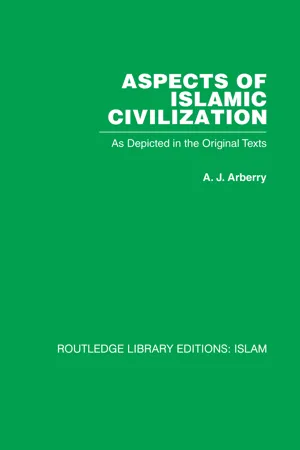
- 408 pages
- English
- ePUB (mobile friendly)
- Available on iOS & Android
eBook - ePub
About this book
Information
ONE

Arabia Deserta
Muhammad, the Messenger of Allah, was born an Arab of the town—the thriving commercial centre of Mecca—member of a noble but impoverished family belonging to a powerful tribe which, though settled locally, had its roots and ramifications in the outspread desert. The language he spoke, and in which he later received his revelations, already prided itself upon a rich literature, largely if not wholly unwritten, consisting for the most part of formal odes.
‘The Arabian ode sets forth before us a series of pictures, drawn with confident skill and first-hand knowledge, of the life its maker lived, of the objects among which he moved, of his horse, his camel, the wild creatures of the wilderness, and of the landscape in the midst of which his life and theirs was set; but all, however loosely they seem to be bound together, are subordinate to one dominant idea, which is the poet’s unfolding of himself, his admirations and his hates, his prowess and the freedom of his spirit. . . . No poetry better fulfils Mr Matthew Arnold’s definition of “a criticism of life”; no race has more completely succeeded in drawing itself for all time, in its grandeur and its limitations, its best and its worst. It is in this sense that the poetry of the Pagan Arabs is most truly their history.’6
Of the very considerable volume of poetry transmitted from the desert bards of the sixth century and collected in writing by Arab scholars of the eighth, pride of first place belongs to seven odes, acclaimed the best work of their seven authors and known as the Mu‘allaqāt. The selections of desert poetry which follows has been drawn from that anthology.7
Imr al-Qais ‘the Wandering King’
Halt, friends both! Let us weep, recalling a love and a longing
by the rim of the twisted sands between Ed-Dakhool and Haumal,
Toodih and El-Mikrát, whose trace is not yet effaced
for all the spinning of the south winds and the northern blasts;
there, all about its yards, and away in the dry hollows
you may see the dung of antelopes spattered like peppercorns.
Upon the morn of separation, the day they loaded to part,
by the tribe’s acacias it was like I was splitting a colocynth;
there my companions halted their beasts awhile over me
saying, ‘Don’t perish of sorrow; restrain yourself decently!’
Yet the true and only cure of my grief is tears outpoured:
what is there left to lean on where the trace is obliterated?
The poet recalls boastingly his amorous exploits which relieved the hard life of desert riding.
Oh yes, many a fine day I’ve dallied with the white ladies,
and especially I call to mind a day at Dára Juljul,
and the day I slaughtered for the virgins my riding-beast
(and oh, how marvellous was the dividing of its loaded saddle),
and the virgins went on tossing its hacked flesh about
and the frilly fat like fringes of twisted silk. . . .
Ha, and a day on the back of the sand-hill she denied me
swearing a solemn oath that she should never, never be broken.
‘Gently now, Fátima! A little less disdainful:
even if you intend to break with me, do it kindly.
If it’s some habit of mine that’s so much vexed you
just draw off my garments from yours, and they’ll slip away.
Puffed-up it is it’s made you, that my love for you’s killing me
and that whatever you order my heart to do, it obeys.
Your eyes only shed those tears so as to strike and pierce
with those two shafts of theirs the fragments of a ruined heart.
Many’s the fair veiled lady, whose tent few would think of seeking,
I’ve enjoyed sporting with, and not in a hurry either,
slipping past packs of watchmen to reach her, with a whole tribe
hankering after my blood, eager every man-jack to slay me,
what time the Pleiades showed themselves broadly in heaven
glittering like the folds of a woman’s bejewelled scarf.
I came, and already she’d stripped off her garments for sleep
beside the tent-flap, all but a single flimsy slip;
and she cried, “God’s oath, man, you won’t get away with this!
The folly’s not left you yet; I see you’re as feckless as ever.”
Out I brought her, and as she stepped she trailed behind us
to cover our footprints the skirt of an embroidered gown.
But when we had crossed the tribe’s enclosure, and dark about us
hung a convenient shallow intricately undulant,
I twisted her side-tresses to me, and she leaned over me;
slender-waisted she was, and tenderly plump her ankles,
shapely and taut her belly, white-fleshed, not the least flabby,
polished the lie of her breast-bones, smooth as a burnished mirror. . . .
Let the follies of other men forswear fond passion,
my heart forswears not, nor will forget the love I bear you.’
The ode concludes with a description of a storm seen in the desert, and its aftermath.
Friend, do you see yonder lightning? Look, there goes its glitter
flashing like two hands now in the heaped-up, crowned stormcloud.
Brilliantly it shines—so flames the lamp of an anchorite
as he slops the oil over the twisted wick.
So with my companions I sat watching it between Dárij
and El-Odheib, far-ranging my anxious gaze;
over Katan, so we guessed, hovered the right of its deluge,
its left dropping upon Es-Sitár and further Yadhbul.
Then the cloud started loosing its torrent about Kutaifa
turning upon their beards the boles of the tall kanahbals;
over the hills of El-Kanán swept its flying spray
sending the white wild goats hurtling down on all sides.
At Taima it left not one trunk of a date-tree standing,
not a solitary fort, save those buttressed with hard rocks;
and Thabeer—why, when the first onrush of its deluge came
Thabeer was a great chieftain wrapped in a striped jubba.
In the morning the topmost peak of El-Mujaimir
was a spindle’s whorl cluttered with all the scum of the torrent;
it had flung over the desert of El-Ghabeet its cargo
like a Yemeni merchant unpacking his laden bags.
In the morning the songbirds all along the broad valley
quaffed the choicest of sweet wines rich with spices;
the wild beasts at evening drowned in the furthest reaches
of the wide watercourse lay like drawn bulbs of wild onion.
Ṭarafa ‘Who Died Young’
The ode of Ṭarafa, who was executed in his twenties, is chiefly prized for a fine picture of a racing camel.
Ah, but when grief assails me, straightway I ride it off
mounted on my swift, lean-flanked camel, night and day racing,
sure-footed, like the planks of a litter; I urge her on
down the bright h...
Table of contents
- Cover
- Title page
- Copyright page
- Contents
- INTRODUCTION
- 1 Arabia Deserta
- 2 The Speech of Allah
- 3 The Sunna and the Successors
- 4 Wisdom from the East
- 5 Science from the West
- 6 La dolce vita
- 7 Religious counsels
- 8 Mystical moments
- 9 Lyrical interlude
- 10 Faith and doubt
- 11 Parable and anecdote
- 12 The Art of Hāfiz
- 13 Two modern Egyptian poets
- 14 The revolt of Islam
- BIBLIOGRAPHY
- INDEX
Trusted by 375,005 students
Access to over 1.5 million titles for a fair monthly price.
Study more efficiently using our study tools.
Frequently asked questions
Yes, you can cancel anytime from the Subscription tab in your account settings on the Perlego website. Your subscription will stay active until the end of your current billing period. Learn how to cancel your subscription
No, books cannot be downloaded as external files, such as PDFs, for use outside of Perlego. However, you can download books within the Perlego app for offline reading on mobile or tablet. Learn how to download books offline
Perlego offers two plans: Essential and Complete
- Essential is ideal for learners and professionals who enjoy exploring a wide range of subjects. Access the Essential Library with 800,000+ trusted titles and best-sellers across business, personal growth, and the humanities. Includes unlimited reading time and Standard Read Aloud voice.
- Complete: Perfect for advanced learners and researchers needing full, unrestricted access. Unlock 1.5M+ books across hundreds of subjects, including academic and specialized titles. The Complete Plan also includes advanced features like Premium Read Aloud and Research Assistant.
We are an online textbook subscription service, where you can get access to an entire online library for less than the price of a single book per month. With over 1.5 million books across 990+ topics, we’ve got you covered! Learn about our mission
Look out for the read-aloud symbol on your next book to see if you can listen to it. The read-aloud tool reads text aloud for you, highlighting the text as it is being read. You can pause it, speed it up and slow it down. Learn more about Read Aloud
Yes! You can use the Perlego app on both iOS and Android devices to read anytime, anywhere — even offline. Perfect for commutes or when you’re on the go.
Please note we cannot support devices running on iOS 13 and Android 7 or earlier. Learn more about using the app
Please note we cannot support devices running on iOS 13 and Android 7 or earlier. Learn more about using the app
Yes, you can access Aspects of Islamic Civilization by A J Arberry in PDF and/or ePUB format, as well as other popular books in Theology & Religion & Islamic Theology. We have over 1.5 million books available in our catalogue for you to explore.