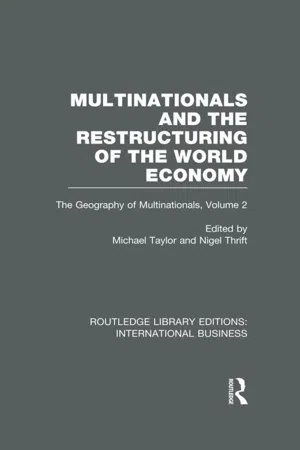
This volume charts the ways in which multinational corporations contributed to the restructuring of the world economy, paying particular attention to the spatial consequences of, and responses to, their operations at a number of scales. The book takes as its theme the differential spatial outcomes of the restructuring of different types of multinational corporation.
eBook - ePub
Multinationals and the Restructuring of the World Economy (RLE International Business)
The Geography of the Multinationals Volume 2
- 10 pages
- English
- ePUB (mobile friendly)
- Available on iOS & Android
eBook - ePub
Multinationals and the Restructuring of the World Economy (RLE International Business)
The Geography of the Multinationals Volume 2
1
INTRODUCTION: NEW THEORIES OF MULTINATIONAL CORPORATIONS
Michael Taylor and Nigel Thrift
Introduction
The last 15 years have seen fundamental changes in the stock of multinational corporations as a result of the rigours of a worldwide recession and the consequent bout of corporate restructuring (Thrift, 1985a). These changes constitute a major challenge to researchers striving to understand the workings of national, regional and urban economies around the world, not least because these economies, almost without exception, are becoming more open to ‘international pressures’ of which the plants and offices of multinational corporations are the most important concrete manifestation. Six changes — all interrelated — are of particular importance.
First, multinational corporations have grown in number. There are no exact figures but certainly there are now many more multinationals than formerly. Many of the new multinationals are the socalled ‘small multinationals’ — smaller firms which have responded more rapidly to foreign production opportunities than might once have been the case (Newbould, Buckley and Thirwell, 1978).
Second, the size of multinational corporations has increased substantially. Many of the largest multinationals are now much larger, at least in terms of assets and sales, than they were 15 years ago.1 Some of the largest multinational corporations have gone ‘global’ (Taylor and Thrift, 1982; Hout, Porter and Rudden, 1982), evolving integrated production and marketing strategies to enhance their share of profits. In the process they have taken on new organisational forms. The process of going global is now well advanced. Already by 1980, 32 per cent of the 180 multinational corporations covered in the Harvard Multinational Enterprise Project had switched to global production structures (Davidson and Haspeslagh, 1982).
Third, and in line with the changes in the number and size of multinational corporations, much more of the foreign production of multinational corporations is likely to be abroad, compared with domestic operations. This tendency shows up in data on assets, sales, employment, and so on (Tables 1.1 and 1.2). Even Swiss corporations, already recognised as some of the most international of multinational corporations, have continued to expand overseas, with the consequent stagnation of home-based employment. (Table 1.3).
Table 1.1: The Average Foreign Content of the World's 350 Largest Industrial Corporations (in millions of US dollars and per cent)

Table 1.2: The Average Foreign Content of 50 of the Largest Britishbased Industrial Corporations (in millions of £ and per cent)

Fourth, multinational corporations have extended into every kind of industrial sector, partly as a function of increasing multinational corporation diversification,2 partly as a function of increasing rates of multinational merger and acquisition (see Andreff, 1984) and partly as a function of the growth of nationally-based firms into multinational corporations in industrial sectors not formerly noted for their degree of multinational penetration. For example, firms in producer service industries, such as management consultancy, real estate consultancy and accounting, have all grown into large multinational corporations quite recently.
Fifth, the mix of the nationality of multinational corporations has changed (Table 1.4). United States-based multinational corporations have declined in importance relatively, while multinationals based in Japan, in various ‘semi-peripheral’ countries like Australia (Table 1.5) or South Africa, and in a few of the countries of the Third World (especially the newly-industrialising countries) have all increased in relative importance.3
Table 1.3: Changes in the Location of Employment of Switzerland's Largest Industrial Multinational Corporations, 1970 to 1980

Table 1.4: Accumulated Direct Investment Overseas by Country ($ US billions)

Table 1.5: Indicators of Australian Direct Investment Abroad: Number of Firms and Level of Investment, 1975-76 and 1981-82

Sixth, many multinational corporations have taken on a more explicitly fiscal character (Taylor and Thrift, 1982), even when they are not in the banking and finance sectors. This new level of involvement with financial matters has arisen partly from the internationalisation of finance that took place in the 1970s, with the result that multinational corporations have come to rely increasingly on the international financial system to raise capital and generate profits, and partly through the increasing centralisation of all types of multinational corporation which has been stimulated by new links between multinational banking corporations and all other types of multinational corporation (see Fennema, 1982; Grou, 1983; Andreff, 1984).
What these six changes amount to is something of a paradox. There is a much greater diversity in the stock of multinational corporations than formerly (Figure 1.1). At the same time multinational corporations have become more integrated Thus, although in many ways multinational corporations now represent a larger, more coherent economic bloc, it is a bloc which is cross-cut by many more fractures and fissures.4 The explanation of how multinational corporations and national, regional and urban economies interact has, therefore, become correspondingly more difficult to achieve. The task of the researcher trying to characterise the operations of the multinational corporations in a country, region or city is made even more problematic because other areas of research which might provide potential guidance are themselves in a state of flux as a result of this set of changes. They can, therefore, provide only a limited source of inspiration. The three main areas of research are industrial economics, organisation theory and Marxist economic theory.
Industrial Economics
The old explanations of the multinational corporation prevailing in the 1960s in industrial economics have failed to account for many of the dimensions of the new multinational diversity (Dunning, 1979). For example, Hymer’s approach was based upon identifying the underlying characteristics of multinational corporations which gave them a competitive edge over other firms. Another approach, usually associated with the name of Horst, was based upon the identification of factors which led multinational corporations to locate in particular countries. Finally, Vernon’s work on the product-cycle theory added the question ‘when’ to the question ‘why’, posed by Hymer, and the question ‘where’, posed by Horst. But each explanation proved deficient in some respect,5 partly because they relied almost exclusively on United States-based corporate activity as an archetype and partly because they concentrated upon foreign direct investment to the exclusion of all other forms of multinational activity.6
Figure 1.1: The Diversification of Multinational Corporations

The new theories that have grown up in the 1970s have tended to move away from this exclusive concentration on explaining foreign direct investment to the explanation of all forms of involvement by firms outside their national borders. This has necessarily meant that much greater attention is now being given to the multinational corporation itself as the locus of all these forms of involvement. This new focus of attention clearly leads towards two main areas of study, namely the theory of the firm and organisation theory. Of these two areas of study, it is the synthesis of the study of multinational corporations and the theory of the firm, going under the banner of internalisation theory, that has so far proved the most popular.
Internalisation is a simple term that applies to a simple insight, namely that a whole series of transactions are internalised within the multinational corporation rather than taking place within the market, either to protect against or to exploit market failure. In other words, planned coordination replaces the unplanned coordination of the market. Or, as Williamson (1975; 1981) would put it, hierarchies replace markets. In this depiction the multinational corporation is seen as an island of conscious power in a sea of unconscious cooperation whose form is the result of a long history of weighing up the administrative and other costs of allowing transactions to take place within the corporation against the benefits (and the risks) of allowing the market to do the work (Rugman, 1981; 1982; Caves, 1982). The problems in this kind of depiction lie in deciding exactly how, when and where the costs of internalisation are outweighed by the benefits, for otherwise the argument becomes perilously close to tautology — corporations internalise markets until it is no longer worth doing so. The problem of making such a decision on the bounds of corporations are compounded because many of the assets of modem multinational corporations (and especially the assets of corporations operating in the service industries producing intermediate goods) cannot be reduced to something concrete and tangible. They can muster a whole series of intangible assets such as technological knowhow and marketing skills which are just as important as more tangible assets but much more difficult to measure (Caves, 1983).
Certainly the concept of internalisation has stimulated new thinking on the behaviour of multinational corporations. For example, vertical integration in multinational corporations used to be explained as arising from technological economies, a patently inadequate explanation in many cases. But, with the advent of the concept of internalisation, vertical integration is now explained as the outcome of a whole series of new factors operating in tandem to produce this particular form of internalisation — factors such as risk-reducing economies associated with long-term contracts, monopolisation in order to make it possible to enhance prices, the avoidance of government regulation (via transfer pricing, and the like), the desire to protect patents, and so on.
However, as this list of factors shows, internalisation theory is open to criticism on the grounds of its seemingly all-encompassing nature. Much of the recent work on internalisation in multinational corporations consists of precisely the addition of these new factors. Admittedly, acknowledgement of the existence of these new factors has been stimulated by the concept of internalisation. However, it is possible to question how far all these new factors can be tied together in one broad, overarching theory with internalisation as its core. As Buckley (1983, p. 42) puts it, internalisation theory is not so much a theory ‘as a concept in search of a theory’. Thus,
The search for a general theory of the multinational enterprise has led to the ‘stretching’ of partial concepts or to an increasingly cumbersome taxonomy. Challenges to the new orthodoxy have been met by redefinition of central concepts or increasingly long inventories of classification.
Dunning (1979; 1981; 1983) has tried to surmount the problems imposed by internalisation theory by proposing an ‘eclectic’ theory of the multinational corporation, increasingly referred to as the ‘OLI [organisation, location, internalisation] paradigm’. As the acronym suggests, this is an attempt to add to the competitive advantage of internalisation that the multinational corporation enjoys the other determinants of foreign direct investment, namely the competitive advantages associated with ownership and location (Table 1.6). The worth of the OLI approach lies in its recognition of the fact that as well as a mushrooming ‘in all types of transactions, notably of intermediate products, which are best undertaken by hierarchies rather than markets, and/or an improvement in the efficiency of hierarchies, particularly MNE hierarchies relative to other forms of governance, to organise these and other transactions’ (internalisation advantages), there has been a proliferation in, ‘the demand for the types of goods, services and rights which MNCs are particularly wellequipped to supply, and/ or an enhanced ability on their part to supply and market these relative to their competitors’ ownership advantages’. At the same time, ‘the inducements to enterprises to produce goods and services from a foreign location have grown; and/or the demand for the type of output which is best supplied from foreign locations has increased’ location advantages (Dunning, 1983, p. 102).
Table 1.6: The OLI Theory of International Production

Table 1.6 continued

Using the OLI approach, many more situations in which multinational corporations are involved can be explained than by appealing just to the advantages of internalisation. In particular such an approach allows different weights to be placed upon different situations, according to which one or a combination of the three competitive advantages are the dominant force. Thus,
it would be unrealistic to suppose that the OLI advantages which explain investment by Standard Fruit in the banana industry of Costa Rica are the same (or have the same value) as that by NV Philips Gloeilampenfabrieken in the electrical appliances industry of Greece, or that of Trust House Forte in the hotel industry. (Dunning, 1983, p. 103)
The OLI approach has been applied in a number of different empirical situations now, from the multinational hotel industry (Dunning and McQueen, 1981a; 1981b) to the location of the offices of different multinational business service corporations (Dunning and Norman, 1983), and has proved very successful in isolating different determinants of foreign investment (Table 1.7). However, at the same time, it still suffers from some of the same disadvantages of internalisation ‘theory’, and specifically it is a list of factors likely to be important in the explanation of the growth of the modern multinational corporation rather than the explanation itself. Theoretical relations between the d...
Table of contents
- Front Cover
- Title
- Copyright
- Contents
- Preface
- 1 Introduction: New Theories of Multinational Corporations
- 2 Labour Dynamics and Plant Centrality in Multinational Corporations
- 3 Multinationals, Business Organisations and the Development of the Fiji Economy
- 4 The International Expansion of an Enterprise of the Semi-periphery: South African Breweries Limited
- 5 Spatial Aspects of Third World Multinational Corporations' Direct Investment in Indonesia
- 6 The Internationalisation of Producer Services and the Integration of the Pacific Basin Property Market
- 7 The Internationalisation of Japanese Commercial Banking
- 8 The Global Investments of a British International Development Agency
- 9 Fruits of Independence? Philippine Capitalists and the Banana Export Industry
- 10 The Role of Foreign Manufacturing in Britain's Great Recession
- 11 Economic Crisis and Corporate Restructuring:Multinational Corporations and The Paper, Printing and Packaging Sector in Bristol
- 12 One Perspective on the Enterprise Perspective
- References
- Author Index
- Subject Index
Trusted by 375,005 students
Access to over 1.5 million titles for a fair monthly price.
Study more efficiently using our study tools.
Frequently asked questions
Yes, you can cancel anytime from the Subscription tab in your account settings on the Perlego website. Your subscription will stay active until the end of your current billing period. Learn how to cancel your subscription
No, books cannot be downloaded as external files, such as PDFs, for use outside of Perlego. However, you can download books within the Perlego app for offline reading on mobile or tablet. Learn how to download books offline
Perlego offers two plans: Essential and Complete
- Essential is ideal for learners and professionals who enjoy exploring a wide range of subjects. Access the Essential Library with 800,000+ trusted titles and best-sellers across business, personal growth, and the humanities. Includes unlimited reading time and Standard Read Aloud voice.
- Complete: Perfect for advanced learners and researchers needing full, unrestricted access. Unlock 1.5M+ books across hundreds of subjects, including academic and specialized titles. The Complete Plan also includes advanced features like Premium Read Aloud and Research Assistant.
We are an online textbook subscription service, where you can get access to an entire online library for less than the price of a single book per month. With over 1.5 million books across 990+ topics, we’ve got you covered! Learn about our mission
Look out for the read-aloud symbol on your next book to see if you can listen to it. The read-aloud tool reads text aloud for you, highlighting the text as it is being read. You can pause it, speed it up and slow it down. Learn more about Read Aloud
Yes! You can use the Perlego app on both iOS and Android devices to read anytime, anywhere — even offline. Perfect for commutes or when you’re on the go.
Please note we cannot support devices running on iOS 13 and Android 7 or earlier. Learn more about using the app
Please note we cannot support devices running on iOS 13 and Android 7 or earlier. Learn more about using the app
Yes, you can access Multinationals and the Restructuring of the World Economy (RLE International Business) by Michael Taylor,Nigel Thrift in PDF and/or ePUB format, as well as other popular books in Business & Business General. We have over 1.5 million books available in our catalogue for you to explore.