![]()
1
Introduction
Asia and the Pacific
Ian Shirley and Carol Neill
The Asian and Pacific region is arguably the most populous, culturally distinctive and economically powerful region in the world today. ‘The region’ is subject to alternative spatial interpretations with contemporary reports providing contrasting definitions and boundaries as well as comparative assessments of particular countries and cities. Despite boundary definitions, for the purposes of comparison there is no argument today over the significance of this cluster of countries and their combined impact on the political economy of the world. Recent reports from global development agencies such as the World Bank, the International Monetary Fund, the Asian Development Bank and the OECD as well as myriad journal articles and books record the spectacular transition of countries in this region over the past six decades. The literature on this region is littered with references to the ‘Asian Economic Miracle’, the rise of the ‘Asian Tigers’ and the speed with which countries in Asia have moved from ‘underdevelopment’ to become global economic and political powers. Irrespective of the indicators recording the achievements of the region over recent years or the significance of particular countries such as China, India, Indonesia and Japan in the political forums of the international community, Asia and the Pacific has emerged today as perhaps the most dominant yet least understood region in the world.
There are two major factors contributing to the lack of understanding regarding the Asian and Pacific region. The first concerns the sheer scale and diversity of Asia and the Pacific both in terms of its physical characteristics and its distinctive populations. The second factor stems from what McKinnon (2011) refers to as the ‘scholarship’ of the region dominated as it is by the Western academy. The literature on development in the region is dominated by global agencies1 established in the aftermath of the Second World War with a primary focus on restoring war-torn Europe and preventing further economic or military conflicts. Trends such as globalisation and urbanisation are examined from within the Western tradition of scholarship and even when scholars of Asian and Pacific origin are cited in the academic literature, they tend to adopt the development philosophies and priorities of academics based in Western institutions. The contemporary literature on cities exemplifies this dominance. Not only are current examinations of Asian cities formulated on the basis of investigations into the growth and shape of Western cities but the Asian cities most cited in the globalisation literature are those that most resemble Western cities.
Perhaps the most graphic example of the way in which the region is misunderstood relates to the Pacific Islands that are either treated as minor players in an increasingly globalised world or ignored in contemporary accounts of the region. Within Oceania, the terms Polynesia, Melanesia and Micronesia are frequently used to distinguish geographical regions of the Pacific rather than as originally intended, to categorise them as distinct cultural entities and traditions (Scheyvens 1999). These cultural entities are in reality Western constructs (Howe 1997) just as it can be argued that because of the arbitrary ways in which they were divided up among the colonising powers, the countries of the Pacific may best be understood as Western fictions (Macpherson 1992a: 431). In contrast to comparative examinations of countries that rely almost exclusively on ‘land’, it is the Pacific Ocean that is regarded in this part of the world as an extension of the land giving these island states their essential character, as well as an important element in the livelihoods of Pacific people. The Pacific Ocean contains some of the most marginal as well as some of the most productive environments for human habitation. To the people of the Pacific the ocean is a pathway, linking their islands and societies and operating as a storehouse containing essential resources for their survival.
The Asian and Pacific Region
The Asian and Pacific region extends over one-third of the earth’s surface and encompasses tropical forests and deserts, hills, mountain ranges and fertile plains. It contains large expanses of land as in the case of India and China; archipelagos such as Indonesia extending over some 19,000 islands; and small island countries such as Samoa and Fiji in the middle of the vast Pacific Ocean. The physical characteristics of the region are punctuated by mountains, gorges and vast expanses of water that have provided an abundance of mineral and natural resources as well as establishing a foundation for the development of agriculture, horticulture, aquaculture and a wide range of land and water based industries. At the same time the physical terrain and seascape of the region has historically generated major physical obstacles that have contributed to divided communities and isolation and these in turn have presented a major challenge for nation-states in providing basic infrastructure and utilities for expanding populations. A constant challenge facing populations throughout the region concerns climatic conditions ranging from extremes of heat and humidity to winter cold and rain – extremes that over recent years have encompassed floods and tropical storms. The region also faces geological hazards – tsunami, earthquakes, landslides and volcanic eruptions. These characteristics and physical landscapes are problematic whenever attempts are made to capture the dynamics of development among any of the constituent states let alone the region as a whole.
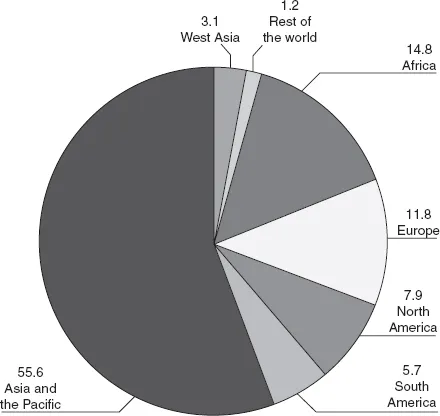
If the physical characteristics seem insurmountable when it comes to understanding the scale and diversity of the region, then the populations that inhabit this vast expanse of land and water defy all attempts to capture the human condition. According to the Asian Development Bank (2011a) almost 56 per cent of the world’s population lives in Asia and the Pacific (see Figure 1.1) although other estimates record the population at over 60 per cent and rising (Pawar 2009).
Figure 1.1World population, 2010 (percentage distribution) (source: Asian Development Bank 2011a: fig. 1.2, reproduced with permission).
Even when the Asian and Pacific region is divided into subregions, nation-states or cities, it is extremely difficult to illustrate the scale, the diversity or the changing ‘demographic landscapes’ of the region. It is a landscape that is characterised by cultural and ethnic diversity and by linguistic, religious and political differences. There are literally hundreds of languages in daily use across the region as well as a multiplicity of dialects. Some writers refer to the fact that people in the Asian and Pacific region communicate their way of life, customs, values and beliefs through some 3,500 languages and thousands of dialects, many of which have been conveyed by oral traditions rather than written scripts (Pawar 2009).
It is a richness and diversity that is further exemplified in religious beliefs and practices. It encompasses the indigenous Shinto and Confucian traditions as well as Buddhism and Hinduism that were introduced from southern Asia. Islam was transported to the region from India whereas Christianity in its Roman Catholic form came to the Philippines with the Spanish in the fifteenth century. Protestant forms of Christianity were introduced by missionaries when they accompanied the various colonial powers that occupied countries in the region over many centuries. Beyond these diverse religions, a multiplicity of sects and castes exist with indigenous people in the region having their own belief systems and traditions (Cole 2007). Not only are these different religious values and beliefs integrated into family, village and community systems (as in the case of Samoa) but they also find expression in political systems, political parties and in the constitutions of some nation-states.
Some 58 per cent of countries in the region have parliamentary systems with the remaining 42 per cent described as monarchies or one-party states (UNDP 2008), but such summaries gloss over the different philosophical beliefs and traditions that find their outward expression in political and cultural practices and in the multiplicity of institutions and agencies that engage in daily expressions of political life. It is the evolution of political systems and governance in the region that is significant in analysing the shape and form of the region today. Apart from Japan and Thailand, other countries in the region were colonised by the United Kingdom, France, Portugal, Spain, the Netherlands, Germany, Japan, China and Russia. Some of these colonial powers executed their authority over nation-states for hundreds of years, extracting resources and capital for the benefit of their homelands. Other forms of ‘colonisation’ such as monarchies, domestic tyrants and more recently international capital have also been significant in shaping the political systems of today with obvious implications for political engagement and citizenship.
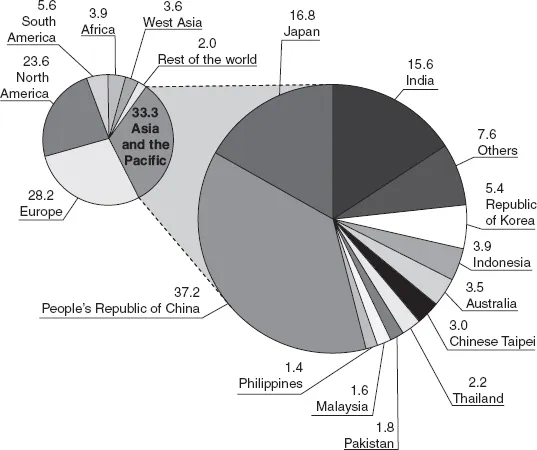
The Asian and Pacific region as defined by the Asian Development Bank (ADB 2011a) generates one-third of the world’s Gross Domestic Product (GDP) with 70 per cent of GDP produced in the region attributed to China, Japan and India (see Figure 1.2). Between 1965 and 1995, the countries of East Asia were collectively described by the World Bank (1993) as the ‘East Asian miracle’ not only because they economically outperformed other low-and middle-income countries in the world but also because of the way in which they effected a social transformation in literacy and life expectancy rates. Average life expectancy at birth rose from 56 years in 1960 to 71 years in 1990 with the adult literacy rate jumping from 73 to 91 per cent over the same period. Per capita income between 1965 and 1990 increased more than four times in five of the East Asian countries and more than doubled in Indonesia, Malaysia and Thailand, thereby recording three decades of sustained and rapid economic growth (World Bank 1993: 2–4; Zhang 2003).
Figure 1.2Asia and the Pacific in the world economy, 2009 (percentage distribution of GDP at PPP) (source: Asian Development Bank 2011a: fig. 2.1, reproduced with permission).
When seen in the context of regional economies today, the output figures for economic growth in the global economy report strong growth in Asia and sluggish growth in North America and Western Europe signifying a shifting economic balance to Asia. Although the USA is still the largest economy in the world, the next three countries are all in Asia, namely the People’s Republic of China, India and Japan.
The population of Asia and the Pacific is forecast to grow at an annual average of 0.5 per cent over the next 40 years with the region containing both very high and very low fertility nations. Most countries in the region have experienced net emigration over recent years meaning that there were more leaving than arriving, although the patterns of internal migration and the urbanisation of the region as a whole have emerged as major preoccupations of planning authorities confronting significant shifts in population demographics. One of these transitions in the population base is referred to as the demographic dividend (Bloom et al. 2000). It attributes the acceleration in economic growth to an increasing proportion of working age individuals, thereby generating high savings and investment rates and enabling these countries to accumulate physical capital and expand productive capacity in line with the expanding workforce. It is a dividend that has been enhanced by public education and an improvement in the basic skills of workers, thereby raising the overall level of human capital.
As the relatively youthful populations of the region give way to older cohorts in which economically inactive retirees account for a growing share of the total population, then the demographic dividend becomes in effect a demographic tax (Asian Development Bank 2011b). In Asia, the ageing of the population reflects an overall decline in fertility and a rising life expectancy although again these trends differ markedly between countries in the region. Not only does the ‘transition’ have significant implications for regional labour markets but also for the distribution of economic benefits and the provision of social security. Whereas major development bodies place importance on the ‘flexibility’ of labour markets, alternative interpretations record the burden of low wages and the inequitable contribution of workers in the factories of Asia.
Over half of the world’s extreme poor (641 million people) live in the Asian and Pacific region, with 70 per cent of this population living in rural areas. The main source of livelihood for the rural poor is agriculture, which provides employment for 60 per cent of working people but accounts for 25 per cent of GDP. The magnitude of poverty in countries such as China and India is a major challenge for the region. Measured against US$2 per day, over 450 million people in China and 865 million people in India live in poverty. Poverty alleviation programmes have had some impact on reducing poverty levels in the region, but recent evidence suggests that the decline in poverty rates is slowing with rural poverty remaining stubbornly high. The slowing in poverty reduction rates has been attributed to the neglect of agriculture in the region. Not only have poverty declines slowed down, but also the benefits of economic growth have been unevenly distributed within countries and across the region, exacerbating extreme inequalities and increasing the gap between rich and poor.
When it comes to explaining the development of Asian and Pacific countries as well as the region as a whole, considerable emphasis is placed on processes such as globalisation and urbanisation as well as variants such as globalism, modernisation and modernity. Not only has international literature produced a wealth of information on different metropolitan constructs from cities to regions, but it has also provided a basis for comparing countries, their major metropolitan centres, the speed and scale of urban processes and contemporary interpretations of nationhood and governance. However, there are serious limitations to this literature. The basis for comparison is predominantly ahistorical and emanates from concepts as well as belief systems that dominate European and North American traditions. There is little or no recognition of alternative value systems and traditions and thus even where judgements are being made about governance systems, these stem from experiences generated in ‘democratic’ nations and global cities such as London and New York. Although the approach adopted in this research programme has attempted to bypass these conventions, the participants are acutely aware of the difficulties involved in building a research and development programme from within their own cities and countries without being unduly influenced by terminology and concepts that dominate academic conventions and literature. That said, it was considered important to briefly review the literature that dominates development programmes and processes.
Globalisation, Urbanisation and the State
Beyond the economic interpretations that have dominated external accounts of development in the Asian and Pacific region, there is now a burgeoning literature devoted to globalisation, urbanisation and the state. While the preoccupation with globalisation has been most dominant over the past four decades, the concept is not new. It has evolved over thousands of years through increasing global contact between different countries and regions of the world. These contacts have progressed through travel, migration, trade, cultural interactions and new technology, each contributing in its own way to the spread of knowledge and understanding. In 2005, Thomas Friedman argued that globalisation and technology had ‘flattened the world’, creating a ‘level playing field’ in which developed and less developed countries would be able to compete on equal terms. Friedman could point to dramatic changes in the world economy especially in global financial markets and in the spread of computer technology, thereby reinforcing the view that a convergence was evident in global systems of interaction and exchange (Held et al. 1999). It is not a viewpoint shared by the contributors to this text. The world is not ‘flat’ and any ‘so-called’ convergence is riddled with contradictions and conflicts as recorded by a range of spurious indicators and ranking systems.
There is some evidence to suggest that what has been referred to as globalisation (or globalism) has generated obvious ‘benefits’ especially over recent decades. This has undoubtedly reinforced the view that the process of globalisation has enhanced the economic and social well-being of many countries across the world through international trade and exchange. If th...