This work concentrates on tracing the evolution of the so-called "red menace" phenomenon as a means of demonstrating the correlation between growing American paranoia and the success of the anticommunist campaign (1935-1955). The House Committee on Un-American Activities 1947 investigation of Hollywood, the nation's most visible industry, served a critical role in conjuring up anti-red hysteria and fanning the flames of virulent anticommunism. Using conveniently unjust tactics, the Committee "painted" targeted Hollywood personalities red and established the infamous blacklist - certified proof in the minds of many that "subversives" were indeed conspiring from within. A failed attempt on behalf of the "Hollywood Ten" to demonstrate the Committee's undemocratic nature allowed HUAC to forge ahead with its investigation and establish the anticommunist foundation upon which Joseph McCarthy would construct his campaign. Hollywood and Anticommunism stands as an important contribution to McCarthy-era literature and should appeal to all interested in the early Cold War and the impact that unwarranted hysteria has had and continues to have on the growth and development of the nation.
eBook - ePub
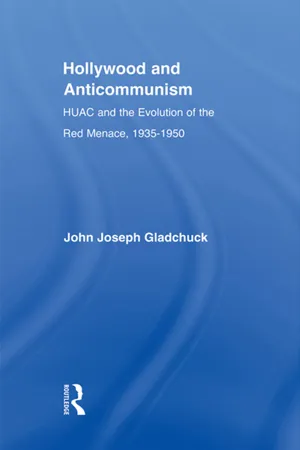
Hollywood and Anticommunism
HUAC and the Evolution of the Red Menace, 1935-1950
- 224 pages
- English
- ePUB (mobile friendly)
- Available on iOS & Android
eBook - ePub
Chapter One
Introduction: HUAC, Hollywood and the Evolution of the Red Menace
Often referred to as “a golden era,” the 1930’s were a glorious time for the movie industry, an industry that stood as arguably the most recognizable in the world. Hollywood, for millions across the globe, symbolized a “dream factory,” a mythological Eden where stars roamed pristine streets awash in Southern California’s tender sun. It was the hallmark of the California “image,” a place of both physical and mystical lore that not only produced “dreams,” but in itself represented one. “There in the studio the dream reawakened,” commented Edmund Morris on young Ronald Reagan’s arrival at Republic Productions studio in the spring of 1936, “it was a dream that had possessed him more than seven years before, of being ‘carried into a new world’ where things really mattered.”1 Hollywood was more than just the films it produced. As a place, it represented the heartbeat of a numinous universe where sun, sand, and eternal warmth lured curious souls in search of fame, fortune, and adventure in a certified land of enchantment. It was a city within a city, a “paradise,” an urban jungle of “blue-trunked trees, tiled and whitewashed houses obscenely brilliant with bougainvillea,” towering palms and majestic hills.2
Hollywood was also defined by its inhabitants, a truly eclectic mix of characters that all combined to imbue “movieland” with its magical essence. Its large “progressive” community, however, arguably stood as its most prominent and certainly its most maligned. Allegedly “infiltrated” by hard line Communists from the East, the Hollywood Communist Party, tinseltown’s progressive organ, was in reality a rather benign organization composed of concerned citizens from a myriad of backgrounds. Contrary to the popularized image of the Communist Party in Hollywood (as portrayed by The House Committee on Un-American Activities (HUAC) in the 1947 “trials”), the film industry’s “Red” community was more cultural than political in nature and posed little if any threat to the security and well being of the United States. Many associated with the Communist Party were attracted to its egalitarian precepts and did not understand the magnitude of Soviet totalitarianism. Marxism, on paper, offered relief from the horror of mass poverty and destitution in the wake of the Great Depression. The Communist Party was an outlet, a vehicle through which to vent frustration regarding capitalism and its shortcomings. Commitment to greater social and economic equality did not, however, equal un-Americanism. Many of these individuals, “parlor Reds,” “Fellow Travelers,” “pink” intellectuals, were fascinated with the concept of communism as a road to utopia but realized that democracy remained the only true “popular” political system. A greater extension of democracy, both socially and economically, is was what most were after.
Communism in the 1930’s, in many ways, (although there certainly existed militant revolutionaries who harbored a thirst for violence) represented a fad for “New Dealers” with the Communist Party’s more “moderate” branches, such as the Hollywood division, serving as “clubs” for “liberals” who wished to voice their concerns regarding America’s social and economic shortcomings.3 “The New Deal liberal in the 1930’s,” remarked historians Kai Bird and Martin J Sherwin, was “committed to supporting and working for racial equality, consumer protection, labor rights, and free speech.”4 Many curious with communism in the aftermath of the Depression legitimately feared a collapse of capitalism and experienced dread over the thought of a fascist alternative. Communism, to a degree, represented both a lesser evil as well as a bridge to a less exploitative world. Clarified by “Fellow Traveler” (though never a registered member of the Communist Party) and father of the atomic bomb Robert Oppenheimer during an executive session before the Joint Committee on Atomic energy in 1950, communism in the 1930’s did not constitute a revolutionary conduit, but rather a vehicle through which concerned “populists” could encourage much needed reform. It represented, in many respects, a ray of hope for a seemingly fallen society. “[I] had naively thought,” opined a somewhat remorseful Oppenheimer,” [that] the Communists possessed some answers to the problems facing the country in the midst of the depression.”5 Despite his “red” reputation, Oppenheimer, like many attracted to the egalitarian tenets of communism in the 1930’s, “loved America,” asserted his longtime secretary Verna Hobson, “and this love was a deep as his love for science.”6
One political position that all affiliated with the Party openly embraced in the 1930’s revolved around “popular front” opposition to Nazism. “In a political age, Hollywood émigrés [primarily Eastern European Jews] found themselves in political situations,” maintained Hollywood historian and biographer Ed Sikov, “while few were more than salon gauchistes, most had no qualms about working with Marxists to combat fascism [in the mid-1930’s], as they had in Europe. But red baiting was abroad in the studios,” continued Sikov, “and the refugees found themselves forced to choose between quietism and fellow traveling.” 7 Positions assumed by several of its members regarding anti-Fascism and inequality in society did, however, constitute a threat to America’s social and economic status quo and therefore drew the attention of the ultraconservative right. Energized by a contentious national climate defined by “Red Scare” paranoia, the House Committee on Un-American Activities assault on Hollywood, initiated by Texas Congressman Martin Dies in 1939, focused the eyes of the world on what John Rankin referred to as the “tarantula of Hollywood where loathsome paintings hung in the home of the seducer of white girls [Charlie Chaplin].”8 Hollywood, according to a power thirsty and clearly delusional Rankin, represented the “the greatest hotbed of subversive activities in the United States, headquarters for one of the most dangerous plots ever instigated for the overthrow of the government.”9 In 1947 the Committee presided over the first of what would become several “official” Hollywood forays as the film industry emerged as a catalyst for the once endangered “red hunting” institution. Hollywood would eventually provide the Committee with the boost that ultimately propelled it into its banner year of 1948, a year that arguably paved the way for Wisconsin Senator Joseph McCarthy and his coast to coast un-American purge.10 Lost amidst House Committee hoopla was the resistance effort put forth by those who refused, in the words of historian Victor Navasky, to “name names.”11
Long before men such as Edward R. Murrow seized the American stage with his highly publicized attack on McCarthy, “The Hollywood Ten” put forth a resolute effort designed, in part, to expose the fallibility of the Committee.12 Unfortunately for the Ten, however, anticommunist fever had the American public mesmerized in 1947 and cost the Ten the popular support necessary to successfully unveil the Committees’ un-Americanism. Ultimately, the Ten were victims of not only the un-American Activities Committee’s betrayal of the constitution, but of the asphyxiating social milieu commensurate with the “Red Scare” era. What could have been arguably a decisive blow to the entire un-American campaign became a bridge to prosperity for the Committee. The silencing of the Hollywood resistance correlated with the emergence of the House Committee on un-American Activities as America’s leading line of defense in a “cold” war against domestic subversion as the “blacklist,” the Committee’s lasting Hollywood legacy, lingered in tinseltown as a dark reminder of the House Committee’s pervasive potency. For the Ten, it was not “Good night and good luck,” to quote the charismatic Murrow, but “good night and tough luck” as the Ten ironically became casualties of an epoch commonly referred to as “McCarthyism” without having ever brushed shoulders with the Senator. As evidenced by the Ten, the “McCarthy” era began well in advance of McCarthy.
The House Committee on Un-American Activities “success” in Hollywood, however, was not simply the product of its collective “genius.” In fact, it could be argued that HUAC succeeded in Hollywood in spite of itself. Its ultraconservative composition and lack of solid leadership rendered it vulnerable to attack from many who deemed the organ an instrument of American totalitarianism. As demonstrated in its years under its “patriarch” Dies, the un-American Activities Committee’s seeming unwillingness to conduct its operation in accordance with the constitution combined with the brazen manner with which it executed its agenda invited a rash of criticism from all corners of the political and social spectrum.13 Attacks on the Committee’s viability became more acute as the Second World War raged on and in fact, by the war’s end, the Committee, with the loss of Dies, faced virtual extinction. With the subversion threat at home seemingly diminished and the congressional outcry against the Committee growing ever stronger, Congress contemplated shelving the much maligned investigative organ. As 1945 approached, the Committee found itself in a rather precarious position, short on both support and resources. “Toward the close of that year,” wrote William F. Buckley, “only a few people still believed in the mission of HUAC.” Fortunately for the Committee, “John Rankin,” observed Buckley, “was one of them.”14
As southern as a southern democrat could be, Mississippi’s John Rankin emerged in late 1944 as arguably the Committee’s last hope. Void of momentum and lacking its charismatic front man in Dies, the Committee teetered on the verge of obscurity and faced, what appeared to be, complete dissolution. Rankin, however, despite his many shortcomings, was astute enough to observe that fear over the so-called Red menace had resurfaced in postwar America. As a result, the return of the “red” phenomenon once again created a “market” for a Red hunting enterprise. “Unless it is held that there is no such thing as un-American activity,” maintained South Dakota’s Karl Mundt, “American’s should be able to agree on what it is and [a] Committee could then expose it.”15 Although the Dies Committee was no more, its powerful pre-war investigation coupled with over twenty years of Red Scare paranoia dating back to the Palmer raids of 1920 rendered the Committee somewhat viable in the immediate postwar period. In fact, as early as 1944 fear over the Soviet Union and its post war aims on both Europe and Asia had begun to manifest itself in the form of anticommunist articles and editorials featured in major publications throughout America. “The greatest threat to mankind and civilization is the spread of the totalitarian philosophy,” wrote Russian immigrant, actress, screenwriter, and infamous “Friendly” witness Ayn Rand in Reader’s Digest’s January 1944 edition, “Totalitarianism is collectivism, the subjugation of the individual to the group. Collectivism is the ancient principle of savagery. A savage’s whole existence is ruled by the leaders of his tribe. Civilization is the process of setting men free from men. Collectivism,” Rand concluded, “is not the New Order of Tomorrow. But there is a New Order of tomorrow, it belongs to the individual man.”16 Regarding communist movement abroad, Reader’s Digest noted in March of 1944 that “While Americans are heatedly arguing ‘what shall we do with Europe,’ a revolution has already started. Russia’s presence in the victorious coalition assures powerful support for those who prefer to follow the road leading to an authoritarian state and a controlled economy. Europeans,” cautioned the magazine, “today stand at a crossroads.”17 There is little doubt that the reading public had once again begun to contemplate the scope of the “red menace” and the impact that it could have both at home and abroad. A “second coming” of the “Red Scare” appeared imminent.18
With the atmosphere ripening, Rankin began his campaign to revive in full the investigation of subversive activity in America. Cognizant of the environment overseas and attune to growing concern over Reds within, the Mississippian remained convinced that communism would soon emerge as a palpable internal threat. Such a development would ultimately force the nation to rally behind a bid to flush Bolshevism from America’s shores. A revived un-American Activities Committee would provide Rankin, along with fellow conservatives in Congress, with a “patriotic” opportunity certain to bolster their political careers. Also intriguing Rankin was the prospect of a full fledged Hollywood investigation, a mission begun by Dies but never truly brought to fruition. If Rankin could somehow convince Congress that a revival of the Committee was indeed necessary, an initial investigation of the film industry was certain to provide the House Committee with the legitimizing publicity required to ascertain permanent status. What better place to demonstrate the necessary nature of such a body than Hollywood, the world’s entertainment epicenter? “It was a match made in heaven,” recalled Eric Bently, clearly chosen, in the words of screenwriter Arthur Miller, “because they [HUAC] were cheap publicity hounds.”19 Rankin’s thirst for fame spurred him as he tirelessly urged his fellow congressmen to recognize the communist threat and restore the un-American organization. His interminable politicking combined with a ripening climate finally paid of in January of 1945 with the reinstatement of the Committee. Rankin had, according to Committee historian Robert K. Carr, engineered one of the most “remarkable procedural coups in modern history.”20 The investigation of subversive activity was once again on and Hollywood, with its star power, global allure, and large progressive population, provided the perfect target for the zealous band of conservatives who viewed the “Committee” as a vehicle to social and political prosperity.
No longer “forced” to investigate “fascism” (in the form of the German-American Bund), an endeavor that Dies and several of his committeemen had been less than excited about in the 1930’s and early 1940’s, the “Rankin” committee (as it was often called although Edward J. Hart (R-N.J) was named initial chair) was able to channel a tremendous amount of energy and enthusiasm into the postwar scourge of communistic unAmericanism.21 Communism had always been the un-American Activities Committee’s “menace of choice” and with Stalin on the move abroad coupled with a rise in communistic fear at home, the prospect of a large scale investigation of the Red Menace looked promising. After conducting a preliminary investigation of the American Communist Party and its most influential characters (men such as William Z. Foster, Earl Browder, and Gerhart Eisler), the Committee made an abrupt turn west and began to concentrate its energies on a thorough inquiry into the extent of the Communist Party’s influence on the American movie making business. “To kick off its postwar campaign HUAC needed a headline grabber and what better than filmland,” noted historian Griffin Fariello, “through the efforts of a titanic publicity machine and the production of more than six thousand films a year, Hollywood in its golden age was the focus of the nation’s fantasies. Hollywood was news,” Fariello asserted, “and the purge of its Communists captured the nation’s attention.”22
The 1947 Hollywood hearings stand as arguably the most significant in the history of the “un-American” Committee. Although never able to produce a legitimate example of Communist agitprop in film, the House Committee, under the “guidance” of New Jersey’s J. Parnell Thomas, effectively confirmed the existence of a large “Red” presence in Hollywood, a “fact” that alarmed Americans across the country and served to further legitimize both the Committee and its mission. “In the past ten-years the Hollywood-Los Angeles area has become the mouthpiece, heart and pocketbook of the American Communist Party,” wrote Oliver Carson in the American Mercury in February of 1948.23 Due in part to the Thomas Committee, however, “the deep red which has covered so much of Hollywood for the past few years is rapidly fading to light pink. The Lush era of easy money, vast crowds and big names is over for Communists in Hollywood.”24 The “blacklist,” which evolved in the wake of the hearings, proved to be one of the most crippling developments of the entire McCarthy age. Very few escaped its perniciousness unscathed as both “Friendly” and “Unfriendly” witnesses experienced its potency in one way or another. As Dalton Trumbo once phrased, in light of the full scope of the investigation, all were “victims” as the un-American Activities Committee prosecuted its hysteria-fueled campaign, shattering the film community and its progressive ethos in the process.25 What remained in the wake of the investigation was an agency driven by fear, arguably a governmental puppet which operated on eggshells in the hope of remaining afloat in the aftermath of the ugliest episode in its history. Producers, writers, and actors all pandered to conservatives in government as the movies themselves became products of the contentious climate within which they were made. For those on the blacklist, a career on the black-market was all one could expect as expulsion from the industry cost writers, directors, and actors alike the opportunity to live and work in the magical environment that had had labored so hard to sustain.
As Trumbo noted in his infamous 1970 Laurel Award speech to the Screenwriters Guild, when looking back on the blacklist, do not bother looking for heroes or villains. There were none. All involve...
Table of contents
- Cover
- Title
- Copyright
- Contents
- Preface
- Acknowledgments
- Chapter One Introduction: HUAC, Hollywood and the Evolution of the Red Menace
- Chapter Two Land of the Free, Home of the Hysterical: American Communism and the Cultivation of "Red" Hysteria
- Chapter Three Painting Them Red: Periodicals and the Proliferation of American Anti-Communism 1935-1950
- Chapter Four The Communist Conundrum: Moderate Hollywood Communists and Why They Were Subject to the HUAC Inquisition
- Chapter Five Communism on Camera: Ninotchka and the Cinematic Representation of the Communist Left
- Chapter Six The Right to Remain Silent: Hollywood, Albert Maltz, and the Post-Hearing Resistance
- Chapter Seven The Red Raid in Retrospect: Reflections on HUAC's Hollywood Investigation and Its Impact on the Evolution of McCarthyism
- Notes
- Bibliography
- Index
Trusted by 375,005 students
Access to over 1.5 million titles for a fair monthly price.
Study more efficiently using our study tools.
Frequently asked questions
Yes, you can cancel anytime from the Subscription tab in your account settings on the Perlego website. Your subscription will stay active until the end of your current billing period. Learn how to cancel your subscription
No, books cannot be downloaded as external files, such as PDFs, for use outside of Perlego. However, you can download books within the Perlego app for offline reading on mobile or tablet. Learn how to download books offline
Perlego offers two plans: Essential and Complete
- Essential is ideal for learners and professionals who enjoy exploring a wide range of subjects. Access the Essential Library with 800,000+ trusted titles and best-sellers across business, personal growth, and the humanities. Includes unlimited reading time and Standard Read Aloud voice.
- Complete: Perfect for advanced learners and researchers needing full, unrestricted access. Unlock 1.5M+ books across hundreds of subjects, including academic and specialized titles. The Complete Plan also includes advanced features like Premium Read Aloud and Research Assistant.
We are an online textbook subscription service, where you can get access to an entire online library for less than the price of a single book per month. With over 1.5 million books across 990+ topics, we’ve got you covered! Learn about our mission
Look out for the read-aloud symbol on your next book to see if you can listen to it. The read-aloud tool reads text aloud for you, highlighting the text as it is being read. You can pause it, speed it up and slow it down. Learn more about Read Aloud
Yes! You can use the Perlego app on both iOS and Android devices to read anytime, anywhere — even offline. Perfect for commutes or when you’re on the go.
Please note we cannot support devices running on iOS 13 and Android 7 or earlier. Learn more about using the app
Please note we cannot support devices running on iOS 13 and Android 7 or earlier. Learn more about using the app
Yes, you can access Hollywood and Anticommunism by John J. Gladchuk in PDF and/or ePUB format, as well as other popular books in History & North American History. We have over 1.5 million books available in our catalogue for you to explore.