eBook - ePub
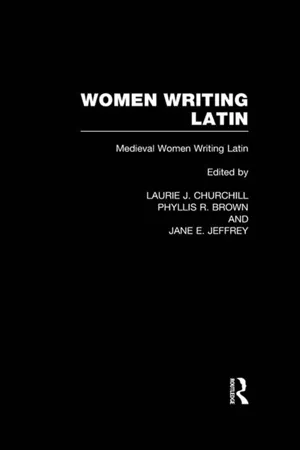
Women Writing Latin
Medieval Modern Women Writing Latin
- 448 pages
- English
- ePUB (mobile friendly)
- Available on iOS & Android
eBook - ePub
Women Writing Latin
Medieval Modern Women Writing Latin
About this book
This book is part of a 3-volume anthology of women's writing in Latin from antiquity to the early modern era. Each volume provides texts, contexts, and translations of a wide variety of works produced by women, including dramatic, poetic, and devotional writing. Volume Two covers women's writing in Latin in the Middle Ages.
Information
Hrotsvit's Callimachus and the Art of Comedy1
Even without external corroborating evidence, we may infer from her works that the nun Hrotsvit lived in Saxony during the second half of the tenth century.2 Because she seems to have had considerable freedom of movement and expression for a woman at that time, writing about worldly affairs evidently with some personal knowledge of them, she was most likely a canoness, that is, not fully cloistered. She must have visited the courts of the Saxon kings, probably more than once, since she chronicles their exploits and composes poetry of a type briefly popularized by a scholar in residence there.3 Her family, therefore, belonged in all probability to the aristocracy. At the same time, women's issues permeate her works, which combine, with remarkable confidence and intelligence, an astoundingly modern outlook with a variety of ancient and medieval rhetorical strategies. That she composed plays, whether to be produced on stage or not, demonstrates furthermore an unusually close familiarity with the classical dramatic tradition and attests to a high level of erudition for anyone, much less a woman in her day. All in all, she is clearly one of the finest writers, indeed minds, of the Ottonian resurgence.
Despite their clear importance, however, Hrotsvit's works have not seen full justice either then or now. Her stagecraft, for instance, has been dismissed as simplistic and unrealizable.4 Not unlike Seneca and his strange and challenging baroque tragedies, which are currently experiencing their own minor revival of interest, rarely have her plays until very recently received fair treatment from the academic and theater communities. As theater historians over the last century have broadened their horizons in general and opened their minds to nontraditional types of theater, they have come to recognize that some good drama does not fit into the prescribed Western modes. Looking now at Hrotsvit's dramas in this, if not more objective, less objecting light, and not judging her for what she never tried to be, we find in her plays effective, performable, and yes, even comic scripts suitable for theater production in this or any day.
The translation below constitutes an attempt to give Hrotsvit some of her due, in this case, a fair showing on stage. Beginning with the supposition that she wrote her plays for production, not mere recitation, I set about seeking a means by which to stage her comedies effectively.5 Of course, underlying all effective drama is a concept guiding the thought and premise of the play. It is the first thing to look for in presenting a drama. To me, one concept stands out in Hrotsvit's plays, namely, the notion that women have the right and power to control their lives, their bodies, and their souls. Again and again, Hrotsvit seems to me to be saying that both genders are fully responsible for their own morality, and, if in the presence of women men feel a temptation to sin or to harm their or others' souls, it is not women who are to blame. By choosing chastity, a woman demonstrates that she is responsible for her own spiritual well-being and that she can achieve eternal fulfillment equal to any man's, even in some ways surpassing men's insofar as a woman may become the chaste “bride” of Christ, a notion Hrotsvit reiterates often and ardently in the language of sexual delight. This theme, the glorification of female sexuality (and its corollary, the deprecation of male sexuality), emerged as the principal concept guiding our theatrical production of Callimachus, because not only is it clearly there but also because it makes for an eminently playable concept today, one that strikes a fundamental chord and resonates...
Table of contents
- Cover
- Half Title
- Women Writers of the World
- Title Page
- Copyright Page
- Dedication
- Table of Contents
- Acknowledgments
- Women Writing Latin: An Introduction
- Radegund and the Letter of Foundation
- A Schoolgirl and Mistress Felhin: A Devout Petition from Ninth-Century Saxony
- Hrotsvit's Callimachus and the Art of Comedy
- Sisters in the Literary Agon: Texts from Communities of Women on the Mortuary Roll of the Abbess Matilda of La Trinité, Caen
- Hildegard of Bingen: The Teutonic Prophetess
- The Problemata of Heloise
- Autobiography or Autohagiography? Decoding the Subtext in the Visions of Elisabeth of Schönau
- Herrad of Hohenbourg and the Poetry of the Hortus deliciarum: Cantat tibi cantica
- Anonymous Lives: Documents from the Benedictine Convent of Sant Pere de les Puelles
- Street Mysticism: An Introduction to The Life and Revelations of Agnes Blannbekin
- Birgitta Birgersdotter, Saint Bride of Sweden (1303?–1373)
- Appendix
- Contributors
Trusted by 375,005 students
Access to over 1.5 million titles for a fair monthly price.
Study more efficiently using our study tools.
Frequently asked questions
Yes, you can cancel anytime from the Subscription tab in your account settings on the Perlego website. Your subscription will stay active until the end of your current billing period. Learn how to cancel your subscription
No, books cannot be downloaded as external files, such as PDFs, for use outside of Perlego. However, you can download books within the Perlego app for offline reading on mobile or tablet. Learn how to download books offline
Perlego offers two plans: Essential and Complete
- Essential is ideal for learners and professionals who enjoy exploring a wide range of subjects. Access the Essential Library with 800,000+ trusted titles and best-sellers across business, personal growth, and the humanities. Includes unlimited reading time and Standard Read Aloud voice.
- Complete: Perfect for advanced learners and researchers needing full, unrestricted access. Unlock 1.5M+ books across hundreds of subjects, including academic and specialized titles. The Complete Plan also includes advanced features like Premium Read Aloud and Research Assistant.
We are an online textbook subscription service, where you can get access to an entire online library for less than the price of a single book per month. With over 1.5 million books across 990+ topics, we’ve got you covered! Learn about our mission
Look out for the read-aloud symbol on your next book to see if you can listen to it. The read-aloud tool reads text aloud for you, highlighting the text as it is being read. You can pause it, speed it up and slow it down. Learn more about Read Aloud
Yes! You can use the Perlego app on both iOS and Android devices to read anytime, anywhere — even offline. Perfect for commutes or when you’re on the go.
Please note we cannot support devices running on iOS 13 and Android 7 or earlier. Learn more about using the app
Please note we cannot support devices running on iOS 13 and Android 7 or earlier. Learn more about using the app
Yes, you can access Women Writing Latin by Laurie J. Churchill,Phyllis R. Brown,Jane E. Jeffrey in PDF and/or ePUB format, as well as other popular books in Literature & Literary Criticism. We have over 1.5 million books available in our catalogue for you to explore.