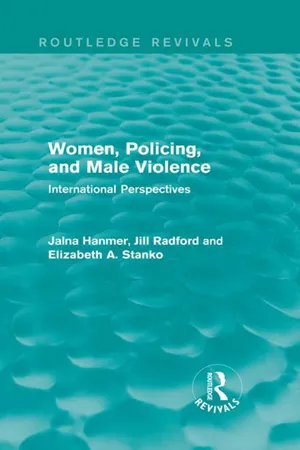
First published in 1989, this book focuses on the policing of male violence against women. It is an issue that has been criticised substantially in the past, and the book shows how even police themselves have sometimes admitted that women have received inadequate treatment. The book includes contributions from North America, Australia, and Western Europe and looks at different approaches that have been taken by states in intervening into the violence of men against women. Chapters explore the differences and similarities of policing practices in western societies at the time surrounding the book's original publication.
eBook - ePub
Women, Policing, and Male Violence (Routledge Revivals)
International Perspectives
- 222 pages
- English
- ePUB (mobile friendly)
- Available on iOS & Android
eBook - ePub
Women, Policing, and Male Violence (Routledge Revivals)
International Perspectives
About this book
Information
Chapter one
Policing, Men’s Violence: An Introduction
Jalna Hanmer, Jill Radford, and Elizabeth A. Stanko
This book explores the police response to violence against women. It owes its origins to the reframing of questions about the violence of men against women that began in the late 1960s when the redefinition of the problem and the process of doing something about it began to move hand in hand. Fundamental questions raised then remain important today. How are women’s experiences of violence from men to be interpreted? What services do women need? How does one particular service, the police, deal with women’s needs? How are violent men to be controlled? In exploring these questions we rediscovered the history of nineteenth century women’s campaigns to gain improvements for women abused by men. Two major ways in which demands for reform have surfaced in the past two centuries are the subject of this volume: the demand for women police and the demand that violence against women from men be treated as crime.
As with any text, this one is specifically located in particular cultures and historical situations. In different times and places women have used various words to describe their experiences of violence from men. Throughout this volume we use the words women fashioned to define and sub-classify their experiences rather than converting these to standardized terms which reflect our own understanding today. While the experiences these terms describe, like the words used to name them, differ from each other, through the process of naming women have voiced their anger and expressed their commitment to struggle and survival. ‘Men’s violence’, ‘sexual violence’, ‘rape’, ‘incest’, ‘sexual abuse of women and children’, ‘woman battering’, ‘womanslaughter’, ‘woman killing’, ‘frawen mishandling’, ‘the male peril’, ‘sexual terrorism’, ‘outrage’, ‘unspeakable horror’, ‘sexual harassment’ — these are some of the words women in several cultures and at different times in this century have drawn upon to describe their experiences of men’s violence.
As with naming experiences, women also use differing terms to encapsulate an explanation of why men are violent. Just as we reject any notion that man is inherently violent, we also reject any parallel beliefs that women are incapable of resisting men’s violence. The contributors to this book describe the possibilities of women’s resistance, illustrating how these are partly linked to women’s positions within social structures, partly to the political consciousness and support networks that have developed among women, and partly to the decisions women make regarding how much of life to share with men. Resistance and fighting back are constant features of every woman’s life, but they take place in a social context of unequal power. The reluctance of the police and criminal justice system to restrain men who commit violence against women or define its perpetrators as criminal is an illustration of this.
In the early days of the present wave of feminism, terms such as ‘patriarchy’ and ‘male supremacy’ were adopted to describe societies characterized by male dominance and female subordination. This domination and subordination were seen to be located in socially constructed relations through which men maintain power over women and children (Coveney et al. 1984; Rhodes and McNeill 1985; Millett 1970; Morgan 1970; Sarachild 1975). As heterosexuality became identified as a system of social relations rather than simply sexual practice, other terms emerged (Rich 1980; MacKinnon 1987). For example, ‘hetero-reality’ is used to describe the world view that woman exists always in relation to man (Raymond 1986). Hetero-reality is grounded in a wide range of affective, social, political, and economic relations that make up hetero-relations between men and women. In Britain ‘hetero-patriarchy’ is beginning to be used to signify a system of social relations based on male dominance, or supremacy, in which men’s structured relationships to women underpin all other systems of exploitation.
This book explores how the treatment abused women receive is always mediated through experiences with men, those who abuse, and those who make up the part of the state that has the mandate to intervene through the use of criminal law. Terms used in this volume include ‘hetero-patriarchy’, ‘patriarchy’, ‘patriarchal societies’, ‘capitalism’, ‘class’, ‘race’, ‘sexism’, ‘male violence’, ‘male power’, ‘male domination’, ‘male supremacy’, ‘social control’. It is not the specific names used to signify specific experiences or explanations that are crucial but the underlying relations of differential power, domination, exploitation, and oppression by men of women that these terms epitomize. These terms are given meaning through the description and analyses of the processes involved in the policing of relations between men and women. This includes both police practices and the ideologies that justify police responses.
Violence against women is a specific example of a more general failure in effective responses to interpersonal crime by the police. But this is not to argue that ineffective police action around interpersonal crime affects everyone who experiences it equally or that every group receives the same lack of or the same type of inappropriate intervention. Research on violence against women (Bart and O’Brien 1985; Hanmer and Maynard 1987; Hanmer and Saunders 1984, 1987; Kelly and Radford 1987; Russell 1982, 1984; Stanko 1985) demonstrates the ways in which women’s lives are controlled by the threat or reality of men’s violence. This work shows that for many women, the primary controlling force in our lives is the ordinary, everyday men who share our homes and who work alongside women in paid and unpaid employment, in education, and with whom we spend our leisure.
Violence and its threat are ugly and crude means of securing control or dominance and may be less effective in the long run. The use of violence presumes a loss of, or an indifference to, a more resilient strategy, compliance through consensus. There is a range of mediating mechanisms through which a consensual control of women by men is reproduced; at the ideological level there is a string of beliefs about both the sanctity of the family and the inherent nature of women which are drawn on to justify women’s subordination to men. The culturally sanctioned views of women and women’s role are embodied in legal, economic, and financial discrimination against women and are expressed through social institutions and processes, for example in the fields of health, welfare, education, science, the military, and the subject of this volume, the police.
Violence may be used by individual men to control or punish individual women who challenge, or are seen to be challenging, their authority. Even if men do not express their power in this way, the fact that they can if they do so choose inevitably underlies apparently harmonious interactions between those who are not equal. In this way the power of men, as individuals and as a sex class, can be asserted. These interests are defined as domestic, emotional and sexual servicing in which reciprocity, to the extent that it exists, is a gift that can be withdrawn at will.
An analysis of men’s violence as a form of social control of women developed from women’s experiences. Women began to listen to other women with a new ear, one that accepted the view of the world as women saw it. This led to new forms of woman-to-woman assistance and to new analyses of men’s violence in securing and maintaining the social subordination of women (Edwards 1987). Women challenged the violence against them and argued that power relations in which men are dominant, like all exploitative social relations, are ultimately secured by violence and its threat (Clark and Lewis 1977; Hanmer 1978; Rhodes and McNeill 1985). Men’s violence against women and children is identified by radical feminists as central to the maintenance and reproduction of all exploitative social relations.
Radical feminist analyses are frequently misrepresented as biologistic. Critics persist in arguing that these rest on a belief that men are innately violent. This is not the case. Rather than resort to biology, the contributors to this book illustrate through research findings how easy an option violence is for men in male supremacist societies. The societies in which this research was conducted have constructed and continue to celebrate forms of chauvinist masculinity which not only tolerates men’s use of violence, but upholds it as a virtue, whether in the promotion of war, in the defence of pornography, or in the nightly television struggles between fictional good and evil. No resort to biological explanation is necessary or even helpful to explain this reality. Further, demands that men examine and reject their misogynist construction of masculinity, and their oppressive practices would be meaningless if they came from biologistic arguments about the inherent and therefore unchangeable nature of man.
This is why strategies to confront men’s violence in Western societies have actively promoted alternatives for women to escape violence. In many countries women have worked to establish their own support networks, as the existence of women’s refuges or shelters and rape crisis centers demonstrate. While offering new services, these women-controlled agencies compensated for the failures of the police to offer support or to act in ways which might secure women’s protection. It was through these alternative responses that we began to amass evidence that the police treatment of rape and battering was inadequate and not uncommonly abusive. Another feminist response is to empower individuals and women as a group by sharing self-defence skills; developing safe transport networks for women; and engaging in collective resistance through confrontation strategies.
While these measures are all valuable, they have never reached all women. Many women have no option but to turn to the police following an attack, whether they’ve been attacked by a man they know or a stranger. For this reason feminists have continued to be concerned about the policing of men’s violence. This concern has taken several forms, from demonstrations and protests around specific cases to police monitoring projects undertaken by women. Feminists have developed detailed critiques of the policing of men’s violence and made specific demands for reform. It is within this context that we review the policing of male violence.
One aim of this book is to evaluate the demand for and introduction of reforms in the policing of men’s violence. This requires a close study of day-to-day, on-the-ground policing, and women’s experiences of this policing. In evaluating these initiatives it is important not only to learn what the police in fact do and how the women concerned feel about this, but also to refer back and locate these measures at the wider structural level. We need to question whether these reforms secure safety for all women or simply provide protection for certain women against some forms of men’s violence. If reforms are geared only to curbing the more obvious excesses of male violence and to protecting women the police define as deserving of protection, then women’s demands will only shore up the existing relations between men and women rather than secure the feminist aim of autonomy for all women irrespective of class, race, and relationship to heterosexuality.
Examining the individual complaints of women about violence from men raises issues about the structural role of the police in maintaining existing gender, sexuality, race, and social class power relationships. The response of the police and legal system in the control of men’s violence is crucial to women’s safety and survival, but as the contributors to this book illustrate, so far they have shown little enthusiasm for protecting women. Feminist criticism of police failure to deal seriously with men’s violence predates the formation of the ‘new police’ in 1829 in Britain, and similar criticisms are a recurrent theme in contemporary feminist criticism in the four countries explored here: Holland, Australia, the United States, and England. Police failure to respond to men’s violence is one of the few areas in which they are rightly, in our view, criticised for insufficient and inappropriate policing, as opposed to exceeding their powers.
As well as being of immediate importance to women who have been attacked, the police response to men’s violence has a general social significance. In deciding how to respond to women reporting violent attacks, the police, and later the courts, are defining which attacks are to be criminalized and proceeded with and which are to be condoned or ‘no-crimed’. The police are making a distinction between attacks they deem to be justifiable and those that are not — that is, those that require police attention. This decision-making process demonstrates that the police do not offer unconditional protection to all women against forms of men’s violence. Rather, any protection they offer is conditional upon women meeting police notions of ‘deservedness’ and the circumstances of the attack meeting their definition of ‘crime’. These notions are inevitably informed by the misogyny, racism, classism, and heterosexism of dominant social ideologies. To the extent police refuse to intervene to assist women, they are effectively legitimizing men’s use of violence as a form of social control.
Male supremacy is not the only power structure in capitalist, neocolonial societies that adversely affects women. While all women are affected by an inferior social status in relation to men, an adequate theoretical analysis must recognize other power structures based on systemic inequality, in particular those of class, race, and sexuality. These power structures are not mutually exclusive but interactive. Women can be simultaneously privileged and oppressed; for example, black working-class women are less valued in three important structured inequalities but, if heterosexual, share a privileged position through their relationship to men. The position of men and women, however, vary on the key dimension of gender, so that while some men may be less valued because of their race, class, or sexuality, all men by virtue of their gender have power as men in relation to all women.
Focusing on police racism demonstrates how women’s lives are affected by the interaction of differing structures of power in contemporary Western societies. In Britain, for example, black women have borne the brunt of police targetting and surveillance strategies directed against the black community in police-defined ‘high crime areas’. In Britain the death of Cynthia Jarrett and the police shooting of Cherry Groce as a result of police raids on the homes of these black women have shaped the attitude of the black community and black women towards the police. Acknowledging the differences that exist between women both in terms of the nature of the types of violence experienced and in terms of our experiences of policing, is an essential element in any response women can make to policing.
Understanding the complexity of the interactions around these power structures is an ongoing project for feminist theory. These structures are not static, but stand in a dynamic relationship with each other. The precise form of interaction between them can never be assumed but only discovered in the context of any one culture at a precise moment in its history. Women’s experience of men’s violence and the policing response provides one example of the structured social relations of men and women characterized by male domination.
Further, recognizing the differences between women in terms of our experiences of policing also means that it is impossible for us to work in a vacuum outside the wider police debates. From the 1960s onwards there have been important shifts in the nature of policing in most Western countries. Targetting and surveillance strategies to curb political and industrial dissent are one initiative among many in the move towards a more militaristic style of policing in an increasingly authoritarian state (Scraton 1985). Not only do shifts in policing styles differentially shape our experiences of policing — the women in the mining communities felt the harsh edge of police raids during the 1986 strike in Britain, for example — but they also have a wider impact on the climate of police-public relations. This is the context into which women may want to require a change in the type of interventions police make in men’s violence.
The contributors to this volume clarify how an acceptance of gender inequality, and the ideology on which it is based, is the foundation for the present police treatment of women. It is through the articulation of women’s experiences that the invisibility of women to this part of the state becomes clear. We suggest this is a glaring example of the lack of women’s autonomy in present-day society. But the maintenance and reproduction of relations characterized by male supremacy require the supression of the most excessive use of violence. What is defined as excessive is culturally variable and shifts through time. It is around these margins that most feminist struggles have been conducted. Demands to outlaw rape in marriage is a key illustration of this. Another example, and one central to this book, is the demand for improvements in the police response to violence against women.
A continuing thread between these chapters is the ideological and social construction and maintenance of a division of the social world for women into public and private spheres. This division expresses the form taken by the social control of women by men. The private/public split represents who is to be policed, and how. Women’s victimization patterns differ from those of men primarily in that our attackers are much more likely to be close associates and the offences are most likely to occur in and immediately around the home. Men who cross women’s paths in chance encounters in public, while greatly feared, do constitute a real and symbolic threat to women, but numerically speaking constitute less of a danger. Because men are usually safe within their own homes and do not fear attack from those with whom they live, that is, women and children, assaults on men are more likely to occur throughout the community. Interpersonal assault that does not occur in or around the home is more likely to be defined as crime by the police. The central relevance of the categories ‘public’ and ‘private’ to police decision-making emerges in all the research on the police described in this volume.
This volume presents findings from research on the policing of men’s violence in England, the Netherlands, Australia, and the United States within the context of changes in law and the organization of policing. To avoid over-generalization, and to facilitate comparison, women’s specific experiences of men’s violence and police responses are explored in four countries that share certain basic features; in particular they are Western formal democratic governments with industrialized capitalist economic structures built out of a history of colonialism. Currently these countries are characterized by cultures that are neocolonial and patriarchal; that is, the interests of men take precedence over those of women and men are organized hierarchiallyvis-à-vis each other. We regard these similarities as important, if only because policing strategies and und...
Table of contents
- Cover
- Half Title
- Title Page
- Copyright Page
- Original Title Page
- Original Copyright Page
- Table of Contents
- Acknowledgements
- 1 Policing, Men's Violence: An Introduction
- 2 Women and Policing: Contradictions Old and New
- 3 Missing the Mark? Policing Battering
- 4 Policing and Male Violence in Australia
- 5 Women and Policing in Britain
- 6 Policing Woman Beating in the Netherlands
- 7 The Legal Response to Woman Battering in the United States
- 8 Improving Policing for Women: The Way Forward
- Bibliography
- Index
Trusted by 375,005 students
Access to over 1.5 million titles for a fair monthly price.
Study more efficiently using our study tools.
Frequently asked questions
Yes, you can cancel anytime from the Subscription tab in your account settings on the Perlego website. Your subscription will stay active until the end of your current billing period. Learn how to cancel your subscription
No, books cannot be downloaded as external files, such as PDFs, for use outside of Perlego. However, you can download books within the Perlego app for offline reading on mobile or tablet. Learn how to download books offline
Perlego offers two plans: Essential and Complete
- Essential is ideal for learners and professionals who enjoy exploring a wide range of subjects. Access the Essential Library with 800,000+ trusted titles and best-sellers across business, personal growth, and the humanities. Includes unlimited reading time and Standard Read Aloud voice.
- Complete: Perfect for advanced learners and researchers needing full, unrestricted access. Unlock 1.5M+ books across hundreds of subjects, including academic and specialized titles. The Complete Plan also includes advanced features like Premium Read Aloud and Research Assistant.
We are an online textbook subscription service, where you can get access to an entire online library for less than the price of a single book per month. With over 1.5 million books across 990+ topics, we’ve got you covered! Learn about our mission
Look out for the read-aloud symbol on your next book to see if you can listen to it. The read-aloud tool reads text aloud for you, highlighting the text as it is being read. You can pause it, speed it up and slow it down. Learn more about Read Aloud
Yes! You can use the Perlego app on both iOS and Android devices to read anytime, anywhere — even offline. Perfect for commutes or when you’re on the go.
Please note we cannot support devices running on iOS 13 and Android 7 or earlier. Learn more about using the app
Please note we cannot support devices running on iOS 13 and Android 7 or earlier. Learn more about using the app
Yes, you can access Women, Policing, and Male Violence (Routledge Revivals) by Jalna Hanmer,Jill Radford,Elizabeth Stanko in PDF and/or ePUB format, as well as other popular books in Social Sciences & Criminology. We have over 1.5 million books available in our catalogue for you to explore.